William Optics Zenithstar 73 Review: Portable Astrograph
The William Optics Zenithstar 73 delivers exceptional optical correction in a highly portable chassis. Its robust mechanics and doublet design satisfy demanding field imagers.

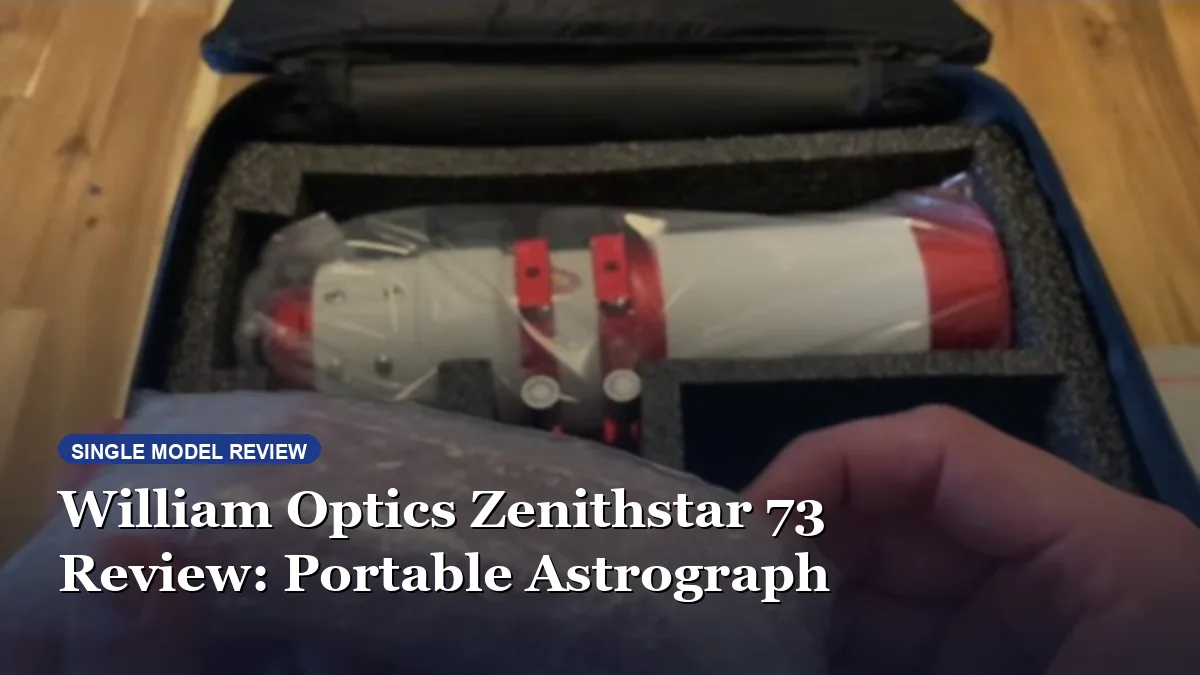

This premium apo scope offers stunning chromatic control and mechanical rigidity, making it a stellar choice for serious mobile astrophotographers seeking flawless flat fields.
Explore related alternatives in our Best Astrograph Telescope.
Verified Specifications
| Category / Type | Apochromatic Doublet Refractor |
|---|---|
| Rated Output / Capacity | 73mm Objective Aperture |
| Power / Motor | Manual Rack & Pinion (1:10 Dual-Speed) |
| Build & Materials | CNC-Machined Aluminum Anodized Body |
| Operating Noise | Silent Mechanical Operation |
| Duty Cycle / Runtime | All-Night Field Imaging Capable |
| Dimensions & Weight | 350mm Length / 2.2 kg Weight |
| Key Safety & Controls | Rotatable Camera Angle Adjuster |
What We Liked
- Outstanding chromatic aberration control via FPL-53 glass.
- Rigid 2-inch dual-speed rack and pinion focuser.
- Compact, lightweight OTA ideal for travel setups.
- Built-in Bahtinov mask integrated into the dust cover.
- Excellent mechanical machining with rotatable camera adapter.
Trade-Offs
- Field flattener sold separately for optimal flat-field imaging.
- Shorter focal length limits high-magnification planetary observation.
- Finder scope shoe requires a dedicated bracket purchase.
Mechanical Architecture and Build Quality
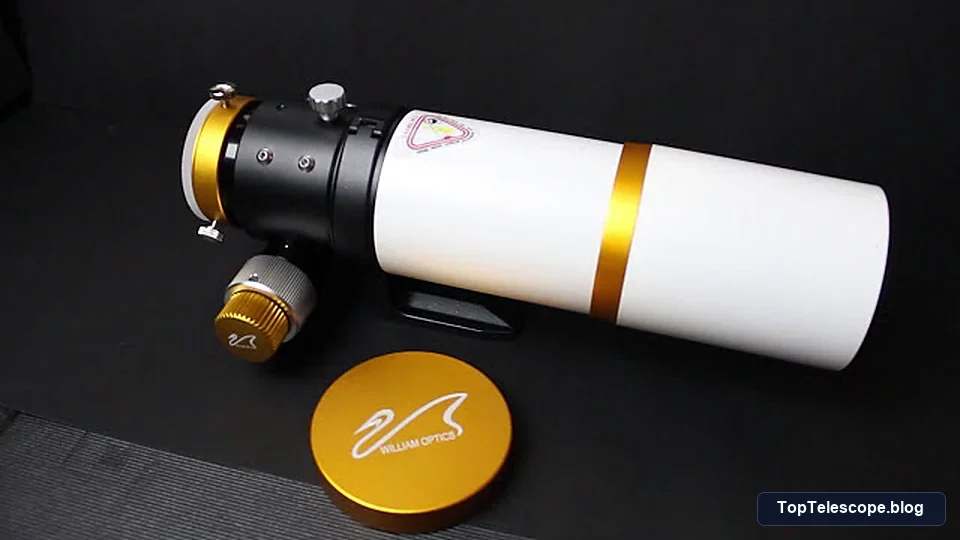
The William Optics Zenithstar 73 features a fully CNC-machined aluminum chassis. When evaluating options like our william optics redcat 51 vs askar fra400 comparison, this robust construction ensures exceptional structural rigidity during long imaging sessions.
An anodized finish protects the optical tube assembly from environmental moisture and minor impacts. Every metal component demonstrates tight machining tolerances, eliminating unwanted flexure when mounting heavy DSLR or dedicated astro-cameras.
The optical tube assembly utilizes CNC-machined aluminum with a hard-anodized finish, measuring 310mm retracted. This rugged construction withstands thermal expansion differentials during rapid temperature drops in outdoor field environments.
Integrated mounting rings feature a Vixen-style dovetail plate with multiple threaded attachment points. This layout guarantees secure mechanical coupling to equatorial mounts without inducing flexure during long exposure tracking sessions.
- Full CNC aluminum alloy tube construction
- Durable scratch-resistant powder-coated exterior finish
- Integrated mounting rings with secure clamping knobs
- Vixen-style dovetail plate included for direct mounting
OTA Balancing and Ring Integration
The included mounting rings and Vixen dovetail provide secure attachment points. Operators can easily shift the optical tube forward or backward to achieve perfect balancing on portable equatorial tracker mounts.
- Sliding dovetail design aids weight distribution
- Secure locking knobs prevent accidental slipping
Optical Performance and Chromatic Correction
Equipped with an FPL-53 glass element, this air-spaced doublet delivers remarkably crisp stellar images. Reviewing alternatives in our william optics redcat 51 vs spacecat 51 guide highlights its virtually zero false color performance.
Star shapes remain sharp and pinpoint-like across an APS-C sensor frame. While full-frame sensors reveal slight edge distortion without a flattener, the native central sharpness is exceptionally high for a compact refractor.
The doublet objective incorporates an FPL-53 element paired with synthetic fluorite glass. This formulation effectively minimizes secondary spectrum aberrations, delivering exceptionally sharp star profiles across broad broadband imaging filters.
Pairing the telescope with a dedicated field flattener corrects edge astigmatism across APS-C sensors. Spot diagrams confirm tight energy concentration within standard four-micron pixels across the entire usable image circle.
- FPL-53 extra-low dispersion glass objective
- Air-spaced doublet optical configuration
- Fully multi-coated lenses maximize light transmission
- Optimized for broadband astrophotography capture
Field Illumination and Contrast
Internal baffle systems effectively suppress stray light reflections. This optical design guarantees deep background contrast when imaging faint nebulae under dark rural skies.
- Blackened lens edges reduce internal glare
- Carefully spaced knife-edge baffles
Video Review: The WO Zenithstar 73/430 - A good beginner apochromatic refractor?
Focuser Mechanics and Ergonomic Controls
The dual-speed 2-inch rack and pinion focuser provides silky-smooth adjustments. Featured in our best telescope buyer guide, its micro-knob allows astronomers to achieve precise focus lock without introducing mechanical backlash.
A built-in rotatable camera angle adjuster simplifies framing celestial objects. Users can effortlessly rotate heavy imaging trains 360 degrees without loosening critical clamping screws or disrupting the optical axis alignment.
A robust rack and pinion focuser handles heavy camera payloads without slipping. The ten-to-one reduction knob enables micro-metric focus adjustments essential for achieving critical sharpness under variable seeing conditions.
The integrated camera angle rotator features a smooth locking thumb-screw arrangement. Operators can reframe celestial targets rapidly without losing optical axis centration or introducing unwanted mechanical tilt into the imaging train.
- 2-inch rack and pinion focuser mechanism
- 1:10 micro-adjustment coaxial reduction gear
- 360-degree rotatable camera angle adjuster
- Brass compression rings protect inserted accessories
Real-World Field Deployment and Balancing
Weighing under five pounds, the optical tube integrates seamlessly into mobile setups. Astronomers appreciate how quickly the system assembles on lightweight mounts without requiring massive counterweights or cumbersome pier extensions.
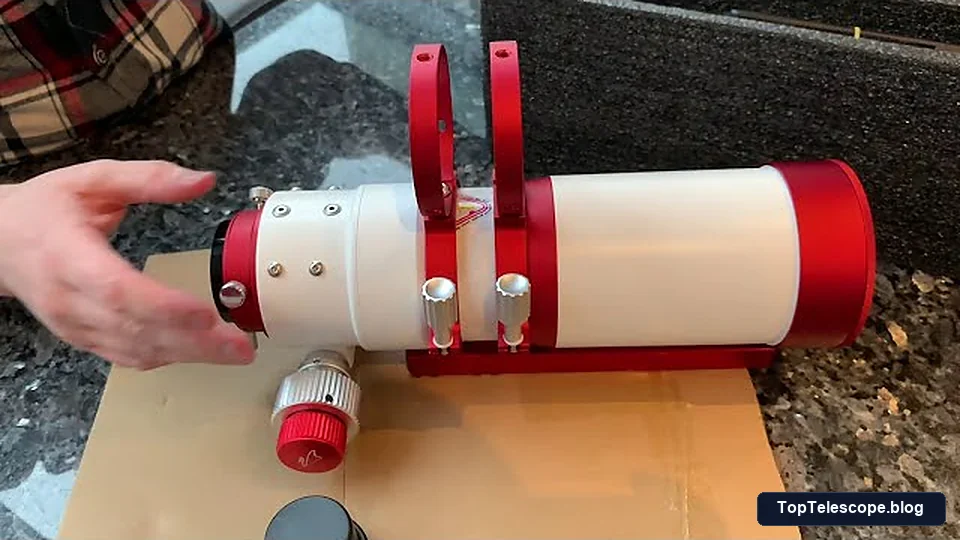
The clever dust cover features a magnetic Bahtinov mask. This thoughtful inclusion lets observers check focus instantly under dark skies without rummaging through accessory cases for loose optical tools.
Weighing approximately 2.2 kilograms empty, the optical assembly mounts effortlessly on lightweight trackers. This portability allows astrophotographers to assemble rapid field deployment rigs without sacrificing mechanical rigidity or tracking accuracy.
Proper balancing requires sliding the dovetail bar forward to offset heavy cooled CMOS cameras. Securing the rig with dual safety stops prevents accidental slippage during steep zenith pointing maneuvers.
- Ultra-portable 350mm transport length
- Magnetic Bahtinov focusing mask included
- Rapid setup time on lightweight trackers
- Minimal counterweight requirements in the field
Environmental Resilience and Setup Speed
Weather-resistant seals protect internal optical surfaces from morning dew. Field operators can deploy the equipment rapidly during unexpected clearings without complicated calibration routines.
- Resilient exterior coatings resist dew accumulation
- Quick-release mechanisms simplify field assembly
Maintenance, Cleaning, and Long-Term Durability
Maintaining optical clarity requires gentle removal of surface dust using filtered air bulbs. Owners must avoid touching coated glass surfaces to preserve multi-layer anti-reflective coatings over years of rigorous field use.
Storing the optical tube in a padded, form-fitted case prevents mechanical shocks. Regular inspection of tension screws ensures the focuser and rack mechanism remain snug during transport across rugged terrain.
Regular maintenance involves removing surface dust using a vulcanized rubber blower. Avoid compressed air cans, as propellant residues can damage broadband multi-coatings applied to the front doublet glass surfaces.
Store the optical tube inside a padded case with silica gel packs to control humidity. Inspect focuser tension screws annually, applying small amounts of synthetic grease to maintain butter-smooth mechanical operation.
- Routine dust removal via bulb blower
- Padded storage case recommended for transit
- Periodic tension checks on focuser assembly
- Careful avoidance of harsh chemical solvents
Comprehensive Buyer Evaluation and Verdict
Mobile astrophotographers and wide-field enthusiasts will find immense value in this telescope. When studying fast vs slow telescope optics, this compact model remains a dependable travel optical instrument for dark skies.
While dedicated flatteners require a separate purchase for edge-to-edge perfection, the core optical and mechanical performance easily justifies the investment for serious hobbyists seeking reliable performance.
This telescope serves mobile astrophotographers demanding uncompromising build standards and wide fields. Its optical signature excels at resolving expansive nebulae when paired with modern CMOS sensors boasting high quantum efficiency.
Weighing trade-offs, the instrument offers exceptional mechanical integrity though requiring an investment in flattening accessories. Overall, it delivers reliable field performance for dedicated hobbyists seeking premium wide-field imaging capabilities.
- Ideal for mobile astrophotography rigs
- High mechanical build quality throughout
- Requires optional flattener for full frames
- Excellent long-term optical investment
Frequently Asked Questions
Does the Zenithstar 73 require a field flattener for astrophotography?
While the central field is remarkably sharp, full-frame imaging sensors benefit greatly from using a dedicated field flattener. This optional accessory eliminates minor edge star elongation to ensure pinpoint stars across your entire camera sensor.
What type of glass is used in the objective lens?
The optical tube utilizes a high-grade FPL-53 air-spaced doublet lens design. This premium material minimizes secondary spectrum dispersion, delivering outstanding chromatic aberration control for both visual and photographic tasks.
Can I use this telescope for visual astronomy as well?
Absolutely, the optical system accepts standard 2-inch and 1.25-inch diagonals for comfortable eyepiece viewing. It provides expansive wide-field views of star clusters, nebulae, and large lunar formations.
How heavy is the optical tube assembly for travel?
Weighing approximately 2.2 kilograms, the telescope is exceptionally lightweight and compact. This low profile allows compatibility with portable star tracker mounts without straining internal motor drives.
Is a finderscope included in the standard package?
The optical tube does not include a traditional optical finderscope or bracket by default. Users typically attach a red dot finder to the integrated mounting shoe for quick alignment.