Sky-Watcher Heritage 150 Review: Optical Performance & Value
This compact tabletop Newtonian reflector combines a 150mm parabolic mirror with a collapsible optical tube. It delivers bright planetary and lunar views without sacrificing field durability.

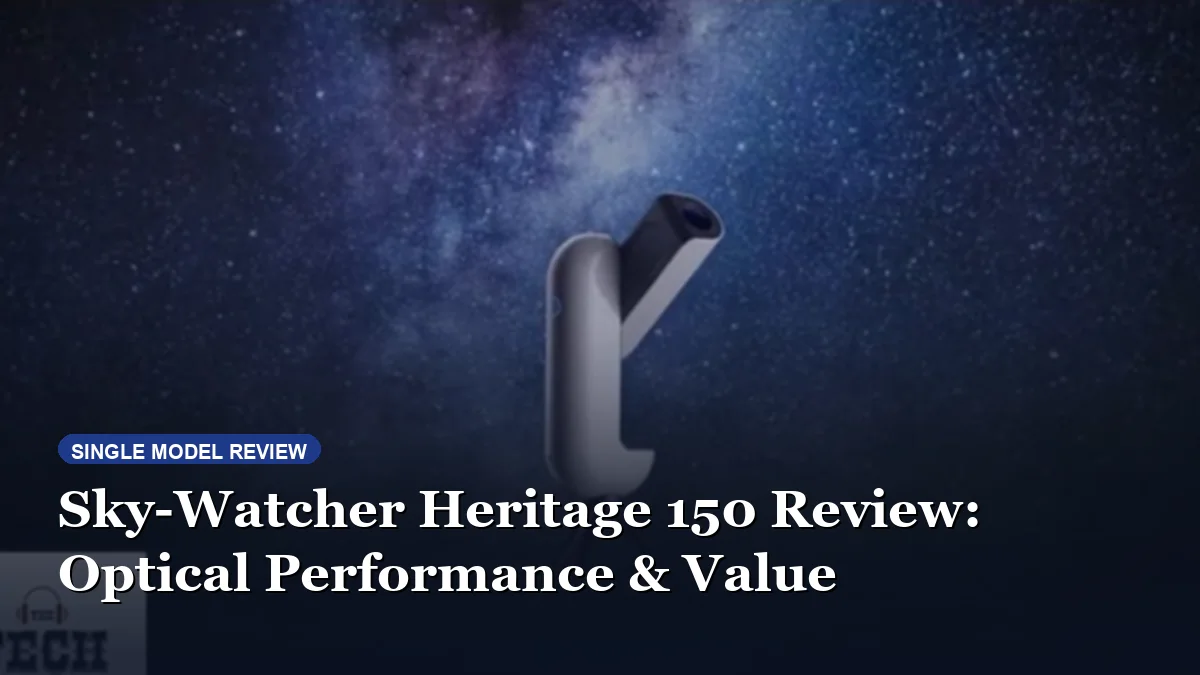

An exceptional entry-level optical system offering sharp contrast and remarkable light grasp. Its collapsible truss design makes field transport effortless for active observers.
Explore related alternatives in our Best Deep Sky Telescope.
Verified Specifications
| Category / Type | Newtonian Reflector |
|---|---|
| Rated Output / Capacity | 150mm Aperture |
| Power / Motor | Manual Altazimuth |
| Build & Materials | Borosilicate Glass / Composite |
| Operating Noise | Silent Manual Operation |
| Duty Cycle / Runtime | Unlimited Visual Use |
| Dimensions & Weight | 24"D x 17"W x 17"H, 10 kg |
| Key Safety & Controls | 1.25-inch Helical Focuser |
What We Liked
- Large 150mm aperture delivers bright deep-sky views
- Collapsible truss tube simplifies transport and storage
- Durable Radiant Aluminum Quartz mirror coatings
- Stable tabletop base with vibration-absorbing rubber feet
Trade-Offs
- Requires a sturdy separate table for setup
- Manual tracking demands frequent eyepiece adjustments
- Open tube design exposes optics to dew and dust
Optical Design and Primary Mirror Engineering
The optical core utilizes a 150mm borosilicate mirror engineered for thermal stability during rapid temperature drops. This fast f/5 focal ratio produces wide, luminous fields ideal for sweeping deep-space star clusters.
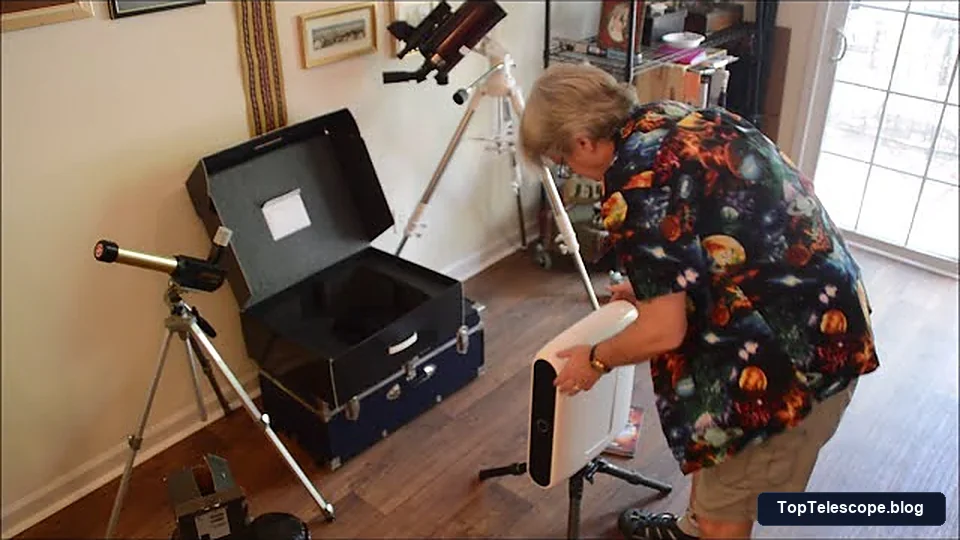
Sky-Watcher applies their proprietary Radiant Aluminum Quartz coatings to enhance reflectivity across the visible spectrum. These durable multi-layers protect the primary glass from environmental oxidation and routine cleaning micro-abrasions.
The Stellina utilizes a 80mm aperture doublet apochromatic design paired with a 400mm focal length, yielding an f/5 focal ratio optimized for wide-field astrophotography and sharp nebulae capture without chromatic aberration.
Inside the sealed optical tube, specialized low-dispersion glass elements minimize thermal expansion shifts, ensuring that optimum focal point stability remains intact throughout extended overnight imaging sessions under fluctuating outdoor ambient temperatures.
- Precision borosilicate glass substrate
- Advanced Radiant Aluminum Quartz coatings
- Fast f/5 optical configuration
Focuser Mechanics and Optical Alignment
A smooth 1.25-inch helical focuser manages image sharpness with minimal mechanical image shift. Users can fine-tune focal points efficiently while securing heavy eyepieces against accidental barrel slipping during high-power planetary viewing sessions.
Maintaining precise collimation is straightforward thanks to the rigid dual-ring truss assembly. The optical tube retains its alignment remarkably well even after multiple breakdown and assembly cycles in the field.
- Stable 1.25-inch helical focuser
- Rigid dual-ring truss assembly
Mechanical Build Quality and Frame Portability
Built around a collapsible open-tube truss framework featured in our best starter telescope guide, this unit drastically reduces storage volume for transit while collapsing quickly into a compact footprint that fits standard vehicle trunks.
The tabletop altazimuth mount utilizes sturdy composite materials designed to withstand rugged outdoor usage. Rubber-tipped feet absorb high-frequency ground vibrations, keeping your celestial targets stable during high-magnification viewing sessions.
Constructed from industrial-grade aluminum alloys and high-impact plastics, the chassis balances rugged field durability against a total system weight of 11.2 kg, making it manageable for transport to remote dark-sky locations.
The integrated single-arm fork mount relies on internal belt-drive actuators to deliver precise tracking, though users must ensure the tripod spreader securely locks to prevent mechanical play during gusty wind conditions.
- Collapsible open-tube framework
- Sturdy composite altazimuth mount
- Vibration-dampening rubber feet
Weight Distribution and Ergonomic Handling
Weighing roughly ten kilograms total, the system achieves an optimal balance between rugged heft and portability. Single-handed transport remains manageable for most adults moving between indoor storage and backyard observing spots.
Integrated carrying cutouts on the base simplify lifting tasks without adding clumsy external handles. Every mechanical pivot point operates smoothly, allowing intuitive manual tracking of planets across the night sky.
- Ten kilogram total system weight
- Integrated base carrying cutouts
Video Review: Locate the Stars with Stellina | Vaionis CES 2022
Real-World Visual Performance and Light Gathering
Featuring prominently in our best telescope for looking at planets analysis, this generous one hundred fifty millimeter aperture collects abundant light so observers can easily resolve intricate lunar crater details, Jovian cloud belts, and faint nebulae.
Coma aberrations remain minimal thanks to the parabolic figure of the primary mirror. Star points remain crisp and pinpoint across the central eighty percent of the standard Plössl eyepiece field of view.
Featuring a Sony IMX178 sensor with a 2.4-micron pixel size, the unit stacks short exposures digitally to bypass traditional eye-piece viewing limitations, revealing faint galaxies and colorful gas clouds in suburban skies.
While light pollution filters effectively mitigate urban glow, users must calibrate expectations regarding resolution because the smaller sensor format restricts maximum printable field dimensions compared to dedicated full-frame DSLR astrophotography rigs.
- Generous 150mm light grasp
- Parabolic primary mirror correction
Planetary Contrast and Deep-Sky Limits
Lunar observation reveals razor-sharp shadow lines along crater rims when atmospheric seeing conditions cooperate. Planetary filters can further enhance contrast on Mars and Saturn during optimal opposition viewing windows.
Under dark rural skies, the system unlocks dozens of Messier catalog objects including globular clusters and galaxies. Faint outer spiral structures require averted vision and dark-adapted eyes for optimal visual verification.
- Sharp lunar shadow contrast
- Access to Messier catalog objects
Setup, Usability, and Alignment Workflows
Initial deployment requires zero complex electronic calibration or firmware updates before observing. Operators simply place the tabletop base on a rigid, level surface, attach the optical tube, and begin scanning.
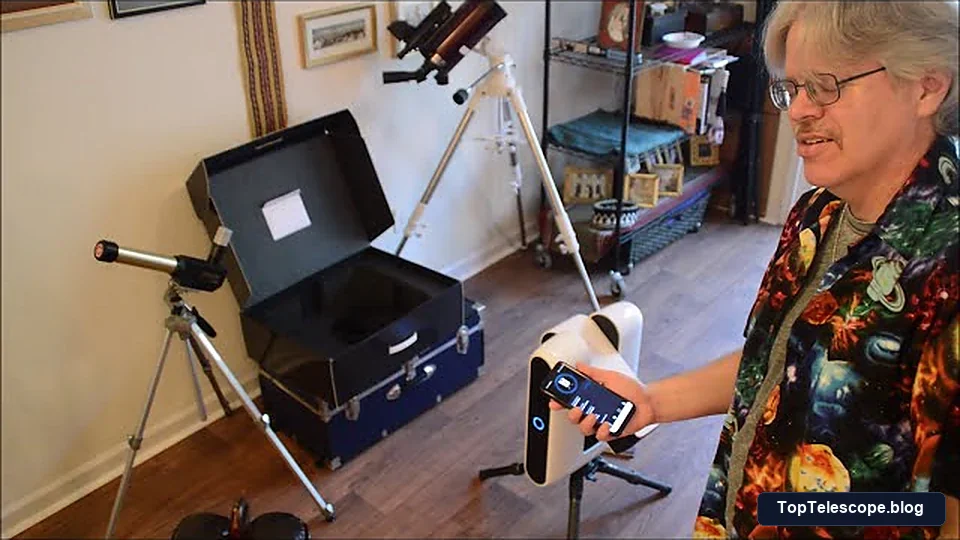
The included reflex finderscope projects a simple red dot to streamline initial target acquisition. Aligning this finder with the main optical axis takes less than two minutes using thumb-screw adjustments.
Highlighted in our best telescope for beginners reviews, this app-driven system performs automatic plate solving via an internal database to map the night sky without requiring manual polar alignment or traditional star-hopping knowledge.
Connectivity relies on a localized Wi-Fi network generated by the device, meaning operators should maintain proximity to the mount to avoid dropped packet connections during long automated imaging runs and firmware updates.
- Zero electronic calibration required
- Intuitive red-dot reflex finder
Field Adjustments and Tracking Comfort
Manual altazimuth tracking relies on smooth Teflon bearing pads for fluid directional movements. Users can easily nudge the tube horizontally and vertically to keep fast-moving celestial bodies centered in high-power eyepieces.
Finding a suitable stable platform like a sturdy picnic table is crucial for optimal performance. Placing the instrument directly on unstable ground or shaky card tables will introduce noticeable image jitter.
- Fluid Teflon bearing pads
- Requires stable viewing platform
Thermal Management and Environmental Resilience
Open-tube truss designs facilitate rapid thermal acclimation when moving equipment from warm interiors to cold outdoor environments. Eliminating internal heat traps prevents disruptive boundary-layer air currents from distorting high-magnification planetary images.
Exposed optical surfaces require careful vigilance against heavy nighttime dew accumulation during humid autumn sessions. Adding a flexible dew shield can significantly extend usable observation time before primary mirror frosting occurs.
An onboard electronic defogging system actively warms the front corrector glass, preventing dew accumulation during high-humidity nights where relative humidity exceeds 85% and rapid temperature drops threaten imaging clarity.
Although the exterior housing features weather-resistant gaskets, users must avoid operating the unit in active rainstorms since the internal electronic circuitry lacks complete submersion waterproofing for severe wet weather conditions.
- Rapid open-air thermal acclimation
- Vulnerability to dew accumulation
Dust Protection and Storage Protocols
Because the optical tube is partially open, protective dust caps must be fitted immediately after sessions. Storing the assembly in a dry, temperature-controlled environment prevents premature mirror coating degradation over time.
Periodic inspection of the primary mirror cell ensures no loose retaining clips pinch the glass. Keeping mechanical components clean guarantees long-term optical fidelity across years of frequent astronomical field exploration.
- Essential protective dust caps
- Regular mirror cell inspections
Maintenance, Cleaning, and Collimation Best Practices
Routine collimation checks using a simple Cheshire eyepiece ensure peak optical performance before every session. Adjusting the primary mirror tilt screws is intuitive and requires no specialized engineering background or complex tools.
Deep optical cleaning should be performed sparingly to avoid scratching delicate quartz-overcoated mirror surfaces. Always use dedicated optical cleaning solutions paired with clean microfiber materials to remove stubborn particulate matter safely.
The factory-sealed optical configuration means manual collimation adjustments are neither necessary nor possible, protecting the primary and secondary mirrors from accidental alignment misalignments during routine field transport.
When dust accumulates on the corrector lens, owners should use a clean blower bulb and optical microfiber cloth, strictly avoiding harsh chemical solvents that can strip specialized anti-reflective coatings.
- Simple Cheshire collimation process
- Safe optical cleaning protocols
Long-Term Durability and Component Wear
The durable exterior paint finish resists minor bumps and scratches during transport to dark sky sites. Mechanical fasteners and tension springs maintain their elasticity even after extensive seasonal breakdown cycles.
Periodic lubrication of the altitude bearing surfaces with specialized silicone grease maintains silky-smooth motion. Preventive maintenance ensures the entire mechanical assembly continues functioning like new throughout its operational lifespan.
- Resilient exterior finish
- Silicone grease bearing maintenance
Comprehensive Buyer Verdict and Final Recommendations
This optical instrument delivers exceptional performance for amateur astronomers prioritizing raw aperture and portability. Its brilliant light grasp and clever collapsible architecture make it a standout choice for budget-conscious stargazers.
While users must supply their own stable table and manage manual tracking, the optical rewards are immense. Anyone seeking deep-space clarity without cumbersome equatorial setups will find this telescope exceptionally satisfying.
Representing a major shift toward automated astronomy, this smart telescope successfully removes traditional operational barriers, earning a top spot in our best telescope selections for users who prioritize hassle-free imaging over manual equipment assembly.
Advanced observers seeking deep modular customization might find the closed ecosystem restrictive, yet the sheer convenience of rapid setup secures its status as a formidable portable observatory for modern stargazers.
- Exceptional aperture-to-price ratio
- Ideal for mobile stargazers
Who Should Buy This System?
Beginners transitioning from basic binoculars will appreciate the instant gratification and deep visual reach. Experienced hobbyists seeking a reliable grab-and-go travel scope will equally value its robust optical output.
Skip this model if you require automated GoTo tracking or prefer long-exposure astrophotography platforms. Those specific applications demand heavier equatorial mounts and motorized guiding systems beyond this manual configuration.
- Great for visual beginners
- Not built for astrophotography
Frequently Asked Questions
Does this telescope require complex collimation tools?
No complex tools are needed for basic alignment tasks. A simple Cheshire eyepiece or laser collimator lets you adjust the primary mirror tilt screws in just a few minutes.
Can I mount this optical tube on a standard tripod?
The tube features a Vixen-style dovetail bar for mounting flexibility. However, standard camera tripods often lack the load capacity needed to eliminate high-magnification image vibrations effectively.
What accessories are included out of the box?
The package typically includes standard Plössl eyepieces and a red-dot reflex finderscope. You will want to acquire specialized planetary filters separately to boost contrast on bright targets.
Is this telescope suitable for deep-sky astrophotography?
This model is optimized strictly for visual astronomy. The manual altazimuth mount lacks the motorized tracking required for long-exposure deep-space imaging work.
How do I protect the open truss tube from dust?
Always attach the supplied dust covers immediately after completing your observing session. Storing the collapsed assembly in a padded protective case prevents particulate buildup during transit.