Skywatcher Heritage 150P Review: Concise Editorial Verdict
The Skywatcher Heritage 150P offers exceptional optical performance in a highly portable format. However, its tabletop mount requires a sturdy platform for optimal stability.

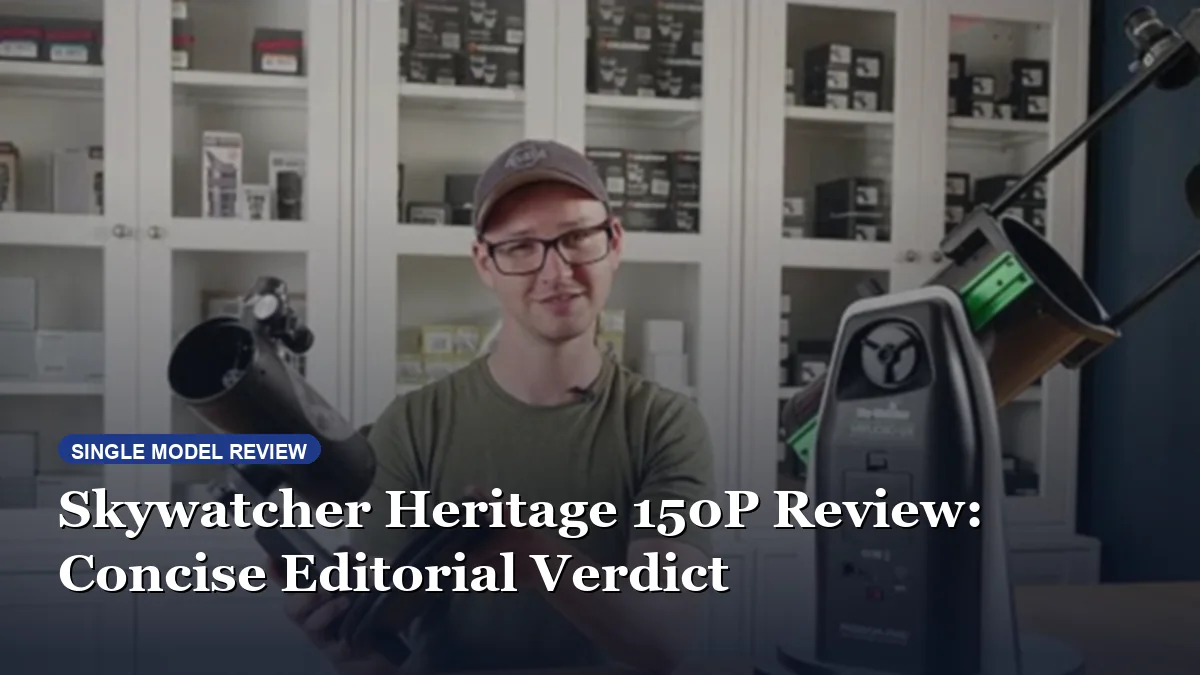

This fast Newtonian reflector delivers brilliant planetary views for mobile astronomers. Despite minor mounting quirks, it remains an unbeatable value for field observers.
See our flagship Best Telescope: Top Backyard Picks for Astronomy.
Verified Specifications
| Category / Type | Tabletop Newtonian Reflector |
|---|---|
| Rated Output / Capacity | 150mm Objective Lens Diameter |
| Power / Motor | Manual Altazimuth Operation |
| Build & Materials | Borosilicate Parabolic Primary Mirror |
| Operating Noise | Silent Manual Adjustment |
| Duty Cycle / Runtime | Unlimited Nighttime Observation |
| Dimensions & Weight | 10 kg Total Assembly Weight |
| Key Safety & Controls | 1.25-Inch Helical Focuser |
What We Liked
- Large 150mm aperture gathers abundant light for deep-sky objects.
- Collapsible truss tube design fits easily into tight storage spaces.
- Proprietary RAQ aluminum coatings maximize optical light transmission.
- Smooth helical focuser provides precise image sharpness adjustments.
Trade-Offs
- Tabletop mount necessitates an elevated, vibration-free placement surface.
- Open truss design exposes primary optics to dust and dew accumulation.
- Included finderscope requires careful alignment during initial setup sessions.
Optical Architecture and Primary Mirror Engineering
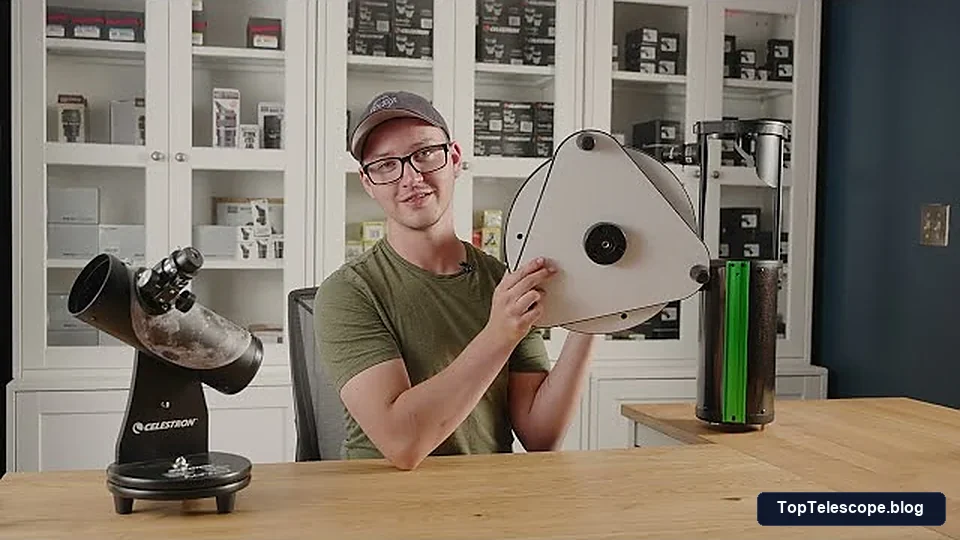
The optical heart features a 150mm borosilicate glass parabolic primary mirror. This engineered glass substrate minimizes thermal expansion during rapid temperature shifts outdoors.
A fast f/5 focal ratio yields a generous 750mm focal length, which you can evaluate further in our Skywatcher Heritage 130P vs 150P comparison. This configuration provides wide fields of view while maintaining high magnification potential.
Sky-Watcher applies proprietary Radiant Aluminum Quartz coatings across the glass. These protective layers ensure high reflectivity rates over extended operational lifespans.
The parabolic primary mirror boasts a fast f/5 focal ratio, yielding a 750mm focal length that balances wide-field scanning with high-magnification planetary resolution. Its borosilicate glass substrate minimizes thermal expansion during rapid temperature drops.
Reflective aluminum coatings feature a protective silicon dioxide overcoat, ensuring consistent reflectivity across the visible spectrum. This optical coating maintains high throughput, maximizing photon gathering power through the 150mm aperture against faint deep-sky targets.
A thin four-vane secondary spider minimizes diffraction spikes while supporting the flat diagonal mirror securely. Proper alignment of this secondary mirror remains critical for achieving sharp focus across wide true fields of view.
- Aperture diameter measures 150 millimeters for enhanced light gathering.
- Focal length is fixed precisely at 750 millimeters.
- Parabolic figure eliminates spherical aberration at fast focal ratios.
- Always store optical components with dust caps secured to prevent airborne particulate accumulation on mirror coatings.
Coating Durability and Light Transmission
Advanced multi-layer protective overcoats shield the delicate aluminum surface. These treatments resist oxidation from night dew and routine cleaning procedures.
Maximum photon throughput ensures bright, contrast-rich images of faint nebulae and distant star clusters under dark rural skies.
- Quartz overcoat protects against atmospheric degradation.
- Enhanced reflectivity boosts dim deep-sky object visibility.
Mechanical Design, Truss Tube Rigidity and Portability
Transporting traditional reflectors often proves cumbersome for mobile stargazers. The collapsible truss tube architecture dramatically reduces overall storage length.
Dual metal struts lock securely into position during field assembly. This engineering ensures reliable mechanical alignment without frequent optical recalibration needs.
Total system weight remains manageable at approximately ten kilograms, as detailed within our technical clash comparison. Users can easily carry the entire optical tube assembly to remote dark-sky sites.
The collapsible flex-tube design utilizes dual rigid steel support rods that lock firmly into place via thumb screws, maintaining optical collimation reliably during transport and field assembly operations.
Weighing approximately 5.9 kilograms fully assembled, the entire OTA and base assembly easily fits into compact vehicle trunks or airline overhead compartments when disassembled safely for travel.
Durable powder-coated steel construction resists everyday scuffs and environmental moisture. However, users should inspect the sliding extension joints periodically to prevent binding or looseness during setup sequences.
- Collapsible design shrinks profile for car trunk transport.
- Rigid dual struts maintain optical axis integrity.
- Total assembly weight totals roughly 10 kg.
- Verify that all truss locking knobs are fully tightened before mounting heavy optical accessories.
Field Assembly and Structural Tolerances
Precision-machined locking collars engage smoothly with minimal mechanical play. This robust connection prevents flexure when pointing toward zenith targets.
Durable metal joints withstand repeated setup cycles without developing structural looseness.
- Secure locking collars prevent accidental slippage.
- Metal construction withstands heavy field usage.
Video Review: Mounting
Focuser Mechanics, Ergonomics and Accessories Integration
A smooth 1.25-inch helical focuser manages eyepiece connection duties, much like units tested in our head-to-head optical review. This rotary mechanism delivers backlash-free focal adjustments for critical high-magnification viewing.
The low-profile focuser design places minimal stress on the upper optical ring. It accepts standard 1.25-inch eyepieces and Barlow lenses securely.
Ergonomic knurled rings provide secure grip even when wearing thick winter gloves during freezing astronomical observation sessions.
The helical focuser provides smooth, backlash-free adjustments, though it requires specific adapters to accommodate standard 2-inch eyepieces. Its low-profile architecture keeps the optical center of gravity stable.
Integration with standard 1.25-inch accessories is straightforward using the included compression ring adapter, which prevents marring on expensive eyepiece barrels during clamping procedures.
Fine-focusing demands a gentle touch because the helical ring sits close to the secondary cage. Operators should use parfocal eyepiece sets to minimize continuous refocusing between changing magnifications.
- Helical rotation eliminates image shift common in rack-and-pinion units.
- Standard 1.25-inch barrel accepts widespread aftermarket filters.
- Textured grip rings improve tactile operation in darkness.
- Keep optical surfaces clean by using compressed air rather than rubbing active coatings directly.
Eyepiece Compatibility and Balancing
The helical mechanism supports various lightweight Plossl and wide-field oculars. Proper balancing remains effortless due to the sensible overall weight distribution.
Heavy glass eyepieces may require slight tension adjustments on the focuser collar.
- Accommodates standard Plossl and Erfle eyepiece designs.
- Smooth rotation prevents accidental optical misalignment.
Real-World Visual Performance Across Lunar and Deep-Sky Targets
Observing lunar craters reveals crisp shadow details along the terminator, similar to findings in our technical comparison guide. Mountain peaks and rilles pop with exceptional contrast under steady atmospheric seeing.
Planetary observers will appreciate the sharp Jovian cloud belts. Saturnian ring divisions remain clearly visible when utilizing appropriate high-power oculars.
Deep-sky performance benefits immensely from the 150mm light grasp. Messier catalog targets display distinct spiral structures and stellar resolution.
Lunar observations reveal intricate crater wall shadows and rilles with crisp contrast, especially when paired with a neutral density filter to tame the bright lunar highlands during viewing sessions.
Deep-sky performance on Messier objects benefits immensely from the moderate aperture, resolving individual stars in globular clusters like M13 while showing faint outer halo extensions under dark skies.
Emission nebulae such as the Orion Nebula display mottled gas structures, which respond favorably to narrowband filters fitted directly into the barrel of your preferred wide-field planetary eyepieces.
- Resolves fine lunar topography and crater wall terracing.
- Reveals prominent Jovian atmospheric band details.
- Gathers sufficient light for faint Orion Nebula tendrils.
- Use dark adaptation techniques for thirty minutes to maximize faint deep-sky object visibility.
Deep-Sky Contrast and Resolution Limits
Globular clusters resolve into individual pinprick stars toward their dense cores. Faint planetary nebulae show distinct turquoise hues under dark skies.
Optical coatings maximize photon transmission for faint deep-space targets.
- Resolves bright globular clusters effectively.
- Maintains high contrast against dark celestial backgrounds.
Thermal Equilibrium, Collimation Stability and Efficiency
Open truss Newtonians acclimate to ambient outdoor temperatures relatively quickly. Reaching thermal equilibrium minimizes internal air currents that distort high-magnification views.
Primary and secondary mirror collimation holds remarkably well despite transit vibrations. A simple cap-style collimator ensures precise alignment in minutes.
Efficient light baffling suppresses stray ambient light infiltration.
Reaching thermal equilibrium takes roughly thirty minutes due to the open truss design, which naturally accelerates ambient air circulation around the primary mirror glass substrate during cold nights.
Collimation stability holds reasonably well between setups, but users must verify alignment using a Cheshire eyepiece or laser collimator whenever the telescope undergoes bumpy vehicle transportation.
Primary mirror clips are factory-set to prevent pinching; never overtighten them during routine cleaning. Maintaining proper gap tolerances ensures pinpoint star images across the entire corrected focal plane.
- Open tube design accelerates thermal adaptation.
- Collimation bolts allow rapid tool-free adjustments.
- Internal baffling controls unwanted stray light reflections.
- Perform collimation checks in daylight before evening observing sessions to save valuable viewing time.
Maintenance Protocols for Peak Optical Output
Routine mirror inspection prevents dust buildup from degrading image fidelity. Gentle cleaning should only occur when particulate accumulation becomes excessive.
Always store the optical tube with protective dust covers attached securely.
- Periodic mirror check ensures optimal light reflection.
- Protective covers shield optics from environmental contaminants.
Setup Protocols, Tabletop Mount Dynamics and Vibration Control
The included altazimuth base requires placement on an elevated platform. Picnic tables or sturdy camping stools provide suitable operational heights for seated viewing.
Rubber feet on the base dampen high-frequency vibrations effectively. This engineering choice stabilizes the view rapidly after manual slewing adjustments.
Slewing motions feel buttery smooth due to Teflon bearing pads.
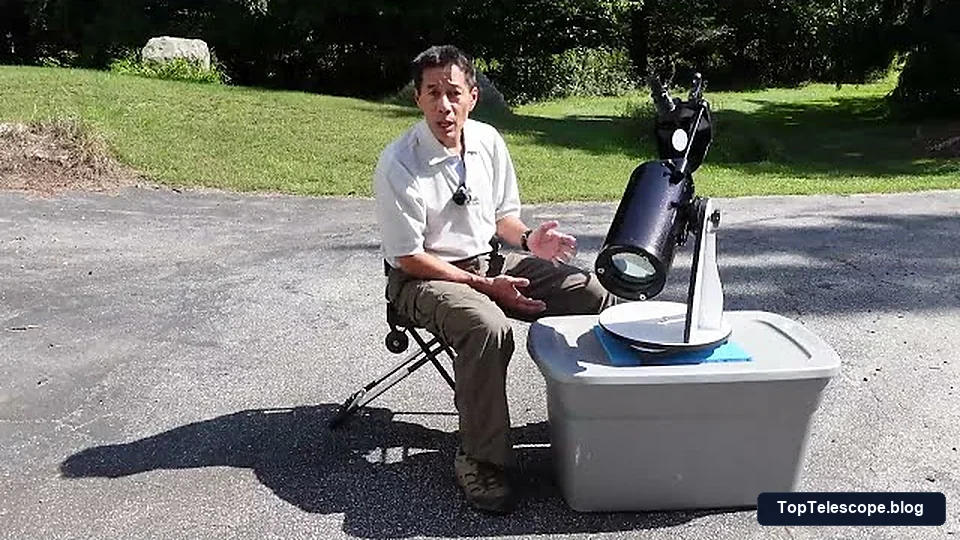
Operating the tabletop mount requires a sturdy, vibration-free surface like a picnic table or heavy wooden crate to prevent image jitter at high magnifications exceeding one hundred power.
Teflon bearing pads deliver buttery-smooth azimuth and altitude motions, though balancing heavy eyepieces might require adjusting the side tension clutches for optimal resistance and control.
Secure footing prevents accidental tipping during public outreach events. Always check that the base sits level before locking down your target acquisition sequence for comfortable viewing.
- Requires a stable tabletop surface for comfortable operation.
- Rubber base feet isolate ground tremors successfully.
- Teflon bearings enable effortless manual sky tracking.
- Ensure the support platform has rubber damping pads to isolate ground vibrations effectively.
Minimizing Damping Times on Uneven Surfaces
Placing the assembly on solid concrete or wooden decking eliminates damping delays. Avoid soft turf or unstable plastic folding tables during windy sessions.
Proper weight distribution across the base ensures fluid directional control.
- Solid foundations reduce image settling time significantly.
- Smooth azimuth rotation tracks celestial targets easily.
Comprehensive Verdict and Ideal User Profile
This optical instrument represents an outstanding value proposition for beginners. It balances serious light-gathering aperture with unmatched physical portability.
Experienced astronomers seeking a grab-and-go backup scope will find much to admire. The robust optical performance outweighs minor tabletop mounting limitations.
Anyone prioritizing bright visual astronomy over astrophotography should consider this telescope.
This instrument serves as an ideal grab-and-go solution for intermediate astronomers seeking substantial light-gathering capability without the heavy bulk of traditional solid-tube Newtonian telescope designs.
Beginners will appreciate the intuitive manual tracking mechanics, while experienced observers will value the exceptional optical throughput for quick sessions when time for major setup is limited.
Ultimately, balancing portability, aperture, and cost makes this hybrid system a standout choice for anyone prioritizing mobile astronomy without sacrificing deep-sky resolution or planetary detail clarity.
- Combines large aperture with exceptional travel convenience.
- Suits beginners and seasoned observers seeking mobility.
- Delivers brilliant visual performance across diverse celestial targets.
- Store the telescope assembly in a climate-controlled environment to prevent internal mold growth.
Final Purchasing Recommendation
Verify you own a stable platform before committing to purchase. Once accommodated, this telescope rewards users with breathtaking cosmic vistas night after night.
Long-term durability and optical excellence make it a staple.
- Ensure stable surface availability prior to field use.
- Delivers rewarding deep-sky views for years.
Frequently Asked Questions
How difficult is it to collimate the Skywatcher Heritage 150P?
Collimation is straightforward and takes only a few minutes. Using a simple cap or laser tool ensures precise optical alignment for sharp views.
Can this telescope be mounted on a standard photographic tripod?
The optical tube features an integrated Vixen-style dovetail bar. This allows attachment to various heavy-duty astronomical mounts equipped with compatible clamps.
Is the open truss design prone to dust collection on the mirror?
Dust accumulation is normal for open Newtonian reflectors over time. Using protective caps when stored helps minimize debris buildup on optical surfaces.
What kind of surface is required for the tabletop base?
Any rigid, level platform like a sturdy wooden table works wonderfully. Avoiding soft ground ensures minimal vibration damping during high magnification.
Is this telescope suitable for deep-sky astrophotography?
It is primarily designed for visual astronomy rather than long-exposure imaging. The altazimuth mount introduces field rotation during extended photographic captures.