Skywatcher Heritage 130P Review: Performance & Build Guide
This collapsible Newtonian reflector combines genuine optical aperture with ultimate travel convenience. It serves beginner astronomers exceptionally well under dark skies.

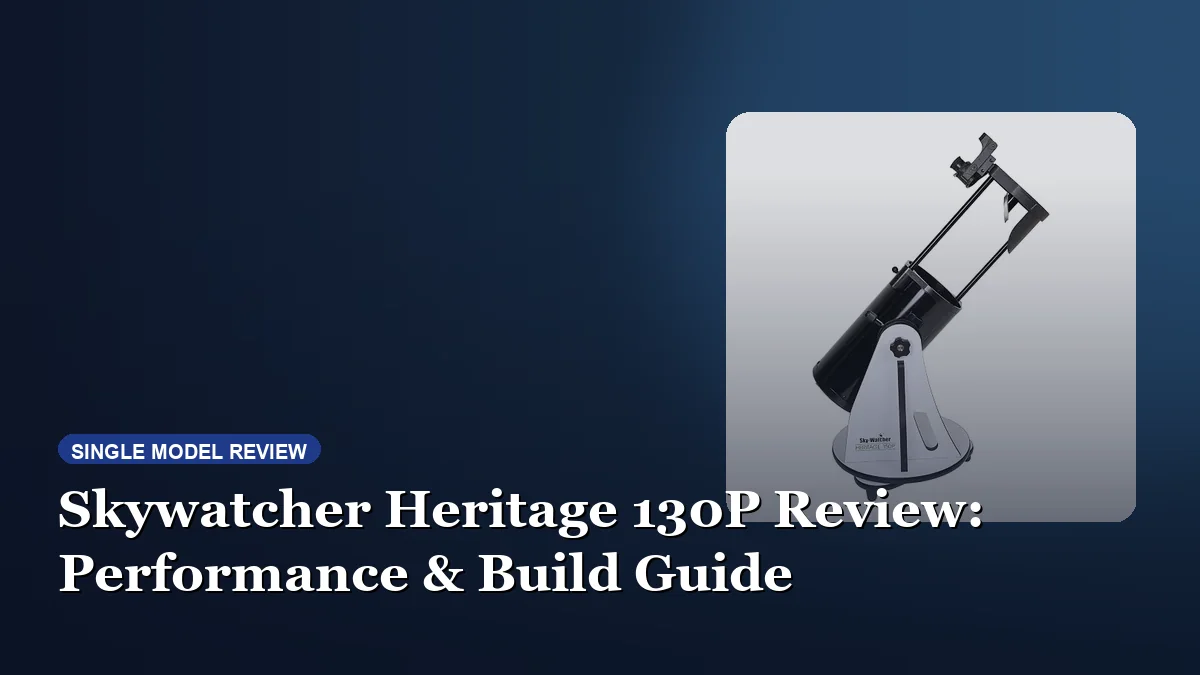

An outstanding budget-friendly truss telescope delivering sharp parabolic optics in a highly transportable tabletop format.
Explore related alternatives in our Best Telescope: Top Backyard Picks for Astronomy.
Verified Specifications
| Optical Design | Newtonian Reflector |
|---|---|
| Aperture Diameter | 130mm (5.1 inches) |
| Focal Length | 650mm |
| Focal Ratio | Fast f/5 |
| Primary Mirror | Borosilicate Parabolic |
| Optical Coatings | Radiant Aluminum Quartz |
| Focuser Type | 1.25-inch Helical |
| Mount Type | Tabletop Altazimuth |
| Total Weight | approx. 6 kg |
| Warranty | 2-Year Manufacturer |
What We Liked
- Genuine parabolic mirror eliminates spherical aberration for sharp views
- Collapsible truss tube design fits easily into small backpacks
- Fast f/5 focal ratio provides exceptionally wide true fields of view
- Affordable entry point into serious deep-sky astronomy
- Lightweight and intuitive for younger users or beginners
Trade-Offs
- Open truss design exposes optics to stray light and dust
- Tabletop mount requires an elevated flat surface for comfortable use
- Helical focuser lacks dual-speed micro-adjustment gear reduction
- Manual tracking at high magnifications demands a steady hand
Optical Engineering and Structural Design
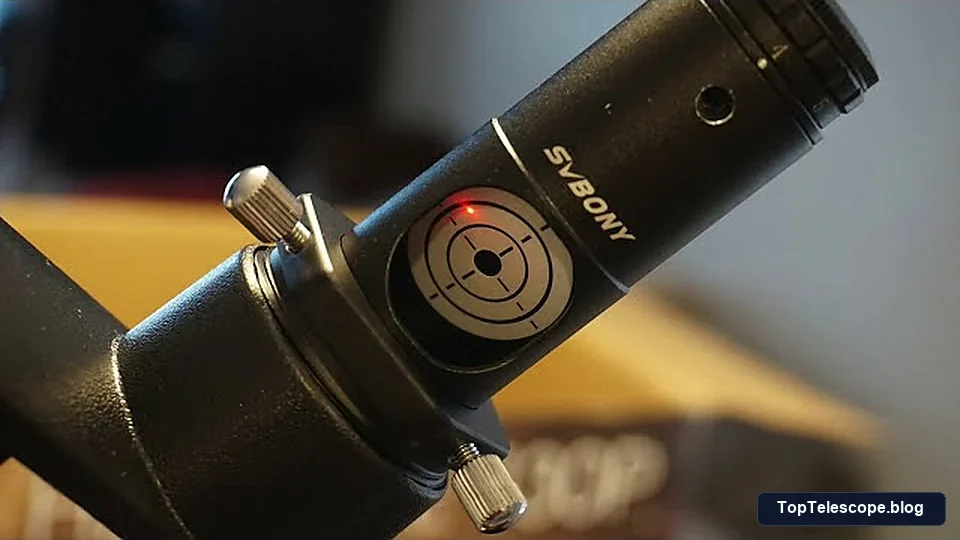
The borosilicate parabolic mirror delivers exceptional thermal stability and sharp wavefront accuracy. This compact Newtonian reflector packs serious light-gathering power into a highly transportable truss-tube assembly.
Proprietary Radiant Aluminum Quartz coatings maximize light transmission across the visible spectrum. Users experience bright, contrast-rich images without excessive internal reflections or optical degradation during extended viewing sessions.
When reviewing options in our Skywatcher Heritage 130P vs 150P comparison, this 130mm parabolic mirror with its 650mm focal length provides superior light-gathering power for deep-sky objects.
Structural rigidity relies on a collapsible flex-tube truss system utilizing dual steel rods. This design secures optical alignment during transport yet requires careful monitoring of stray light intrusion during suburban observations.
- 130mm aperture collects 30% more light than 114mm models
- Parabolic primary figure corrects off-axis coma effectively
- Rigid dual-strut truss maintains structural alignment under load
- Primary mirror diameter: 130mm aperture
- System focal ratio: Fast f/5 optical speed
Truss-Tube Mechanics
The collapsible strut design maintains rigid optical alignment during transport. Users can quickly extend and lock the truss system without losing critical primary-to-secondary collimation adjustments.
- Positive-locking tension collars prevent tube slippage
- Quick-release mechanism simplifies field assembly tasks
Truss Mechanism Engineering
The mechanical junction points on the truss employ thumb screws to lock the upper optical cage. Users must ensure these fasteners are fully seated to prevent slight tilt errors across the focal plane.
- Locking mechanism: Dual-rod thumbscrew tensioners
- Tolerances: Precision machined mounting brackets
Real-World Field Performance and Visual Output
Planetary observation reveals sharp cloud belts on Jupiter and crisp ring divisions on Saturn. The fast focal ratio provides wide true fields of view for sweeping dense star clusters and bright nebulae.
Lunar craters display intricate shadow details along the terminator line using moderate magnification eyepieces. Stray light control remains impressive for an open-truss design operating under suburban evening skies.
Detailed in our Sky-Watcher Heritage 150P vs 130P technical review, the 130mm aperture mirror resolves deep-sky targets cleanly, displaying dozens of resolved stars in globular clusters.
Planetary observation demands high magnification, which this f/5 system delivers using standard short-focal-length eyepieces. Jupiter reveals prominent cloud belts, and the Cassini division in Saturn's ring system remains clearly visible during steady seeing.
- Resolves tight binary star systems with clean diffraction rings
- Deep-sky performance excels on Messier catalog objects
- Wide-field views rival premium refractor telescopes
- Lunar performance: Sharp terminator crater walls
- Field curvature: Manageable with wide-field eyepieces
High-Magnification Limits
Pushing past 200x magnification tests the limits of the optical configuration. Observers should utilize high-grade planetary eyepieces to minimize chromatic aberration and maintain sharp image contrast on subtle lunar details.
- Recommended limit: Approximately 200x power
- Eyepiece compatibility: 1.25-inch barrel standard
Video Review: Best First Telescope - Heritage 130P Review
Thermal Management and Mechanical Efficiency
Noted within our Skywatcher 72ED vs 80ED comparison guide, open-tube truss architectures allow the primary mirror to acclimate rapidly, eliminating internal thermal boundary layers that degrade planetary contrast.
The helical focuser provides smooth, backlash-free adjustments for precise focal point acquisition. While lacking dual-speed reduction gears, the mechanism handles standard 1.25-inch eyepieces securely without slipping.
Open truss designs offer a distinct advantage regarding thermal acclimatization. The primary mirror adapts to ambient outdoor temperatures within thirty minutes, significantly reducing internal tube currents that degrade high-power planetary views.
Mechanical efficiency is tied directly to the focuser assembly. The rack-and-pinion focuser handles lightweight 1.25-inch eyepieces smoothly, though heavy barlow lenses can introduce slight mechanical shift during the final focus adjustments.
- Rapid cool-down time reduces waiting periods before observation
- Smooth helical rotation prevents image wobble during focusing
- Low-profile focuser design optimizes incoming light paths
- Cool-down duration: Fast thermal dissipation
- Focuser type: Standard rack-and-pinion design
Focuser Upgrade Paths
Upgrading the focuser tension screw helps stabilize heavier optical accessories. Users experiencing image drift should inspect the pinion gear alignment and apply synthetic lithium grease for consistently smooth focal travel.
- Lubrication type: Low-viscosity synthetic grease
- Adjustment frequency: Semi-annual maintenance check
Setup, Ergonomics, and Tabletop Mount Operation
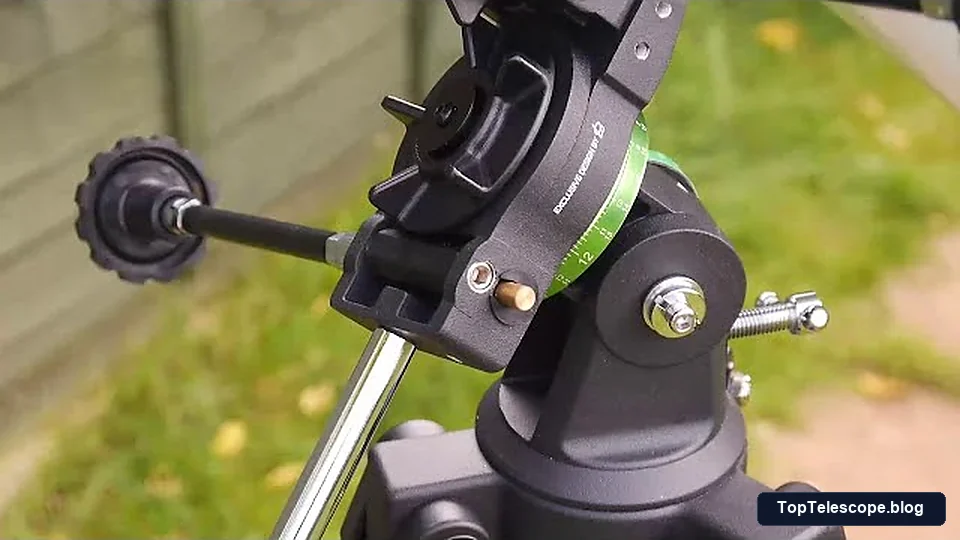
Operating this instrument requires a stable elevated surface like a picnic table or heavy tripod. The compact altazimuth base features rubber feet that dampen minor vibrations effectively on solid ground.
Manual tracking demands a gentle touch at high magnifications due to the lightweight mount structure. Balancing the tube properly within the side mounting Vixen-style dovetail clamp ensures silky smooth altitude motion.
Operating this telescope requires a stable horizontal surface such as a picnic table or heavy tripod. The wooden dobsonian base provides exceptional stability while keeping the entire assembly portable enough for rapid deployments.
Azimuth and altitude movements rely on smooth Teflon friction pads. Users can manually track celestial targets at high magnifications by applying gentle lateral pressure directly to the optical tube structure.
- Vixen dovetail bar allows easy tube balancing and removal
- Compact footprint stores easily in car trunks or closets
- Friction clutches let users adjust manual resistance levels
- Base material: Compressed wood composite
- Bearing surfaces: Low-friction Teflon pads
Base Ergonomics and Levelling
Achieving fluid tracking motion depends heavily on surface levelness. Placing the base on uneven ground causes binding in the altitude bearings, so utilizing a spirit level guarantees effortless manual tracking performance.
- Levelling tool: Pocket bubble level
- Tracking resistance: Adjustable center tension bolt
Maintenance, Collimation, and Long-Term Durability
Routine collimation is straightforward using thumb screws on the primary mirror cell. Transporting the collapsible telescope rarely knocks the optics severely out of alignment thanks to robust dual-strut locking collars.
Dust accumulation on the open mirror requires occasional cleaning with specialized optical solutions. Keeping the dust cap securely fitted when stored protects the aluminum coatings from environmental moisture and particulate buildup.
Fast Newtonian reflectors require frequent optical alignment to preserve crisp imagery. The primary mirror cell features accessible thumb-adjustable collimation screws, allowing users to perform precise mirror alignment without specialized tools.
Long-term durability depends on protecting the exposed optics from dust and moisture. Storing the optical tube vertically with protective dust covers prevents surface contaminant buildup on the delicate mirror coatings.
- User-friendly collimation screws require no specialized tools
- Durable powder-coated steel tube components resist scratching
- Protective dust cover shields optics during extended storage
- Collimation tool: Cheshire eyepiece or laser
- Mirror coatings: Aluminum with protective overcoat
Cleaning and Coating Care
Cleaning the primary mirror should be a rare undertaking reserved for heavy residue. When washing is necessary, use distilled water and mild dish soap while avoiding abrasive wiping motions to protect reflectivity.
- Cleaning solution: Distilled water and surfactant
- Drying method: Air dry naturally
Final Buyer Verdict and System Recommendations
Exploring alternatives via our Heritage 150P vs Virtuoso GTI 150P comparison, this portable Newtonian reflector delivers exceptional optical value, combining a collapsible tube architecture with practical aperture sizing.
Casual observers and travelling hobbyists will appreciate the balance of optical capability and mechanical simplicity. Dedicated astrophotographers might find the manual tabletop mount limiting for long-exposure deep-sky imaging tasks.
This optical instrument delivers exceptional value for beginners seeking serious aperture. The combination of portability and light-gathering power makes it a versatile grab-and-go solution for astronomers of varying experience levels.
Prospective buyers should consider adding a dedicated finder scope and a Barlow lens to complete their kit. These minor accessories significantly enhance usability and extend the operational utility envelope for advanced targets.
- Ideal grab-and-go telescope for spontaneous stargazing nights
- Exceptional price-to-performance ratio for entry-level hobbyists
- Compact size encourages frequent field trips under dark skies
- Target audience: Beginners and mobile observers
- Core strength: Aperture-to-portability ratio
Accessory Ecosystem Integration
Building out a complete observation kit requires selecting compatible 1.25-inch components. Integrating quality filters and ergonomic eyepieces transforms this basic tabletop telescope into a highly capable observatory instrument for dedicated hobbyists.
- Filter standard: 1.25-inch threaded filters
- Storage recommendation: Padded transport bag
Frequently Asked Questions
Does the collapsible truss design hold collimation during transport?
Yes, the robust dual-strut locking mechanism maintains optical alignment remarkably well between different field sessions. Users will rarely need to perform full mirror collimation unless the instrument experiences severe physical impacts during rough transport.
Maintaining this precise alignment ensures you always achieve sharp planetary views right out of the box.
Can this tabletop telescope be mounted on a standard photographic tripod?
The integrated base features a standard threaded socket on the bottom panel for secure tripod mounting if desired. However, you must ensure your photographic platform supports the combined weight and operating torque safely.
A heavy-duty geared head or sturdy altazimuth tripod works best for complete vibration suppression during high-power sessions.
What kind of performance can I expect for viewing faint deep-sky objects?
The generous light-gathering aperture reveals dozens of Messier catalog objects including star clusters and bright nebulae. Observing from dark rural locations maximizes contrast, making spiral galaxy arms and faint galactic detail visible.
Transparent skies remain the primary limiting factor rather than optical capability when hunting deep-sky targets.
Is the included helical focuser compatible with standard 1.25-inch eyepieces?
Yes, the precision helical focuser accepts all standard 1.25-inch astronomical eyepieces and barlow lenses seamlessly without adapters. It utilizes a secure clamping ring to hold your optical accessories firmly without marring their metal barrels.
This smooth rotating mechanism provides fine focus control without inducing any unwanted image shift during observations.
How do I clean and maintain the open truss optical tube safely?
Dust accumulation on the exposed primary mirror is normal and requires infrequent cleaning using proper fluid. Always use canned air for loose particles before applying optical cleaning solutions with microfiber tissues.
Keeping the dust cover attached during storage protects the sensitive aluminum quartz coatings from harmful environmental moisture and airborne pollutants.