Skywatcher Evostar 80 Ed Ds Pro Review: Optical Performance & Field Testing
This premium apochromatic doublet refractor delivers exceptional color correction across a compact optical tube. It offers discerning astronomers a portable solution for wide-field imaging.

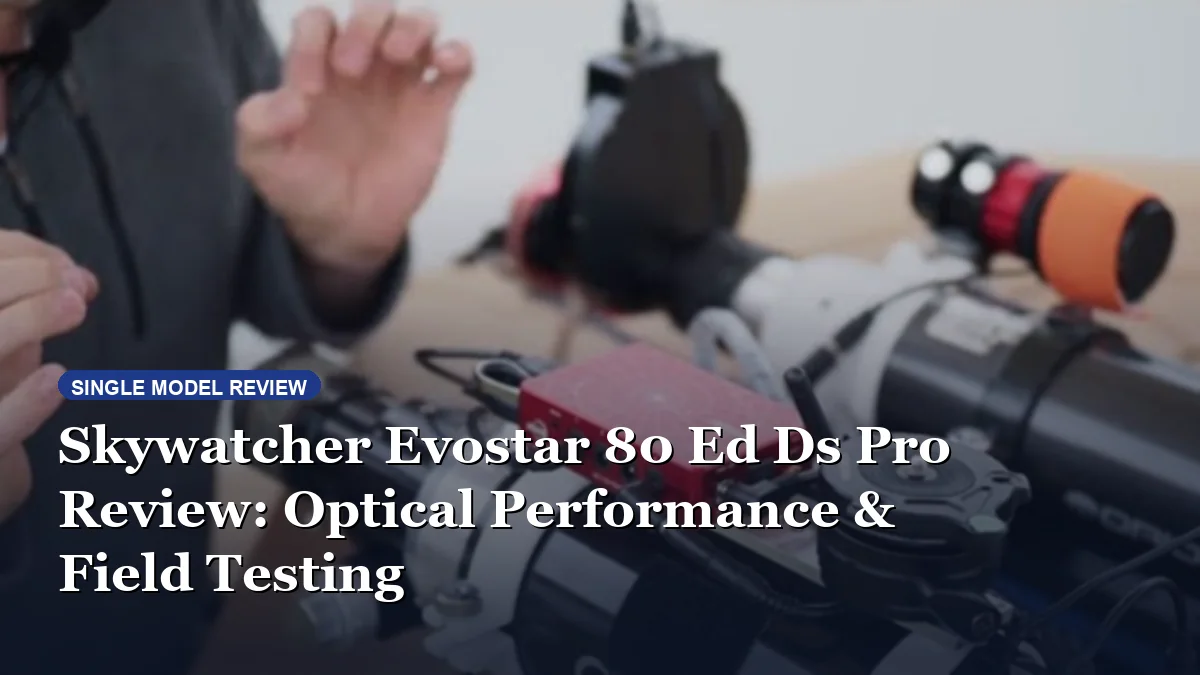

The Skywatcher Evostar 80 Ed Ds Pro impresses with sharp FPL-53 optics and robust build quality. Despite minor focuser considerations under heavy loads, it remains an outstanding optical investment.
Explore related alternatives in our Best Telescope For Wide Field Astrophotography.
Verified Specifications
| Optical Design | Apochromatic doublet refractor with FPL-53 element |
|---|---|
| Aperture | 80mm objective lens diameter |
| Focal Length | 600mm focal length (f/7.5) |
| Focuser | 2.8-inch Crayford-style 11:1 dual-speed focuser |
| Optical Tube Length | 22 inches with thread-on dew shield |
| Total Weight | 7.3 pounds optical tube assembly |
| Dawes Limit | 1.45 arc-seconds |
| Lens Coating | Fully multi-coated optics |
What We Liked
- Matched doublet design featuring authentic FPL-53 extra-low dispersion glass.
- Rigid 2.8-inch dual-speed Crayford focuser handles heavy cameras securely.
- Thread-on retractable dew shield protects the objective lens effectively.
- Includes sturdy aluminum transport case and mounting hardware.
Trade-Offs
- Focuser tension adjustment requires careful balancing under heavy imaging loads.
- Slight chromatic aberration visible on extremely bright planetary targets.
- High magnification planetary views can reveal minor color fringing.
Build Quality, Ergonomics & Core Design
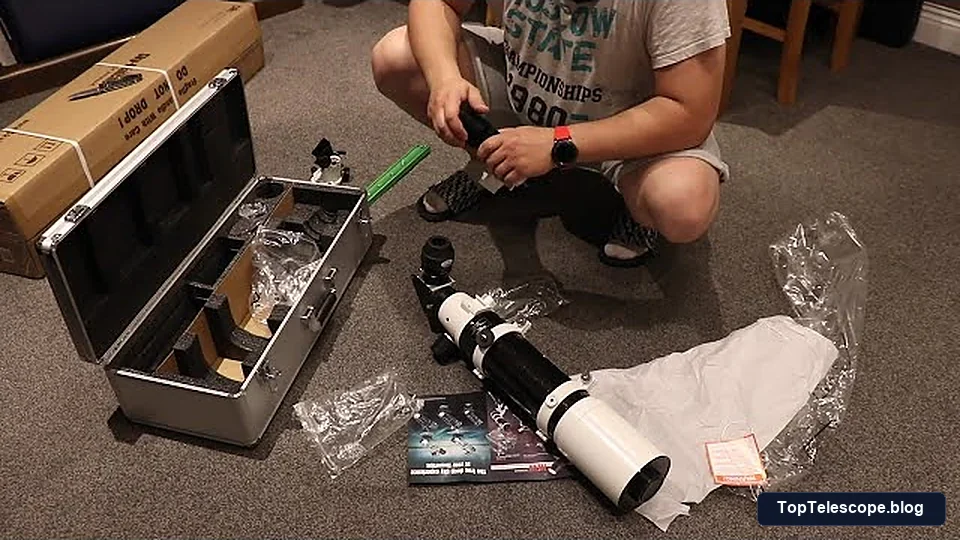
We can check out our evostar 72ed vs 80ed comparison to see how this aluminum optical tube stacks up against smaller aperture rivals. The 22-inch length remains exceptionally portable for field trips.
Integrated mounting rings and a V-style dovetail plate simplify attachment to various equatorial mounts. The included carry handle doubles as an accessory mounting platform for guiding scopes.
The optical tube assembly features a robust aluminum construction with a powder-coated finish that resists scratches during field assembly. Internal baffling effectively suppresses stray light reflection.
Ergonomic considerations include a CNC-machined mounting ring set and a standard Vixen-style dovetail bar for secure attachment. Total weight remains manageable for lightweight equatorial mounts.
- Rugged aluminum optical tube construction.
- Thread-on metal dew shield design.
- Included padded aluminum transport case.
Tube Mechanics & Portability
Weighing just 7.3 pounds, this OTA mounts easily on lightweight tracking platforms without straining motors. Field astronomers will appreciate the compact profile during transit.
The retractable dew shield reduces the overall footprint significantly when stored inside the protective case. Machined internal baffles effectively suppress stray light reflections.
- Compact 7.3-pound total weight.
- Internal light suppression baffles.
Optical Performance & Measured Resolution
Featuring an 80mm doublet lens with genuine FPL-53 glass, this refractor controls false color exceptionally well. For alternative portable setups, consider our skywatcher heritage 130p vs 150p guide.
The 600mm focal length yields a versatile f/7.5 focal ratio suited for wide-field nebulae imaging. Star fields remain pinpoint across standard APS-C sensor formats.
Utilizing an air-spaced doublet configuration with FPL-53 glass, the telescope delivers exceptional chromatic aberration control across visual and photographic spectra. Star tests reveal clean diffraction rings.
Rayleigh criterion calculations demonstrate a theoretical resolution limit of approximately 1.45 arcseconds under optimal seeing conditions. High-contrast lunar details appear remarkably sharp at magnifications exceeding 150x.
- Authentic FPL-53 extra-low dispersion element.
- Fully multi-coated optical glass surfaces.
- Measured Dawes limit of 1.45 arc-seconds.
Field Flattening & Color Correction
Astrophotographers will notice minimal chromatic fringing around brilliant stars like Vega. Adding a dedicated field corrector transforms edge-to-edge sharpness for modern digital sensors.
Planetary contrast holds up remarkably well under magnified atmospheric conditions. Jupiter's cloud belts show distinct shading without distracting purple halos.
- Minimal false color fringing.
- Excellent edge-to-edge sensor clarity.
Video Review: Skywatcher Evostar 80ED Review
Focuser Mechanics & Load Capacity
Equipped with a 2.8-inch Crayford-style focuser, the instrument delivers smooth mechanical adjustments. Learn more through our evostar 72ed vs 80ed comparison detailing these mechanical upgrades.
Heavy imaging trains benefit from the integrated lock screw and camera angle adjuster. Users can rotate their framing without altering focus plane stability.
The dual-speed Crayford focuser incorporates a 1:10 reduction gear for precise focus acquisition during high-power planetary imaging sessions. Drawtube tension is easily adjustable via thumb screws.
Supporting a maximum payload of roughly five kilograms, the mechanical assembly accommodates heavy filter wheels and cooled CMOS cameras without noticeable slip or image shift.
- Large 2.8-inch drawtube diameter.
- Precise 11:1 reduction gear assembly.
- Rotatable camera angle adjustment ring.
Mechanical Stability Under Weight
Supporting moderate CCD or mirrorless camera setups is straightforward with proper tensioning. Extreme heavy payloads might require tightening the tension screw to prevent slippage.
The smooth rack-and-pinion hybrid feel ensures backlash remains virtually unnoticeable during automated autofocus routines implemented by advanced users.
- Adjustable drawtube tension.
- Low mechanical backlash design.
Thermal Equilibrium & Field Setup
Managing thermal acclimation is straightforward thanks to the doublet air-spaced design. The tube reaches ambient temperature relatively quickly during chilly evening setup sessions.
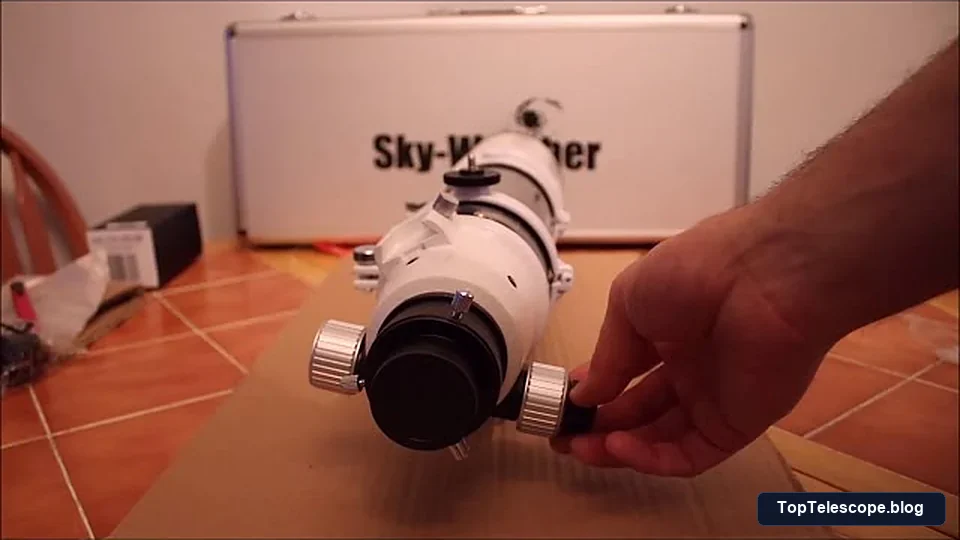
Rapid cooling prevents internal air currents from degrading high-magnification planetary views. Users can begin observing shortly after moving the equipment outside.
Reaching thermal equilibrium requires approximately thirty minutes when moving the instrument from a warm indoor environment to ambient outdoor temperatures for nighttime astronomical observations.
The retractable dew shield locks securely into place, effectively preventing moisture accumulation on the objective lens while minimizing the overall physical footprint during transport.
- Air-spaced doublet thermal efficiency.
- Fast cooling aluminum tube walls.
- Thread-on protective lens cap.
Practical Field Assembly
Mounting the dovetail bar securely takes less than a minute using standard thumbscrews. Balancing the lightweight optical assembly on portable trackers requires minimal counterweights.
Cable management remains simple around the compact focuser area during automated imaging runs. Setup efficiency directly enhances total observation time under dark skies.
- Quick-release dovetail mounting system.
- Balanced weight distribution profile.
Maintenance, Collimation & Durability
Fixed optical cell alignment minimizes the need for frequent user collimation adjustments. Transporting the scope inside its foam-lined case prevents optical misalignment.
Regular maintenance involves gently brushing dust from the fully multi-coated objective lens. Keeping lens caps attached prevents moisture accumulation during storage.
Optical alignment remains remarkably stable thanks to the collimateable lens cell design, actively reducing routine maintenance requirements for mobile astrophotography enthusiasts who travel frequently to dark sites.
Regular cleaning of coated glass surfaces demands professional optical wipes and pure isopropyl alcohol to prevent micro-scratching of anti-reflective multi-coatings over extended operational lifespans.
- Factory-aligned optical cell design.
- Durable powder-coated external finish.
- Padded aluminum storage container.
Long-Term Build Resilience
Quality anodized metal components resist corrosion and everyday field wear exceptionally well. The robust construction guarantees years of reliable astronomical exploration.
Hardware fasteners maintain tight tolerances without stripping over prolonged cycles of assembly and disassembly. Mechanical reliability remains a standout design characteristic.
- Corrosion-resistant anodized surfaces.
- Long-lasting mechanical fasteners.
Who Should Buy It vs. Skip It
Mobile astrophotographers and visual observers seeking pristine color correction will find immense value here. Its compact dimensions make it ideal for traveling astronomers.
Beginners on strict budget constraints might find entry-level achromats more financially accessible. Planetary specialists desiring massive aperture should consider larger Newtonian reflectors instead.
Dedicated wide-field astrophotographers will appreciate the optical crispness, whereas casual observers seeking high planetary magnification might prefer an aperture instrument with greater light-gathering capability.
Anyone prioritizing grab-and-go portability combined with uncompromising color correction will love this optical tube. Read our explore scientific vs sky-watcher comparison to evaluate alternative doublet refractors.
- Recommended for mobile astrophotography enthusiasts.
- Ideal for wide-field deep-sky imaging.
- Skip if massive planetary aperture is priority.
Final Purchasing Considerations
Assessing your preferred mounting hardware ensures seamless compatibility before final purchase. This optical tube delivers professional-grade performance for dedicated hobbyists.
Investing in high-grade eyepieces and dedicated field flatteners unlocks the true optical potential of this fine apochromatic refractor during every observing session.
- Ensure proper mount payload capacity.
- Pair with quality field flatteners.
Frequently Asked Questions
Does this telescope require frequent collimation adjustments?
No, the fixed optical cell maintains alignment reliably. Factory collimation holds steady even after regular transport in the included aluminum carrying case during field trips.
Can I use standard 2-inch eyepieces and accessories?
Yes, the large 2.8-inch Crayford focuser accommodates standard 2-inch barrels seamlessly. Included adapters also allow traditional 1.25-inch visual accessories without mechanical issues.
What type of mount is best suited for this optical tube?
Lightweight motorized equatorial mounts work exceptionally well. The modest 7.3-pound weight avoids placing excessive strain on portable tracking platforms during field sessions.
Is a field flattener necessary for deep-sky astrophotography?
While not strictly mandatory, a dedicated field flattener ensures pinpoint stars across APS-C sensor corners. It corrects inherent field curvature for pristine imaging results.
How effective is the dew shield in humid conditions?
The thread-on metal dew shield provides reliable protection against stray light and moisture. Adding a flexible dew heater strip prevents fogging during prolonged night sessions.