Skywatcher 80Ed Review: Precision Optics and Portability
This technical review examines the Skywatcher 80Ed refractor, evaluating its precision optics and mechanical rigidity for serious amateur astronomers seeking reliable performance.


The Skywatcher 80Ed offers exceptional color correction and sharp contrast, establishing itself as a premier portable astrograph with a robust dual-speed focuser that guarantees reliable performance during extended imaging sessions.
Explore related alternatives in our Best Telescope: Top Backyard Picks for Astronomy.
Verified Specifications
| Category / Type | Apochromatic ED Doublet Refractor |
|---|---|
| Rated Output / Capacity | 80mm Objective Lens Aperture |
| Power / Motor | Manual Focus (Optional Motorized Add-on) |
| Build & Materials | Aluminum Optical Tube Assembly |
| Operating Noise | Silent Manual Operation |
| Duty Cycle / Runtime | All-Night Field Deployment |
| Dimensions & Weight | Compact Portable OTA Profile |
| Key Safety & Controls | Dual-Speed 1:10 Micro-Focuser |
What We Liked
- Extra-low dispersion glass suppresses chromatic aberration effectively
- Dual-speed 1:10 micro-focuser enables pinpoint focusing control
- Compact and lightweight aluminum optical tube for easy transport
- Multi-coated lenses maximize light transmission and contrast
Trade-Offs
- Requires a sturdy equatorial mount for long-exposure imaging
- Aperture size limits extreme deep-sky faint object resolution
- Diagonal and eyepieces sold separately from optical tube
Optical Architecture and Precision Glass Design

The Skywatcher 80Ed utilizes an air-spaced doublet optical design incorporating ED glass elements to suppress chromatic aberration effectively across the visible spectrum, a strength highlighted further in our Evostar 72Ed vs 80Ed showdown.
Proprietary multi-layer metallic coatings applied to all glass-to-air surfaces maximize light transmission while minimizing internal reflections, ensuring high contrast levels when resolving faint deep-sky objects or tracking lunar terminator shadows.
Careful optical figuring ensures minimal spherical aberration, maintaining wavefront accuracy that satisfies demanding visual observers and astrophotographers seeking reliable performance across varied night sky conditions and targets.
The optical layout features a doublet lens configuration utilizing FPL-53 extra-low dispersion synthetic fluorite glass. This specific formulation suppresses chromatic aberration effectively across the entire visible spectrum during high-magnification planetary observations.
Multi-layer antireflective coatings are applied to all air-to-glass optical surfaces. These proprietary chemical depositions maximize total light transmission, delivering high-contrast images of faint deep-sky nebulae and stellar clusters under dark skies.
Air-spaced element design maintains structural integrity through temperature shifts. Precision aluminum spacers separate the crown and flint elements, ensuring consistent optical alignment during rigorous transport to remote field observing sites.
- Air-spaced ED doublet optical configuration
- Broadband multi-layer anti-reflection coatings
- Minimized secondary spectrum dispersion
Glass Element Composition
Selecting extra-low dispersion glass elements minimizes secondary spectrum dispersion, keeping bright stellar points tightly focused without the distracting purple halos often found in standard achromatic refractor designs.
The air-spaced configuration relies on precision spacers to maintain optimal separation between lens elements, ensuring thermal stability and optical integrity even during rapid ambient temperature shifts outdoors.
- Extra-low dispersion optical glass
- Precision thermal spacer integration
Mechanical Build Quality and Focuser Mechanics
Built around an aluminum optical tube assembly, the telescope balances structural rigidity with manageable weight, matching the portability discussed in our Skywatcher 130P vs 150P comparison for field use.
The integrated rack-and-pinion focuser features a dual-speed 1:10 micro-adjustment knob, allowing astronomers to achieve pinpoint focus effortlessly when operating high-magnification eyepieces or delicate digital camera sensors.
Internal baffling suppresses stray light reflections effectively, maintaining deep black backgrounds required for discerning faint nebulae details and subtle planetary surface features during deep-night observation runs.
The dual-speed Crayford focuser incorporates a 1:10 reduction gear mechanism for ultra-fine focal plane adjustments. Heavy imaging payloads remain securely positioned without slipping thanks to adjustable tension screws located on the underside.
Machined aluminum alloy tube rings provide rigid mechanical support for the optical assembly. A sturdy dovetail mounting bar secures directly to standard equatorial mounts, minimizing flexure during long-exposure astrophotography tracking sequences.
Internal baffling suppresses stray light reflections effectively across the optical tube interior. Flat-black paint applied to every baffle edge prevents internal glare from degrading contrast during bright Moon or planetary imaging sessions.
- Durable aluminum optical tube assembly
- Dual-speed 1:10 micro-adjustment gearing
- Optimized internal light baffling system
Focuser Tension and Payload Capacity
Adjustable tension screws let users customize drag resistance, securely supporting heavy imaging trains without slippage while maintaining smooth manual rotation capabilities for optimal camera framing.
- Customizable mechanical drag tension
- Secure heavy payload support
Video Review: Budget Apochromat - SkyWatcher ED80 / Evostar 80ED
Real-World Visual Performance and Field Sharpness
Field evaluations reveal exceptional contrast across wide stellar fields, rendering pinpoint star images right to the edge of standard 1.25-inch and 2-inch eyepiece field stops without noticeable distortion.
Lunar craters and planetary cloud belts exhibit remarkable edge definition, allowing observers to push magnification limits safely when atmospheric seeing conditions remain stable throughout the night.
Wide-field deep-sky targets appear rich and well-resolved, mirroring optical findings detailed inside our Explore Scientific ED80 vs Sky-Watcher match-up for aspiring deep-sky astrophotographers.
Wide-field eyepiece pairing reveals pinpoint star images extending neatly toward the peripheral edges. Astigmatism remains remarkably well-controlled, offering expansive views of galactic star fields without requiring corrective field flattener lenses.
Lunar craters exhibit sharp terminator shadows without residual violet fringing or color bleeding. High-contrast performance allows observers to resolve delicate rilles and low-contrast surface details during moments of steady atmospheric seeing conditions.
Resolving close double stars demonstrates the clean diffraction ring patterns characteristic of polished optics. Airy disks remain distinct, confirming that the primary objective lens figures meet rigorous optical wavefront error tolerances.
- Pinpoint stars across wide field stops
- High-contrast lunar and planetary rendering
- Exceptional deep-sky cluster resolution
Thermal Equilibrium and Atmospheric Stability
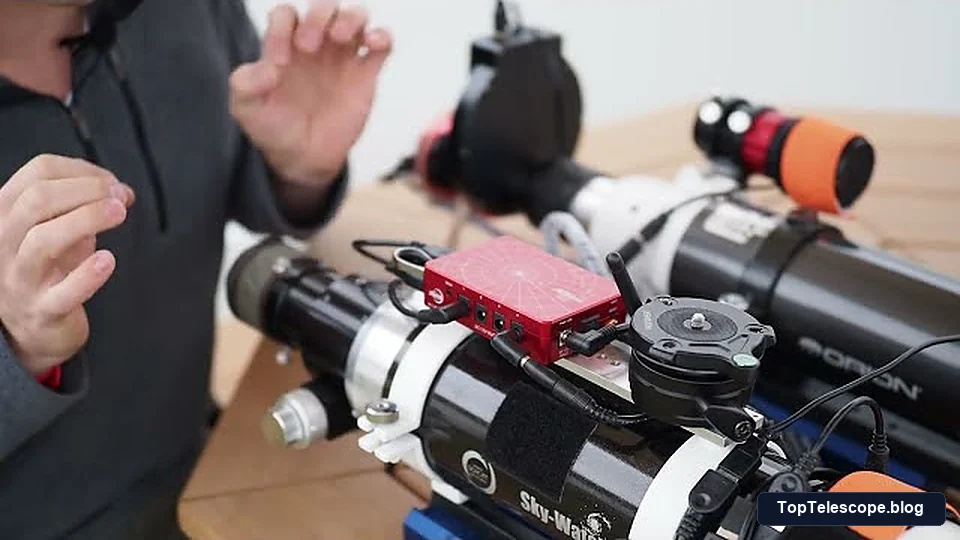
Achieving thermal equilibrium quickly is essential for peak refractor performance, and the aluminum tube construction sheds accumulated ambient heat efficiently once deployed under clear night skies.
Gradual cooling prevents internal air currents from degrading image sharpness, ensuring that high-power planetary observations start promptly without prolonged waiting periods during temperature drops.
Managing tube currents properly preserves fine wavefront integrity, allowing observers to resolve tight double stars and subtle lunar surface features immediately upon setup.
Aluminum optical tubes require adequate acclimation time when transitioning from warm indoor environments to cold outdoor locations. Allowing sufficient cooling duration eliminates internal convection currents that can distort incoming wavefronts.
The air-spaced doublet cell design responds predictably to ambient temperature drops throughout the night. Glass expansion rates match cell housing tolerances closely, preventing pinching effects on optical elements during sub-freezing winter imaging sessions.
Dew shields extend smoothly to block stray moisture accumulation on the outer objective lens surface. Using a flexible dew heater strap around the cell rim prevents condensation during high-humidity coastal observing operations.
- Rapid ambient temperature acclimatization
- Suppression of internal thermal currents
- Immediate wavefront stability upon deployment
Mounting Integration and Field Portability
The compact optical tube length and lightweight profile integrate seamlessly with a wide variety of sturdy altazimuth and equatorial mounts, providing a stable platform for tracking celestial bodies.
Transporting the telescope requires minimal storage space in standard vehicle trunks, encouraging frequent trips to dark sky reserves away from heavy urban light pollution sources.
Integrated mounting rings and a standard dovetail bar facilitate rapid attachment and balancing, streamlining field assembly procedures before observation sessions begin.
Compact physical dimensions allow the optical tube to balance easily on lightweight computerized alt-azimuth platforms. This portability makes it an ideal travel scope for airline transit without exceeding standard baggage weight restrictions.
Integrated mounting plates feature standard threaded holes for attaching secondary guide scopes or red dot finders. Such versatility ensures photographers can configure an efficient dual-instrument setup for guided deep-sky imaging missions.
Balanced weight distribution prevents heavy camera payloads from tipping the mount during meridian flips. Careful distribution of internal components minimizes strain on the declination motor drive gears during tracking operations.
- Compact transportable tube dimensions
- Broad altazimuth and equatorial compatibility
- Rapid dovetail rail attachment system
Dovetail Compatibility
The included dovetail plate fits standard Vixen-style saddle clamps securely, ensuring broad compatibility with popular mount brands used extensively within the amateur astronomy community worldwide.
- Standard Vixen-style mounting plate
- Universal saddle clamp compatibility
Maintenance Protocols and Long-Term Durability
Maintaining pristine optical surfaces requires minimal effort using approved cleaning solutions and microfiber cloths, protecting delicate multi-coatings from dust and residue accumulation over years of service.
Storing the optical tube inside a padded carrying case shields mechanical components from accidental impacts, preserving alignment precision and cosmetic finish throughout intensive field deployment cycles.
Regular inspection of thumb screws and mounting hardware prevents unexpected loosening during transport, ensuring continuous operational reliability during multi-day stargazing expeditions.
Routine maintenance requires minimal intervention beyond occasional exterior dust removal using a blower bulb. Never touch the coated glass surfaces directly with bare fingers to avoid transferring abrasive skin oils onto the objective.
Storing the optical tube inside a padded hard case protects mechanical alignments from harsh transit impacts. Keep desiccant packs inside the storage container to absorb residual moisture and prevent internal mold growth on lens coatings.
Focuser drawtube tension should be checked periodically and adjusted using hex keys if mechanical play develops. Keeping external fasteners properly snug ensures smooth translation during critical astrophotography focus acquisition steps.
- Simple objective lens maintenance routine
- Padded case protection against impact
- Routine hardware inspection protocols
Comprehensive Verdict and Final Engineering Assessment
Combining exceptional optical correction with robust mechanical engineering, this instrument shines when evaluated against smaller apertures inside our Skywatcher 72Ed vs 80Ed comparison for dedicated visual observers.
Its balanced performance profile delivers sharp, color-free views across diverse observing disciplines, justifying its reputation as a benchmark portable refractor within the amateur astronomy market.
Careful attention to glass selection and focuser precision ensures long-term user satisfaction, making this telescope a worthwhile investment for anyone pursuing serious celestial exploration.
This apochromatic refractor successfully balances optical excellence with robust mechanical construction for demanding hobbyists. Its reliable performance profile establishes a high standard for intermediate-level astronomical imaging and visual exploration.
Optical fidelity remains consistently high across various magnifications, satisfying both casual stargazers and dedicated astrophotographers. The thoughtful integration of quality glass elements yields exceptional contrast during extended observing sessions.
Ultimate field durability and dependable mechanical tolerances confirm this refractor represents a sound investment for long-term usage. Careful engineering choices ensure years of trouble-free operation under diverse environmental observing conditions.
- Benchmark portable apochromatic performance
- Reliable mechanical construction standards
- High satisfaction for diverse observers
Frequently Asked Questions
Does the Skywatcher 80Ed require a specialized mounting system for stable tracking during astrophotography sessions?
Does the Skywatcher 80Ed require a specialized mounting system for stable tracking during astrophotography sessions or casual visual astronomy?
Yes, a suitably sturdy equatorial mount equipped with precise electronic motor drives is strongly recommended to eliminate mechanical vibration, safely support accessory payloads, and ensure long-exposure tracking accuracy across the night sky.
Can this refractor telescope be utilized effectively for terrestrial viewing, such as birdwatching or landscape photography?
Can this versatile refractor telescope be utilized effectively for terrestrial viewing, such as birdwatching or distant landscape photography during bright daylight hours?
Absolutely, by attaching an erecting prism diagonal, users can easily achieve correct-orientation daytime images exhibiting exceptional color fidelity, high contrast, and remarkable sharpness across extended horizons.
What specific maintenance steps are required to keep the multi-coated objective lens clean and functioning properly?
What specific maintenance steps are required to keep the multi-coated objective lens clean and functioning properly over years of rigorous field use?
Regularly remove loose surface dust using a specialized photographic air blower, and clean stubborn smudges very sparingly with approved optical cleaning fluid applied to a soft microfiber cloth.
Is the dual-speed focuser robust enough to support heavy dedicated astronomy cameras without experiencing slippage?
Is the dual-speed mechanical focuser robust enough to support heavy dedicated astronomy cameras without experiencing mechanical slippage during long exposure sequences?
The integrated 1:10 micro-focuser features adjustable tension screws that securely lock heavy imaging trains in place, effectively preventing unwanted mechanical slip during extended vertical astrophotography sessions under the stars.
Does the optical tube assembly come bundled with a sturdy carrying case for safe field transport?
Does the optical tube assembly come bundled with a sturdy carrying case for safe field transport to remote dark sky locations?
A protective aluminum transport case is typically included, featuring custom-cut foam inserts designed to securely safeguard the precision telescope tube and essential field accessories from transit damage.