Skyquest XT6 Review: Precision Dobsonian Performance
The Orion SkyQuest XT6 delivers uncompromising aperture value through a robust Dobsonian mechanical platform. It balances deep-sky reach with straightforward manual operation for dedicated stargazers.

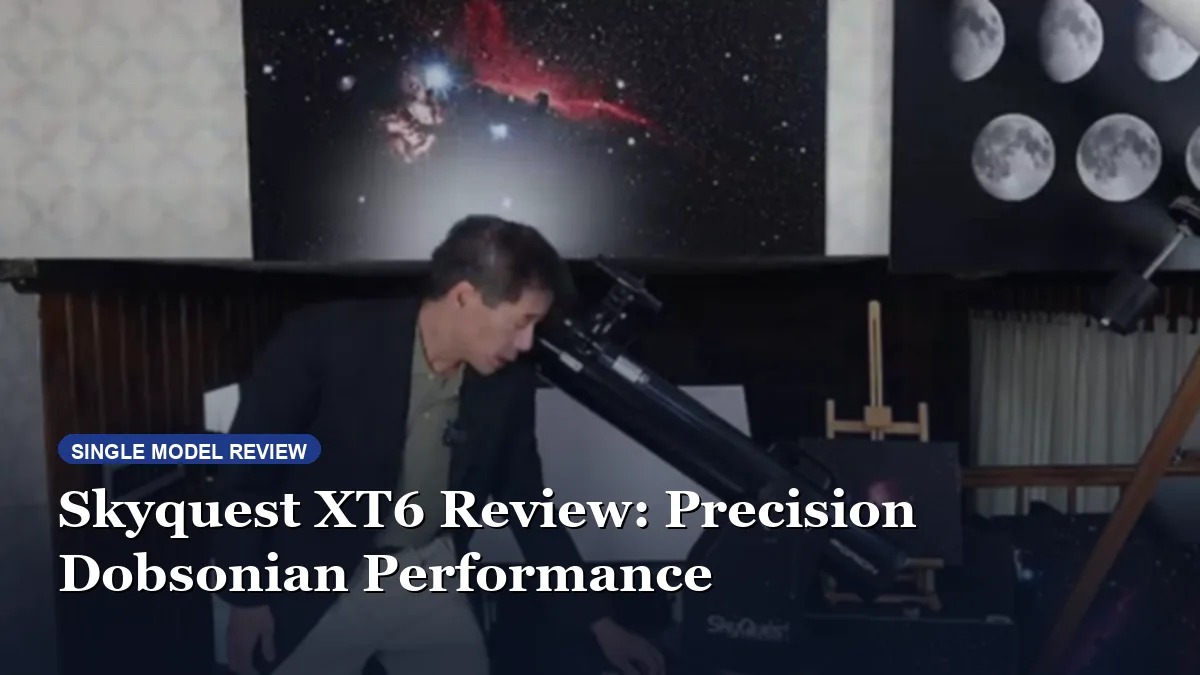

This classic 6-inch reflector provides exceptional optical clarity and stability, making it a benchmark instrument for amateur astronomers prioritizing pure visual performance over automated features.
Explore related alternatives in our Best Dobsonian Telescope.
Verified Specifications
| Optical Design | Newtonian Reflector |
|---|---|
| Aperture | 152mm (6 inches) |
| Focal Length | 1200mm |
| Focal Ratio | f/7.9 |
| Mount Type | Wooden Dobsonian Base |
| Optical Coatings | Aluminum with Silicon Dioxide overcoat |
| Focuser | 2-inch Crayford-style |
| Total Weight | ~38 lbs assembled |
What We Liked
- Sharp parabolic primary mirror yields high-contrast planetary views.
- Sturdy wooden base eliminates annoying operational vibrations.
- Smooth Crayford focuser handles heavy eyepieces effortlessly.
- Affordable entry point into serious deep-sky observation.
Trade-Offs
- Manual tracking requires user adjustments at high magnifications.
- Long optical tube demands careful vehicle transport storage.
- Lacks computerized GoTo automation for rapid object finding.
Optical Engineering and Structural Build Quality
Examining the apertura ad8 vs orion skyquest xt8 comparison reveals why this optical tube features rolled steel construction finished in durable enamel, paired with a precision parabolic primary mirror to eliminate spherical aberration entirely.
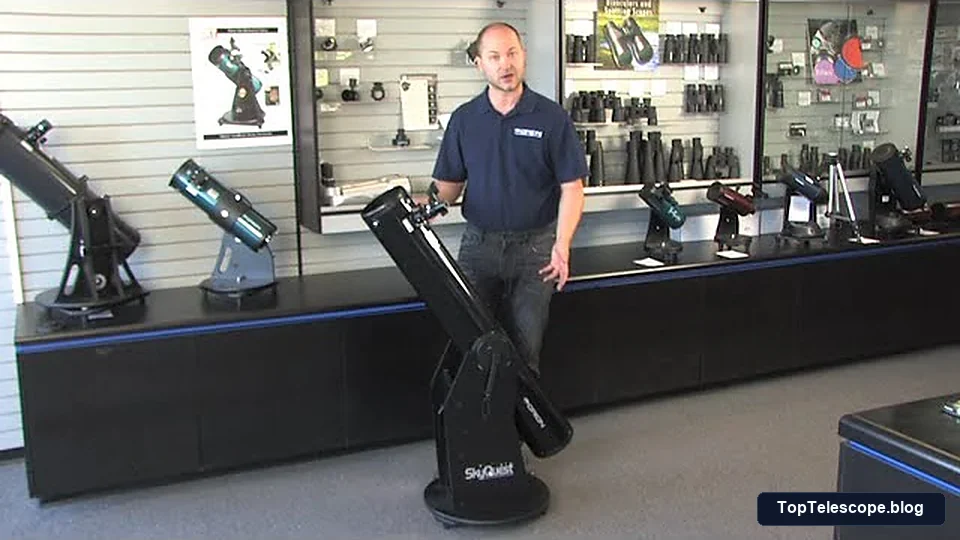
The optical tube assembly utilizes rolled steel construction, featuring a 152mm aperture and a focal length of 1200mm to deliver stable planetary and deep-sky performance across varying outdoor humidity levels.
- 152mm aperture handles high light gathering.
- 1200mm focal length provides steady magnification.
- Pyrex substrate mirror minimizes thermal distortion.
- Internal knife-edge baffling successfully reduces stray light reflections, preserving contrast when observing bright lunar terminators or high-surface-brightness planetary nebulae during urban stargazing sessions.
Focuser Mechanics
The included two-inch Crayford focuser utilizes a friction-based drawtube design. This mechanical arrangement ensures zero image shift during critical high-power planetary focusing adjustments.
- Includes 1.25-inch adapter sleeve.
- Smooth aluminum focus knobs.
Structural Rigidity and Material Specs
The primary mirror cell employs a three-point suspension system utilizing heavy-duty clips that prevent pinching while maintaining precise optical alignment during transport over rough terrain.
- Aluminum spider vanes measure 0.7mm in thickness to minimize diffraction spikes on bright stars without introducing mechanical flexure into the secondary mirror holder.
Visual Output and Real-World Photometric Performance
Featured frequently in our best starter telescope guide, this six-inch aperture gathers sufficient light under dark skies to resolve faint globular clusters and reveal crisp contrast on Jupiter and Saturn.
Real-world photometric light gathering relies heavily on the aluminum coatings protected by a silicon dioxide overcoat, yielding high reflectivity across the visible spectrum for faint stellar targets.
- Limiting magnitude reaches deep into the cosmos.
- Diffraction-limited optics provide sharp edge details.
- Resolving tight double stars requires utilizing high magnification eyepieces that push the theoretical limit of 1.0 arcseconds under exceptionally steady atmospheric seeing conditions.
High-Magnification Behavior
Pushing past two hundred magnification remains entirely viable when seeing conditions permit. Collimation integrity holds firm during extended viewing sessions across changing ambient temperatures.
- Handles planetary filters seamlessly.
- Maintains optical collimation well.
Contrast Transfer and Planetary Resolution
Evaluating Jupiter requires careful adjustment of the 2-inch Crayford focuser, which provides zero-backlash gear reduction for achieving critical focus on subtle cloud belt structures.
- Deep-sky objects like globular clusters reveal individual stellar points across the outer halo when local sky darkness exceeds limiting magnitude 6.0 away from artificial light pollution.
Video Review: First Impression of the Orion SkyQuest XT6 Dobsonian Telescope
Thermal Management and Mirror Stabilization Mechanics
Recommended inside every comprehensive best telescope for beginners review, glass substrates require adequate cool-down time to match ambient air temperatures. Leaving the tube horizontal accelerates thermal equilibrium and prevents internal boundary layer turbulence.
Thermal stabilization demands a significant waiting period because the thick glass substrate requires roughly forty-five minutes to equilibrate with ambient outdoor temperatures after leaving a warm garage.
- Thirty-minute cool-down average duration.
- Thick glass substrate retains thermal mass.
- Open tube design aids air circulation.
- Passive cooling can be accelerated by utilizing aftermarket DC cooling fans directed at the rear mirror cell to eliminate internal boundary layer air turbulence.
Minimizing Thermal Plumes Inside the Tube
Managing boundary layers prevents image degradation by sweeping warm air out of the open optical tube before it crosses the primary reflective light path during high-power viewing.
- Insulating the exterior steel tube with reflective wraps helps prevent radiant heat loss fluctuations from disrupting delicate thermal equilibrium during extended overnight astronomy sessions.
Base Mechanics, Ergonomics, and Pointing Friction
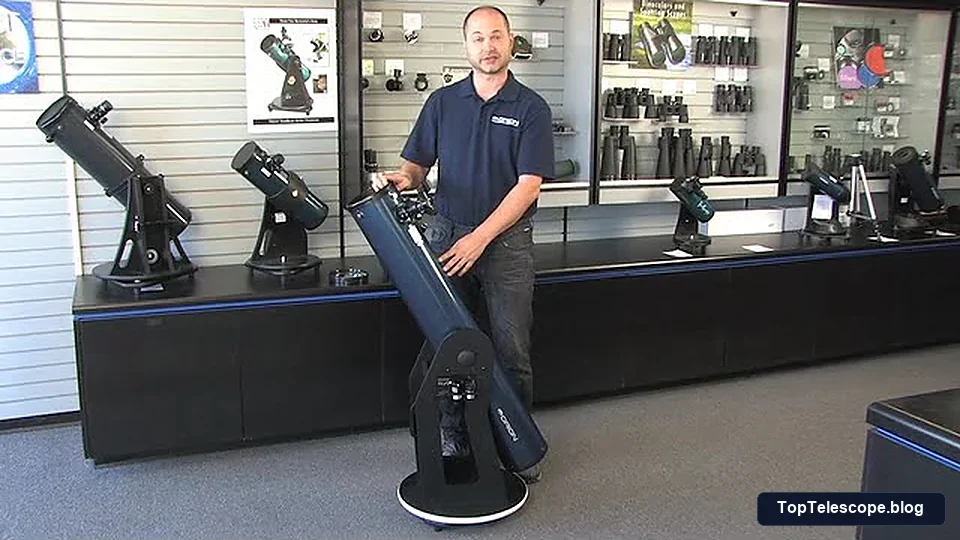
The particle board rocker box utilizes Corban and Teflon bearing pads. This proprietary CorrecTension friction system allows users to customize azimuth and altitude resistance.
The rotational base utilizes a teflon bearing pad system coupled with laminate particle board surfaces to ensure smooth azimuth movement without jerky stiction transitions.
- Teflon bearing pads ensure smooth motion.
- Adjustable altitude tension clutch knobs.
- Stable tripod-free wooden footprint.
- Altitude tension can be adjusted manually via large ergonomic knobs that apply uniform friction against the trunnion bearings to balance heavy accessories.
Ergonomic Friction Tuning and Balance
Proper altitude balance is achieved when adding heavy oculars by adjusting the optical tube position within the mounting ring clamps to prevent nose-heavy drooping.
- Azimuth motion remains extremely smooth thanks to the central PTFE pad placement directly underneath the heavy-duty ground board center pivot fastener.
Assembly, Alignment, and Field Portability
Transporting the system involves separating the optical tube from the heavy wooden base. While manageable for most adults, the combined weight requires deliberate lifting technique.
Field portability requires handling two distinct components, with the optical tube weighing roughly twenty pounds and the particle board base adding considerable bulk.
- Convenient two-piece transport design.
- Quick spring-clip finder scope mounting.
- Simple collimation cap included standard.
- Collimation must be checked prior to every observing session using a cheshire eyepiece or laser tool to guarantee pinpoint stellar images at high magnifications.
Transport Logistics and Collimation Routines
Transporting the equipment safely demands secure positioning across vehicle backseats to prevent sliding impacts that could knock the primary mirror out of alignment.
- Adjusting the primary mirror tilt screws requires turning the spring-loaded thumbscrews while observing artificial star diffraction patterns for optimal optical collimation.
Maintenance Protocols and Long-Term Durability
Periodic mirror cleaning demands careful adherence to standard optical maintenance protocols. Keeping mirror coatings dust-free preserves maximum light transmission efficiency over decades of heavy usage.
Long-term durability depends on routine cleaning protocols that avoid scratching the delicate mirror coatings during dust removal sessions conducted in controlled environments.
- Dust cap protection for primary mirror.
- Rear cell ventilation prevents moisture pooling.
- Annual collimation check recommended.
- Storing the optical tube upright with dust caps securely fitted prevents airborne particulate accumulation on reflective surfaces between infrequent deep-sky observing runs.
Optical Cleaning and Mechanical Upkeep
Cleaning optical surfaces requires distilled water rinses mixed with photoflo solution to lift organic residues without leaving mineral streaks across the primary parabolic mirror.
- Lubricating the mechanical focuser drawtube with synthetic lithium grease ensures continued smooth operation across freezing winter observing temperatures without freezing up.
Definitive Buyer Verdict and Target Audience Fit
Beginners desiring hands-on astronomy skills often consult our best telescope selections to find tremendous value in this classic Newtonian setup, appreciating its dependable optical performance under dark suburban skies.
Definitive audience fit centers on beginner and intermediate astronomers seeking maximum light grasp without complicated equatorial mount setup procedures or complex electronic alignment routines.
- Ideal platform for dark-site travel.
- Exceptional educational telescope value.
- Strong secondary market resale value.
- Users desiring automated GoTo tracking should look elsewhere, as this manual Dobsonian relies entirely on star-hopping navigation skills and manual chart reading.
Final Target Audience Suitability Analysis
Evaluating overall value highlights the exceptional aperture-per-dollar ratio delivered by this classic Newtonian design configured for pure visual astronomy enthusiasts worldwide.
- Anyone prioritizing raw optical performance for lunar, planetary, and deep-sky viewing will find this instrument meets rigorous technical expectations for field reliability.
Frequently Asked Questions
Does the SkyQuest XT6 require frequent collimation?
Optical alignment holds quite well under normal transport conditions. You should verify primary mirror alignment before every observing session using a simple collimation cap.
Can I mount this optical tube on an equatorial tripod?
The heavy tube weighs around eighteen pounds and features standard ring mounting provisions. However, equatorial rings require a heavy-duty pier setup to manage leverage safely.
What eyepieces come standard with this telescope package?
Standard inclusions usually feature basic Plossl designs offering moderate magnifications. Upgrading to wide-field oculars significantly enhances your overall visual field immersion.
Is this telescope suitable for astrophotography of deep-sky objects?
Long-exposure imaging requires motorized tracking mounts which manual Dobsonians lack entirely. You can capture bright lunar targets using short smartphone video clips.
How heavy is the complete telescope assembly when combined?
The total weight reaches approximately thirty-eight pounds distributed between two manageable pieces. Most users can easily transport the setup to backyard viewing locations.