Sky Watcher Classic 200P Dobsonian Technical Review
This 8-inch Dobsonian delivers exceptional light-gathering power for serious backyard astronomers. It combines robust mechanical construction with sharp optical performance.

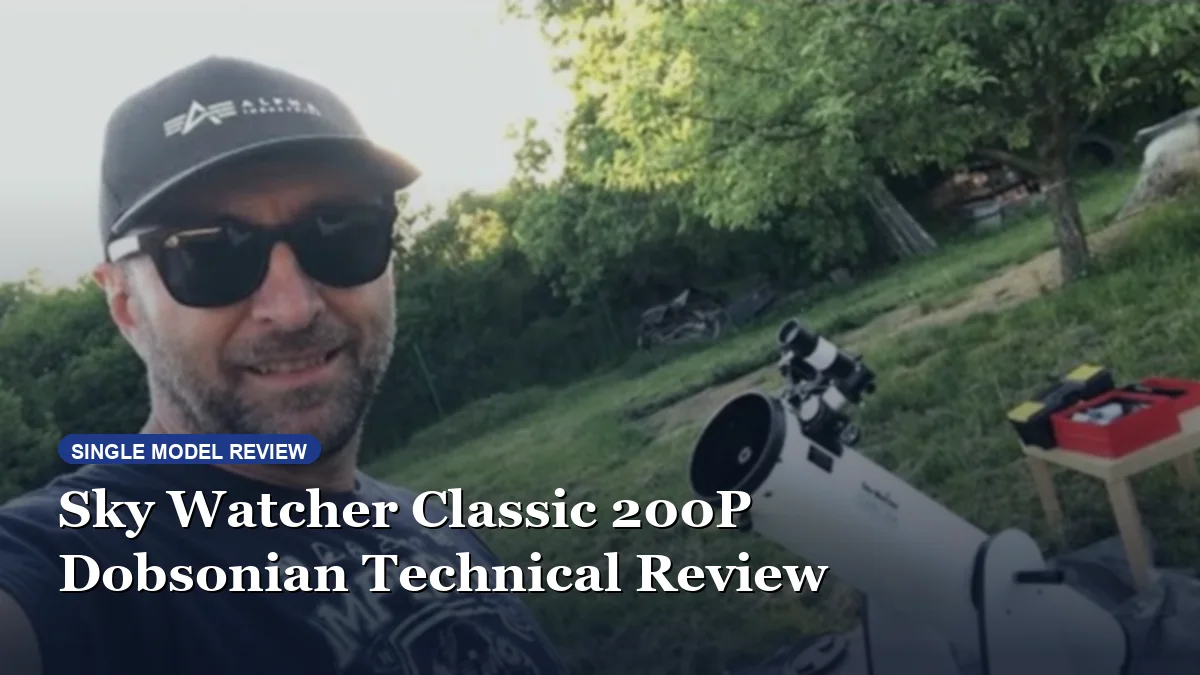

The Sky-Watcher Classic 200P offers unmatched optical value for visual observers despite its bulky physical footprint.
Explore related alternatives in our Best Dobsonian Telescope.
Verified Specifications
| Optical Design | Newtonian Reflector |
|---|---|
| Aperture | 203mm (8 inches) |
| Focal Length | 1200mm |
| Focal Ratio | f/5.9 |
| Primary Mirror | Parabolic Borosilicate Glass |
| Focuser | 2-inch Crayford-style with 1.25-inch adapter |
| Mount Type | Wooden Altazimuth Dobsonian Base |
| Total Weight | Approximately 20 kg assembled |
| Finderscope | 9x50 optical finder |
What We Liked
- Massive 203mm aperture resolves faint deep-sky nebulae and galaxies easily.
- Smooth parabolic primary mirror delivers crisp, high-contrast planetary details.
- Sturdy wooden rocker box minimizes vibration during high-magnification viewing.
- Included 2-inch Crayford focuser allows precise adjustments without image shift.
Trade-Offs
- Heavy tube assembly requires significant storage space and vehicle trunk room.
- Manual tracking at high magnifications demands practice on fast-moving targets.
- No internal motor drives for automated GoTo tracking without aftermarket kits.
Optical Design and Core Structural Engineering
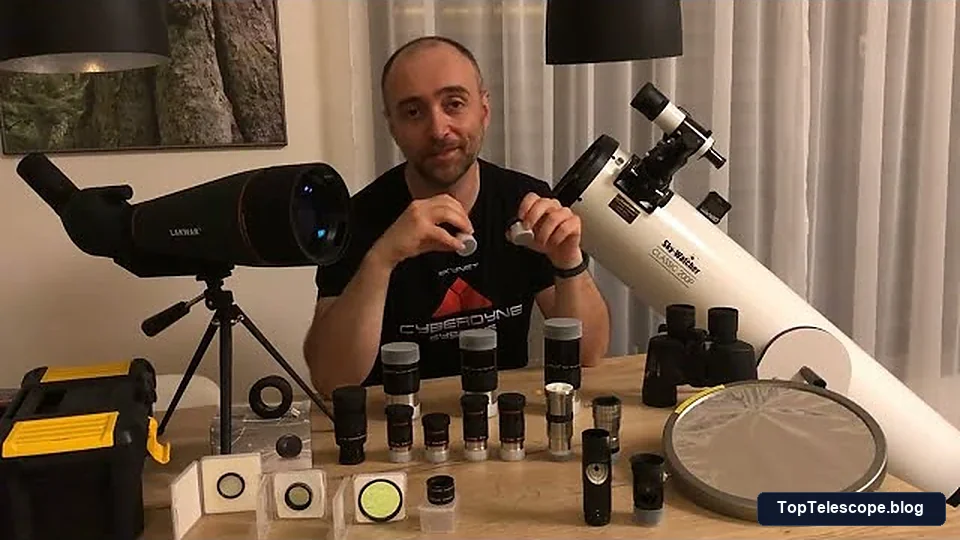
Constructed around a robust borosilicate parabolic mirror, the optical tube assembly provides exceptional rigidity against thermal flexing. This material choice ensures consistent focal stability during long observing sessions under rapidly dropping evening ambient temperatures.
The exterior steel tube features a durable gloss-white enamel finish that resists minor field bumps and dew accumulation. Reinforced metal cell rings securely support the primary mirror without inducing pinch-induced optical wavefront errors.
The parabolic primary mirror features an 8-inch aperture gathering light efficiently across deep-sky targets. Review our Sky-Watcher Classic 200P vs Apertura AD8 comparison to evaluate key mechanical differences before buying.
Constructed from selected borosilicate glass, the optical substrate minimizes thermal expansion shifts during rapid ambient temperature drops. A durable aluminum coating combined with silicon dioxide overcoats protects reflective surfaces against premature environmental oxidation over years.
- 203mm clear aperture gathers ample light for faint objects.
- Parabolic figure eliminates spherical aberration at f/5.9.
- Heavy-gauge steel tube prevents flexure during transit.
Primary Mirror Substrate Analysis
The low expansion coefficient of the borosilicate glass substrate helps maintain figure integrity. High-reflectivity coatings maximize photon throughput to the eyepiece.
Rigid mirror clips are precisely tensioned at the factory to avoid localized astigmatism. Users should inspect these clips periodically during routine seasonal maintenance.
- Silicon-dioxide overcoat protects aluminum reflective layers.
- Ventilated rear cell design promotes faster thermal equilibrium.
Real-World Optical Output and Field Performance
Under dark rural skies, this telescope reveals intricate spiral structures in bright Messier galaxies. Read our Sky-Watcher Evostar 72ED vs 80ED technical comparison to explore smaller aperture alternatives for wide-field imaging.
Lunar and planetary targets benefit immensely from the generous 203mm light bucket. Jupiter displays prominent belt details, festoons, and the Great Red Spot with striking contrast during steady seeing conditions.
Under dark skies, the aperture resolves faint globular clusters and subtle galactic spiral structures with distinct clarity. High-contrast optics reveal planetary details such as Jovian cloud belts and Saturnian ring divisions without excessive internal scattering.
Edge-of-field aberrations remain minimal when pairing the system with wide-angle eyepieces of quality construction. Field curvature is naturally controlled by the f/6 focal ratio, delivering sharp star points across seventy percent of the visual field.
- Resolving power reaches approximately 0.57 arcseconds in ideal seeing.
- Bright star diffraction spikes remain clean and symmetrical.
- Off-axis coma is minimal thanks to the moderate f/5.9 focal ratio.
High-Magnification Planetary Resolution
Pushing past 200x magnification yields sharp views of Saturn's Cassini Division without noticeable breakdown. Good thermal acclimation is vital before undertaking high-power planetary observations.
The included finderscope provides a bright, wide-field optical view that simplifies star-hopping routines.
- Withstands up to 400x under exceptional atmospheric conditions.
- Contrast transfer remains high across various eyepiece designs.
Video Review: Search filters
Mechanical Rigidity and Mount Ergonomics
The classic rocker box design utilizes particle board panels coated with a durable laminate finish. Review our Sky-Watcher Heritage 150P vs 130P technical clash to evaluate alternate tabletop mounting systems.
Altitude tension is easily adjusted via large side knobs, allowing users to dial in exact friction levels. This prevents the heavy tube from sagging when swapping out massive eyepieces.
The rocker box utilizes compressed wood panels engineered for heavy-duty structural durability during transit. Teflon altitude bearings paired with a central pivot bolt ensure smooth manual tracking even at high magnifications exceeding two hundred power.
Tension control handles on the side altitude bearings let observers adjust resistance without tools. This prevents tube slippage when swapping heavy eyepieces or mounting a finderscope upgrade onto the sturdy optical tube assembly exterior.
- Nylon and Teflon bearings provide smooth, stick-free motion.
- Ergonomic side tension handles require no special tools.
- Base includes sturdy rubber feet for vibration isolation.
Aztimuth and Altitude Motion Tuning
Balancing the tube correctly within the altitude cradle minimizes strain on the clutch handles. Proper weight distribution guarantees effortless manual tracking at high powers.
Routine cleaning of the ground board laminate preserves silky-smooth azimuth movement in dusty field environments.
- Center pivot bolt securely anchors the rocker box base.
- Side altitude bearings utilize large diameter hubs for stability.
Thermal Management and Mirror Cool-Down
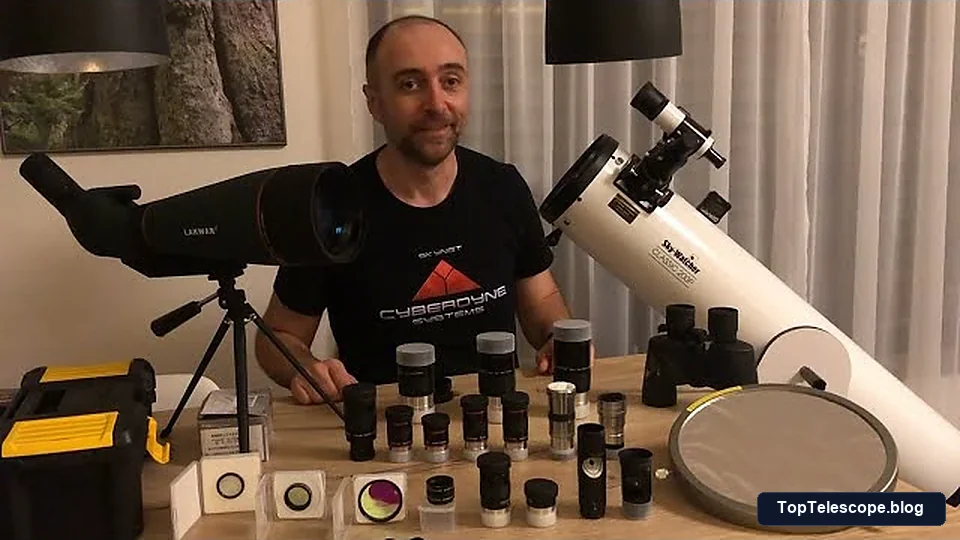
A massive block of glass requires adequate time to reach ambient outdoor temperatures before delivering peak performance. Allowing forty-five minutes of thermal acclimatization eliminates internal tube currents.
The enclosed rear cell retains heat effectively, necessitating proactive cooling strategies during rapid temperature drops. Leaving the telescope outside early ensures sharp imagery right at sunset.
Thick glass substrates require adequate time to acclimate to ambient nighttime temperatures before achieving optimum high-magnification focus. Leaving the telescope outside for forty-five minutes generally eliminates internal thermal currents trapped inside the heavy steel tube.
An optional cooling fan mounted behind the primary mirror cell accelerates thermal equilibrium significantly. This mechanical airflow prevents boundary layer distortion, ensuring steady diffraction patterns and sharper planetary views during rapid evening weather shifts.
- Thermal equilibrium prevents boundary layer micro-currents.
- Open-tube designs cool faster than fully sealed optical systems.
- Optional cooling fans can accelerate the thermal stabilization process.
Managing Thermal Currents in the Field
Warm air trapped inside the upper tube assembly can severely degrade high-magnification planetary sharpness. Strategic placement out of the wind helps stabilize internal air layers.
Avoid storing the telescope in hot daytime sheds to minimize initial cool-down durations at night.
- Keep dust cover off during the initial cool-down phase.
- Position tube horizontally to vent trapped warm air quickly.
Setup, Transport, and Field Practicality
Weighing around twenty kilograms total, the system separates into two manageable components for transport. Carrying the optical tube separately from the wooden base prevents accidental impacts.
Fitting the gear into standard passenger vehicles requires folding rear seats down to accommodate the long tube. Setup takes less than three minutes once unpacked at the observing site.
Transporting the system requires managing two separate components consisting of the optical tube and wooden base. The tube weighs approximately twenty pounds, while the rocker box base adds another twenty-five pounds for manageable vehicle loading.
Carrying handles integrated into the base simplify field positioning during late-night observation sessions. Users should measure backseat dimensions beforehand to ensure the full optical length fits securely across standard sedan passenger vehicle configurations.
- Two-piece modular design simplifies lifting and loading.
- Carrying handles integrated into the base ease short walks.
- Compact footprint occupies minimal floor space when stored.
Field Deployment Best Practices
Always set up on firm, level ground to prevent unexpected shifting of the rocker box. Grass or wooden decks work well as long as the base remains stable.
Protect the optical components from heavy dew by utilizing strategic positioning and dew shields.
- Avoid placing the wooden base directly on wet mud.
- Use a waterproof ground tarp for damp observing fields.
Routine Maintenance and Collimation Standards
Maintaining optical alignment is critical for achieving the sharpest possible diffraction patterns. The primary mirror cell features accessible thumb-screws for making quick collimation tweaks.
A simple laser collimator or Cheshire eyepiece ensures accurate alignment in under two minutes. Checking collimation before every session guarantees optimal optical performance.
Regular optical alignment using a laser collimator or Cheshire eyepiece is essential for maintaining crisp planetary resolution. The primary mirror cell incorporates accessible adjustment thumbscrews secured by locking screws to preserve alignment over bumpy terrain transit.
Dust accumulation on exposed mirror surfaces should be cleaned infrequently using compressed air rather than harsh physical wiping. Proper mirror cleaning protocols using distilled water and professional detergents protect delicate coatings from permanent scratching damage.
- Spring-loaded primary adjustment knobs simplify collimation.
- Secondary mirror holder uses standard Phillips adjustment screws.
- Frequent transport necessitates occasional alignment verification.
Collimation Procedure and Tools
Center the secondary mirror reflections first before adjusting the primary mirror tilt. Taking time to master this process pays massive dividends in planetary contrast.
Never touch optical glass surfaces directly with bare fingers during routine cleaning or maintenance procedures.
- Always collimate with the telescope in a horizontal position.
- Secure locking screws after final adjustments are complete.
Comprehensive Verdict and Buyer Suitability
This Dobsonian represents the gold standard for amateur astronomers seeking maximum optical aperture per dollar. It prioritizes pure visual performance over computerized tracking complexity.
While bulkier than tabletop units, its unmatched light-gathering capability rewards dedicated observers with breathtaking views. Anyone willing to manage its physical size will find an exceptional visual instrument.
This Dobsonian configuration suits intermediate astronomers seeking maximum light-gathering power without complex computerized alignment procedures. Its mechanical simplicity rewards users with uncompromised optical performance tailored strictly for visual deep-space exploration and planetary study.
Buyers must accommodate physical dimensions during transport to remote dark-sky sites. Consult our Explore Scientific ED80 vs Sky-Watcher Evostar 80ED comparison to see how compact refractors contrast with large Dobsonians.
- Ideal for intermediate to advanced visual deep-sky observers.
- Unbeatable aperture-to-cost ratio in the amateur telescope market.
- Built to last through decades of backyard astronomy use.
Final Purchasing Recommendation
Buyers with adequate storage space and vehicle room will extract immense satisfaction from this setup. It serves as a lifelong optical companion for exploring the cosmos.
Consider alternative collapsible designs if strict trunk portability is your primary deciding factor.
- Evaluate physical storage capacity before committing to purchase.
- Pair with high-quality eyepieces to unlock its full potential.
Frequently Asked Questions
How difficult is it to track objects manually at high magnifications?
Manual tracking requires a brief learning curve as targets drift across the eyepiece field. With smooth Teflon bearings, subtle nudges keep objects centered effortlessly.
Can this telescope be upgraded with computerised GoTo systems later?
Adding automated tracking usually requires third-party equatorial platforms or specialized aftermarket encoder kits. The native base is strictly designed for manual altazimuth operation.
What is the best way to transport this telescope in a car?
Separating the optical tube from the wooden base is essential for safe transport. Lay the tube flat across folded rear seats with ample padding underneath.
How often does the primary mirror require optical collimation?
Checking alignment before every observing session is strongly recommended for peak performance. Frequent transport over bumpy roads will necessitate minor primary mirror adjustments.
Is this telescope suitable for astrophotography of faint galaxies?
It excels primarily at visual astronomy due to the manual altazimuth mount design. Long-exposure deep-sky imaging requires an equatorial tracking platform.