Redcat 71 Review: Technical Optical Performance Analysis
This high-end apochromatic astrograph delivers stunning flat-field stellar imaging across large camera sensors. Its integrated Petzval optical design eliminates traditional backfocus spacing headaches entirely.

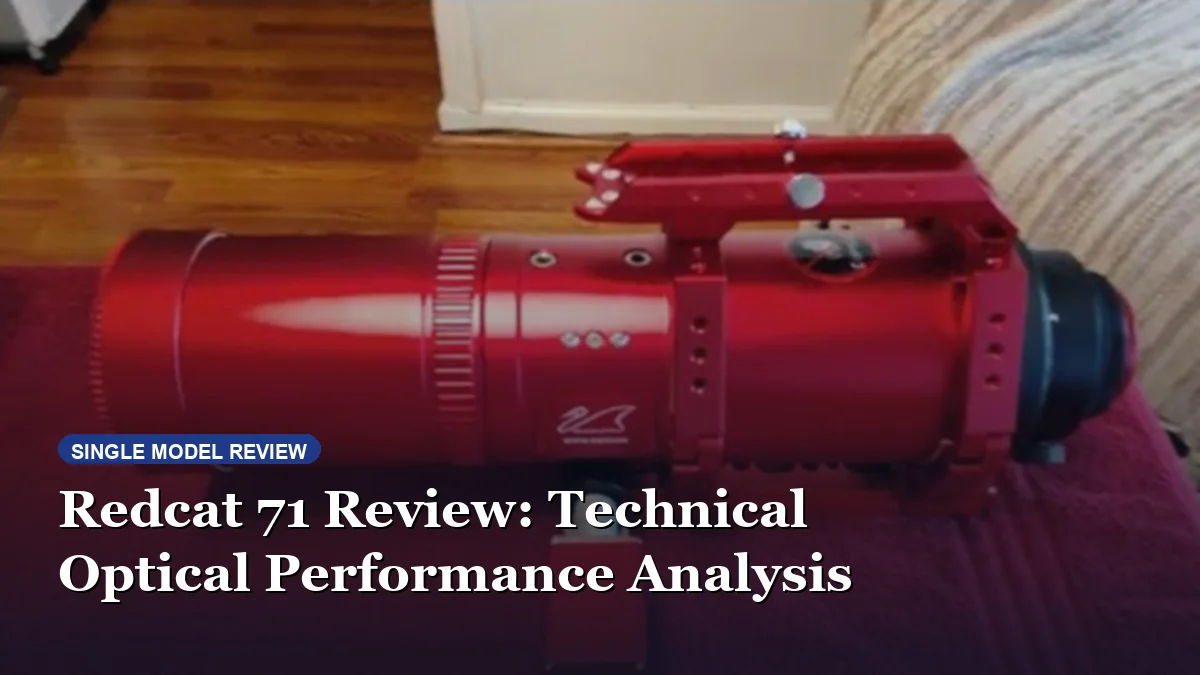

The Redcat 71 excels at delivering pin-sharp stars across APS-C sensors with zero optical distortion. Integrated camera tilting and robust mechanical build quality justify its premium standing among field imagers.
Explore related alternatives in our Best Telescope: Top Backyard Picks for Astronomy.
Verified Specifications
| Optical Design | Petzval Apochromatic Triplet |
|---|---|
| Aperture | 71mm |
| Focal Length | 350mm |
| Focal Ratio | f/4.9 |
| Glass Material | FPL-53 Synthetic Fluorite |
| Image Circle | Full Frame (45mm) |
| Focuser Type | Helical with M48/M56 adapter |
| OTA Weight | 2.9 kg (6.4 lbs) |
| Mounting Ring | Vixen-style dovetail with handle |
What We Liked
- Built-in flattener delivers a truly flat 45mm image circle.
- FPL-53 glass eliminates chromatic aberration across broadband spectra.
- Compact, highly portable physical footprint for field travel.
- Innovative internal camera tilter simplifies optical train alignment.
- Patented finder/guide scope saddle integrated into the mounting ring.
Trade-Offs
- Helical focuser requires a learning curve for fine adjustments.
- Fixed focal length restricts planetary or high-magnification visual work.
- M48 connection limits larger custom heavy-duty camera rotators.
Optical Architecture and Glass Quality
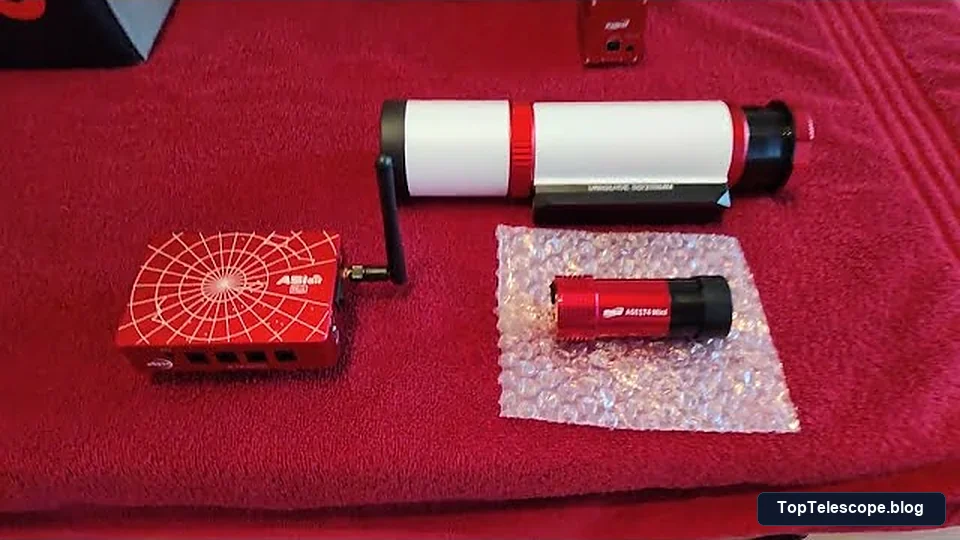
The Redcat 71 utilizes a sophisticated four-element Petzval design featuring premium synthetic fluorite glass. This configuration ensures exceptional color correction and eliminates annoying chromatic aberration across broad imaging spectra.
By incorporating FPL-53 optical elements, the telescope achieves remarkable contrast levels. You can discover more top-tier options within our best telescope guide for advanced backyard stargazing sessions.
- Four-element optical layout
- Synthetic FPL-53 glass material
- Zero secondary chromatic aberration
FPL-53 Glass Performance
Synthetic fluorite elements drastically reduce secondary spectrum dispersion compared to standard crown glasses. Color purity remains pristine even when imaging high-contrast stellar targets during long exposures.
Star colors render naturally without requiring aggressive digital post-processing steps to fix fringing. Advanced broadband coatings maximize light transmission across the entire visible spectrum efficiently.
- Low dispersion fluorite elements
- Enhanced broadband light transmission
Petzval Field Correction
The internal four-element configuration places corrector lenses strategically inside the main optical tube assembly. Internal field flattening removes curvature entirely without messing up camera sensor spacing tolerances.
Users save considerable setup time by avoiding tedious backfocus distance measurements with digital calipers. Optimal field flatness is guaranteed right out of the box for all compatible cameras.
- Internal corrector lens placement
- Zero backfocus spacer required
Mechanical Build and Ergonomic Design
Precision CNC machining defines the exterior chassis, protecting delicate internal optics. For more insights, check out our redcat 51 comparison featuring alternative astrograph systems.
An integrated mounting ring includes a built-in saddle for guide scopes, reducing accessory clutter. This clever structural choice improves overall balance on standard equatorial mounts without adding excess weight.
- Rugged CNC-machined aluminum body
- Corrosion-resistant anodized red coating
- Built-in Vixen-style mounting plate
CNC Machining Quality
Aerospace-grade aluminum alloys provide exceptional structural rigidity without adding unnecessary physical mass. Tough anodized surfaces resist scratches and minor impacts encountered during frequent field deployment routines.
Every threaded port and mounting point exhibits tight tolerances for secure accessory attachment. Mechanical integrity remains uncompromised even under heavy accessory loads during extended tracking sessions.
- Aerospace-grade aluminum chassis
- Tight accessory port tolerances
Integrated Mounting Features
The multi-function saddle accepts standard finder brackets and guide scopes directly without adapters. Streamlined handling prevents snagging cables and simplifies field assembly under dark-sky conditions.
A Vixen-style dovetail plate secures the optical tube firmly to most equatorial tracking mounts. Balanced weight distribution reduces strain on right ascension and declination gear drives significantly.
- Built-in guide scope saddle
- Vixen dovetail integration
Video Review: William Optics REDCAT 71 (first light!)
Real-World Astrophotography Performance
Delivering a flat 45mm image circle, this astrograph effortlessly covers modern full-frame sensors without edge distortion. Stars remain pinpoint pinpricks right into the extreme corners of large CMOS detectors.
Wide-field targets like the Orion Nebula or Andromeda Galaxy reveal stunning structural detail and rich gas clouds. The fast f/4.9 focal ratio drastically reduces required sub-exposure integration times in dark skies.
- True full-frame sensor coverage
- Fast f/4.9 photographic speed
- Pinpoint corner-to-corner star shapes
Full-Frame Sensor Coverage
Large digital sensors capture expansive cosmic landscapes without vignetting darkening the corner pixels. Corner star shapes remain sharp and round across the entire forty-five millimeter imaging circle.
Astrophotographers enjoy seamless image stitching and mosaic creation without troublesome optical aberrations. High-resolution imaging becomes effortless when paired with modern low-noise CMOS camera systems.
- Full 45mm illuminated circle
- Edge-to-edge star sharpness
Fast Focal Ratio Efficiency
The rapid focal ratio gathers faint photons much faster than traditional slower refractor designs. Shorter exposure times minimize tracking error risks and atmospheric turbulence impacts on images.
Imaging faint narrowband structures becomes significantly more practical during short summer nights. Higher photon collection rates boost overall signal-to-noise ratios across every stacked master integration frame.
- Rapid f/4.9 optical speed
- Enhanced signal-to-noise ratio
Focuser Precision and Operational Workflow
The smooth helical focuser uses a patented internal tension ring design to secure heavy camera payloads. Adjustments feel precise, though users accustomed to traditional rack-and-pinion knobs require some adaptation.
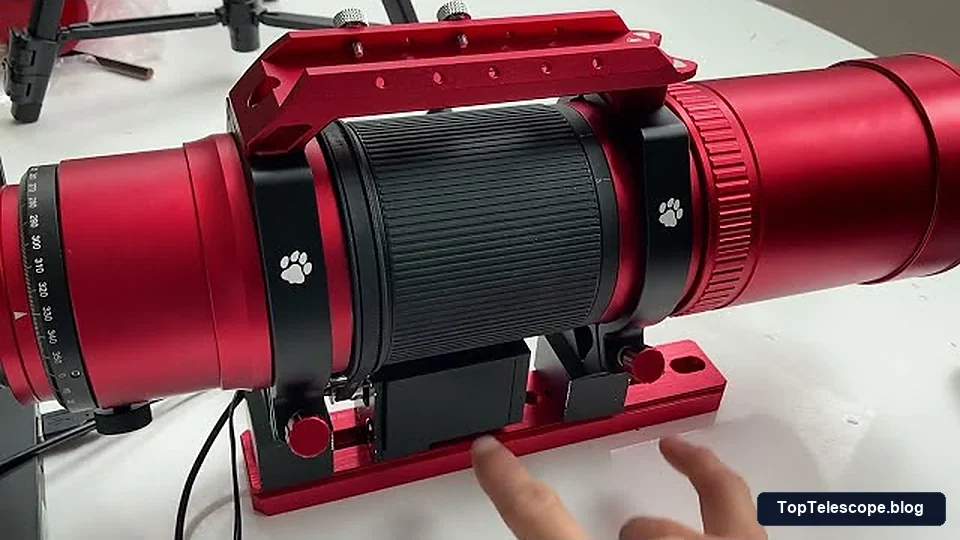
A built-in rotational ring allows effortless framing adjustments without loosening threaded camera connections. This feature prevents unwanted cable snags and maintains proper optical train alignment during multi-hour framing sessions.
- Friction-based helical focusing ring
- Integrated camera rotation mechanism
- Heavy payload bearing capacity
Helical Focus Operation
Friction-based focusing relies on a smooth rotating collar rather than external gear teeth. Tension locking screws prevent accidental slippage once the optimal focus point is accurately found.
Micro-adjustments require a steady hand to achieve critical focus on faint deep-sky targets. Absolute stability locks the focus position firmly in place throughout temperature fluctuations.
- Rotating collar adjustment
- Secure tension locking screws
Camera Rotation System
The integrated rotator ring lets users reframe celestial targets without unscrewing image trains. Cable management improves dramatically since USB and power wires rotate smoothly alongside the camera.
Smooth ball-bearing rotation prevents image tilt and mechanical shifting during framing tweaks. Precise alignment stays intact across multiple orientation changes throughout long imaging sessions.
- Integrated camera rotator
- Ball-bearing rotation smoothness
Thermal Stability and Environmental Efficiency
Rapid temperature acclimation is crucial for maintaining sharp focus during sudden evening ambient drops. The aluminum tube assembly contracts uniformly, preserving optical alignment under shifting outdoor weather conditions.
Dew accumulation remains a common challenge during long overnight imaging sessions in humid climates. Users should pair this optical tube with an active dew heater strip for uninterrupted operational reliability.
- Uniform thermal contraction rates
- Fast ambient temperature stabilization
- Compatibility with standard dew strips
Temperature Acclimation
Metal optical tubes require time to reach thermal equilibrium with ambient outdoor air. Fast cooling times prevent internal air currents from degrading planetary or stellar image sharpness.
Consistent thermal behavior minimizes focus drift during the coldest hours of the night. Stable glass elements maintain critical optical tolerances despite dropping environmental temperatures.
- Uniform tube contraction
- Minimized focus thermal drift
Dew Mitigation Strategies
High humidity nights threaten objective lenses with moisture condensation that ruins exposures. Dew shields offer initial protection, but active heating strips ensure completely fog-free operating sessions.
Wrapping a flexible heater band around the dew shield maintains safe glass temperatures. Uninterrupted imaging continues safely through heavy morning dew conditions without data loss.
- Retractable dew shield
- Active heater band compatibility
Setup, Transport, and Long-Term Durability
Weighing under three kilograms, the optical tube fits easily into standard airline carry-on luggage. The included padded canvas case provides exceptional protection against shocks during bumpy transit to remote dark-sky sites.
Routine maintenance requires only basic cleaning of the outer doublet surfaces using optical-grade microfiber cloths. Robust mechanical tolerances ensure long-term collimation stability despite frequent travel and field deployment.
- Airline carry-on friendly dimensions
- Heavy-duty padded transport case
- Maintains collimation through transit
Travel Portability
Compact dimensions make this astrograph an ideal travel companion for expeditions. Airline carry-on compliance is further detailed in our spacecat comparison guide for mobile astrophotographers.
Lightweight build characteristics prevent undue strain on portable lightweight star tracker mounts. Field mobility opens up access to pristine dark-sky locations far away from urban light pollution.
- Lightweight travel footprint
- Overhead bin compatibility
Maintenance and Care
Keeping exposed glass clean requires specialized optical cleaning solutions and gentle microfiber cloths. Regular dust removal preserves broadband coating integrity over years of heavy field use.
Mechanical joints and tension screws benefit from occasional inspection to ensure tight operation. Long-term durability remains exceptionally high due to premium corrosion-resistant material selections.
- Simple optical cleaning routine
- Corrosion-resistant materials
Comparative Market Position and Final Verdict
Competing directly with high-end portable astrographs, this model stands out for its integrated Petzval corrector. Zero backfocus calculation requirements make it exceptionally user-friendly for intermediate and advanced astrophotographers alike.
While the fixed focal length limits planetary close-ups, wide-field celestial imaging capabilities remain peerless. Anyone seeking an uncompromising travel-friendly imaging scope will find this instrument delivers extraordinary professional results.
- No backfocus spacing required
- Superior travel-friendly astrograph design
- Exceptional wide-field imaging results
Market Competitiveness
Premium optical instruments command higher budgets based on engineering complexity and glass quality. Unmatched convenience justifies the investment for imagers seeking hassle-free optical train setups.
Competing doublet scopes require separate field flatteners and precise spacer rings. Integrated design principles are also highlighted in our best starter telescope roundup for beginners.
- Integrated optical workflow
- High-end engineering standards
Final Buying Recommendations
Serious wide-field astrophotographers will find this portable astrograph an indispensable imaging tool. Professional results await anyone willing to invest in high-grade transportable optical systems.
Beginners should note the fixed focal length before committing to deep-sky photography. Ultimate portability makes it a top-tier choice for mobile astrophotography enthusiasts.
- Ideal for mobile imagers
- Uncompromising optical clarity
Frequently Asked Questions
Does the Redcat 71 require a field flattener?
No external field flattener is ever required because the optical tube incorporates a sophisticated built-in Petzval design that handles all necessary field correction completely internally during exposures.
This integrated lens layout guarantees a pristine, distortion-free image circle reaching right out to your camera's extreme corners without ever requiring complex mathematical backfocus spacer calculations.
What sensors are fully compatible with this telescope?
The advanced optical design easily covers modern full-frame digital sensors while providing extraordinary illumination and pristine sharpness across the entire photographic focal plane.
Larger camera chips benefit immensely from this expansive forty-five millimeter image circle without experiencing any noticeable mechanical vignetting or corner degradation during long deep-sky imaging sessions.
How do you adjust focus on the helical focuser?
Focusing relies on an exceptionally smooth helical ring mechanism equipped with an internal tension lock to secure heavy imaging equipment safely during tracking.
Fine adjustments require careful manual turning of the ribbed mechanical ring, which completely replaces traditional rack-and-pinion knobs to ensure maximum streamlined field portability.
Is this telescope suitable for airline travel?
Weighing under three kilograms with a remarkably compact physical tube length, it fits effortlessly into standard airline overhead luggage compartments.
The included padded case safeguards the delicate optical components against aggressive transit handling while remaining extremely portable for remote dark-sky field excursions.
Can I attach a guide scope easily?
A clever multi-functional mounting ring features a built-in dovetail saddle specifically engineered for mounting small guide scopes securely. This smart mechanical integration completely eliminates the need for extra mounting brackets while keeping your overall imaging rig balanced and lightweight.