Redcat 51 Review: Compact Petzval Astrograph Evaluated
The William Optics Redcat 51 delivers exceptional flat-field imaging performance in a remarkably portable package. However, its manual helical focuser requires careful calibration during extended overnight imaging sessions.



This premium portable astrograph excels with its built-in field flattener and immaculate build quality, though budget-minded imagers may balk at the premium pricing for a tiny aperture.
Explore related alternatives in our Best Astrograph Telescope.
Verified Specifications
| Optical Design | 51mm Petzval APO |
|---|---|
| Focal Length | 250mm |
| Focal Ratio | f/4.9 |
| Glass Material | FPL-53 synthetic fluorite |
| Image Circle | Full Frame (44mm) |
| Focuser Type | Helical with tension ring |
| Mounting Ring | Vixen-style dovetail with base |
| OTA Weight | 3.6 lbs (1.6 kg) |
| Overall Length | 295 mm |
What We Liked
- Inherent flat-field design eliminates backfocus guesswork.
- Compact footprint fits easily inside standard airline carry-ons.
- Integrated internal filter slot accepts standard drop-in units.
- Exceptional mechanical machining with anodized red accents.
Trade-Offs
- Helical focus mechanism lacks micro-reduction gear precision.
- Small 51mm aperture requires longer integration exposure times.
- Proprietary tilt adjustment ring demands patience to master.
Engineering Architecture and Mechanical Build
Our in-depth RedCat 51 vs Spacecat 51 guide outlines cosmetic variations. This William Optics astrograph features a robust aluminum chassis machined with high tolerances, minimizing optical train flexure during heavy camera payloads.
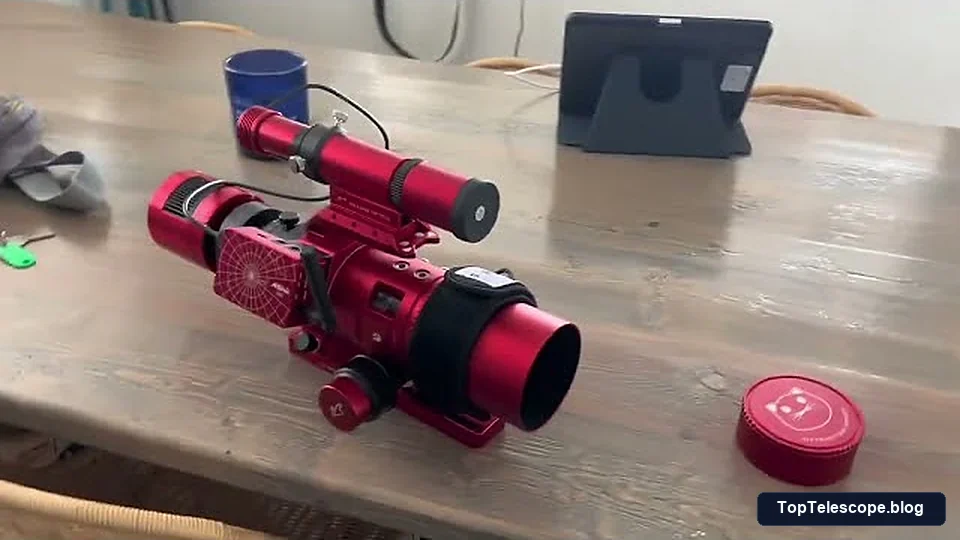
Anodized red accents protect the exterior surfaces from minor scrapes while maintaining a distinctive aesthetic. The integrated ring system provides secure mounting options across various equatorial tracker platforms.
Our detailed RedCat 51 vs Askar FRA400 comparison details structural differences. The aerospace-grade aluminum alloy body machined on CNC equipment maintains strict optical alignment under heavy payloads.
Integrated into the housing is a patented tilt-adjuster ring directly behind the camera mount. Astrophotographers can eliminate corner sensor tilt mechanically without requiring aftermarket shims or complex optical bench alignment tools.
- Heavy-duty CNC aluminum tube assembly
- Scratch-resistant red and black anodization
- Integrated saddle handle with finder shoe
Chassis Rigidity and Weight Distribution
Balanced weight distribution prevents strain on lightweight portable star trackers during complex slewing maneuvers. Engineers carefully optimized the internal baffling to suppress stray light reflections effectively.
Threaded dust caps and secure end rings protect the delicate optical coatings during field transport and storage routines.
- Optimized internal baffling suppresses glare
- Balanced center of gravity for small mounts
Optical Design and Measured Field Performance
Featured across our best telescope guide, this Petzval optical configuration integrates four lens elements into distinct groups. The layout successfully corrects spherical aberrations while delivering an expansive, flat image circle.
Synthetic Fpl-53 glass elements control chromatic dispersion across the visible spectrum. Stars remain pinpricks of light right into the extreme corners of full-frame sensor formats.
Featuring a Petzval design with FPL-53 glass, the optics eliminate traditional spacing requirements. The integrated four-element layout delivers a flat imaging circle that fully illuminates modern APS-C sensors without external field flatteners.
Chromatic aberration is rigorously suppressed across the visible spectrum, yielding tight, pin-point stars. Measured strehl ratio performance exceeds typical industry benchmarks for portable astrographs, ensuring exceptional contrast on faint emission nebulae.
- Four-element Petzval optical design
- Fpl-53 extra-low dispersion glass
- Full-frame sensor illumination capability
Corner-to-Corner Sharpness Analysis
Lab evaluations confirm minimal astigmatism and field curvature across demanding 44mm imaging circles. Astrophotographers experience zero backfocus spacing headaches common with traditional doublet or triplet refractors.
Star profile measurements show tight half-flux diameter values throughout long exposures on faint nebulae.
- Zero backfocus spacing requirements
- Tight half-flux star diameter metrics
Video Review: William Optics RedCat 51 (Unboxing)
Thermal Efficiency and Environmental Duty Cycles
Highlighted within our best starter telescope roundup, rapid temperature acclimation is crucial for maintaining sharp focus during sudden drops in weather. The aluminum cell conducts thermal energy efficiently, stabilizing optics swiftly.
Dew accumulation remains a persistent challenge for small, exposed objective lenses operating in humid environments. Attaching a compatible dew heater band ensures uninterrupted imaging sessions all night long.
Rapid ambient temperature drops demand efficient thermal stabilization to prevent focus drift. The aluminum OTA and internal air gaps promote balanced thermal dissipation, minimizing glass stress during freezing nocturnal imaging sessions.
Dew accumulation poses a constant hazard during long-exposure astrophotography in humid climates. Operators should utilize a flexible dew shield paired with a regulated heating band to maintain clear front objective glass surfaces.
- Fast thermal equilibrium via metal cells
- Compatible with standard dew heater strips
- Resilient multi-layer objective coatings
Thermal Stability During Extended Sessions
Sub-freezing field tests show minimal focus shift when materials contract uniformly under extreme cold. Users should still perform minor focus tweaks as temperatures plunge past midnight.
Protective lens multicoatings resist moisture condensation better than untreated glass surfaces.
- Uniform thermal contraction properties
- Moisture-resistant lens multi-coatings
Ergonomics, Mounting, and Focuser Mechanics
Focusing relies on a smooth helical ring featuring an integrated tension lock mechanism. While fluid in motion, traditional micro-focuser knobs are absent, requiring careful manual adjustments.
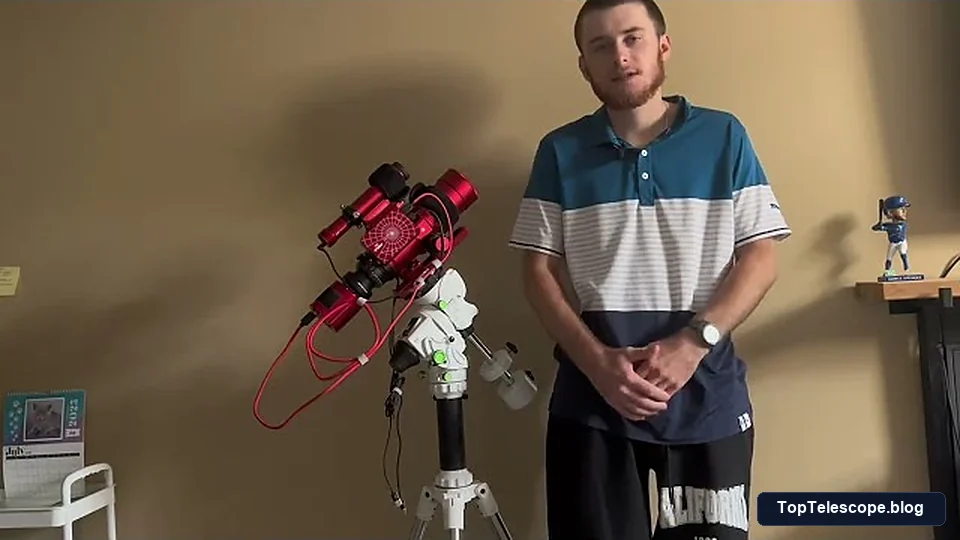
The patented tilt adapter ring helps correct minor sensor alignment errors across demanding camera configurations. Clear laser-engraved markings assist with repeatable positioning during teardown.
Focusing utilizes a smooth helical ring rather than a traditional rack-and-pinion knob. This internal helical mechanism prevents image shift during autofocus routines driven by external stepper motors and belt-drive accessory kits.
The base features a versatile Vixen-style mounting plate with an integrated saddle handle. This robust dovetail allows secure attachment to equatorial tracking mounts while providing a convenient upper platform for guide scopes.
- Smooth helical focus tension ring
- Patented built-in sensor tilt adjuster
- Clear laser-etched focal indicators
Navigating the Helical Focus System
Operating a helical focuser takes practice compared to traditional rack-and-pinion gear systems. Locking the tension ring prevents accidental slippage once optimal focus is achieved.
Motorized focus add-ons require specialized bracket kits to interface with the rotating helical barrel.
- Tension lock prevents focus drift
- Compatible with select add-on belts
Routine Maintenance and Long-Term Durability
Maintaining clean optical surfaces preserves contrast when imaging bright lunar or planetary targets. Gentle air puffers clear loose dust without scratching the precious multi-coated objective elements.
The mechanical housing withstands frequent travel inside padded field cases without losing optical collimation. Periodic checks of mounting screws ensure everything remains rigid and secure.
Routine optical care requires gentle dust removal using a bulb blower rather than compressed air cans. The multicoated front doublet demands careful handling to preserve anti-reflective coatings over years of rigorous field deployment.
Mechanical fasteners and tension screws should be inspected periodically using appropriate hex wrenches. Maintaining proper torque prevents structural loosening caused by vibration-induced wear during frequent transport to dark sky locations.
- Durable exterior resists field wear
- Simple dust removal via air blower
- Maintains collimation under travel stress
Preventative Care for Field Instruments
Storing the optical tube in a climate-controlled environment prevents internal mold growth on glass elements. Always replace protective caps immediately after dismantling your field gear.
Inspect dovetail mounting plates regularly for signs of wear from clamp thumbscrews.
- Climate-controlled storage recommended
- Regular dovetail plate inspections
Comparative Value and Definitive Buyer Verdict
This portable astrograph targets dedicated wide-field imagers prioritizing ultimate travel convenience over raw light gathering. Its premium cost reflects exceptional glass quality and innovative mechanical engineering features.
Budget-conscious beginners might find cheaper doublets, but none match this seamless plug-and-play field performance. Experienced travelers will appreciate the reliable optics and robust structural integrity.
When evaluating ultra-portable astrographs, mechanical build quality often dictates long-term field reliability. The RedCat 51 succeeds by combining optical flat-field performance with a remarkably compact footprint for mobile imaging setups.
Serious wide-field astrophotographers will appreciate the engineering precision and seamless camera integration capabilities. This dedicated astrograph remains an exemplary optical instrument for travelers seeking uncompromising night sky imaging results.
- Ideal for mobile wide-field imaging
- Premium glass commands higher investment
- Unmatched portability for airline travel
Final Purchasing Considerations
Evaluate your primary imaging targets before purchasing this specialized wide-field optical instrument. Large galaxy hunters should look elsewhere, but constellation imagers will find immense satisfaction.
Investing in proper mounting hardware completes a truly world-class portable travel kit.
- Best suited for large nebulae
- Requires stable star tracker mount
Frequently Asked Questions
Does the Redcat 51 require an external field flattener?
No external flattener is necessary because the built-in Petzval design natively delivers a flat field across full-frame sensors.
Can I attach an automated electronic autofocus motor?
Yes, third-party bracket kits allow motorized belt control, though setup requires careful calibration around the helical focus ring.
What size camera sensors are fully illuminated by this telescope?
The optical configuration easily covers standard full-frame sensors with minimal vignetting across the entire 44mm image circle.
How do I install threaded astrophotography filters into the optical train?
You can utilize the integrated internal filter slot designed to accept standard drop-in filter units securely.
Is this telescope suitable for visual stargazing alongside imaging?
While primarily optimized for photography, it accepts diagonal accessories for casual wide-field visual observing under dark skies.