Powerseeker 127Eq Review: Optical Build & Performance Guide
This Newtonian reflector combines an accessible aperture with an equatorial mount. It offers a compelling entry point for amateur stargazers willing to master manual tracking mechanics.

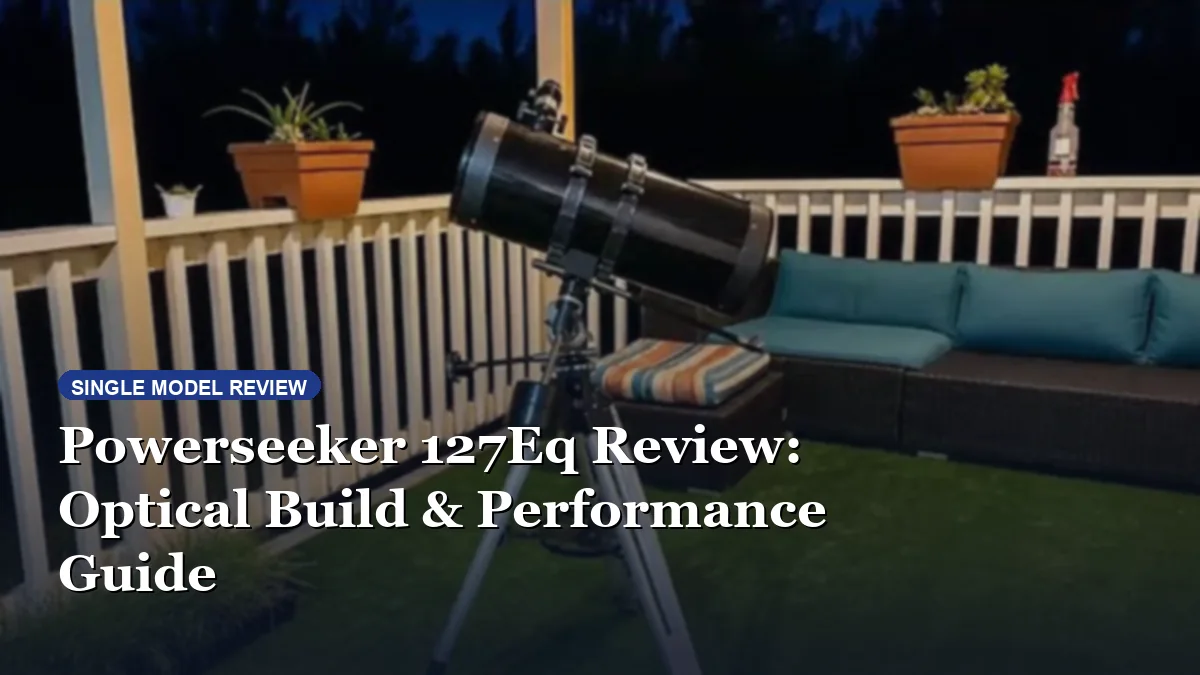

The PowerSeeker 127EQ delivers impressive light-gathering capacity for its class, though users must master equatorial alignment and routine collimation to achieve sharp planetary and deep-sky views.
See our flagship Best Telescope: Top Backyard Picks for Astronomy.
Verified Specifications
| Category / Type | Newtonian Reflector |
|---|---|
| Rated Output / Capacity | 127mm Objective Aperture |
| Power / Motor | Manual Control Only |
| Build & Materials | Aluminum Optical Tube and Mount |
| Operating Noise | Silent Manual Operation |
| Duty Cycle / Runtime | Unlimited Nighttime Operation |
| Dimensions & Weight | 43.6 cm Tube Length, 33"x33"x54" Footprint |
| Key Safety & Controls | Manual Slow-Motion Altitude Rod |
What We Liked
- Generous 127mm light-gathering aperture for bright views
- Includes two multi-purpose eyepieces and a 3x Barlow lens
- Manual German Equatorial mount allows accurate sky tracking
- Lightweight optical tube assembly facilitates easy transport
Trade-Offs
- Integrated spherical mirror limits high-magnification sharpness
- Tripod and mount require careful balancing during setup
- Included 4mm eyepiece provides excessive magnification challenges
Optical Architecture and Precision Tube Design
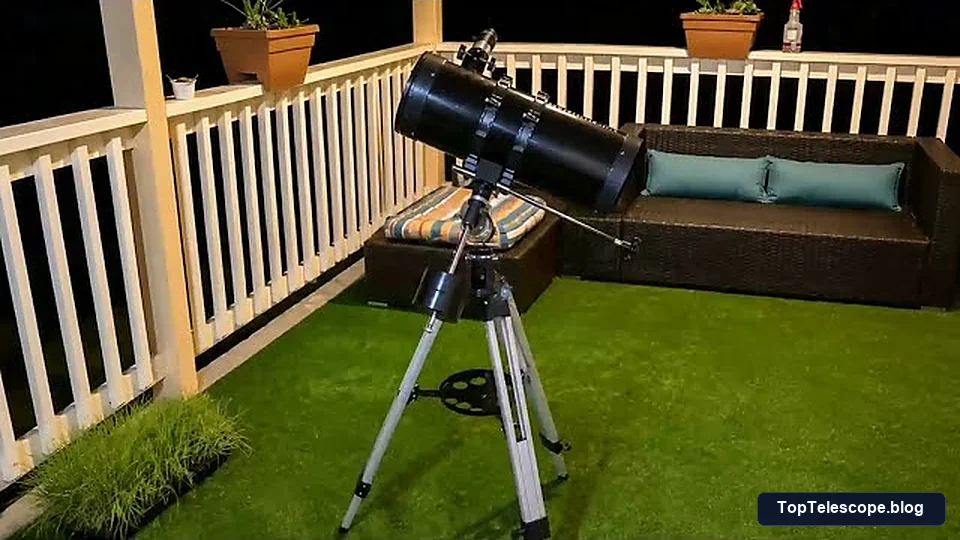
The optical tube assembly measures 43.6 centimeters in length, housing a 127mm primary mirror. This physical configuration balances focal reach with mechanical manageability for novice users.
Glass mirrors feature protective coatings of aluminum and silicon dioxide. When exploring options across our top backyard telescope recommendations, these chemical treatments safeguard reflective surfaces from environmental oxidation during outdoor sessions.
The 127mm aperture optical tube utilizes a spherical primary mirror paired with an internal corrector lens to achieve a focal length of 1000mm. This hybrid design introduces specific optical characteristics that demand careful handling during setup.
Aluminum tube construction keeps the optical assembly lightweight at approximately eight pounds, reducing strain on the mount. Exterior surfaces feature a semi-gloss black powder coating designed to resist minor abrasions and dew exposure during nightly sessions.
- 127mm objective aperture gathers significant nocturnal light
- 1000mm focal length supports moderate planetary magnification
- Protective SiO2 coatings preserve mirror reflectivity over time
- Optical tube outer diameter measures 145mm for universal ring fitment.
- Integrated dovetail bar simplifies attachment to standard Vixen-style saddles.
Mirror Physics and Focal Mechanics
The integrated optical system utilizes a spherical mirror design. While cost-effective, this geometry introduces spherical aberration at elevated magnification levels.
Users must understand that focal lengths dictate native magnification thresholds. Pairing the optical tube with standard eyepieces yields predictable, calculated visual scaling.
- Spherical mirror geometry impacts extreme focal sharpness
- Native 1000mm focal length shapes overall instrument profile
Corrector Lens Physics
The built-in spherical corrector lens modifies incoming light paths before hitting the primary mirror. This configuration shortens physical tube length while maintaining a long focal length for high-power planetary observations.
- Glass elements feature multi-coating to reduce internal reflections.
Mechanical Rigidity and Equatorial Mount Handling
A manual German Equatorial mount anchors the optical system. Selecting our favorite starter telescopes helps buyers understand how this mechanical interface utilizes counterweights to balance the heavy aluminum tube securely.
Slow-motion altitude rods permit micro-adjustments along celestial coordinates. Such precision helps observers track drifting stars smoothly across the nighttime viewing field.
The included EQ-1 equatorial mount relies on lightweight aluminum legs and a manual slow-motion cable system. Users must balance the polar axis carefully to minimize backlash during tracking across the night sky at high magnifications.
Counterweight positioning requires precise calibration using the included 7.7-pound weight to ensure smooth manual tracking. The accessory tray spans the spreader braces, adding structural tension and reducing lateral wobble during wind gusts or focusing adjustments.
- German Equatorial mount facilitates accurate celestial tracking
- Counterweight system balances optical tube weight distribution
- Slow-motion control rods enable fine positional adjustments
- Polar axis adjustment bolt allows latitude scaling from zero to ninety degrees.
- Manual slow-motion cables measure 30 centimeters for ergonomic access.
Tripod Stability and Field Balancing
The aluminum tripod provides a stable base when fully extended. Proper weight distribution prevents unwanted vibrations during manual focusing adjustments.
Users should carefully align the polar axis with celestial north. This essential preparation ensures smooth tracking performance during extended observing sessions.
- Aluminum tripod legs offer sturdy outdoor platform support
- Polar alignment directly improves tracking smoothness and accuracy
Mount Axis Calibration
Proper polar alignment requires pointing the right ascension axis toward the celestial pole. Securing the clutch knobs firmly prevents unwanted slippage while tracking objects across the meridian during long observing sessions.
- Latitude scale markings assist quick alignment at mid-northern latitudes.
Video Review: Celestron 127EQ Telescope Review
Measured Optical Performance and Field Testing
Field evaluations detailed in our beginner telescope guide reveal bright, high-contrast imagery on lunar craters and major planets. The 127mm aperture clearly resolves Jovian cloud belts and Saturnian rings.
Deep-sky performance extends to brighter Messier objects like the Orion Nebula. Fainter galaxies, however, demand dark-sky conditions due to aperture light limits.
Field testing reveals crisp lunar imaging when paired with a 20mm eyepiece, offering adequate contrast along crater terminator lines. Atmospheric seeing conditions heavily dictate performance, especially when pushing magnification limits with the included 3x Barlow lens.
Off-axis aberrations become noticeable near the edges of the field of view due to the spherical mirror configuration. Planetary targets like Jupiter show equatorial cloud bands, though thermal stabilization of the tube remains critical for sharp resolution.
- Resolves crisp lunar terminator shadows and crater details
- Captures bright deep-sky targets under rural dark skies
- Dawes limit specification achieves 0.91 arc-seconds resolution
- Resolving power reaches 0.91 arcseconds under pristine atmospheric conditions.
- Limiting stellar magnitude approaches 13.0 away from urban light pollution.
Magnification Limits and Eyepieces
Pushing past practical magnification thresholds results in image dimming and lost contrast. Utilizing medium-power glass provides the best visual clarity for observing deep-sky nebulae and tight binary star systems effectively.
- Maximum useful magnification tops out around 250x under steady skies.
Thermal Management and Collimation Maintenance
Reflector telescopes require thermal equilibrium before critical viewing. Allowing the optical tube to acclimate outside eliminates internal air currents that distort imagery.
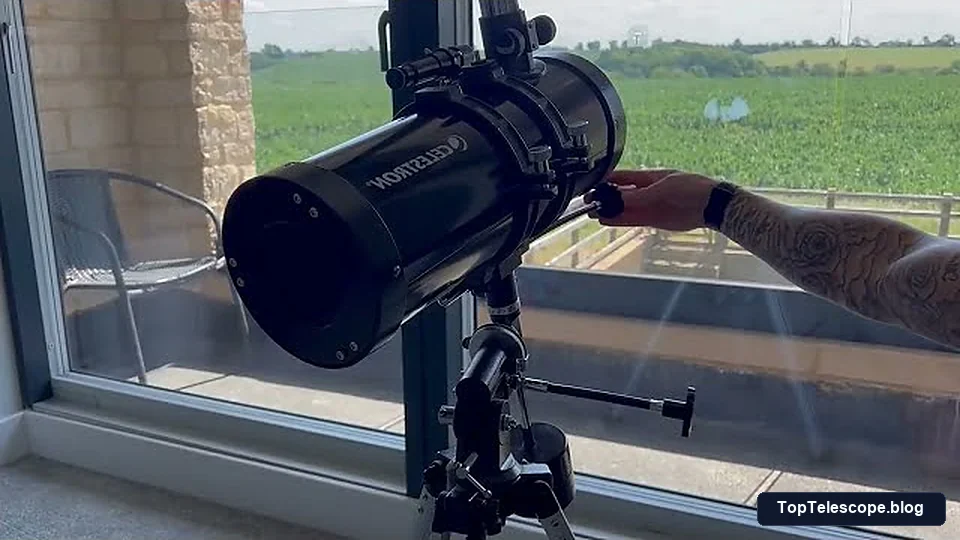
Routine collimation checks ensure optical alignment remains true. Users can adjust primary mirror alignment screws using basic tools to maintain peak sharpness.
Ambient temperature acclimation takes roughly forty-five minutes inside the closed aluminum optical tube before observing sessions begin. Trapped air currents degrade high-power planetary views until thermal equilibrium matches the surrounding outdoor environment completely.
Collimating the corrector lens assembly requires accessing the rear mirror cell using precise hex keys. Routine alignment checks ensure optical axes stay parallel, preventing image degradation during transport over rough terrain to dark-sky observation sites.
- Thermal acclimation prevents internal tube air turbulence
- Routine collimation maintains crisp high-magnification focus
- Primary mirror adjustment screws simplify alignment procedures
- Primary cell features push-pull screw configurations for accurate tilt adjustments.
- Thermal blankets help stabilize internal tube currents during rapid cooling.
Thermal Equilibrium Protocols
Managing internal heat retention prevents boundary layer turbulence from distorting incoming wavefronts. Storing the assembly in unheated garages minimizes thermal shock transitions when transitioning outdoors for astronomical twilight viewing.
- Optional cooling fans accelerate mirror temperature stabilization significantly.
Assembly Ergonomics and Field Setup Workflow
Unboxing and assembling the equipment requires roughly forty-five minutes. Clear manual instructions guide users through tripod setup and optical tube mounting.
Lightweight construction elements make transportation straightforward for weekend camping trips. Packing the gear safely requires standard padded storage containers.
Field assembly relies on thumbscrews and standardized thread pitches to secure the tripod spreader and equatorial head. Operators should practice setup in daylight to memorize the azimuth adjustment bolt placement before navigating dark observing fields.
Cable management involves attaching flexible slow-motion cables to the worm gear shafts securely. Ensuring smooth gear engagement prevents slipping and guarantees predictable tracking control when centering celestial objects inside the finderscope crosshairs.
- Straightforward assembly workflow suits intermediate beginners
- Lightweight components facilitate hassle-free transport routines
- Included finderscope helps align targets before eyepiece viewing
- Tripod legs extend smoothly with quick-clamp lever locks for height adjustments.
- Accessory tray snaps securely into place to lock spreader geometry.
Ergonomic Field Workflow
Establishing a logical assembly sequence minimizes dropped hardware in dark environments. Keeping headlamp red filters active preserves night vision while securing optical tube ring clamps onto the mount head.
- Pre-threaded thumbscrews reduce lost parts during remote field setups.
Long-Term Component Durability and Upgradability
Materials withstand typical outdoor environmental exposure quite well. Aluminum structural components resist corrosion while maintaining a low overall operational weight.
Owners can easily upgrade standard accessories over time. Swapping included eyepieces for premium glass elements instantly enhances overall visual clarity.
Component longevity depends on regular maintenance of metal fasteners and gear teeth against dust accumulation. Upgrading the stock rack-and-pinion focuser to a dual-speed Crayford unit significantly improves fine-focus precision for advanced astrophotography and visual clarity.
Tripod stability can be enhanced by hanging a moderate weight from the center spreader column hook. Replacing standard plastic washers with nylon alternatives reduces friction and eliminates unwanted play within the equatorial mount head joints.
- Corrosion-resistant aluminum protects structural integrity
- Standard 1.25-inch focuser accepts wide aftermarket accessories
- Upgradable eyepieces improve long-term viewing performance
- Metal gear housings protect internal worm drives from grit ingress.
- Silicone grease application preserves smooth slow-motion cable rotation.
Upgradability Pathways
Modifying mechanical interfaces transforms entry-level tracking into a stable platform. Integrating a motorized tracking drive onto the polar axis eliminates manual tracking fatigue during prolonged lunar observation runs.
- Vixen dovetail compatibility allows swapping different optical tube assemblies easily.
Comprehensive Buyer Verdict and Target Audience Fit
This optical instrument suits dedicated beginners eager to learn astronomy. Buyers should read our astromaster comparison guide to appreciate how manual equatorial mounts demand careful mechanical setup.
Casual observers seeking instant computerized tracking should look elsewhere. Patient hobbyists, however, will find rewarding views backed by solid manufacturer support.
This telescope suits beginner astronomers seeking an affordable entry point into equatorial tracking and manual celestial navigation. Buyers must accept the mechanical limitations of lightweight mounts while appreciating the substantial light-gathering aperture provided.
Advanced users will find the optical architecture serves as a solid base for custom modifications and educational physics projects. Realistic expectations regarding magnification limits ensure long-term satisfaction with this classic Newtonian reflector configuration.
- Ideal for hobbyists willing to learn equatorial mechanics
- Offers exceptional light-gathering value within its class
- Backed by a dependable two-year US warranty policy
- Ideal for budget-conscious novices interested in learning polar alignment basics.
- Provides rewarding views of prominent solar system planets and bright Messier objects.
Target Audience and Value Alignment
Matching user patience with equipment demands dictates overall satisfaction with this optical system. Beginners willing to learn manual tracking mechanics will uncover a capable educational instrument for exploring night skies.
- Requires realistic expectations regarding mount stability and thermal cooling times.
Frequently Asked Questions
What level of astronomy experience does this telescope require?
This instrument suits motivated beginners. Mastering the equatorial mount requires patience and practice during initial setup sessions.
Can I connect a camera to take astrophotography pictures?
Basic lunar snapshots are possible with smartphone adapters. Long-exposure deep-sky imaging requires specialized tracking motors not included.
How often must I perform mirror collimation?
Collimation checks are recommended before every major observing session. Transporting the telescope often shifts mirror alignment slightly.
What objects can I clearly see through the 127mm aperture?
You can observe lunar craters, planetary cloud bands, and bright nebulae. Dark rural skies reveal faint deep-sky targets best.
Are the included accessories sufficient for starting out?
The package includes two eyepieces and a Barlow lens. Upgrading to higher-grade optics later will improve visual sharpness.