Orion XT8i Review: Dobsonian Precision
The Orion XT8i pairs a massive eight-inch reflector with the Intelliscope push-to system. It delivers exceptional light gathering while requiring manual navigation via digital encoders.


This classic Dobsonian excels in deep-sky brightness and ease of use. Intelliscope digital setting circles streamline targeting without sacrificing the authentic manual observing experience.
Explore related alternatives in our Best Dobsonian Telescope.
Verified Specifications
| Category / Type | Newtonian Reflector Dobsonian |
|---|---|
| Rated Output / Capacity | 8-Inch Aperture (203mm) |
| Power / Motor | 9V Battery for Intelliscope Computer |
| Build & Materials | Borosilicate Glass Mirror & Particle Board Base |
| Operating Noise | Silent Manual Operation |
| Duty Cycle / Runtime | Continuous Manual Viewing |
| Dimensions & Weight | 41.5 lbs Total Assembled Weight |
| Key Safety & Controls | Dual Optical Encoders & Hand Controller |
What We Liked
- Massive 8-inch aperture collects ample light for faint deep-sky targets
- Intelliscope push-to system simplifies object location without motorized noise
- Sturdy wooden rocker box provides excellent mechanical stability
- Smooth 2-inch Crayford focuser accepts diverse eyepiece formats
Trade-Offs
- Heavier two-piece design requires manageable lifting strength
- Push-to system demands correct initial alignment procedures
- Lacks motorized tracking for long-exposure astrophotography
Optical Tube Assembly and Mirror Construction
The optical tube assembly features an eight-inch parabolic primary mirror crafted from low-expansion borosilicate glass. This precise optical surface minimizes spherical aberration and delivers sharp planetary details across high magnifications.
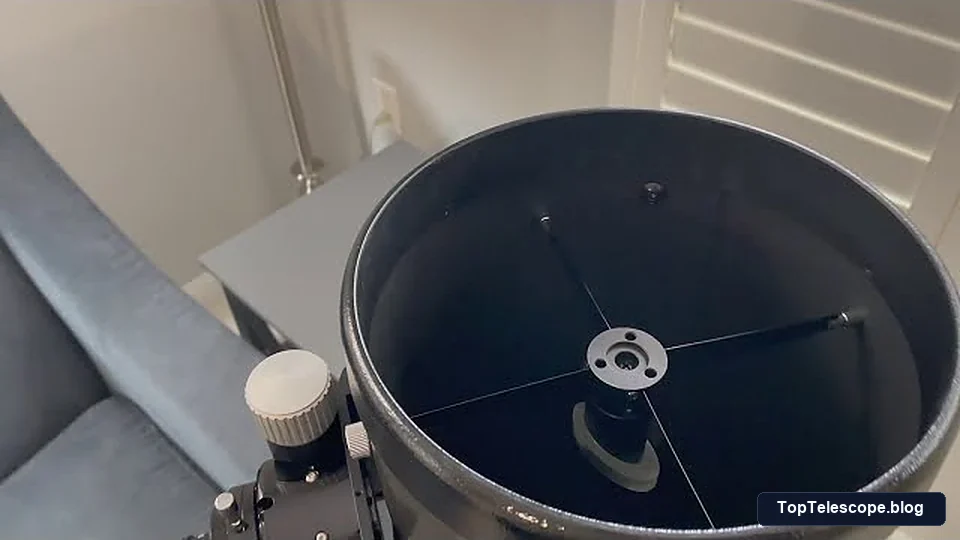
Aluminum coatings enhanced with silicon dioxide protect the reflective surface from premature degradation. Discover more mirror specifications in our Apertura AD8 vs Orion SkyQuest XT8 technical showdown regarding proper thermal acclimation and wavefront accuracy.
The optical tube assembly utilizes rolled steel measuring 203mm in aperture with a focal length of 1200mm. This provides an f/5 focal ratio suitable for balancing wide-field views with high-magnification planetary observation sessions.
The primary mirror features borosilicate glass coated with aluminum and a protective silicon dioxide overcoat. This configuration minimizes thermal expansion during rapid temperature drops while ensuring long-term reflectivity retention across standard observing cycles.
- 8-inch aperture light collection
- Low-expansion borosilicate glass substrate
- Silicon dioxide protective overcoat
Focal Length and Optical Speed
Operating at a focal length of twelve hundred millimeters, the system yields a versatile f/5.9 focal ratio. This balance accommodates wide-field star clusters alongside high-power lunar and planetary observations.
- 1200mm focal length
- f/5.9 focal ratio
Intelliscope Computerized Object Locator System
Unlike traditional motorized GoTo mounts, the Intelliscope system relies on dual optical encoders. Users manually push the telescope while digital readouts guide alignment corrections directly to the target.
The handheld controller houses a database exceeding fourteen thousand celestial objects. Setup requires a straightforward two-star alignment process followed by pinpointing a calibration star in the local sky.
Operating the push-to system requires installing high-resolution encoder disks on both the altitude and azimuth axes. These encoders interface with the hand controller via RJ-45 modular cables to track precise mechanical movements in real time.
Alignment involves leveling the base and centering two reference stars using the hand controller database. The internal microprocessor then calculates coordinates, displaying directional arrows to guide manual positioning toward over 14,000 celestial objects.
- 14,000+ object database
- High-resolution digital optical encoders
- Compact handheld display controller
Encoder Precision and Power Requirements
High-resolution encoders track altitude and azimuth movements with impressive accuracy. The lightweight hand controller operates efficiently on standard nine-volt batteries without cumbersome external power tanks.
- Standard 9V battery operation
- Dual-axis encoder tracking
Video Review: Review of the Orion XT8i Newtonian reflector Dobsonian telescope
Dobsonian Mount Ergonomics and Mechanical Stability
The particle-board rocker box provides a sturdy base utilizing Teflon pads. You can evaluate similar mounting systems in our Orion XT8 vs XT10 comparison for buttery-smooth azimuth rotation and consistent altitude tension.
Carrying handles integrated into the wooden base improve transport ergonomics significantly. However, users must manage a combined weight exceeding forty pounds when moving the complete assembly outdoors.
The particleboard rocker box assembly provides robust structural stability but adds substantial weight, requiring a two-piece transport strategy for field use. Teflon azimuth bearings ensure smooth rotational movement without sudden stiction during manual tracking adjustments.
Altitude tension is managed via Corian-on-Teflon bearing pads combined with large spring-loaded knobs. This adjustable friction clutch prevents optical tube slippage when swapping heavy eyepieces or mounting auxiliary finderscopes along the upper ring assembly.
- Durable particle-board construction
- Teflon azimuth bearing pads
- Integrated transport carrying handles
Tension Optimization
Adjustable spring tension knobs let observers customize the altitude friction. This prevents front-heavy imbalances when swapping between heavy eyepieces or mounting accessory barlow lenses.
- Spring tension adjustment knobs
- Balanced altitude movement
Focuser Mechanics and Accessory Integration
A standard two-inch Crayford focuser delivers backlash-free mechanical adjustments. It includes a step-down adapter to accept traditional one-and-one-quarter-inch eyepieces securely without marring barrel surfaces.
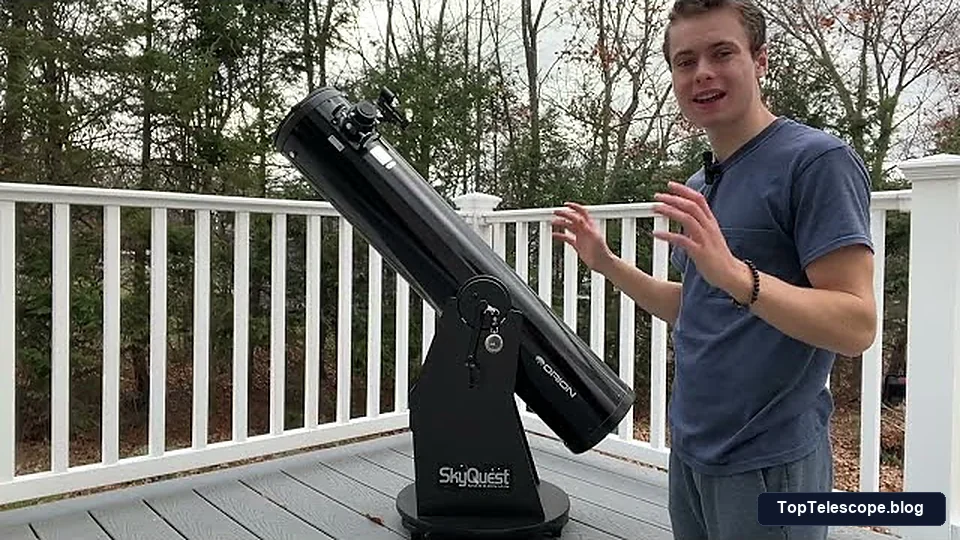
The mechanical drawtube travel accommodates various optical accessories smoothly. Upgrading to compression ring adapters enhances eyepiece alignment and prevents accidental slippage during zenith observations.
Equipped with a 2-inch Crayford focuser, the telescope accepts standard wide-field eyepieces while including a 1.25-inch adapter for smaller barrels. The dual-speed 10:1 reduction knob allows ultra-fine focus adjustments critical for resolving lunar craters.
Mechanical alignment of the focuser drawtube minimizes image shift during travel. The thumbscrew compression ring secures expensive glass elements firmly without marring barrels, maintaining optical axis integrity throughout extended observation sessions under heavy loads.
- 2-inch Crayford focuser design
- 1.25-inch step-down adapter included
- Smooth drawtube travel mechanics
Real-World Deep-Sky and Planetary Performance
Light-gathering capacity reveals faint spiral arms in distant galaxies and sharp globular cluster cores. As highlighted in our Apertura AD10 vs Orion XT10 comparison, Jupiter exhibits distinct cloud belt structures under steady seeing.
Collimation plays a critical role in preserving high-contrast performance at maximum magnifications. Regular alignment checks using a laser collimator ensure optical axes remain perfectly parallel throughout extended sessions.
Under dark skies, the 8-inch aperture resolves globular clusters into distinct stellar points and reveals delicate spiral structure in bright galaxies like M51. Light gathering capacity exceeds smaller beginner scopes by a substantial observational margin.
Planetary resolution thrives on the steady f/5 optical design, displaying clear cloud bands on Jupiter and the Cassini Division in Saturn's rings during moments of stable atmospheric seeing. Thermal equilibrium remains essential for optimal performance.
- Deep-sky galaxy spiral arm resolution
- High-contrast planetary cloud details
- Requires periodic collimation checks
Routine Maintenance and Collimation Protocols
Maintaining peak optical performance requires periodic mirror cleaning and precise collimation adjustments. Users should employ thumb screws on the primary mirror cell for straightforward field adjustments.
Storing the optical tube upright with dust caps secured prevents particulate accumulation. Avoid touching bare glass surfaces to preserve proprietary reflective coatings over years of heavy astronomical use.
Maintaining peak optical performance requires periodic collimation of the primary and secondary mirrors using a laser collimator or Cheshire eyepiece. Adjusting the three spring-loaded thumbscrews on the cell ensures correct optical alignment before every session.
Dust accumulation on optical surfaces should be removed using a bulb blower rather than compressed air or abrasive cloths. Storing the tube vertically with dust caps securely attached prevents particulate settling on the primary mirror coating.
- Thumb screw collimation adjustments
- Dust cap protection protocols
- Careful mirror surface maintenance
Final Verdict and Operational Summary
The Orion XT8i stands out in our best Orion telescope for beginners guide by bridging manual Dobsonians and digital encoders. Reliable digital tracking empowers novices to locate elusive deep-sky targets without losing mechanical simplicity.
Balancing aperture, manual tracking freedom, and digital object location, this telescope delivers exceptional value for intermediate astronomers. Its robust mechanical build demands dedicated transport effort but rewards users with deep, reliable astronomical utility.
- Combines manual viewing with digital locating
- Exceptional value for light gathering
- Ideal for intermediate astronomy enthusiasts
Frequently Asked Questions
Does the Intelliscope system track objects automatically?
No, the system uses digital encoders to guide manual push-to navigation. Users must reposition the telescope manually based on directional arrows displayed on the hand controller.
How difficult is mirror collimation for beginners?
Collimation becomes straightforward with basic tools like a laser collimator or Cheshire eyepiece. Regular alignment checks ensure crisp planetary images during high-magnification viewing sessions.
Can I attach a DSLR camera for astrophotography?
The Dobsonian mount lacks motorized equatorial tracking required for deep-sky long-exposure photography. Lunar and planetary imaging remains possible using high-speed video capture techniques.
What power source does the hand controller require?
The Intelliscope computer operates efficiently on a single standard nine-volt battery. Low power consumption ensures extended field usability without heavy external power stations.
How heavy is the complete telescope setup?
The optical tube weighs about twenty pounds while the wooden base adds another twenty-one pounds. Transporting the system requires two separate trips for comfortable handling.