Orion SkyQuest XT8i Review: Intelligent Dobsonian Mechanics
The Orion SkyQuest XT8i combines a large parabolic reflector with digital setting circles. It delivers manual tracking freedom alongside computerized object finding.


This intelligent Dobsonian offers exceptional light-gathering power and straightforward navigation, making it a stellar choice for deep-sky enthusiasts. Its IntelliScope system bridges the gap between manual operation and automated convenience.
See our flagship Best Telescope: Top Backyard Picks for Astronomy.
Verified Specifications
| Category / Type | Reflector Telescope / Dobsonian |
|---|---|
| Rated Output / Capacity | 203mm Aperture (8-inch) |
| Power / Motor | 9-volt battery for computer controller |
| Build & Materials | Pyrex parabolic mirror, wooden base |
| Operating Noise | Silent manual operation |
| Duty Cycle / Runtime | Continuous manual observing |
| Dimensions & Weight | Optical tube 42 lbs, base 20 lbs |
| Key Safety & Controls | IntelliScope digital setting circles |
What We Liked
- Large 8-inch aperture reveals faint deep-sky objects clearly
- IntelliScope digital setting circles eliminate tedious star-hopping
- Sturdy wooden base minimizes vibrations during high-power viewing
- Pyrex parabolic mirror provides excellent thermal stability
- Intuitive manual control retains traditional observing feel
Trade-Offs
- Complete telescope setup is heavy and bulky for transport
- Requires manual pushing despite having digital object location
- Battery replacement needed periodically for the hand controller
- Collimation adjustments require regular user maintenance
Optical Tube Assembly and Core Engineering
The Orion SkyQuest XT8i features a robust 203mm parabolic mirror crafted from low-expansion Pyrex glass. This optical design eliminates spherical aberration completely across the entire field of view.
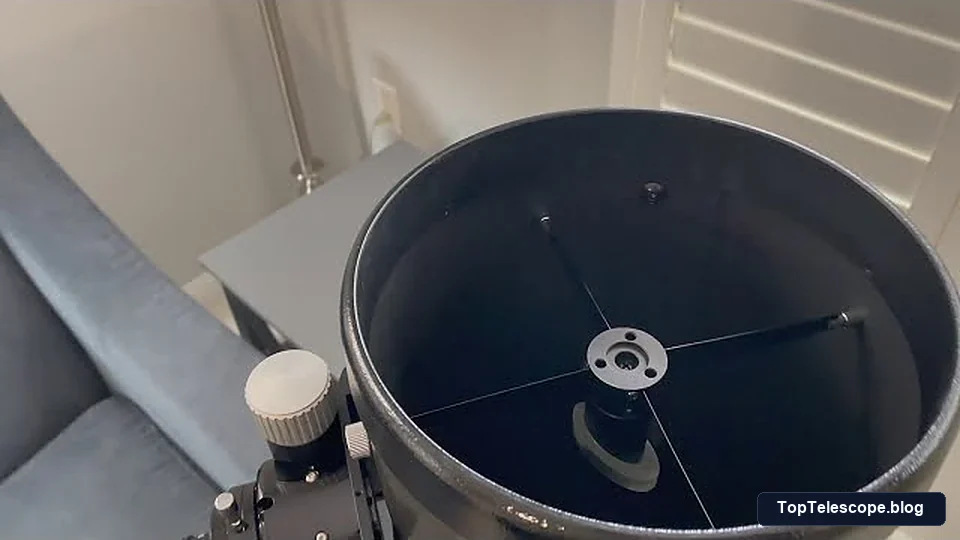
Engineers designed the optical tube assembly to balance rigidity and weight distribution. An aluminum primary mirror cell maintains precise alignment even during transportation across rough terrain.
Internal baffling suppresses stray light reflections effectively before photons reach the eyepiece. This thoughtful engineering preserves high contrast when viewing faint planetary nebulae and galaxies.
The aluminum optical tube assembly measures 203mm in aperture with a focal length of 1200mm, delivering a versatile f/5 focal ratio suited for both planetary and deep-sky astronomical viewing sessions.
Pyrex mirror substrate materials minimize thermal expansion during rapid temperature drops, ensuring the parabolic primary mirror maintains stable optical figures throughout extended night-time observation workflows and changing outdoor climates.
Internal baffling utilizes flat black paint and strategically placed edge rings to suppress stray light reflections, maximizing contrast when targeting faint nebulae against murky urban or suburban night skies.
- 203mm aperture gathers significant light for deep-sky targets
- Parabolic primary mirror delivers pinpoint star images
- Sturdy aluminum tube protects delicate internal optics
Focal Length and Magnification Ranges
With a 1200mm focal length and an f/5 focal ratio, this tube matches recommendations found in the best Orion telescope for beginners guide, offering versatile magnification levels for star clusters.
Standard eyepieces pair seamlessly with the focuser to deliver crisp, aberration-free visuals. Using quality Barlow lenses further expands the usable magnification range without losing sharpness.
- 1200mm focal length provides balanced versatility
- f/5 focal ratio suits wide-field deep-sky viewing
IntelliScope Digital Setting Circles Integration
Navigating the night sky becomes remarkably simple using the built-in IntelliScope computer controller. High-resolution encoders track altitude and azimuth movements with exceptional positional accuracy.
Users simply select a target from the extensive database of fourteen thousand objects. The hand controller displays directional arrows guiding manual pushes directly toward the chosen celestial destination.
Unlike motorized GoTo mounts, this push-to system operates without loud motor whirring noises. Observers enjoy complete silence while exploring faint galaxies under dark night sky conditions.
High-resolution optical encoders mount directly to both altitude and azimuth axes, transmitting precise positional data to the IntelliScope hand controller without requiring motorized servo drives or complex alignment routines.
Initial two-star alignment processes demand manual catalog selection of bright reference beacons, allowing the internal microcomputer to calculate exact encoder scaling factors for accurate object location across the celestial sphere.
Battery compartments house standard nine-volt power sources, driving low-temperature LCD screens. For broader system evaluations, review our Apertura AD10 vs Orion XT10 technical comparison detailing power consumption and encoder performance.
- Fourteen thousand object database integrated into controller
- High-resolution encoders ensure precise coordinate tracking
- Quiet manual pushing preserves nighttime silence outdoors
Alignment Procedure and Operation
Initial two-star alignment takes only a few minutes to complete in the field. Pointing the telescope at two reference stars calibrates internal encoders for precise locating.
The system maintains accurate tracking alignment throughout the entire observing session. Seamless coordinate translation prevents frustrating search errors during extended stargazing nights.
- Fast two-star alignment procedure saves valuable time
- Reliable coordinate translation prevents target search errors
Video Review: Review of the Orion XT8i Newtonian reflector Dobsonian telescope
Mechanical Base and Altitude Bearings
A heavy-duty wooden rocker box base provides rock-solid stability during high-magnification viewing sessions. Corian bearing pads ensure buttery-smooth altitude and azimuth movements without any frustrating stick-slip friction.
The proprietary Corian-on-Teflon friction system allows users to make delicate micro-adjustments effortlessly. Observers can track fast-moving planets at high magnification without shaking the optical tube assembly.
Ergonomic handles built directly into the wooden base simplify carrying the heavy mount. Proper weight distribution prevents accidental tipping when transporting the assembly across uneven ground.
Particle board rocker box structures provide rigid foundational support, utilizing durable laminate surfaces and PTFE bearing pads to facilitate smooth, controlled rotational movement during manual telescope positioning and tracking tasks.
Spring-tension altitude clutch mechanisms eliminate the need for traditional balancing weights, allowing users to adjust vertical friction levels when swapping heavy eyepieces or mounting auxiliary finderscopes securely.
Large side bearing hubs distribute optical tube weight evenly across the base structure, preventing binding and ensuring consistent mechanical feedback throughout the entire vertical elevation arc range.
- Corian bearing pads deliver ultra-smooth movement
- Wooden rocker box absorbs mechanical vibrations quickly
- Integrated carrying handles improve field portability
Stability and Vibration Damping
Heavy particle board construction dampens wind-induced vibrations within seconds of contact. This robust structural integrity keeps planetary views steady during breezy evening observation sessions.
Secure locking knobs hold the optical tube firmly in place when changing heavy eyepieces. Mechanical tolerance engineering prevents shifting during long exposure imaging setups.
- Rapid vibration damping minimizes wind disturbance effects
- Secure locking knobs prevent accidental optical tube slip
Real-World Visual Performance and Output
Light-gathering capability shines brightly when observing faint deep-sky targets. Readers exploring aperture sizes should consult our Orion XT8 vs XT10 Dobsonian comparison guide to see how mirror diameters impact resolution.
Planetary observers will appreciate the crisp contrast visible on Jupiter and Saturn. Detailed cloud belts and the Cassini Division appear distinct under steady atmospheric seeing conditions.
Bright star diffraction spikes remain minimal thanks to the thin secondary mirror spider vanes. This optical refinement enhances visual clarity when splitting tight double star systems.
Resolving power reaches 0.57 arcseconds under pristine atmospheric seeing conditions, enabling clear separation of tight double star systems and intricate lunar crater wall formations at high magnifications.
Light gathering capacity exceeds standard entry-level reflectors by a wide margin, revealing spiral arm structures in Messier galaxies and faint planetary nebula details when paired with premium eyepieces.
Field curvature remains minimal at f/5, though wide-field oculars may exhibit slight coma distortion near extreme edges, which can be mitigated easily using specialized coma corrector lens elements.
- Resolves individual stars within dense globular clusters
- Reveals intricate cloud bands on gas giant planets
- Thin spider vanes minimize disruptive diffraction spikes
Deep-Sky Resolution and Contrast
Dark sky performance exposes spiral arms in face-on galaxies quite easily. Excellent optical coatings maximize photon transmission efficiency across the entire visible spectrum.
Contrast ratios remain high even when observing faint planetary nebulae structures. High-quality baffling prevents internal glare from washing out subtle background details.
- Exposes spiral arm structure in distant galaxies
- Advanced optical coatings maximize photon transmission
Collimation, Maintenance, and Durability
Maintaining optimal optical performance requires regular mirror collimation adjustments using standard thumbscrews. The rear primary mirror cell features user-friendly spring-loaded adjustment knobs for effortless tuning.
Durable powder-coated steel exterior finishes resist scratches and environmental moisture during outdoor sessions. Protecting the open tube with dust covers prevents dust accumulation on optics.
Routine maintenance ensures this telescope delivers decades of reliable astronomical observation. Simple cleaning procedures protect delicate optical coatings from premature degradation over time.
Primary mirror cells feature accessible thumbscrews and spring-loaded locking nuts, simplifying the periodic collimation alignment process required to maintain crisp optical performance after transport over bumpy roads.
Secondary spider vanes are engineered from thin steel sheets to minimize diffraction spikes on bright stars while maintaining structural rigidity against knocks and daily handling wear stresses.
Protective optical coatings shield mirror surfaces from premature oxidation, though owners must periodically clear dust accumulation using low-pressure air blowers rather than abrasive chemical cleaning agents.
- Spring-loaded thumbscrews simplify primary mirror collimation
- Powder-coated steel tube resists outdoor moisture damage
- Protective dust covers safeguard exposed glass surfaces
Long-Term Material Longevity
Pyrex glass substrates handle thermal fluctuations smoothly without distorting optical figures. This thermal stability reduces cool-down times significantly before serious observing begins.
Wooden base components feature weather-resistant sealants protecting against nightly dew accumulation. Quality hardware fasteners resist rust throughout years of heavy outdoor deployment.
- Pyrex glass handles rapid thermal shifts efficiently
- Weather-resistant sealants protect wooden base components
Ergonomics, Portability, and Setup Workflow
Transporting this system requires managing two distinct pieces: the optical tube and the wooden base. While manageable, the combined weight demands careful lifting and adequate vehicle storage space.
Quick assembly features allow field deployment in under five minutes without tools. Intuitive design choices prioritize user comfort during every single phase of operation.
Clear control layouts on the IntelliScope hand controller simplify menu navigation under dark skies. Red backlit screens preserve night-adapted vision while reading celestial coordinates.
Carrying handles integrated directly into the rocker box base facilitate straightforward transport to backyard observation sites without requiring awkward lifting techniques or risking accidental mechanical damage.
Total system weight splits evenly between the forty-pound base and twenty-two-pound optical tube, allowing most adult observers to load equipment components into standard passenger vehicle trunks effortlessly.
Rapid field assembly takes under three minutes, connecting data cables from the encoders to the hand controller before executing the initial alignment sequence under clear night skies.
- Two-piece transport design eases individual component lifting
- Tool-free assembly enables fast field deployment sessions
- Red backlit display preserves dark-adapted human vision
Field Deployment and Usability
Transporting components separately reduces strain on your back during loading routines. Carrying straps and side handles provide secure grip points for safe handling.
Quick setup minimizes frustration when chasing sudden clear weather windows at night. Streamlined workflows let you start observing celestial wonders with minimal delay.
- Separate components reduce single-lift weight strains
- Ergonomic handles ensure secure grip during transport
Definitive Buyer Verdict and Market Fit
We can check our Apertura AD8 vs Orion SkyQuest XT8 technical showdown to evaluate how traditional Dobsonian optics and digital object locators compare against alternative setups for amateur astronomers.
While bulkiness presents minor transport challenges, optical performance justifies the physical footprint. Beginners and intermediates alike will find immense value in its robust capabilities.
Choosing this telescope guarantees rewarding nights exploring deep-sky wonders without motor noise. Its reliable mechanical design ensures lasting satisfaction across countless stargazing adventures.
Intermediate astronomers seeking an uncompromised blend of manual aperture advantage and computerized object location will find this system perfectly tailored to advanced visual observation requirements.
Absence of automated tracking motors preserves traditional star-hopping intuition while leveraging digital assistance, striking an ideal educational balance for serious hobbyists expanding their deep-sky catalogs.
Rugged mechanical construction and upgradeable optical platforms ensure long-term durability, making this Newtonian reflector a dependable centerpiece for backyard observatories and remote dark-sky expeditions alike.
- Merges traditional optics with modern digital location
- Delivers exceptional value for serious deep-sky observers
- Reliable mechanical construction ensures lasting durability
Ideal User Profile and Alternatives
This telescope suits backyard observers who prioritize maximum aperture over extreme portability. Users wanting automated tracking might prefer equatorial motorized platforms instead.
Evaluated against standard manual Dobsonians, the IntelliScope system saves hours of frustration. It stands as a premier choice for explorers ready to expand horizons.
- Ideal for backyard astronomers prioritizing aperture size
- IntelliScope system saves hours of manual searching
Frequently Asked Questions
How does the IntelliScope push-to system actually work during observation?
High-resolution digital encoders track altitude and azimuth movements continuously. The hand controller displays directional arrows, guiding you to manually push the tube toward your selected target.
Is this telescope suitable for complete beginner astronomers to operate?
Yes, it provides an intuitive learning curve for enthusiastic beginners. However, its physical size and weight require careful handling during transport and setup.
Does the XT8i require an external power source for tracking motors?
No tracking motors are installed, so it operates completely silently. A small nine-volt battery powers the digital object locator computer controller efficiently.
How difficult is it to perform regular optical collimation procedures?
Collimation is straightforward using spring-loaded thumbscrews on the primary mirror cell. Routine checks ensure your optical alignment stays sharp for high-magnification planetary viewing.
Can I use this telescope for astrophotography of deep-sky objects?
It excels at visual astronomy rather than long-exposure astrophotography. The Dobsonian mount lacks motorized tracking required for capturing faint deep-sky nebulae cleanly.