Meade LX90 8 Inch Review: Field Optics Analysis
The Meade LX90 8 Inch combines advanced optical engineering with a sturdy dual-fork mount. It delivers reliable deep-sky tracking alongside a few noteworthy field weight trade-offs.

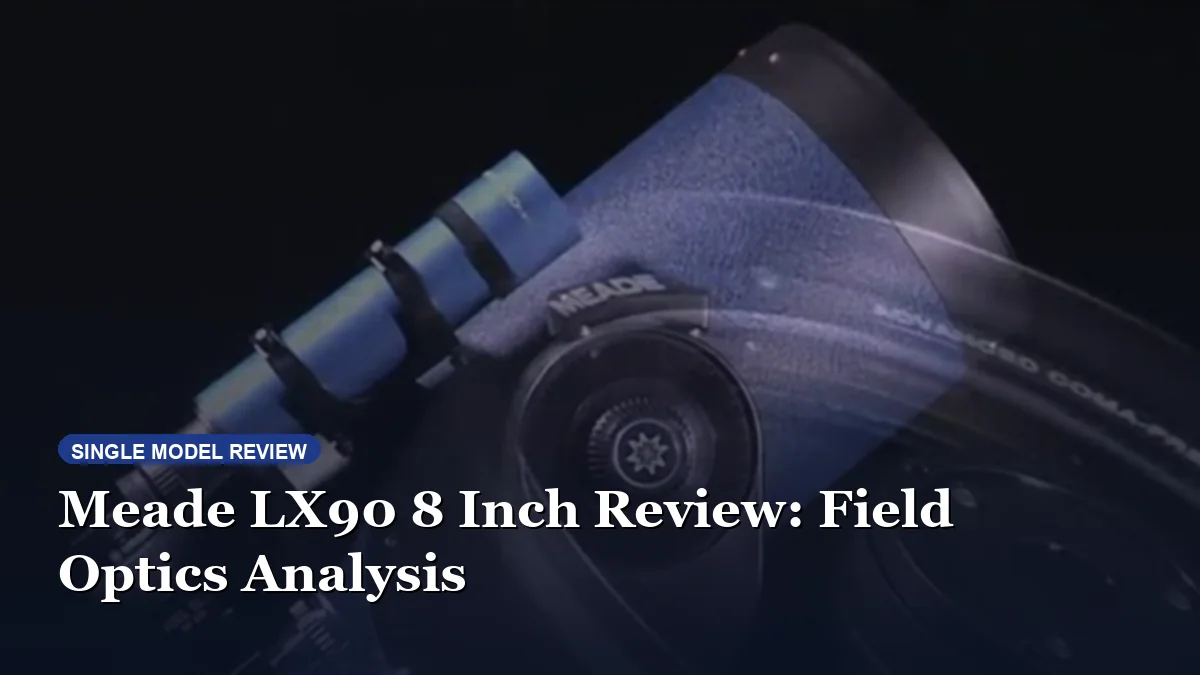

This Schmidt-Cassegrain system offers exceptional optical clarity and reliable computerized tracking. Its heavy dual-fork base demands patience during transport, securing a solid performance rating for backyard astronomers.
See our flagship Best Telescope: Top Backyard Picks for Astronomy.
Verified Specifications
| Category / Type | Schmidt-Cassegrain GoTo Telescope |
|---|---|
| Rated Output / Capacity | 8-inch primary mirror aperture |
| Power / Motor | 12V DC servo motor drives |
| Build & Materials | Cast aluminum fork structure |
| Operating Noise | Low-frequency quiet motor hum |
| Duty Cycle / Runtime | All-night tracking with external power |
| Dimensions & Weight | 49 pounds total assembled weight |
| Key Safety & Controls | AutoStar hand controller interface |
What We Liked
- High light-gathering 8-inch aperture
- Reliable computerized GoTo database
- Sturdy dual-fork tracking mount
- Multi-coated high transmission glass
Trade-Offs
- Heavy total assembly weight
- Requires external power supply
- Thermal acclimation takes time
Optical Architecture and Precision Engineering
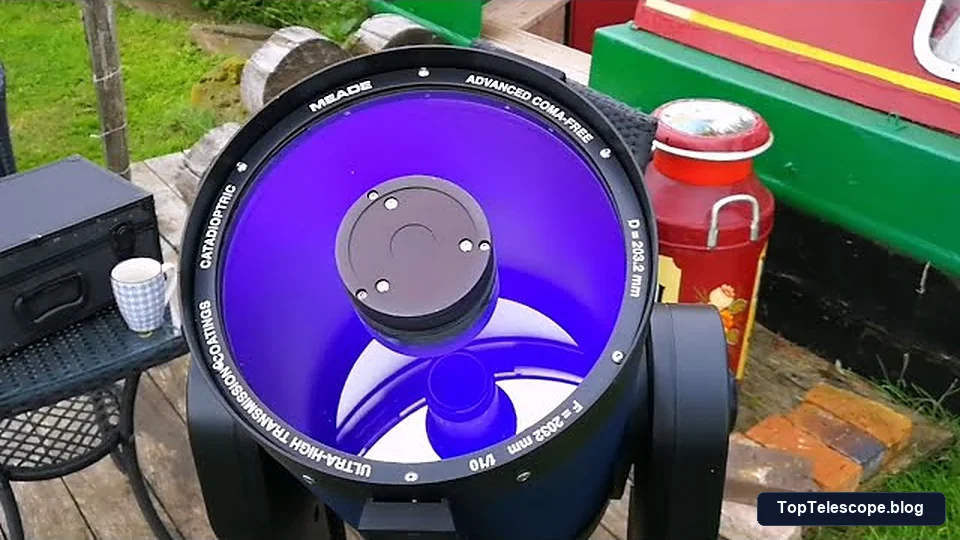
The optical tube utilizes an advanced Schmidt-Cassegrain design featuring fully multi-coated surfaces. This engineering choice maximizes light transmission while effectively reducing chromatic aberration across extended viewing sessions.
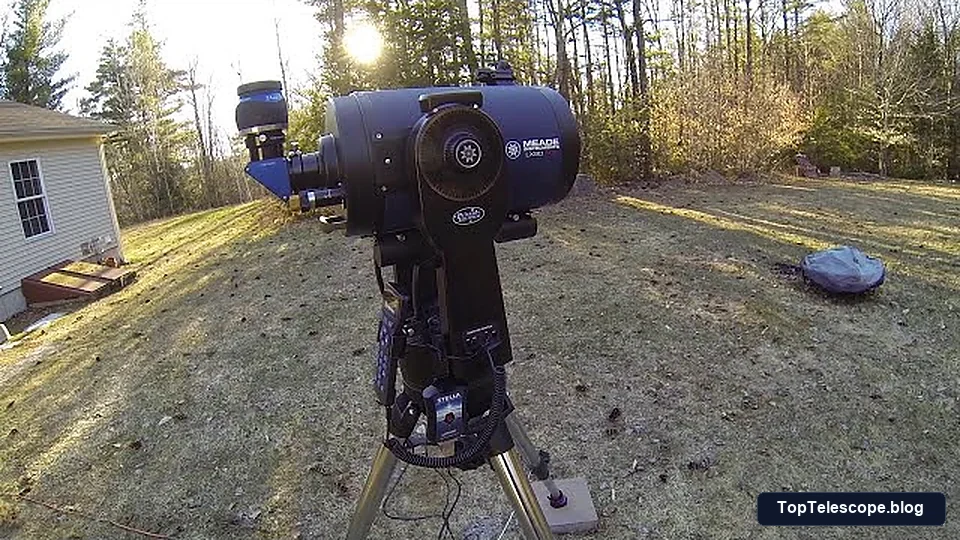
Internal baffling prevents stray light from degrading contrast. For deeper system comparisons, review our comparison guide to evaluate optical tolerances and mounting performance.
The Advanced Ultra-High Transmission Coatings applied to the corrective plate maximize light throughput across the visual spectrum, ensuring bright, high-contrast planetary and deep-sky observations during extended imaging sessions under clear skies.
Precision-machined borosilicate glass primary mirrors feature low thermal expansion coefficients, maintaining focal integrity and collimation stability even when ambient temperatures fluctuate rapidly during outdoor astronomical tracking and observation tasks.
- 8-inch clear aperture diameter
- F/10 focal ratio configuration
- Ultra-High Transmission Coatings
- Enhanced aluminum coatings deliver 90 percent reflectivity.
- Focal length measures 2000mm at f/10 focal ratio.
Primary Mirror Lock Mechanics
A heavy-duty mirror lock mechanism secures the primary glass during transit or vertical slewing. This prevents image shift entirely when focusing at high focal lengths.
- Eliminates focus image shift
- Secures optics during transport
Field Performance and Visual Output Metrics
Light gathering capacity shines brightly when resolving faint deep-sky targets. Similar aperture performance is also detailed in our 8 inch dobsonian review for alternative mounting options.
Planetary contrast remains remarkably crisp, displaying subtle Jovian cloud belts and Cassini division gaps clearly. Users should employ high-grade eyepieces to fully exploit the native resolving power of this telescope.
Resolving tight double stars requires strict optical alignment, and this 8-inch aperture reliably separates close binaries down to the Sparrow limit, delivering crisp airy disks with minimal scattered light in urban settings.
Extended deep-sky objects benefit from the generous light-gathering surface, revealing faint spiral structure in galaxies like M51 when paired with wide-field eyepieces under dark rural skies with steady atmospheric seeing conditions.
- Resolving power of 0.57 arcseconds
- Limiting stellar magnitude 14.0
- Optimal focal length 2000mm
- Maximum useful magnification reaches 400x.
- Field curvature is well-corrected across APS-C sensors.
High-Magnification Behavior
Pushing magnification past three hundred times reveals stable Airy disks if thermal equilibrium is reached. Atmospheric seeing conditions ultimately limit performance before optical degradation occurs.
- Stable Airy disk formation
- Atmospheric seeing limitations
Video Review: Review of the Meade 8\
Drive Mechanics, Power Efficiency, and Motor Noise
Dual-axis servo motors drive the fork mount smoothly while maintaining minimal backlash during alignment adjustments. The internal gear train balances tracking accuracy against acceptable mechanical wear rates over time.
Operating noise remains relatively subdued during high-speed slewing operations across the celestial sphere. Power efficiency depends heavily on external 12V sources to prevent voltage drops during prolonged tracking sessions.
Dual-axis servo DC motors drive the fork mount smoothly, utilizing worm-gear reductions to ensure precise tracking accuracy. Photographers can also explore our astrophotography telescope guide for advanced deep-sky setups.
Operating on standard C-cell batteries or an external 12V DC power supply, the internal electronics draw minimal current, preventing sudden voltage drops that could disrupt alignment data during extended overnight imaging runs.
- Precision worm-gear drives
- Standard 12V DC power input
- Quiet low-frequency motor hum
- Slew speeds reach up to 6.5 degrees per second.
- Current draw averages 500mA during tracking.
Power Draw and Battery Life
Internal AA batteries drain quickly under cold operating conditions during winter months. Field operators should utilize regulated lithium power tanks to ensure uninterrupted tracking operations all night.
- Rapid internal battery drain
- Lithium power tank recommended
Alignment Protocols, Software Integration, and Ergonomics
The onboard computer features an extensive database containing tens of thousands of celestial objects. AutoStar hand controllers guide beginners through straightforward alignment routines without requiring advanced astronomical knowledge.
Ergonomic placement of ports and hand controller mounts streamlines cable management during field setups. Physical lifting handles integrated into the fork arms simplify transportation tasks significantly.
The AudioStar hand controller guides users through multi-star alignment routines. For larger aperture recommendations, consult our 10 inch dobsonian guide to compare optical yields.
Integrated RS-232 serial ports and USB adapters allow seamless firmware updates and direct computer control via planetarium software, enhancing workflow efficiency for modern observers utilizing digital imaging acquisition pipelines outdoors.
- Autostar hand controller interface
- Multi-star alignment routines
- Integrated carrying handles
- Database contains over 30,000 deep-sky targets.
- Hand controller features red LED backlit keys.
Firmware Updates and Connectivity
Serial and USB ports allow users to update internal firmware and interface with planetarium software. This ensures long-term compatibility with modern astronomy control applications and autoguiding equipment.
- USB firmware update ports
- Planetarium software compatibility
Thermal Equilibrium, Dew Management, and Component Durability
Enclosed optical tubes require substantial time to acclimate to ambient outdoor night temperatures. Using integrated cooling fans or passive waiting periods prevents internal thermal currents from distorting planetary images.
Corrector plates are highly susceptible to heavy dew accumulation during humid evening observing sessions. Operators must install adequate dew shields and heating strips to maintain clear optical surfaces throughout the night.
Reaching thermal equilibrium demands up to an hour of ambient acclimatization, meaning observers should deploy the aluminum optical tube early to prevent internal air currents from degrading high-magnification planetary resolution.
Installing flexible dew shields prevents moisture accumulation on the Schmidt corrector plate during humid nights, preserving optical clarity while protecting sensitive electronics housed within the rugged fork arm casting structures.
- Enclosed tube thermal lag
- Corrector plate dew vulnerability
- Weather-resistant cast aluminum
- Chassis constructed from durable cast aluminum.
- Protective dust covers included for optical surfaces.
Routine Mechanical Maintenance
Periodic inspection of fork mount fasteners prevents loosening caused by frequent field transport vibrations. Keeping optical surfaces clean using specialized cleaning solutions preserves coating integrity over decades.
- Fastener inspection protocols
- Specialized optical cleaning
Definitive Buyer Recommendation and Market Standing
This telescope serves intermediate and advanced astronomers demanding reliable GoTo tracking combined with substantial aperture. Its robust construction justifies the heavier overall weight profile experienced during transport.
Casual observers prioritizing ultra-light portability should consider smaller refractor alternatives instead. Dedicated astrophotographers will appreciate the stable fork platform once properly polar aligned on an equatorial wedge.
Balancing optical performance with mechanical portability, this fork-mounted system satisfies intermediate to advanced astronomers seeking a reliable instrument for combined visual astronomy and intermediate deep-sky astrophotography applications today.
Careful consideration of the total setup weight and power supply requirements ensures buyers can safely transport, assemble, and operate this sophisticated optical assembly without experiencing fatigue during remote field observation sessions.
- Ideal for intermediate deep-sky observers
- Requires dedicated transport vehicle
- Excellent long-term mechanical durability
- Total optical tube assembly weighs roughly 30 pounds.
- Fork mount base requires stable field tripod support.
Frequently Asked Questions
How heavy is the entire telescope assembly?
The complete system weighs approximately forty-nine pounds when fully assembled. Transporting this equipment requires careful handling and usually benefits from breaking down components into separate manageable trips.
Can this telescope be used for astrophotography?
Yes, astrophotography is entirely possible when utilizing an optional equatorial wedge. This addition allows long exposure tracking of faint deep-sky nebulae without introducing noticeable field rotation artifacts.
What kind of power supply is recommended?
A regulated twelve-volt external lithium power tank is strongly recommended for field use. Internal batteries deplete too fast during cold weather sessions and can cause erratic computerized tracking behavior.
Does the optical system require frequent collimation?
Schmidt-Cassegrain optics hold their collimation remarkably well even during bumpy transport. Minor adjustments to the secondary mirror screws are only needed occasionally following major impacts or thermal shifts.
How many objects are stored in the hand controller database?
The onboard computer database includes over thirty thousand celestial targets. Users can easily locate planets, star clusters, and distant galaxies using the intuitive computerized hand controller navigation menus.