Meade LX200 GPS Review: Advanced Optical Performance
This advanced catadioptric telescope combines precise GPS positioning with heavy-duty fork mounting. However, its substantial physical weight demands careful transport planning.

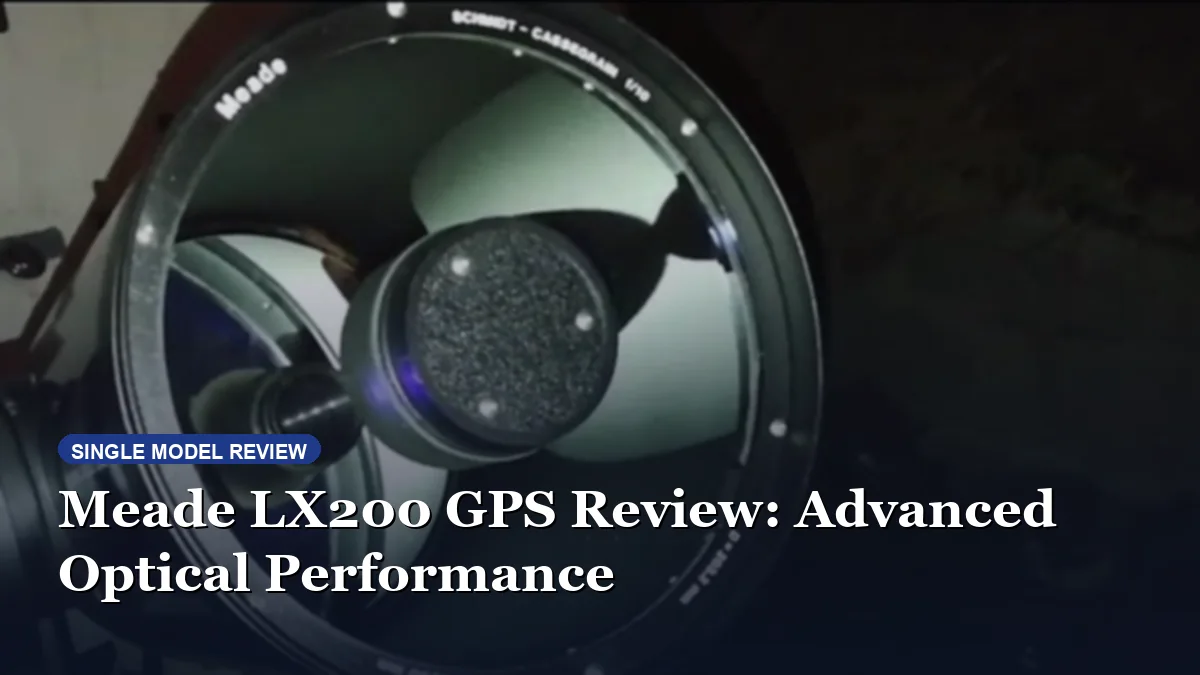

The Meade system delivers exceptional optical clarity and reliable automated alignment. Autostar II integration makes it a formidable tool for deep-sky observation.
See our flagship Best Telescope: Top Backyard Picks for Astronomy.
Verified Specifications
| Optical Design | Advanced Schmidt-Cassegrain |
|---|---|
| Aperture Size | 10-inch to 12-inch configurations |
| Focal Length | 2500mm focal length |
| Mount Type | Dual-fork motorized altazimuth |
| Control System | Autostar II hand controller |
| Connectivity | RS232 serial and USB console ports |
| Power Requirement | 12V DC external power source |
| System Weight | Exceeds 60 lbs assembled |
What We Liked
- Integrated GPS receiver accelerates field alignment initialization.
- Rigid dual-fork mount minimizes mechanical vibration during tracking.
- Comprehensive Autostar II database simplifies object location.
- Robust USB-to-serial connectivity supports modern firmware upgrades.
Trade-Offs
- Heavy optical tube assembly complicates solo field setup.
- Requires a stable external 12V power supply for optimal operation.
- Legacy serial architecture necessitates specific adapter cables.
Optical Architecture And Aperture Engineering
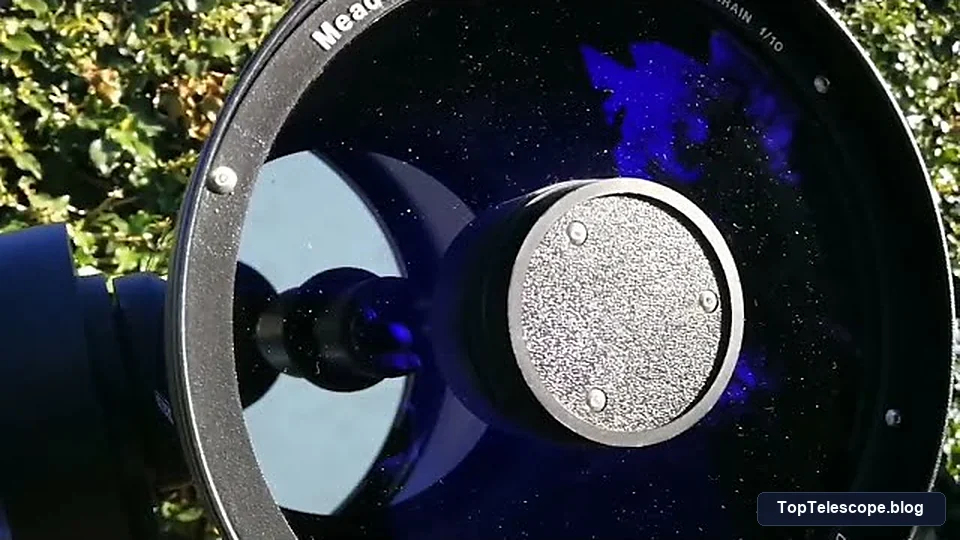
The optical configuration utilizes a modified Schmidt-Cassegrain design to deliver high-contrast planetary views. Its large aperture gathers substantial light, revealing faint deep-sky structures with remarkable clarity.
For buyers weighing optical performance between leading Schmidt-Cassegrain systems, reviewing the Celestron EdgeHD 8 vs Meade LX90 8 technical comparison highlights vital aperture differences.
The advanced Advanced Ultra-High Transmission Coatings applied to the corrector plate maximize photon throughput across the visible spectrum. This specialized optical formula significantly reduces surface reflections while enhancing overall contrast during faint deep-sky observations.
Featuring a classic Schmidt-Cassegrain optical design, the system balances a long focal length within a remarkably compact aluminum tube assembly. Primary mirror translation utilizes a precision micro-focus mechanism to minimize image shift during adjustments.
- Large aperture maximizes faint photon collection
- Multicoated corrector plate reduces internal glare
- Long focal length supports planetary detail
Focal Length Dynamics
Operating at an extended focal length provides exceptional native magnification. Users can easily resolve tight binary star systems and intricate lunar craters without excessive barlow usage.
- High native magnification capabilities
- Sharp resolution across lunar targets
Mechanical Mount Stability And Drive Mechanisms
Such heavy-duty mount designs frequently rank near the top when researching the best telescope for backyard astronomy because stable tracking platforms remain essential.
Precision worm gears drive both axes smoothly during extended astrophotography exposures. Backlash is minimized through careful mechanical engineering, ensuring consistent tracking accuracy over long imaging sessions.
Heavy-duty cast aluminum fork arms provide robust structural support, effectively dampening vibrations during high-magnification planetary viewing sessions. The oversized base incorporates wide bearing surfaces designed to handle substantial payloads without flexing under loads.
Driven by large worm gear drives on both axes, tracking accuracy remains exceptionally stable throughout long-exposure astrophotography runs. Periodic error correction routines can be programmed directly into the hand controller to minimize tracking drift errors.
- Dual-fork design enhances structural rigidity
- Precision worm gears reduce tracking backlash
- Heavy aluminum castings absorb field vibrations
Video Review: Meade LX200 8\
Automated Alignment And GPS Integration Protocols
Automated features like an internal GPS receiver often simplify setup routines for newcomers evaluating a best starter telescope option to bypass manual coordinate entries.
Once initialized, the computer queries local alignment stars to build a reliable sky model. Automated slewing maneuvers move swiftly to target coordinates with dependable positioning accuracy.
The integrated Sony GPS sensor automatically acquires precise time, date, and geographical coordinates directly from orbiting satellites upon startup. This automated data acquisition drastically reduces initial setup time before beginning the alignment routine.
Utilizing Level North Technology, the mount determines true vertical and magnetic north orientations using internal electronic sensors. Subsequent automatic two-star alignment sequences quickly sync the database for reliable GoTo target positioning across the sky.
- Internal GPS automates site calibration
- Fast initialization reduces setup time
- Reliable GOTO database includes thousands of targets
Modern Connectivity And Firmware Management Systems
Beginners exploring automated GoTo setups might prefer finding the best Meade telescope for beginners featuring intuitive hand controllers and robust software integration.
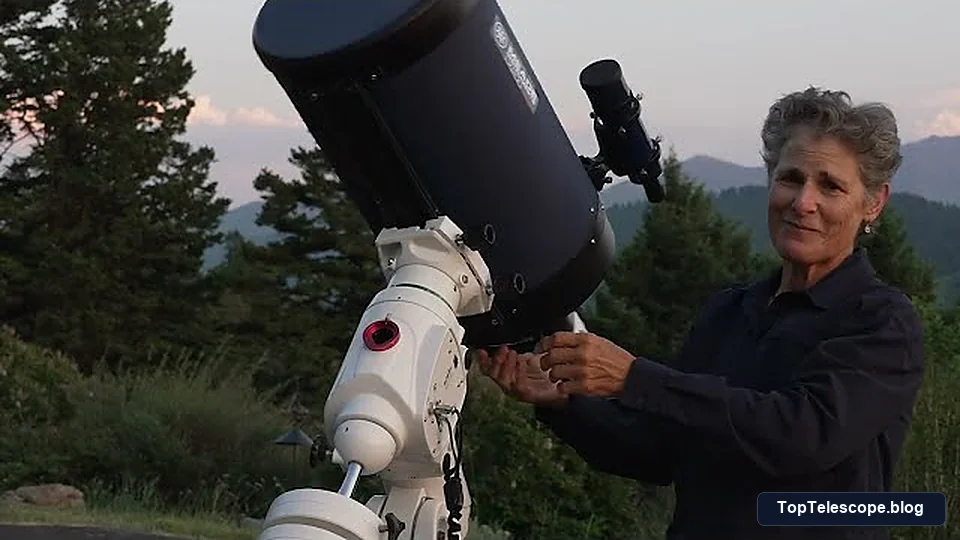
Upgrading firmware and controlling tracking parameters via planetarium software becomes seamless with updated drivers. Users can execute remote observation sequences without touching the physical hand paddle.
Equipped with standard RS-232 serial ports, the telescope readily interfaces with external computers for planetarium software integration and remote observatory automation. Users can easily update internal control databases using serial-to-USB adapter cables.
The Autostar hand controller features flash memory architecture, allowing operators to download the latest firmware patches and updated satellite orbit elements. This upgradability ensures long-term software compatibility with modern third-party astronomical mapping applications.
- USB conversion cables bridge legacy ports
- Compatible with major planetarium software packages
- Firmware updates enhance tracking performance
Field Assembly Ergonomics And Power Requirements
Transporting this heavy optical assembly demands careful handling and secure vehicle placement. The substantial weight of the fork mount requires two people for safe field assembly.
Power delivery relies entirely on stable 12V DC external batteries to prevent erratic tracking behavior. Maintaining a consistent voltage supply prevents internal computer resets during critical imaging runs.
Weighing nearly thirty kilograms total, the optical tube and fork assembly requires careful handling during field transport and setup. Integrated carrying handles built into the fork base help prevent accidental drops during field assembly procedures.
Operating reliably on a 12-volt DC power source, the internal electronics demand a stable electrical supply to prevent erratic GoTo behavior. Using heavy-duty external power tanks prevents voltage drops during high-torque slew operations.
- Heavy assembly requires two-person setup
- External 12V battery ensures stable power
- Ergonomic carrying handles ease transport
Long-Term Maintenance And Operational Durability
Regular cleaning of the corrector plate preserves optimal light transmission over years of use. Users must employ proper optical cleaning solutions to avoid scratching delicate antireflective coatings.
Mechanical gears benefit from periodic inspection and professional lubrication to maintain smooth slewing operation. Storing components in dry padded cases prevents internal moisture accumulation and corrosion.
Routine maintenance requires keeping the corrector plate clean using optical-grade micro-fiber cloths and approved cleaning solutions. Periodic inspection of the internal drive gears ensures proper meshing and prevents premature mechanical wear over years of use.
Storing the instrument in a climate-controlled environment prevents moisture accumulation and protects sensitive electronic components from corrosion. Applying fresh synthetic grease to the mechanical tracks maintains smooth azimuth rotation mechanics during cold weather observing.
- Gentle cleaning protects optical coatings
- Periodic gear checks ensure smooth tracking
- Padded storage cases prevent environmental damage
Frequently Asked Questions
How does the GPS receiver assist alignment?
The internal GPS sensor automatically captures exact time and location data upon startup. This automation eliminates manual coordinate entry errors during initial setup.
Can I connect this telescope to a modern laptop?
Yes, utilizing a specialized USB-to-serial console cable allows seamless connection. Modern computers interface directly with the Autostar II hand controller.
What power supply is recommended for field use?
A stable 12V DC external power source is strictly required for reliable operation. Reliable power prevents unexpected computer resets during long imaging sessions.
Is this optical system suitable for beginner observers?
The heavy weight and complex alignment procedures cater best to advanced users. Experienced astronomers will appreciate its deep technical capabilities and precision tracking.
How do I update the hand controller firmware?
Users must connect a compatible interface cable and run software updates via a PC. Firmware updates improve tracking algorithms and database accuracy.