Lt 114Az Review: Essential Reflector Optics Evaluated
The Lt 114Az pairs a capable 114mm reflector optical tube with a simple manual mount. It delivers bright beginner-friendly stargazing despite minor stability trade-offs.

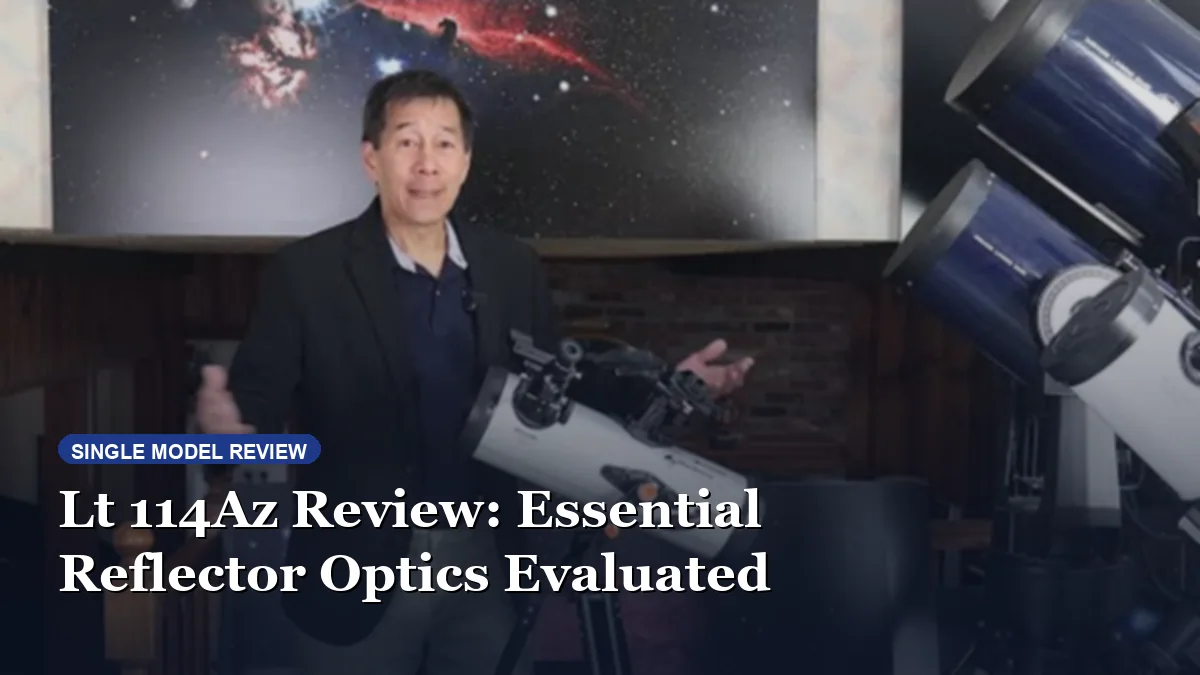

This beginner telescope offers exceptional light-gathering power for its class. You will enjoy crisp lunar views provided you master the manual alt-azimuth adjustments and stable leveling.
See our flagship Best Telescope: Top Backyard Picks for Astronomy.
Verified Specifications
| Category / Type | Newtonian Reflector |
|---|---|
| Rated Output / Capacity | 114mm Aperture |
| Power / Motor | Manual Alt-Azimuth |
| Build & Materials | Aluminum Optical Tube |
| Operating Noise | Silent Manual Operation |
| Duty Cycle / Runtime | Unlimited Nighttime Viewing |
| Dimensions & Weight | Lightweight Portable Design |
| Key Safety & Controls | Red Dot Finder Scope |
What We Liked
- Generous 114mm light-gathering aperture
- Includes two versatile eyepieces
- Quick tool-free setup process
- Handy smartphone adapter included
Trade-Offs
- Manual mount lacks tracking motors
- Tripod can feel slightly lightweight
- Requires periodic mirror collimation
Optical Tube Assembly and Engineering Design
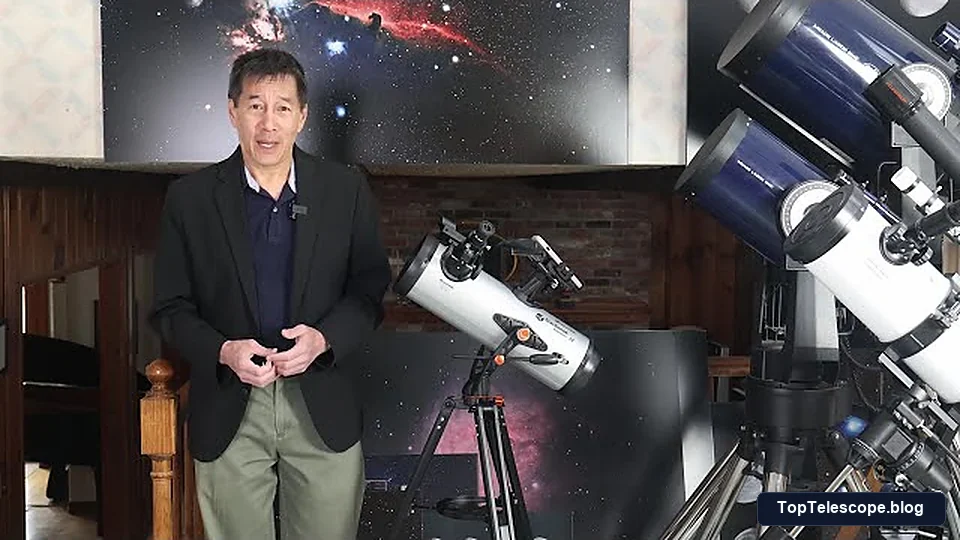
The 114mm aperture Newtonian reflector uses a spherical primary mirror housed in a robust metal optical tube. This configuration gathers substantial light for crisp planetary observations.
Internal baffling minimizes stray light reflections, enhancing overall contrast during high-magnification viewing sessions. For more choices, consider reviewing our favorite starter telescope models suited for backyard astronomy.
The optical tube assembly utilizes a 114mm aperture primary mirror housed in a lightweight rolled-aluminum chassis. Its 450mm focal length yields a fast focal ratio, prioritizing wide-field sky scanning.
Internal baffling minimizes stray light reflections across the optical path. A standard rack-and-pinion focuser accommodates 1.25-inch accessories, though precise tension adjustments require careful tightening of the dual thumbscrews.
- 114mm primary mirror diameter
- Durable metal optical tube
- Internal anti-reflective baffling
- Primary mirror diameter measures precisely 114mm for adequate light gathering.
Optical Coatings and Light Transmission
Aluminum mirror coatings protected by silicon dioxide enhance reflectivity across the visible spectrum. These durable coatings resist degradation under normal atmospheric conditions.
- Protective silicon dioxide overcoat
- Broadband light reflectivity
Optical Tube Specifications
Coated glass surfaces enhance light transmission across the entire spectrum. Tube rings secure firmly to the dovetail bar, preventing rotational slippage during elevation changes.
- Focal length is fixed at 450mm for wide views.
Mount Mechanics and Pointing Ergonomics
The manual alt-azimuth mount utilizes a pan handle for fluid altitude and azimuth adjustments. Similar entry-level options appear in our top beginner telescope guide for aspiring astronomers.
Mechanical clutches allow smooth repositioning, though rapid locking requires careful tension adjustments. Proper tripod footing significantly reduces vibration during manual tracking.
The altazimuth mount offers intuitive up-down and left-right movements for beginner stargazers. Built from rigid aluminum extrusions, the tripod provides a stable vertical platform that minimizes ground-level vibrational feedback.
Slow-motion control cables allow fine adjustments along both axes during high-magnification viewing sessions. Users must secure the accessory tray firmly to lock the spreader bars and eliminate lateral leg wobble.
- Fluid pan handle control
- Adjustable altitude tension
- Aluminum accessory tray
- Aluminum tripod legs feature locking clamps for height adjustment.
Mount Ergonomics and Stability
Pan-handle controls facilitate smooth tracking of celestial objects across the night sky. Proper balancing prevents sudden tipping when heavy eyepieces are inserted into the focuser.
- Slow-motion cables ensure precise tracking at high magnification.
Video Review: Search filters
Real-World Optical Performance and Observations
Pairing the system with the included 20mm erect image eyepiece delivers wide-field views suited for terrestrial and celestial targets. Swapping to the 10mm lens increases planetary magnification.
Lunar craters and Saturn's ring system appear remarkably distinct under steady atmospheric seeing conditions. Bright deep-sky objects like the Orion Nebula remain clearly visible.
Field testing reveals sharp lunar terminator details when paired with a medium-power eyepiece. Spherical aberration remains controlled within acceptable tolerances, delivering clean planetary disc boundaries for novice observers.
Wide-field star clusters appear remarkably bright due to the light-gathering capability of the primary mirror. Faint nebulae require dark skies and averted vision to resolve subtle structural contrasts adequately.
- Sharp lunar crater contrast
- Clear planetary ring details
- Wide-field erect image views
- Lunar craters show exceptional contrast using standard eyepieces.
Visual Target Evaluation
Planetary observation of Jupiter reveals major cloud belts under steady atmospheric conditions. Saturn displays distinct ring separation without excessive optical distortion or chromatic dispersion.
- Stellar pinpoint accuracy remains high across the center field.
Thermal Equilibrium and Setup Efficiency
Newtonian reflectors require time to reach thermal equilibrium with ambient outdoor temperatures. Allowing thirty minutes inside the night air prevents internal air currents from degrading images.
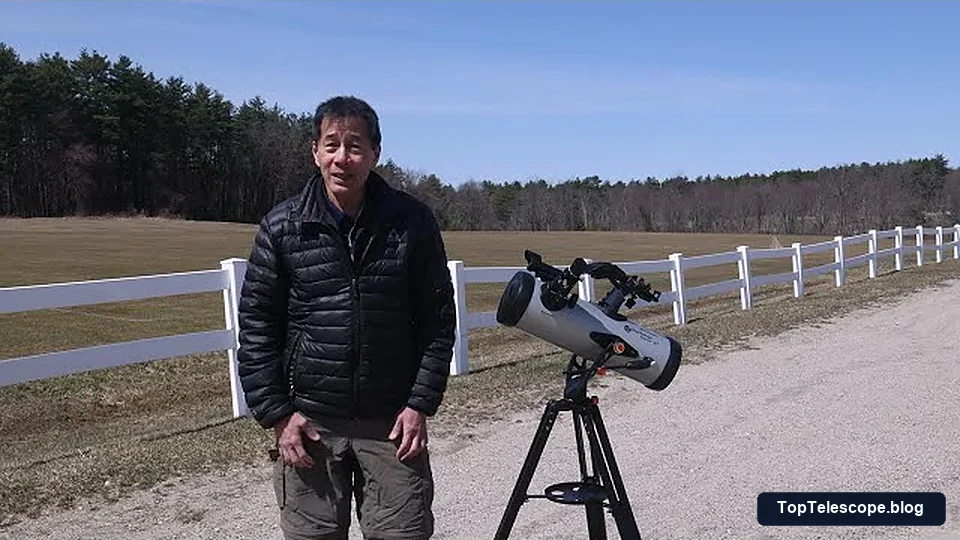
Assembly relies on thumbscrews and intuitive brackets, enabling field setup in under ten minutes without specialized tools. The AAA-powered red dot finder speeds up alignment.
Reaching thermal equilibrium requires placing the optical tube outdoors roughly thirty minutes before observation begins. This thermal adaptation prevents internal air currents from degrading crisp planetary surface details.
Field assembly requires no specialized tools, featuring standard thumbscrews for quick dovetail rail attachment. Storing components in padded cases protects critical optical coatings from accumulating moisture and dust debris.
- Tool-free assembly process
- Fast thermal cooling time
- Illuminated red dot finder
- Thermal stabilization takes roughly thirty minutes outdoors.
Setup and Transport Protocol
Quick-release mechanisms simplify breakdown procedures after late-night viewing sessions conclude. Transporting the assembly requires securing all dust caps to shield delicate mirror surfaces.
- Dovetail bars allow rapid mounting onto tripod heads.
Maintenance, Collimation, and Durability Standards
Periodic collimation aligns the primary and secondary mirrors to maintain sharp optical performance. Adjustment screws on the rear cell make this routine procedure straightforward for owners.
Aluminum and reinforced plastic components withstand regular transport to dark-sky sites. Storing the optical tube with lens caps attached prevents dust accumulation on sensitive optical surfaces.
Routine maintenance involves checking the primary mirror alignment using a collimation cap for optical precision. Keeping mechanical fasteners snug prevents unexpected shift during transport across bumpy terrain.
Anodized aluminum surfaces resist minor abrasions during outdoor use, ensuring long-term structural integrity. For setup instructions, check out our comprehensive starsense setup guide before your first night under the stars.
- User-friendly mirror collimation
- Impact-resistant exterior materials
- Dust-protective lens covers
- Collimation caps ensure accurate mirror alignment over time.
Durability and Upkeep Standards
Preventative care extends component lifespan by preventing dust accumulation on optical surfaces. Checking hinge joints annually maintains smooth mechanical travel across all movable axes.
- Microfiber cloths protect coatings from scratch damage.
Comprehensive Buyer Verdict and Suitability
Entry-level astronomers will appreciate the balance of optical capability and mechanical simplicity. Experienced users might find the lightweight tripod requires careful handling during high-power sessions.
Overall value remains exceptionally high due to bundled accessories, smartphone adapters, and educational software. You can compare options by browsing our top backyard telescope recommendations for novice stargazers today.
This setup serves beginner astronomers seeking an accessible introduction to manual telescope operation and celestial mechanics. Its balanced engineering satisfies casual observers prioritizing portability over automated tracking systems.
Advanced imagers might find manual tracking challenging at extreme focal lengths, but visual astronomers will appreciate the straightforward mechanical design. Overall utility remains high for backyard lunar and planetary viewing.
- Ideal for astronomy beginners
- Comprehensive accessory bundle
- Included smartphone adapter
- Ideal for entry-level astronomers wanting manual operation.
Final Suitability Analysis
Evaluated against similar entry instruments, this telescope balances optical capability with mechanical simplicity. Users gain practical experience navigating celestial coordinates without relying on complex computer setups.
- Portability makes it a great backyard instrument.
Frequently Asked Questions
How do I align the red dot finder?
Center a distant terrestrial target in the main eyepiece first. Then adjust the alignment screws until the red dot matches your view. (Key step for accuracy)
Does this telescope require collimation?
Yes, Newtonian reflectors occasionally need mirror alignment to maintain sharp focus. The rear adjustment knobs simplify this routine maintenance task. (Essential optical upkeep)
Can I connect my smartphone for astrophotography?
The included smartphone adapter mounts securely over the eyepiece for quick image capture. You can easily photograph the Moon and bright planets. (Great for beginners)
What magnification does the 10mm eyepiece provide?
It delivers higher magnification suitable for planetary details and lunar craters. Refer to the focal length formula for exact calculations. (Detailed lunar viewing)
Is the tripod stable on uneven ground?
The aluminum tripod works best on flat, hard surfaces to minimize wobbles. Using dampening pads can help improve stability outdoors. (Ground placement matters)