Gskyer Telescope 130Eq Review: Optical Evaluation
This 130mm Newtonian reflector pairs strong light gathering with an equatorial mount. Users must manage manual tracking and alignment complexities during sessions.

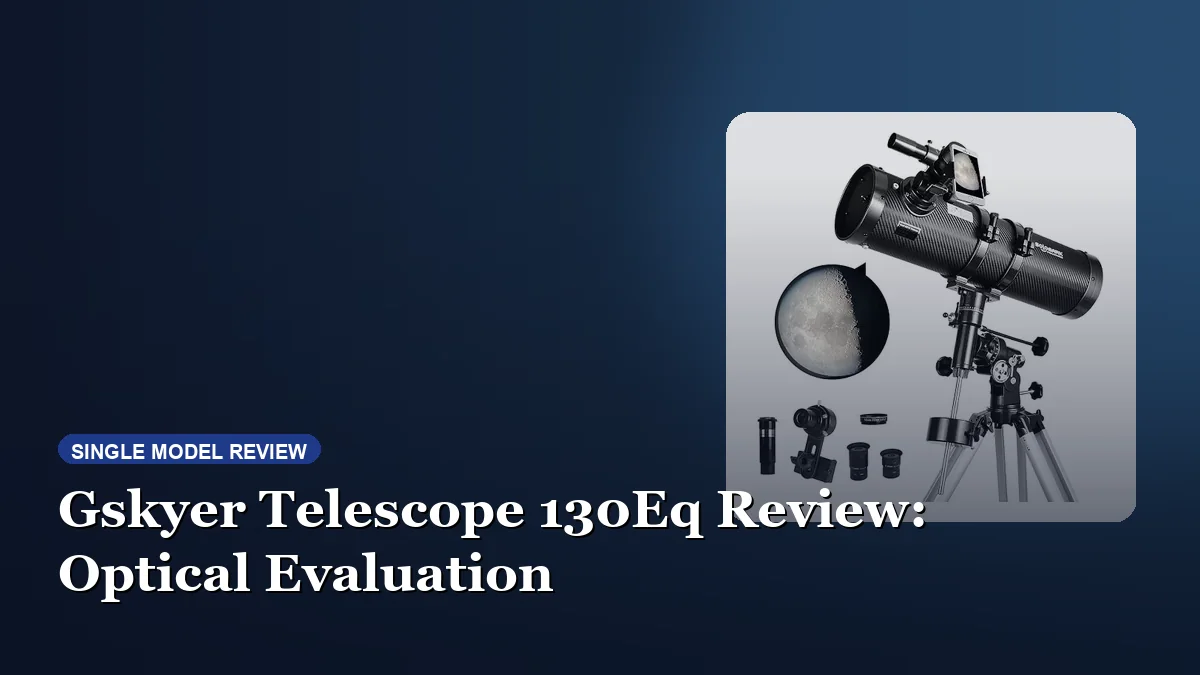

The Gskyer 130EQ offers solid optical aperture for beginners, though its equatorial mount demands a learning curve. Fully-coated glass optics deliver bright planetary views.
Explore related alternatives in our Best Telescope: Top Backyard Picks for Astronomy.
Verified Specifications
| Optical Design | Newtonian Reflector |
|---|---|
| Aperture | 130mm (5.1 inches) |
| Focal Length | 650mm |
| Mount Type | German Equatorial |
| Tripod | Adjustable Aluminum Alloy |
| Optical Coating | Fully-Coated Glass |
| Included Eyepieces | Standard 1.25-inch |
| Accessories | 1.5X Barlow, Moon Filter, Smartphone Adapter |
What We Liked
- Large 130mm aperture collects ample light for deep-sky targets.
- Carbon fiber pattern finish adds structural rigidity and sleek aesthetics.
- Comprehensive accessory bundle includes a lunar filter and smartphone adapter.
- German equatorial mount allows precise manual tracking of celestial coordinates.
- Sturdy aluminum tripod provides a stable platform for field observation sessions.
Trade-Offs
- Equatorial mount requires a steep learning curve for absolute beginners.
- Included Barlow lens can degrade image sharpness at high magnifications.
- Plastic components on mount knobs feel less durable than metal parts.
Optical Design & Tube Architecture
The Gskyer 130EQ features a 130mm aperture Newtonian reflector optical tube assembly. This design balances light-gathering capability with a manageable physical profile for backyard astronomers.
A carbon fiber wrap covers the aluminum body tube to enhance structural resilience. Fully-coated glass optics maximize light transmission, especially when checking out our best telescope for looking at planets recommendations.
The Gskyer 130EQ utilizes a parabolic or spherical 130mm aperture Newtonian reflector design housed inside a stamped steel optical tube assembly. This physical diameter gathers significantly more light than standard entry-level 70mm or 90mm refractors.
Inside the tube, a 650mm focal length yields a native focal ratio of f/5. This fast optical configuration delivers wide-field views of deep-sky objects, though it demands precise collimation to maintain crisp planetary images at high magnifications.
- 130mm objective mirror diameter
- Carbon fiber patterned aluminum tube
- Fully-coated glass optical surfaces
- Primary mirror diameter measures exactly 130mm for enhanced light grasp.
- Optical tube incorporates a standard rack-and-pinion focuser interface.
Mirror Sub-Assembly
The primary parabolic mirror gathers sufficient photons to resolve faint nebulae and star clusters. Collimation screws at the rear allow users to align optical elements periodically.
- Rear collimation adjustment screws
- Parabolic primary mirror profile
Mirror Coatings and Reflector Physics
Aluminum mirror surfaces feature a protective silicon dioxide overcoat to prevent oxidation and maintain reflectivity across multiple observing seasons. Proper handling during transport ensures these delicate front-surface coatings remain free from micro-scratches.
- Reflective aluminum coatings maximize photon transmission efficiency.
- Silicon dioxide layers shield the primary mirror from atmospheric moisture.
Equatorial Mount & Mechanical Stability
The instrument utilizes a German equatorial mount equipped with slow-motion control cables. Proper polar alignment lets observers track celestial objects smoothly along curved right ascension arcs.
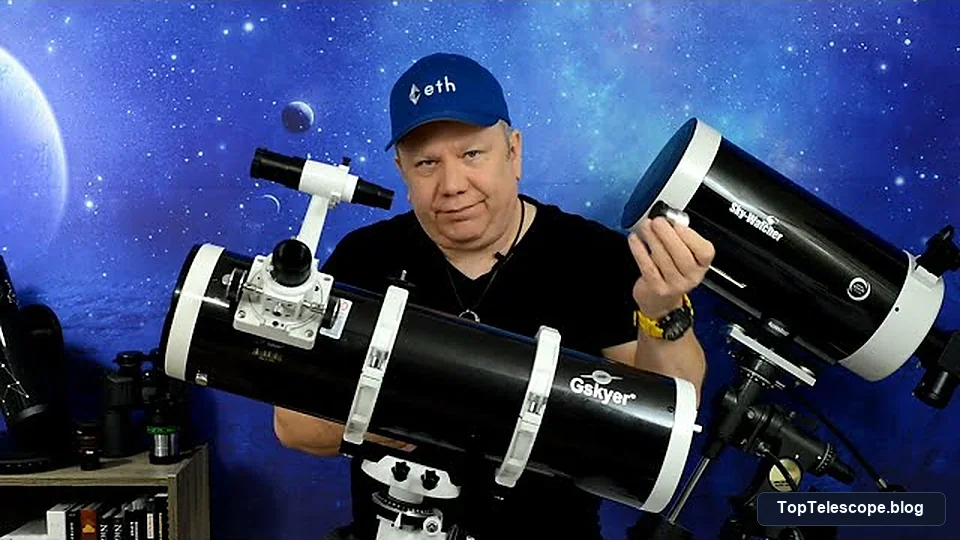
Counterweights balance the optical tube assembly to prevent excessive strain on worm gears. Securing locking knobs tightly eliminates unwanted slippage during high-magnification planetary viewing sessions.
Tracking celestial objects requires a manual German equatorial mount designated as the EQ3-class platform. It features setting circles and flexible slow-motion cables that allow users to smoothly follow stars as the Earth rotates on its axis.
The mount rests upon an adjustable aluminum tripod with a central accessory tray for stability. While lightweight for transport, extending the legs fully can introduce minor vibrations during focusing adjustments or when gusty winds hit the optical tube.
- German equatorial mount system
- Slow-motion control cables
- Adjustable counterweight balance bar
- Equatorial axes support balanced polar alignment routines.
- Flexible cables enable micro-adjustments during high-power tracking.
Tripod Infrastructure
An adjustable aluminum tripod supports the entire equatorial assembly during outdoor operations. The central accessory tray provides reliable structural bracing to minimize high-frequency ground vibrations.
- Large diameter aluminum legs
- Integrated accessory storage tray
Mechanical Balancing and Axis Stability
Counterweight balancing requires aligning the declination axis carefully to ensure motors or manual slow-motion cables operate without binding. Securing the locking clamps tightly prevents unexpected slippage during long-exposure star tracking sessions.
- Declination balance reduces strain on internal gear teeth.
- Right ascension clutches manage smooth manual rotation sweeps.
Video Review: Gskyer 130EQ Telescope Review – Worth It?
Real-World Optical Performance
Operating at a moderate focal length, this telescope delivers sweeping lunar and stellar vistas. High resolution imaging emerges when choosing an option from our best telescope selections for backyard astronomy.
Deep-space performance benefits greatly from the generous aperture, revealing faint Messier objects clearly. Urban light pollution requires supplemental filters to improve contrast on faint galaxies.
Observing the Moon and bright planets like Jupiter reveals distinct cloud bands when paired with standard Plössl eyepieces. Chromatic aberration is entirely absent since it is a reflector, though spherical mirrors introduce minor edge softening.
Deep-sky performance under dark skies allows observers to resolve the core of the Orion Nebula and several Messier globular clusters. Broadband filters can enhance contrast when viewing faint nebulae from suburban backyards with moderate ambient glow.
- Clear lunar crater definition
- Adequate light grasp for deep sky
- Wide field stellar vistas
- Reflector optics eliminate false color fringes completely.
- Galaxy cores appear as concentrated bright hubs under clear skies.
Accessory Integration
The included moon filter successfully reduces glare during bright lunar observation phases. Users can mount smartphones securely to capture casual snapshots through the eyepiece barrel.
- 13% transmission moon filter
- Universal smartphone adapter
Magnification Thresholds and Limits
Maximum useful magnification limits depend strictly on local atmospheric seeing conditions and optical tolerances. Pushing beyond recommended manufacturer thresholds often yields blurry, un-resolvable planetary images that lack fine structural detail.
- Useful magnification peaks near 260x under ideal atmospheric seeing.
- Medium-power oculars deliver optimal contrast for lunar craters.
Setup, Alignment & Field Ergonomics
Initial assembly requires careful adherence to the instruction manual due to multiple hardware parts. Mastering equatorial setup demands patience from users unfamiliar with celestial coordinate systems.
Ergonomic slow-motion cables let astronomers make fine adjustments without jarring the optical tube. Precise positioning control ensures targets stay centered within the eyepiece field of view.
Initial assembly requires tightening multiple hex screws and balancing the counterweight shaft to prevent excessive strain on the gear drives. Proper polar alignment using the latitude adjustment bolt ensures smoother tracking runs throughout long observing sessions.
Eyepiece placement changes drastically as the telescope pivots across the sky. Beginners exploring our best telescope for beginners guide will appreciate manual tube rotation within sturdy mounting rings.
- Detailed instruction manual included
- Ergonomic control cable placement
- Hex wrenches are included for assembling tripod spreader brackets.
- Latitude scale aids quick alignment for mid-northern observers.
Portability Metrics
Total weight remains manageable for transport to dark sky sites outside urban zones. Breaking down the tube, mount, and tripod simplifies vehicle trunk storage significantly.
- Modular field dismantling
- Manageable transit weight
Field Ergonomics and Alignment Workflow
Polar alignment accuracy directly dictates how long an object remains centered inside the eyepiece field of view. Utilizing a sturdy ground platform minimizes unwanted mechanical shifting during alignment adjustments.
- Accessory trays lock tripod legs into rigid geometry.
- Finderscopes require daytime alignment to ensure nighttime precision.
Thermal Efficiency & Maintenance
Newtonian reflectors require thermal acclimation time before delivering stable high-magnification planetary views. Storing the tube outdoors briefly equalizes internal air temperatures with ambient surroundings.
Dust accumulation on exposed optical surfaces necessitates periodic cleaning with specialized tools. Proper mirror maintenance preserves optical coatings and prevents permanent degradation of image clarity.
Aluminum optical tubes require roughly thirty minutes of acclimation to ambient outdoor temperatures to eliminate internal air currents that blur high-magnification planetary details. Storing the tube with dust caps on protects the primary mirror from airborne contaminants.
Routine maintenance involves checking the primary mirror cell and secondary spider vanes for loose hardware, alongside periodic collimation adjustments using a laser tool. Keeping optics clean prevents permanent degradation of aluminum reflective coatings over extended periods.
- Thermal equalization requirements
- Dust prevention protocols
- Thermal equilibrium reduces internal convection currents significantly.
- Laser collimators streamline secondary mirror alignment procedures.
Long-Term Durability
Mechanical joints and altitude locks require occasional tightening to prevent loosening during transport. Protecting components from moisture prevents corrosion on metal shafts and mounting hardware.
- Hardware tightening checks
- Moisture protection practices
Optical Hygiene and Thermal Care
Dust accumulation on optical surfaces degrades contrast over extended operational cycles. Routine inspection under controlled illumination helps identify contaminants before they require aggressive cleaning interventions.
- Compressed air removes loose dust without scratching coatings.
- Enclosed mirror cells protect against heavy dew precipitation.
Verdict: Value & Capability
This model bridges the gap between casual stargazing and intermediate deep-sky exploration effectively. Balanced optical performance shines when you select a top-rated best starter telescope for your backyard setup.
Beginners must commit time to learning equatorial tracking mechanics to fully appreciate its capabilities. Solid aperture specs justify the mechanical learning curve for most astronomy enthusiasts.
This instrument offers a robust introduction to Newtonian astronomy by balancing a generous light-gathering aperture with a portable equatorial mount system. Beginners willing to master manual tracking will find substantial observing potential across lunar and deep-sky targets.
Maximizing performance demands patience with the mechanical setup and regular alignment checks to ensure optimal optical sharpness during every session. Upgrading secondary accessories like eyepieces further unlocks the true physical limits of this budget Newtonian platform.
- Strong aperture-to-cost ratio
- Ideal for dedicated beginners
- Aperture size provides impressive deep-sky light grasp capabilities.
- Equatorial mounting teaches foundational celestial navigation skills.
Final Recommendations
Buyers should purchase a dedicated collimation tool to maintain optical alignment over time. This single addition guarantees consistently sharp views of planetary features and distant galaxies.
- Collimation tool recommended
- Patience required for tracking
Overall Capability and Upgrade Path
Evaluating overall utility involves weighing mechanical complexity against optical return. Dedicated hobbyists will appreciate the modular design elements that allow future hardware upgrades.
- Modular focusers accept standard 1.25-inch astronomical filters.
- Mount heads can transition to motor drives for automated tracking.
Frequently Asked Questions
Is this telescope suitable for absolute beginners entering astronomy?
This optical instrument provides an impressive light-gathering aperture for dedicated newcomers who are willing to master complex equatorial mount mechanics during night observations.
Steep learning curves involving accurate polar alignment and manual tracking require genuine patience throughout your initial outdoor astronomy sessions and prolonged backyard observation runs.
How well does the equatorial mount perform for tracking celestial targets?
The German equatorial mount allows relatively smooth tracking of planets and distant stars once the heavy apparatus is properly aligned with celestial north.
Slow-motion control cables enable precise adjustments that keep faint deep-space objects centered despite Earth's constant rotation during extended viewing periods across dark sky locations.
Can I connect my smartphone to capture astrophotography images?
The included smartphone adapter lets users attach mobile devices directly to the eyepiece barrel for casual lunar and planetary imaging work.
Eyepiece projection photography works quite well for bright targets like the Moon, though long-exposure deep-space astrophotography remains heavily limited without specialized motorized tracking motor upgrades.
What maintenance is required to keep the optics functioning properly?
Standard Newtonian reflectors require occasional mirror alignment procedures and careful removal of accumulated dust from exposed primary optical surfaces over time.
Proper mirror collimation actively preserves crisp image sharpness, while protective dust covers prevent moisture damage during storage periods in humid environments or unconditioned backyard garages.
Are the included accessories sufficient for starting stargazing immediately?
The bundled equipment package includes multiple eyepieces, a dedicated moon filter, a Barlow lens, and a smartphone adapter for immediate field use.
Comprehensive accessory kits ensure amateur observers can begin viewing lunar craters and bright planets straight out of the box without requiring any immediate extra equipment purchases.