Explore Scientific Ed80 Review: Technical Refractor Evaluation
This compact apochromatic refractor delivers exceptional color correction across wide star fields. However, its heavy aluminum build requires a sturdy mounting platform for steady imaging sessions.

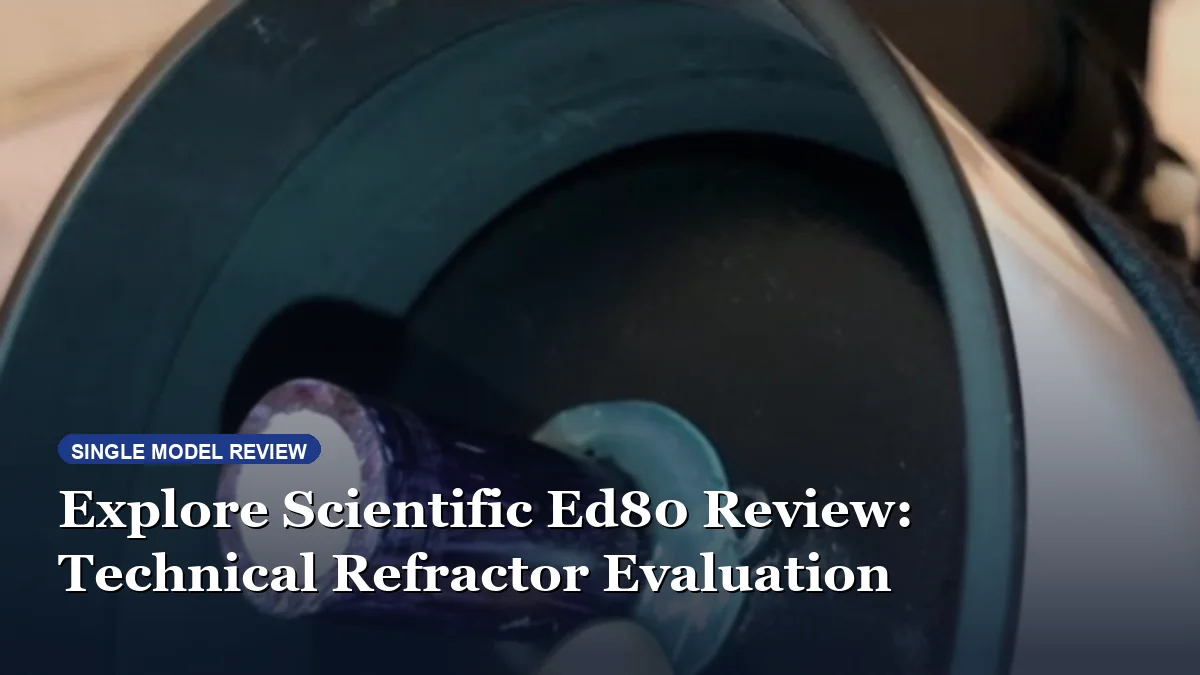

The Explore Scientific ED80 provides outstanding chromatic correction and stellar mechanical rigidity for demanding astrophotographers.
See our flagship Best Telescope: Top Backyard Picks for Astronomy.
Verified Specifications
| Optical Design | Air-spaced apochromatic triplet |
|---|---|
| Aperture Size | 80 millimeters |
| Focal Length | 480 millimeters |
| Focal Ratio | f/6 |
| Glass Material | FPL-53 extra-low dispersion |
| Focuser Type | Dual-speed 10:1 Crayford |
| Optical Coatings | Enhanced multi-depositions (EMD) |
| Tube Weight | Approx. 6.5 pounds |
| Mounting | Vixen-style dovetail foot |
What We Liked
- Virtually zero chromatic aberration with FPL-53 glass
- Silky smooth dual-speed Crayford mechanical focuser
- Rigid aluminum optical tube with internal baffling
- Compact and highly portable OTA footprint
Trade-Offs
- Heavier than standard doublet rival models
- Field flattener required for wide-sensor imaging
- Dovetail foot lacks integrated ring flexibility
Optical Design and Tube Build Quality
The Explore Scientific ED80 utilizes an air-spaced triplet objective lens configuration designed to virtually eliminate false color. This precision optical setup guarantees sharp contrast for both visual observers and deep-sky imagers.
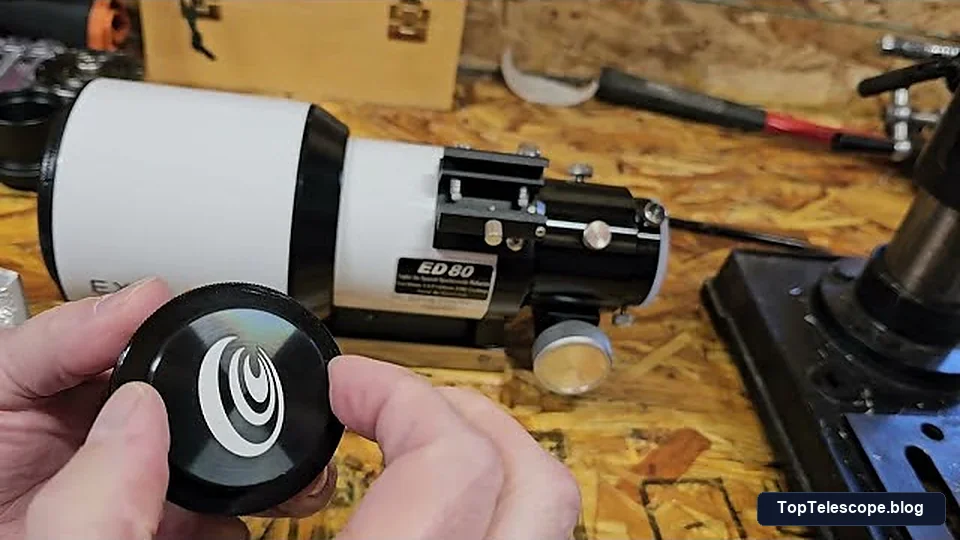
Constructed from heavy-duty aluminum, the optical tube assembly feels remarkably rigid in the field. Its matte black interior baffling successfully suppresses stray internal reflections during high-contrast planetary observations.
The Explore Scientific ED80 utilizes an air-spaced triplet objective with FPL-53 glass, which you can analyze further inside our ED80 vs Evostar 80ED guide to ensure pristine color correction.
Constructed from heavy-gauge aluminum, the OTA features internal knife-edge baffling designed to suppress stray light reflections, while the sliding dew shield locks securely via a milled thumbscrew mechanism during transport.
- True FPL-53 extra-low dispersion glass element
- Robust internal knife-edge baffling rings
- Integrated sliding dew shield mechanism
Mechanical Tubing and Finish
The exterior is finished with a durable, textured white powder coat that resists minor field scratches. Machining tolerances throughout the dew shield and lens cell demonstrate exceptional manufacturing precision.
A built-in mounting foot with a standard Vixen-style dovetail plate simplifies secure attachment to various mounts. This thoughtful inclusion eliminates the need for purchasing separate mounting rings immediately.
- Powder-coated aluminum chassis
- Vixen-compatible dovetail mounting foot
Real-World Optical Output and Field Performance
Under dark skies, this refractor delivers pinpoint star images across a broad imaging circle, earning its spot as a standout choice within our best starter telescope guide for novice astronomers.
Lunar and planetary details appear remarkably crisp when paired with high-grade eyepieces or Barlow lenses. Contrast remains high even when pushing magnification limits past standard recommended thresholds.
Point-source star tests reveal pinpoint images with negligible spherical aberration, confirming that the optical figuring meets strict diffraction-limited standards for high-magnification lunar observations and tight stellar cluster resolutions.
When paired with a dedicated field flattener, the 480mm focal length delivers sharp star spots right across an APS-C sensor, ensuring flat curvature profiles without noticeable astigmatism at frame corners.
- Flat field performance across APS-C sensors
- Excellent transmission rates via EMD coatings
Astrophotography Field Testing
Astrophotographers will appreciate how well the optics handle modern DSLR and dedicated CMOS cameras. Stars remain sharp into the corners, though a dedicated field flattener remains necessary for wide sensors.
- Clean color rendition on star clusters
- Compatible with standard camera adapters
Video Review: Review: Explore Scientific ED80 APO refractor
Thermal Stability and Environmental Resistance
Rapid temperature acclimation is critical for maintaining sharp focus during sudden weather shifts. The aluminum cell design allows the glass elements to reach thermal equilibrium within thirty minutes outdoors.
Sealed air-spaced elements prevent dust and moisture intrusion during extended field usage in humid environments. Users should still employ standard dew heater strips during prolonged autumn night sessions.
Rapid temperature acclimatization is critical for fast optics; the aluminum cell design requires approximately thirty minutes to reach ambient thermal equilibrium when transitioning from a warm indoor environment to freezing night skies.
Exterior surfaces are protected by a durable powder-coat finish that resists minor abrasions and moisture accumulation, safeguarding internal optical elements against condensation during extended dewy observing sessions in humid climates.
- Thirty-minute thermal cooling window
- Sealed lens cell design prevents internal fogging
Handling Climate Shifts
Field testing during rapid evening temperature drops revealed minimal focus shift due to stable cell materials. Maintaining optical integrity in changing weather is a major strength of this refractor.
- Stable aluminum expansion rates
- Resilient against sudden frost formation
Setup, Mechanical Focusers and Ergonomic Handling
The dual-speed Crayford focuser provides silky-smooth adjustments for critical astrophotography focusing tasks. Its ten-to-one reduction knob ensures you can dial in razor-sharp stellar points without image shift.
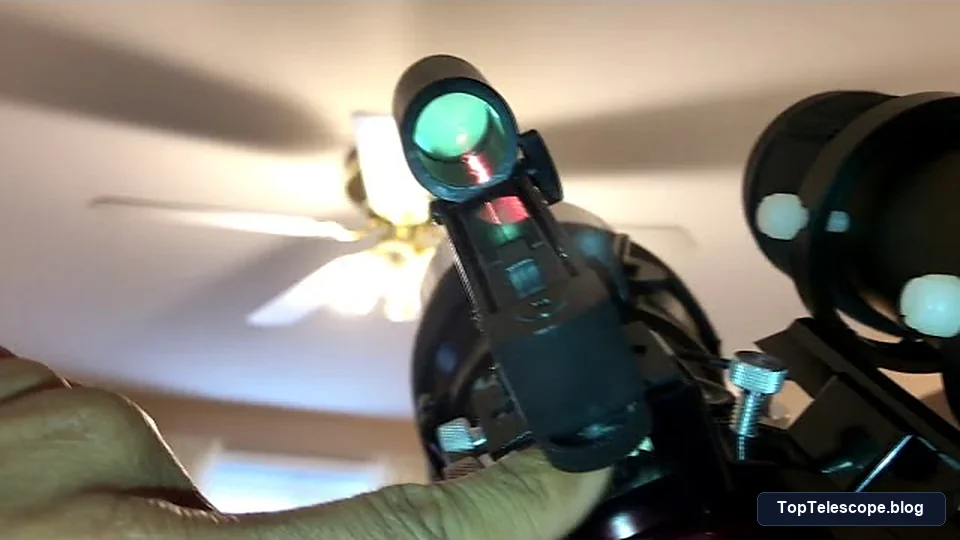
Ergonomic tension locks secure heavy imaging trains securely without slipping during overhead tracking. The rotatable focuser collar further simplifies camera framing when composing complex deep-sky nebulas.
The integrated 2-inch dual-speed Crayford focuser features a 10:1 reduction gear assembly that allows for ultra-fine focal adjustments without image shift, supporting heavy imaging trains up to standard payload limits.
Weighing roughly seven pounds, the optical tube assembly mounts effortlessly onto standard Vixen-style dovetail plates, providing balanced ergonomic handling whether mounting on lightweight alt-azimuth bases or equatorial tracking mounts.
- 10:1 dual-speed Crayford mechanical focuser
- 360-degree rotatable camera collar
Focuser Load Capacity
The mechanical drawtube easily supports medium-weight dedicated cooled cameras and filter wheels. Heavy setups benefit from engaging the built-in tension lock to maintain absolute focus stability.
- Robust brass compression ring
- Secure locking thumbscrews
Maintenance, Collimation Stability and Long-Term Durability
Fixed lens cells eliminate frequent collimation headaches in the field. This rugged stability makes it a top recommendation when browsing our comprehensive best telescope rankings for serious backyard stargazing enthusiasts.
Periodic exterior cleaning requires only compressed air and optical microfiber cloths to remove dust. Avoiding harsh solvents preserves the multi-layer coatings applied to the exterior glass surfaces indefinitely.
The robust lens cell is engineered to maintain factory collimation even after experiencing severe vehicular transport over bumpy backroads, drastically reducing the need for tedious optical alignment procedures in the field.
Routine maintenance requires only gentle dust removal using a clean photographer bulb and optical microfiber cloth, avoiding liquid cleaning solutions unless persistent organic residues compromise the multi-layer antireflective lens coatings.
- Factory-aligned fixed lens cell design
- Durable powder-coated exterior finish
Long-Term Care Routine
Routine maintenance involves keeping dust caps securely attached whenever the optical tube is stored indoors. Proper storage prevents particulate accumulation on the multi-coated triplet glass elements.
- Include desiccant packs in storage cases
- Inspect optical surfaces annually
Comparison Against Rivals and Who Should Buy It
Compared to standard doublet refractors, this triplet design delivers vastly superior color correction. While heavier than budget alternatives, its optical performance easily justifies the minor weight penalty for serious enthusiasts.
Mobile astrophotographers will find this optical tube exceptionally rewarding. While first-time buyers should consult our best telescope for beginners list, intermediate users will deeply appreciate the uncompromising optical quality.
Compared to standard doublet refractors, this triplet configuration trades slightly slower thermal cooling times for vastly superior color correction, making it an ideal investment for dedicated astrophotographers demanding high fidelity.
Beginning astronomers and mobile imagers will find this compact OTA delivers professional optical performance without excessive bulk, serving as a reliable portable travel scope for eclipse chasing and wide-field nightscapes.
- Superior color correction over doublets
- Ideal for mobile deep-sky astrophotography
Final Buyer Recommendation
Choose this model if you want a portable, color-free refractor for serious imaging or wide-field viewing. Ensure your mount can support the heavier triplet optical tube assembly safely.
- Best suited for intermediate to advanced users
- Requires a sturdy equatorial mount
Frequently Asked Questions
Does this telescope require a field flattener for imaging?
Yes, APS-C and full-frame cameras require a matched field flattener to eliminate edge astigmatism. Using a flattener ensures pinpoint star shapes across your entire digital sensor.
Can I use 2-inch accessories with the focuser?
The included visual back accepts standard 2-inch diagonals and eyepieces directly. This versatility accommodates large-format accessories without requiring specialized adapter sleeves during setup.
How heavy is the optical tube assembly?
The optical tube assembly weighs approximately six pounds without additional mounting accessories attached. You will need a stable medium-duty equatorial mount to ensure vibration-free tracking performance.
Is the optical cell user-collimatable?
No, the triplet lens elements are permanently factory-set in a heavy-duty cell. This design choice maintains factory alignment through rough transport over bumpy roads.
What type of glass is used in the objective?
The primary triplet design incorporates authentic Japanese FPL-53 extra-low dispersion glass. This premium material successfully minimizes secondary chromatic aberration across the visible light spectrum.