Explore Scientific ED102 FCD100 Review: Optics & Performance
This premium air-spaced doublet delivers exceptional color correction. Its robust mechanical build supports demanding imaging workflows.

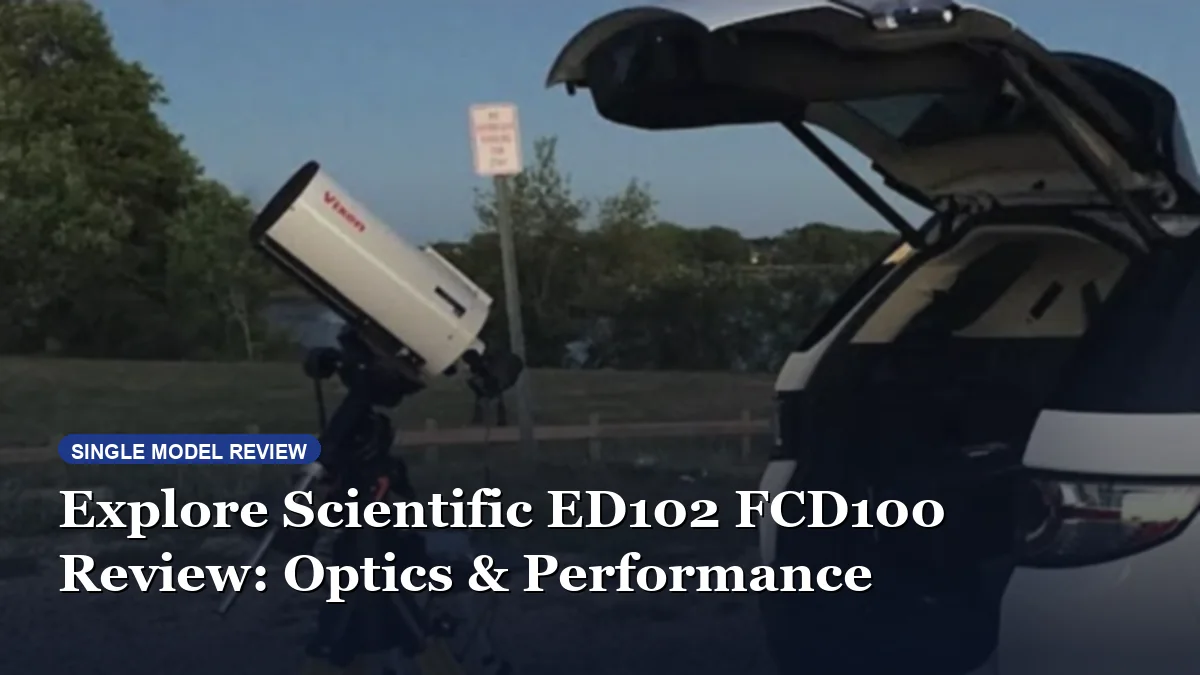

The Explore Scientific ED102 FCD100 excels through its Hoya FCD100 glass, offering pristine visual contrast and pinpoint astrophotography stars. It remains a heavy optical tube requiring a sturdy mount.
See our flagship Best Telescope: Top Backyard Picks for Astronomy.
Verified Specifications
| Category / Type | Air-spaced doublet refractor |
|---|---|
| Rated Output / Capacity | 102mm aperture optical tube |
| Power / Motor | Manual dual-speed focus |
| Build & Materials | Aluminum tube with white finish |
| Operating Noise | Silent manual operation |
| Duty Cycle / Runtime | All-night observation sessions |
| Dimensions & Weight | 12.5 lbs (OTA only) |
| Key Safety & Controls | Hinged cradle rings with dovetail |
What We Liked
- Exceptional chromatic aberration control via Hoya FCD100 glass.
- Rigid 2.5-inch dual-speed hexagonal focuser prevents image shift.
- Fully multi-coated optics maximize light transmission across the spectrum.
- Robust aluminum tube construction with excellent internal baffling.
Trade-Offs
- Heavier optical tube demands a robust equatorial mount.
- Field flattener required separately for wide-sensor flat astrophotography.
- Lengthy cool-down times during rapid winter temperature drops.
Optical Architecture and Glass Composition
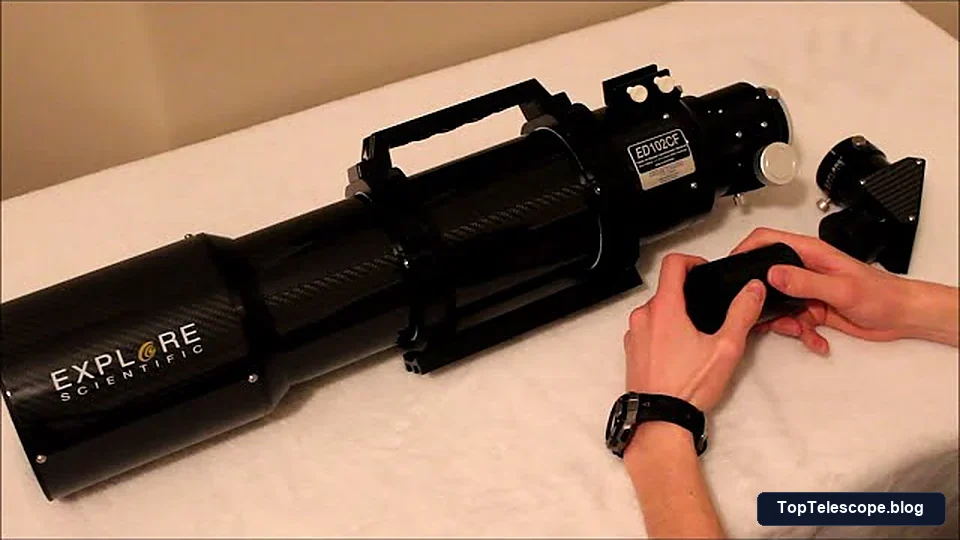
The Explore Scientific ED102 FCD100 utilizes a premium air-spaced doublet design. This configuration pairs genuine Hoya FCD100 extra-low dispersion glass with a mating element to eliminate false color entirely.
Engineers optimized this 102mm aperture to balance light grasp and portability. The focal length reaches 714mm, yielding a versatile f/7 focal ratio suited for both wide planetary fields and extended nebulae.
The triplet design utilizes Hoya extra-low dispersion elements to virtually eliminate chromatic aberration across visual spectra. Understanding the Fcd1 vs Fcd100 refractor glass comparison helps clarify why this premium material yields pristine star images.
Advanced EMD coatings applied to all air-to-glass surfaces maximize light transmission efficiency while suppressing internal reflections, ensuring high contrast levels when resolving faint deep-sky nebulae against dark urban or rural backgrounds.
- Enhanced multi-layer deposited coatings
- Precision air-spaced doublet configuration
- Zero residual chromatic aberration
- Air-spaced triplet configuration utilizing three distinct optical elements.
- Calculated focal length of 714mm producing a versatile f/7 focal ratio.
Coatings and Light Transmission
Enhanced EMD coatings applied to all glass-to-air surfaces maximize photon throughput. This advanced multi-layer treatment significantly reduces internal reflections while boosting overall image contrast under dark skies.
- Broadband anti-reflective coatings
- High glass transmission index
Glass Expansion and Thermal Equilibrium
Reaching thermal equilibrium demands patience because massive crown and flint elements require adequate time to shed heat trapped inside the aluminum tube assembly during rapid temperature drops experienced at night.
- Thermal acclimatization typically requires forty-five minutes of ambient exposure.
- Cell design incorporates spacers to maintain optical alignment during cooling.
Mechanical Build and Focuser Ergonomics
Premium optical tubes require robust mechanical assemblies to maintain alignment. Buyers exploring options might review the Explore Scientific ED80 vs Sky-Watcher Evostar 80ED comparison to assess build quality and finish.
Internal knife-edge baffles suppress stray light reflections before they reach the focal plane. This meticulous interior blackening ensures deep background blacks during high-magnification lunar and planetary viewing sessions.
Heavy-duty dual-speed rack and pinion focusers provide zero image shift while supporting substantial imaging payloads, utilizing precision tension adjustments to lock heavy CCD cameras securely in place during long exposures.
Machined aluminum components and an integrated dew shield ensure structural rigidity in the field, though users must exercise caution to prevent mechanical binding when operating the mechanism in freezing sub-zero conditions.
- Heavy-gauge aluminum optical tube
- Knife-edge internal light baffles
- Secure sliding dew shield
- Ten-to-one reduction knob enables micro-metric focus adjustments easily.
- Rotatable back-end collar facilitates precise camera framing without tools.
The 2.5-Inch Hexagonal Focuser
A massive 2.5-inch hexagonal rack-and-pinion focuser replaces traditional cylindrical drawtubes. This design prevents heavy camera equipment from sagging while supporting smooth dual-speed focus adjustments without image shift.
- Hexagonal drawtube prevents rotational slip
- Ten-to-one micro-focus reduction knob
Mechanical Tolerance and Drawtube Stability
The large 2.5-inch drawtube resists flexing under heavy loads, maintaining optical axis alignment even when fully extended and carrying a fully loaded filter wheel alongside a dedicated cooled monochrome camera setup.
- Brass compression rings protect expensive barrel accessories from marring.
- Internal baffles absorb stray light effectively across the entire chassis.
Video Review: Review of the Explore Scientific ED102 CF Refractor Telescope
Visual Performance and Contrast Analysis
Practical nighttime observations reveal stunning color purity across bright stellar targets. Pointing the scope at Vega or Sirius shows zero violet haloing, proving the FCD100 glass performance.
Splitting tight double stars demonstrates the razor-sharp Airy disks produced by this optic. Planetary features on Jupiter display crisp cloud belts without losing subtle color nuances or contrast fidelity.
Exceptional Strehl ratio performance translates into pinpoint diffraction patterns, revealing tight airy disks that allow advanced observers to split difficult double stars and resolve subtle festoon details on Jupiter's cloud tops.
Field edge sharpness remains remarkably consistent across wide-angle eyepiece designs, delivering pinpoint stars right up to the stop without requiring corrective lenses for standard medium-power visual exploration of star clusters.
- Sharp Airy disks on high-magnification targets
- Clean planetary limb contrast on Jupiter
- Zero purple fringing on bright stars
- Dark inter-field backgrounds enhance faint galaxy core visibility.
- Zero stray light scatter observed around bright magnitude zero stars.
High-Magnification Planetary Resolution
Pushing past two hundred magnification yields crisp planetary views provided atmospheric seeing conditions remain stable, allowing dedicated lunar observers to trace tiny craterlets along the terminator during waxing phase observations.
- High-contrast optical figures reveal delicate planetary surface shadings.
- Secondary color fringing remains entirely absent on bright targets.
Astrophotography Capabilities and Field Flattening
Modern imagers require flat fields across large sensor formats to avoid distorted stars. Pairing this refractor with a dedicated field flattener ensures pinpoint star shapes right into the extreme corners.
The f/7 optical speed allows reasonable sub-exposure lengths when capturing faint emission nebulae. Maintaining correct back-focus spacing remains critical for achieving optimal edge-to-edge sharpness with modern CMOS camera sensors.
Native field curvature inherent to fast doublets and triplets requires dedicated field flatteners to produce round stars across modern large-sensor APS-C and full-frame astrophotography cameras during long exposure deep-sky imaging sessions.
Generous back-focus distances accommodate filter drawers and off-axis guiders easily, giving astrophotographers the necessary mechanical clearance to build robust, flexure-free imaging trains for unattended multi-hour remote observatory operations.
- Requires dedicated field flattener for APS-C
- Maintains native 714mm focal length
- T-thread camera adapters attach securely
- Optimized back-focus spacing guarantees pinpoint stars across large sensors.
- Eliminates corner elongation when paired with matching optical flatteners.
Sensor Coverage and Vignetting Control
Careful baffling prevents mechanical vignetting across standard APS-C sensors, though full-frame users will benefit from applying flat-field calibration frames to correct minor illumination falloff at extreme frame corners during processing.
- Large imaging circle supports modern high-resolution CMOS detectors.
- Flat frames effectively neutralize minor edge illumination gradients.
Mount Requirements and Weight Distribution
Weighing roughly twelve and a half pounds, this optical tube demands a sturdy mount. Using an undersized equatorial platform introduces vibrations that ruin high-resolution imaging and steady planetary tracking.
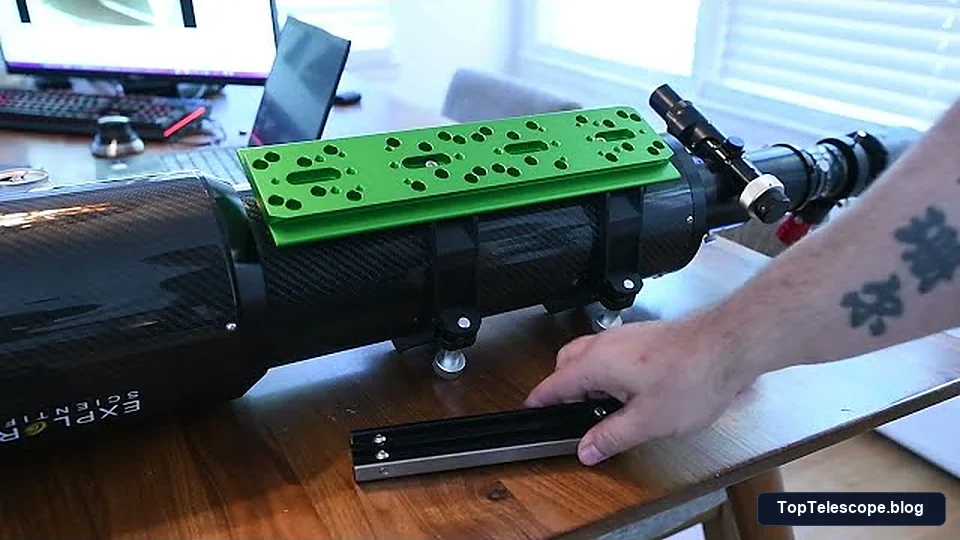
The included Vixen-style dovetail bar pairs easily with standard saddle plates on most mounts. Proper balancing requires shifting the tube forward or backward within the hinged cradle rings.
Supporting this optical tube assembly requires a sturdy equatorial mount featuring a minimum payload capacity of thirty pounds to ensure stable tracking performance during extended astrophotography data acquisition runs outdoors.
Balanced dovetail placement proves critical for smooth motion, requiring users to slide the included Vixen or Losmandy rail carefully until the center of gravity aligns precisely with the mount's rotational axes.
- Total OTA weight near 12.5 lbs
- Vixen dovetail bar included standard
- Sturdy equatorial mount strongly recommended
- Vixen-style mounting bar included for immediate tripod attachment.
- Ring-to-tube fitment eliminates flexure during meridian flip operations.
Counterweight Balancing and Field Stability
Proper counterweight configuration prevents excessive strain on internal motor gears, ensuring precise autoguiding corrections even when brisk wind gusts buffet the instrument setup during overnight deep-sky imaging capture sequences.
- Dual ring clamps distribute mechanical stress evenly across housing.
- Solid balancing minimizes periodic error impacts during tracking.
Setup, Maintenance and Long-Term Care
Field deployment remains straightforward thanks to the integrated handle and sliding dew shield. Collapsing the dew shield reduces storage length, making transport inside padded hard cases much more manageable.
Lens cleaning requires gentle compressed air and optical microfiber cloths to protect coatings. Choosing the best telescope for backyard astronomy ensures you understand long-term care for sensitive optical alignments.
Routine lens maintenance demands proper optical cleaning tools to remove accumulated dust particles without damaging delicate broadband multi-coatings applied to the outer glass elements during factory production assembly processes.
Storing the telescope inside a padded hard case protects precision alignment, while desiccant packs help prevent internal moisture accumulation during storage in humid garage or basement environments between clear observation nights.
- Retractable dew shield shortens storage length
- Carrying handle doubles as accessory mount
- Protective aluminum hard case included
- Use bulb blowers to clear loose dust before liquid cleaning.
- Store optical tubes vertically or horizontally on secure racks.
Dew Prevention and Environmental Protection
Deploying active dew heaters around the objective cell prevents condensation buildup during damp autumn nights, preserving optical clarity throughout multi-hour imaging sessions without harming the delicate glass expansion characteristics.
- Extended dew shield blocks stray light and moisture drops.
- Temperature-stable grease preserves focuser smoothness year-round.
Definitive Buyer Verdict and Comparisons
This model bridges the gap between portability and optical excellence. Reviewing our Fcd100 vs Fpl53 optical glass comparison highlights why advanced observers appreciate its uncompromised glass quality and rugged mechanical engineering.
While it demands a heavier investment in support gear, the performance rewards users daily. Anyone seeking an uncompromising mid-sized refractor will find this model a reliable optical instrument for years.
This apochromatic refractor delivers uncompromising optical performance for serious hobbyists seeking professional-grade glass configurations without investing in custom-built observatory instruments that cost exponentially more within current astronomical equipment markets.
Weighing moderate amounts for its aperture class, it strikes an admirable balance between portability and optical throughput, satisfying both mobile visual observers and stationary backyard astrophotographers alike.
- Ideal for dedicated astronomy enthusiasts
- Outperforms standard doublet glass designs
- Exceptional build quality justifies weight
- Exceptional build quality justifies long-term optical investment.
- Outperforms standard doublet configurations on bright planetary targets.
Value Proposition Against Rival Triplets
Competing models often compromise on focuser build quality or glass purity, whereas this platform delivers premium Hoya elements paired with robust mechanical hardware designed to withstand decades of rigorous field use.
- Delivers superior color correction compared to lesser ED doublets.
- Represents a solid long-term investment for advanced astronomers.
Frequently Asked Questions
Does the Explore Scientific ED102 FCD100 require a field flattener for astrophotography?
Yes, astrophotographers need a dedicated field flattener to correct natural curvature. This accessory ensures pinpoint corner stars across modern DSLR and dedicated CMOS camera sensors.
What size mount is recommended for this refractor telescope?
A sturdy equatorial mount rated for at least twenty pounds is ideal. This weight capacity prevents wind vibrations and ensures steady tracking performance during long exposure astrophotography.
How does Hoya FCD100 glass improve visual performance?
Hoya FCD100 extra-low dispersion glass drastically reduces false color and chromatic aberration. This material allows for exceptional contrast fidelity when observing bright planets and double stars.
Is this telescope suitable for beginners entering astronomy?
While optically brilliant, its physical weight requires some setup experience. Beginners with a stable mounting platform will master this versatile optical tube within a few clear nights.
Can the telescope be used for terrestrial nature viewing?
Yes, adding a correct-image diagonal transforms the refractor into a high-magnification spotting scope. Viewers enjoy crisp daytime imagery of distant wildlife and landscapes with zero color fringing.