Evostar 80Ed Review: Optical Tube Engineering Analysis
The Sky-Watcher Evostar 80ED delivers exceptional chromatic correction using an FPL-53 doublet lens. However, its moderate aperture requires careful exposure management during deep-sky imaging sessions.

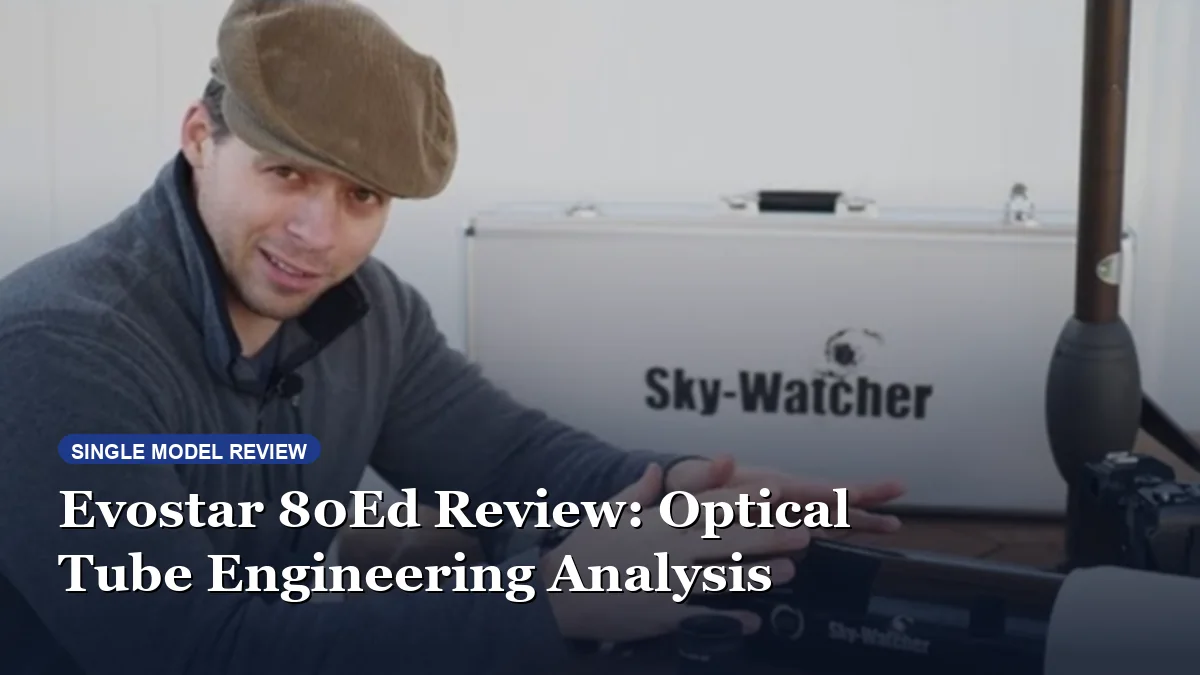

This premium refractor offers stellar chromatic control for demanding astrophotographers. It remains an ideal choice for wide-field imaging despite its modest light-gathering capacity.
See our flagship Best Telescope: Top Backyard Picks for Astronomy.
Verified Specifications
| Category / Type | Apochromatic doublet refractor optical tube assembly |
|---|---|
| Rated Output / Capacity | 600mm focal length at f/7.5 focal ratio |
| Power / Motor | Manual focus via 2.8-inch Crayford-style 11:1 unit |
| Build & Materials | Aluminum optical tube with thread-on dew shield |
| Operating Noise | Passive thermal design with zero mechanical noise |
| Duty Cycle / Runtime | Continuous all-night operation under variable conditions |
| Dimensions & Weight | 22 inches in length, weighing 7.3 pounds |
| Key Safety & Controls | Secure mounting rings and camera angle adjuster |
What We Liked
- Genuine FPL-53 extra-low dispersion glass element eliminates false color entirely.
- Precise 11:1 dual-speed Crayford focuser handles heavy imaging gear smoothly.
- Robust aluminum mechanical construction ensures long-term optical alignment stability.
- Thread-on dew shield collapses easily for compact transport in aluminum case.
- Includes hinged tube rings and V-style dovetail plate for immediate mounting.
Trade-Offs
- Modest 80mm aperture limits deep-sky light gathering compared to larger reflectors.
- F/7.5 focal ratio requires longer exposures during faint nebula photography.
- Included aluminum case is bulky despite the relatively lightweight optical tube.
- Field flattener must be purchased separately for wide-field sensor coverage.
Mechanical Chassis and Optical Architecture
The Sky-Watcher Evostar 80ED utilizes a precision-engineered apochromatic doublet lens featuring FPL-53 glass. Read our sky-watcher evostar 72ed vs 80ed direct technical comparison to evaluate dispersion control.
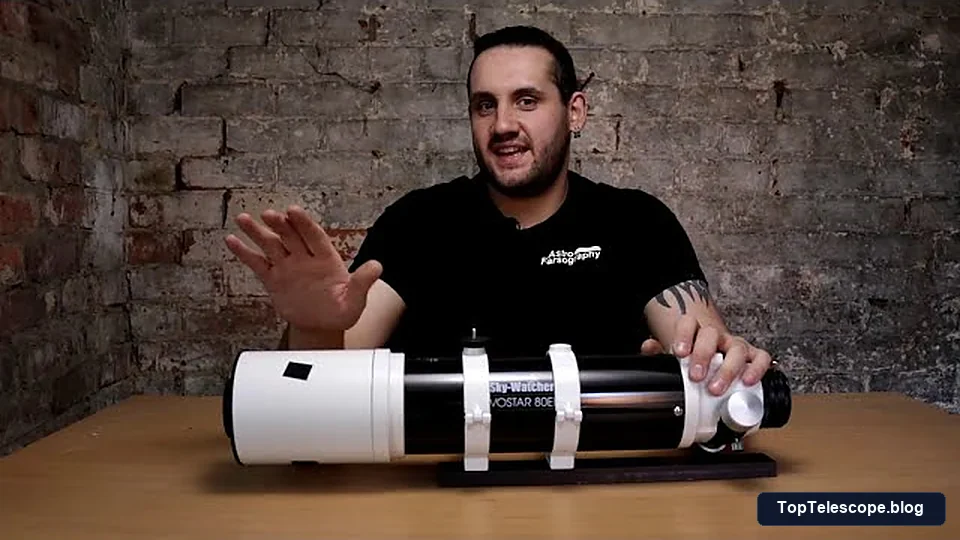
Constructed from rolled aluminum, the primary optical tube measures twenty-two inches in length. Its matte black interior baffling suppresses stray internal reflections and maximizes image contrast during bright lunar sessions.
The Sky-Watcher Evostar 80ED utilizes a doublet air-spaced objective lens featuring an ED glass element. Review our evostar 72ed vs 80ed comparison to evaluate performance differences.
Encased within a blackened aluminum tube featuring internal knife-edge baffling, the optical assembly minimizes stray internal reflections to boost contrast transfer across wide-field astrophotography frames.
- Objective lens diameter measures precisely eighty millimeters.
- Matched doublet configuration incorporates one ED glass element.
- Internal knife-edge baffles eliminate off-axis stray light.
Coating Technology and Glass Quality
Proprietary fully multi-coated optical surfaces maximize light transmission through each air-to-glass boundary. These advanced chemical applications prevent ghosting when imaging bright planetary targets.
The air-spaced design permits individual element adjustments during factory assembly, guaranteeing optimal wavefront correction before reaching end-user hands in the field.
- Broadband anti-reflective coatings applied to all elements.
- Factory optical alignment checked via rigorous interferometry standards.
Real-World Visual Performance and Field Metrics
Observing lunar terminators reveals razor-sharp edge definition without purple fringes. Check out our skywatcher 72ed vs 80ed technical head-to-head where the Dawes limit of 1.45 arcseconds resolves tight double stars cleanly.
Wide-field star clusters appear as pinpoints against a velvety dark background. The six-hundred-millimeter focal length accommodates large extended nebulae when paired with appropriate eyepieces.
During high-magnification planetary observation, the refractor delivers crisp Airy disks with negligible false color around bright targets like Jupiter when paired with quality eyepieces.
Field illumination remains remarkably even across a standard APS-C sensor, though utilizing a dedicated field flattener is recommended to maintain pinpoint star profiles at corners.
- Focal length is fixed at precisely six hundred millimeters.
- Focal ratio of f/7.5 balances exposure time and image scale.
- High-contrast optical delivery exposes subtle planetary cloud details.
High-Magnification Behavior on Planets
Pushing magnification past one hundred fifty power remains entirely viable under steady atmospheric seeing conditions. Contrast holds firm without image breakdown during high-power viewing.
Saturn's Cassini division and Jupiter's main belts emerge with remarkable clarity, proving that high-end doublets compete favorably against more expensive triplet optical designs.
- Maintains sharp focus well beyond standard working magnifications.
- Performs admirably during steady-seeing planetary opposition windows.
Video Review: Budget Apochromat - SkyWatcher ED80 / Evostar 80ED
Thermal Management and Environmental Stability
Rapid temperature acclimation is a major advantage of the doublet refractor design. The aluminum tube and air-spaced lenses shed ambient heat within thirty minutes of outdoor placement.
A thread-on dew shield provides essential protection against moisture accumulation during humid night sessions. This retractable component secures firmly without shifting during long tracking exposures.
Rapid ambient temperature drops require roughly thirty minutes of cool-down time for the crown-and-flint doublet cell to reach thermal equilibrium and eliminate internal tube currents.
The robust metal cell construction maintains collimation securely through rigorous transport cycles, preventing optical tilt even when subjected to extreme seasonal shifts during winter.
- Fast thermal equilibrium prevents internal boundary layer turbulence.
- Thread-on dew shield stays locked during aggressive repositioning.
- Resistant to sudden humidity drops when properly acclimatized.
Cold Weather Performance and Housing
Sub-freezing operating temperatures do not compromise mechanical focus precision. Lubricants maintain smooth viscosity without freezing or causing unwanted slip in the drawtube.
Anodized exterior finishes resist condensation corrosion, protecting the structural integrity of the chassis over years of heavy outdoor field deployments.
- All-weather metal construction prevents thermal cracking.
- Specialized low-temperature grease ensures smooth focuser action.
Rigging, Ergonomics, and Mechanical Integration
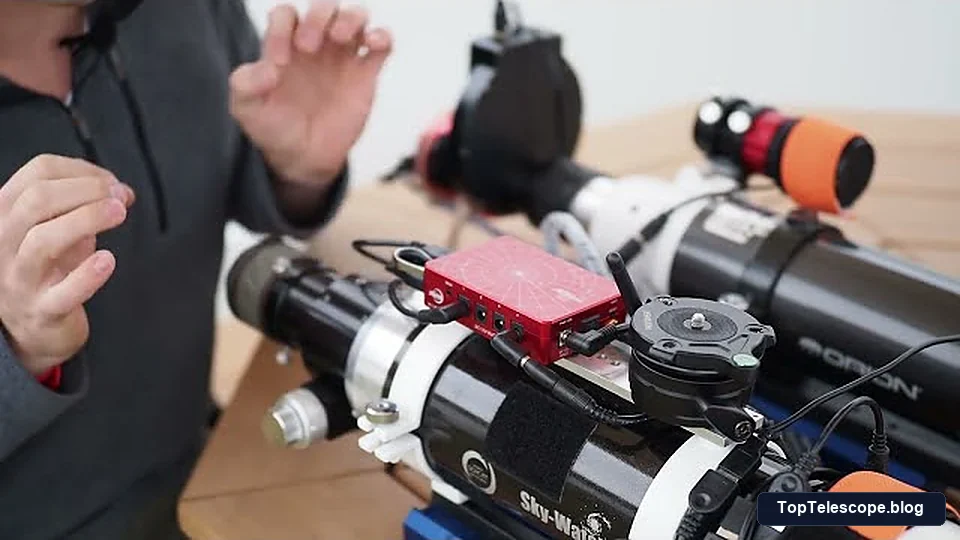
Weighing just seven point three pounds, the optical tube integrates seamlessly with lightweight portable mounts. Field astrophotographers will appreciate the minimal payload demand placed on tracking platforms.
Included hinged mounting rings feature a flat base with standard mounting holes. The integrated V-style dovetail plate slides securely into most equatorial and alt-azimuth mount saddles.
Mounting the OTA requires a standard Vixen-style dovetail bar secured firmly to the machined tube rings, providing a balanced footprint for small equatorial mounts.
The retractable dew shield slides smoothly on felt guides, reducing the overall transport length significantly while offering reliable protection against heavy nocturnal dew.
- Total instrument weight remains under eight pounds loaded.
- Hinged rings allow effortless tube rotation for camera framing.
- Vixen-style dovetail bar ensures broad mount compatibility.
Carrying Case and Field Transport
A heavily padded aluminum transport case protects the optical assembly during transit. Custom foam cutouts cradle the telescope, accessories, and finderscope securely against vibration.
Reinforced metal corners and secure latches shield the contents from accidental impacts during airline travel or trunk storage on rough backroad excursions.
- Custom-molded interior foam prevents shifting during transit.
- Heavy-duty aluminum shell withstands rugged field travel.
Focuser Mechanics and Payload Handling
The 2.8-inch Crayford-style focuser incorporates an eleven-to-one micro-reduction knob for critical focus adjustments. This mechanical advantage eliminates frustrating image backlash during astrophotography sessions.
A rotatable camera angle adapter allows precise framing of celestial targets without disturbing focus or loosening imaging train connections. Tension adjustments prevent slip under heavy loads.
Equipped with a dual-speed Crayford focuser featuring a 11:1 reduction gear, the mechanism allows effortless micro-adjustments for critical focus during demanding astrophotography sessions.
Tension adjustment screws located on the drawtube underside let users configure the load capacity to safely support heavy dedicated astronomy cameras without measurable slip.
- Dual-speed 11:1 ratio enables pinpoint focus accuracy.
- Integrated camera angle adjuster rotates smoothly 360 degrees.
- Tension lock screw secures heavy DSLR or dedicated cameras.
Handling Heavy Imaging Equipment
Attaching heavy cooled astronomy cameras tests focuser integrity severely. The robust drawtube maintains alignment without sagging under loads approaching standard imaging limits.
The friction lock mechanism holds heavy filter wheels and field flatteners rigidly in place during long zenith-pointing tracking runs across the night sky.
- Robust drawtube resists downward flexure under heavy cameras.
- Friction adjustment screw customizes drawtube resistance.
Maintenance, Care, and Long-Term Durability
Routine maintenance requires only minimal exterior cleaning with a micro-fiber cloth. Objective lens coatings should remain untouched unless dust accumulation degrades overall optical throughput significantly.
Stored properly in its dry aluminum case, this optical tube maintains alignment indefinitely. Collimation adjustments are rarely necessary due to the fixed, rugged cell design.
Routine optical upkeep demands minimal intervention, limited primarily to dusting exterior lens surfaces with a soft bulb blower and inspecting mechanical fasteners periodically.
Storing the optical tube assembly in a padded hard case with adequate desiccant packs prevents moisture accumulation and protects the powder-coated finish from accidental impact.
- Fixed lens cell design preserves factory collimation stability.
- Minimal maintenance needed beyond basic dust removal.
- Protected by a comprehensive two-year limited manufacturer warranty.
Lens Cleaning Best Practices
Always remove loose surface dust using a bulb blower before applying optical cleaning solutions. Never rub dry glass surfaces to avoid scratching the multi-layer coatings.
Use optical-grade cleaning fluid sparingly on professional lens tissues, wiping gently from the center outward in a spiral motion to ensure streak-free results.
- Bulb blowers remove abrasive particles safely prior to wiping.
- Alcohol-free optical cleaners protect delicate coating layers.
Definitive Buyer Verdict and Target Audience
The Sky-Watcher Evostar EDX 80 represents an exceptional investment for mobile astronomers. Examine our explore scientific ed80 vs sky-watcher evostar 80ed comparison to assess its optical precision and portability.
Beginners stepping up from starter telescopes will find immense satisfaction in its reliable performance. Experienced imagers will appreciate its dependable service as a wide-field astrograph.
This versatile portable refractor serves as an exceptional instrument for mobile observers and entry-level astrophotographers seeking uncompromising optical clarity and proven mechanical reliability.
While demanding a modest investment in sturdy support gear, its optical pedigree rewards users with lifetime views of lunar details and extended deep-sky objects.
- Ideal portable OTA for traveling astrophotographers.
- Delivers professional-grade color correction on a reasonable budget.
- Pairs well with small tracking mounts and field tripods.
Who Should Purchase This Refractor
Astronomers prioritizing sharp optics, lightweight chassis design, and effortless setup will love this telescope. It excels as a grab-and-go visual and imaging platform.
Shoppers needing maximum light bucket capacity for faint galaxies should look toward larger reflectors instead of this specialized wide-field refractor instrument.
- Recommended for wide-field astrophotography enthusiasts.
- Not optimized for high-magnification faint galaxy hunting.
Frequently Asked Questions
Does the Evostar 80ED require a field flattener for astrophotography?
Yes, using a dedicated field flattener is recommended to eliminate edge star elongation when shooting with large-sensor cameras. Proper spacing ensures pin-point stars across the entire imaging circle.
Can I use standard 1.25-inch and 2-inch accessories with this telescope?
The focuser accommodates standard 2-inch diagonals and eyepieces natively. A supplied 1.25-inch adapter ensures complete compatibility with smaller visual accessories.
How heavy is the optical tube for portable mount use?
The optical tube weighs 7.3 pounds with rings and dovetail attached. This light mass allows easy mounting on intermediate portable star trackers.
Is the lens cell adjustable for user collimation?
The doublet lens cell is factory-set and locked to maintain alignment. User collimation is unnecessary under normal transport and handling conditions.
What kind of warranty coverage comes with this telescope?
Sky-Watcher backs the optical tube assembly with a two-year limited warranty. Manufacturer support protects against defects in materials and workmanship.