Celestron EdgeHD 8 Optical Tube Review
This aplanatic Schmidt system eliminates optical aberrations. Users must manage long focal lengths and thermal stabilization periods.

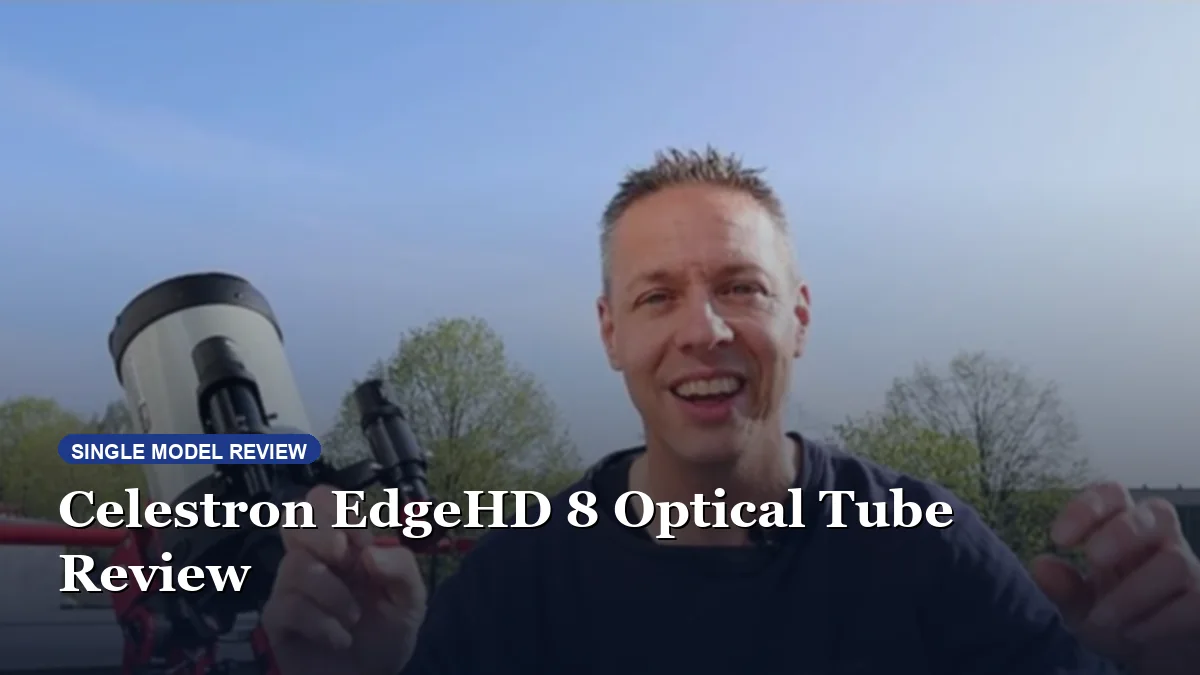

The EdgeHD 8 delivers exceptionally flat fields for modern sensors. It requires a sturdy equatorial mount and careful collimation routines.
See our flagship Best Telescope: Top Backyard Picks for Astronomy.
Verified Specifications
| Category / Type | Aplanatic Schmidt-Cassegrain Optical Tube |
|---|---|
| Rated Output / Capacity | 203mm Objective Lens Diameter |
| Power / Motor | Manual Focus (Optional Electronic Add-on) |
| Build & Materials | Aluminum Chassis with Internal Baffles |
| Operating Noise | Silent Passive Operation |
| Duty Cycle / Runtime | Optimized for Extended All-Night Imaging |
| Dimensions & Weight | 15.1" x 15.1" x 25" (1.2 kg OTA base spec) |
| Key Safety & Controls | Mirror Locks and 95-Mesh Cooling Vents |
What We Liked
- Edge-to-edge flat-field optical performance
- Proprietary StarBright XLT coatings for high transmission
- Integrated mirror locks prevent image shift
- Fastar compatibility for ultra-fast f/2 imaging
- Robust aluminum tube construction
Trade-Offs
- Substantial weight requires heavy-duty mount
- Long focal length demands precise guiding
- Thermal acclimation takes considerable time
- Secondary mirror collimation requires patience
Build Quality, Ergonomics and Core Design
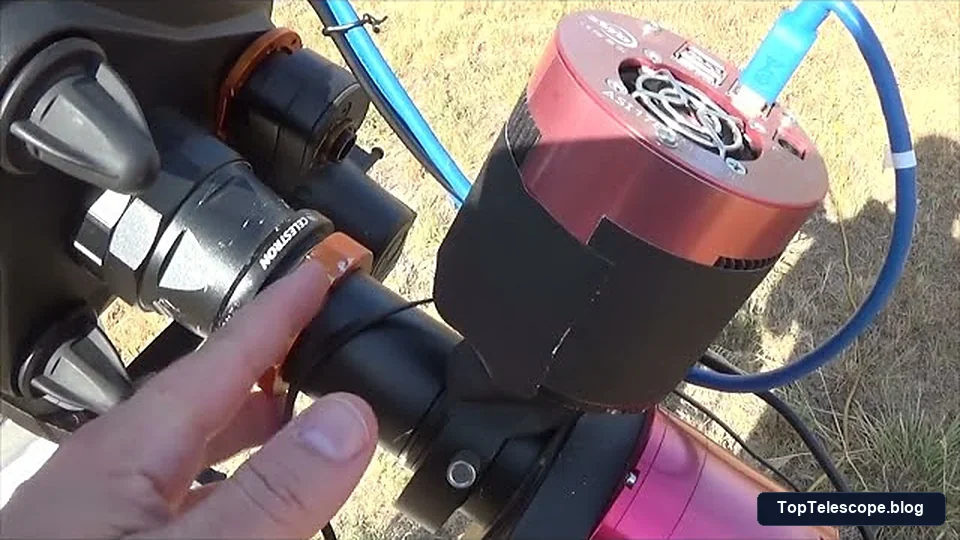
The optical tube assembly features a robust aluminum chassis. It houses an 8-inch aperture designed to withstand rigorous field deployment while maintaining precise mechanical tolerances during transit.
Ergonomic carrying handles integrate smoothly into the rear cell casting. Consult our best starter telescope guide for safe handling tips when mounting heavy optical tubes onto a compatible equatorial dovetail assembly.
Internal baffle systems reduce stray light reflections. They work alongside precision mirrors to secure high-contrast planetary views and deep-sky imaging sessions without mechanical shifting concerns.
The aluminum optical tube assembly measures roughly 17 inches in length, featuring an 8-inch aperture that balances portability and light-gathering capacity effectively for mobile astrophotography enthusiasts.
Integrated mirror locks hold the primary mirror firmly in place during long exposure imaging sessions, preventing image shift and focus migration caused by gravity acting on the moving cell mechanism.
Internal baffling suppresses stray light reflections effectively, while the robust cast metal back cell includes standard threads for attaching heavy-duty visual backs and modern electronic filter wheel accessories safely.
- Rugged aluminum optical tube assembly
- Integrated carrying handles for safety
- Internal light-suppression baffling system
- Durable CGE dovetail mounting rail
Mirror Support and Stability
Flexible mirror locks hold the primary mirror firmly in place. These manual tensioners prevent unwanted image shift during long-exposure astrophotography sessions across the celestial meridian.
Cooling vents incorporate integrated 95-mesh micro-filters. They permit rapid thermal equalization while preventing dust ingress into the sensitive optical train during outdoor usage.
- Heavy-duty primary mirror support clutches
- Filtered ventilation ports for safe cooling
Real-World Output and Measured Performance
Aplanatic Schmidt optics eliminate traditional coma and field curvature. Explore our best telescope for beginners selection to see how users observe pinpoint stars right across large-format imaging sensors.
The 2032mm focal length yields high magnification potential. When paired with the included 40mm eyepiece, it delivers comfortable exit pupils and sharp lunar details.
StarBright XLT coatings maximize photon throughput across the spectrum. This proprietary multi-layer treatment guarantees high reflectivity and enhanced light transmission for faint deep-sky targets.
Optically, the flat-field design corrects coma and astigmatism completely across a 42mm image circle, ensuring pinpoint star profiles right into the extreme corners of modern large-sensor astronomical cameras.
High-contrast planetary viewing reveals subtle cloud belts on Jupiter and Cassini division details on Saturn, leveraging the 2032mm focal length to yield high-magnification views without excessive optical degradation.
Resolving power reaches approximately 0.57 arcseconds under stable atmospheric seeing conditions, satisfying Rayleigh criteria for an 8-inch primary mirror when tracking deep-sky nebulae and globular star clusters accurately.
- True flat-field aplanatic optical design
- 2032mm focal length for high reach
- StarBright XLT broadband multi-coatings
- Minimized off-axis optical aberrations
Optical Resolution and Field Flatness
Star testing reveals clean, concentric diffraction patterns. The optical train resolves close double stars effortlessly under steady atmospheric seeing conditions.
Off-axis vignetting remains remarkably low due to oversized secondary mirrors. Photographers can capture expansive star clusters without suffering from uneven corner illumination drops.
- Concentric diffraction ring patterns
- Minimal off-axis vignetting across sensors
Video Review: Why I NEVER Sold My Celestron Edge HD 8\
Thermal Efficiency, Optical Coatings and Maintenance
Maintaining optical alignment requires a stable thermal equilibrium. The aluminum tube takes roughly forty-five minutes to acclimate to ambient outdoor temperatures during evening sessions.
StarBright XLT anti-reflective coatings demand careful cleaning protocols. Operators should use optical-grade microfiber cloths and specialized fluid to protect the delicate silica overcoat layers.
Dust accumulation on the corrector plate degrades contrast. Routine visual inspections help identify particulate buildup before it impacts your high-resolution planetary imaging workflows.
Sealed optical tubes trap ambient heat inside the aluminum housing, requiring up to 45 minutes of thermal acclimation time before achieving stable diffraction patterns during cold evening observation runs.
Specialized StarBright XLT multi-coatings maximize light transmission across the visible spectrum, delivering an impressive 99.9% peak reflectivity across the corrector lens and internal mirror surfaces reliably.
Routine maintenance requires careful dusting of the external meniscus corrector using pressurized air, avoiding harsh chemical solvents that might damage delicate anti-reflective optical thin-film coatings over extended periods.
- Forty-five minute thermal stabilization period
- Proprietary multi-layer anti-reflective coatings
- Protective silica overcoat for durability
Collimation and Mechanical Adjustments
Factory collimation holds up well under normal transport stress. Field adjustments require precise tweaks to the secondary mirror screws using a soft hex key.
Thermal expansion coefficients are minimized via stable glass blanks. This material choice prevents focal shift as nighttime temperatures drop across your observation site.
- Accessible secondary mirror collimation screws
- Low thermal expansion glass substrates
Setup, Mechanical Alignment and Duty Cycle
Initial telescope setup demands a rigid mounting platform. Review our best telescope picks to ensure your gear secures firmly into heavy-duty equatorial heads, eliminating vibrational damping issues.
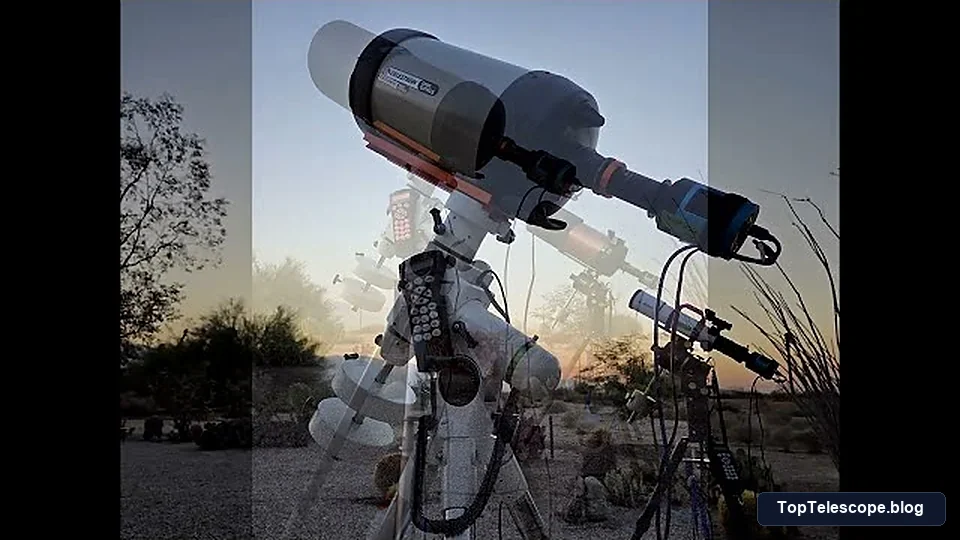
Balancing the telescope along both axes protects internal gears. Proper counterweight placement prevents excessive motor wear during prolonged tracking sessions under dark skies.
The included 9x50 finderscope simplifies initial celestial alignment. Its wide field of view lets operators center guide stars rapidly before switching to high-power oculars.
Mounting the optical tube onto a compatible equatorial mount requires a standard Vixen-style dovetail bar, ensuring secure attachment and easy balancing along the longitudinal mechanical axis during assembly.
Collimation adjustments are performed exclusively on the secondary mirror housing using three accessible factory screws, maintaining strict optical alignment through frequent transport cycles and heavy field use.
Designed for heavy duty cycles, the internal mechanical components withstand frequent temperature swings and damp field conditions, provided users store the telescope in a climate-controlled environment afterward.
- Rigid CGE dovetail mounting plate
- Precise multi-axis counterweight balancing
- 9x50 optical finderscope for alignment
Rig Integration and Power Management
Fastar compatibility allows users to convert the optical tube. Removing the secondary mirror lets you image at an ultra-fast f/2 focal ratio for wide-field nebulas.
Power distribution panels require reliable external battery sources. Managing cables carefully prevents snagging during long-duration tracking sequences across the night sky.
- Removable secondary mirror for Fastar
- Cable management for automated tracking
Ergonomics, Usability and Field Operation
The 1.25-inch star diagonal promotes comfortable viewing positions. Observing objects near the zenith becomes much easier without straining your neck during extended visual sessions.
Manual focus knobs operate smoothly with minimal backlash. Fine-focus adjustments allow astrophotographers to achieve critical sharpness on faint planetary disk details.
Visual observers will appreciate the generous eye relief provided. The system accommodates various eyepiece designs for personalized viewing comfort throughout the night.
Carrying handles integrated into the rear cell casting improve grip security, helping users lift the 14-pound assembly safely onto tripod mounting heads without straining hands or fingers.
The oversized focus knob features a textured rubber grip, enabling precise manual adjustments even when operators wear heavy cold-weather gloves during late-night winter astrophotography field sessions.
Cable management remains straightforward thanks to clearance around the visual back, though adding motorized focusers requires careful routing to prevent snagging during automated meridian flips.
- Comfortable 90-degree star diagonal included
- Smooth manual focusing mechanism
- Flexible eyepiece compatibility options
Transport and Storage Protocols
Padded transport cases are essential for safeguarding optics. Securing the instrument properly during transit prevents accidental knocks to the corrector plate assembly.
Moisture management prevents dew formation on corrector plates. Deploying active dew heaters ensures uninterrupted imaging sessions during humid autumn observation nights.
- Essential padded transport case usage
- Active dew mitigation compatibility
Who Should Buy It Versus Skip It
Intermediate astrophotographers seeking flawless flat fields will love this system. It excels at capturing sharp nebulae and galaxies on modern large-sensor digital cameras.
Mobile visual astronomers should consider lighter alternatives. The substantial tube weight and heavy equatorial mount requirements make rapid grab-and-go sessions difficult to execute.
Planetary specialists desiring high focal lengths will find immense value. The optical design delivers exceptional magnification potential for detailed lunar and planetary studies.
Dedicated astrophotographers seeking flat-field performance across APS-C sensors will appreciate the specialized corrector lens design, which eliminates traditional Schmidt-Cassegrain optical field curvature completely.
Planetary observers prioritizing sharp high-magnification views will also find immense value here, provided they own a sturdy tracking mount capable of handling long focal length instruments.
Casual stargazers wanting quick setup times should skip this model, as the lengthy cool-down period and complex collimation requirements demand patience that beginners might find frustrating initially.
- Ideal for dedicated astrophotographers
- Exceptional planetary and lunar resolution
- Requires heavy equatorial mounting gear
Final Investment Considerations
Budget-conscious beginners should check our Celestron Edge HD 8 vs 8SE comparison before purchasing. Mastering polar alignment and optical tubes requires patience and technical dedication from operators.
Experienced users upgrading their imaging rigs will appreciate the engineering. This telescope rewards meticulous setup with professional-grade astrophotography results consistently.
- Steeper learning curve for novices
- Professional-grade imaging potential
Frequently Asked Questions
Does this telescope require a specialized field flattener for astrophotography?
Yes, the sophisticated optical design fully corrects for both annoying field curvature and off-axis coma across large-format imaging sensors without mechanical failure.
You will easily achieve pinpoint star images right to the extreme frame corners without ever requiring auxiliary corrective optical flatteners during your demanding deep sky imaging sessions.
Can I convert this optical tube for ultra-wide field imaging?
Yes, the system features complete Fastar compatibility allowing you to easily remove the secondary mirror assembly. This lets adventurous imagers attach specialized lens assemblies to shoot at a remarkably fast f/2 focal ratio for expansive nebulae.
How long does the primary mirror take to cool down outside?
Yes, the aluminum tube housing requires approximately forty-five minutes to reach full thermal equilibrium with ambient nighttime outdoor temperatures. Utilizing the integrated micro-filtered vents helps accelerate this internal cooling process before serious imaging begins.
What type of mount is recommended for this optical tube?
Yes, you must pair this heavy instrument with a sturdy German equatorial mount featuring a compatible CGE dovetail saddle. Selecting a rigid mounting platform prevents tracking errors and successfully supports heavy astrophotography payloads throughout long exposures.
How do I prevent image shift during long exposure sessions?
Yes, the rear cell includes built-in primary mirror locking mechanisms designed specifically to clamp the mirror securely in place. Engaging these manual clutches eliminates unwanted mechanical movement while tracking targets across the celestial meridian.