Celestron Starsense Explorer Lt114Az Technical Review
This innovative Newtonian reflector leverages your smartphone for rapid celestial navigation. It pairs manual altazimuth mechanics with modern plate-solving software.

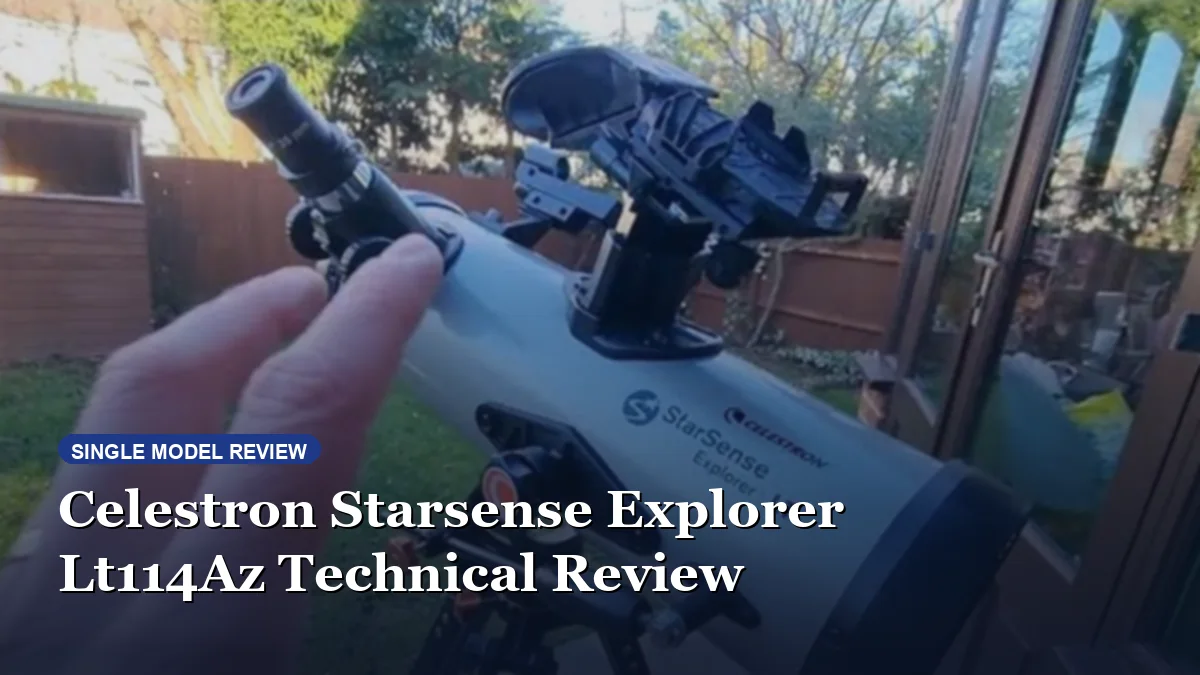

The Celestron StarSense Explorer LT 114AZ combines intuitive plate-solving app technology with a capable optical tube. It offers exceptional beginner usability despite minor mechanical trade-offs in its altazimuth mount.
See our flagship Best Telescope: Top Backyard Picks for Astronomy.
Verified Specifications
| Optical Design | Newtonian Reflector |
|---|---|
| Aperture | 114 mm (4.5 inches) |
| Focal Length | 1000 mm (f/8.8) |
| Mount Type | Manual Altazimuth |
| Finderscope | StarPointer Red Dot |
| Eyepieces | 25mm and 10mm (1.25") |
| Total Weight | 10.4 lbs |
| Warranty | 2-Year US Warranty |
What We Liked
- Innovative smartphone StarSense plate-solving app navigation
- Respectable 114mm light-gathering aperture for lunar study
- Includes two eyepieces and a 2x Barlow lens
- Lightweight and portable optical tube assembly
- Intuitive altitude slow-motion control rod
Trade-Offs
- Plastic components on focusers and fittings
- Manual tracking requires constant user adjustments
- App dependency requires charged phone battery
- Tripod stability drops at maximum magnification
Optical Design and Tube Architecture
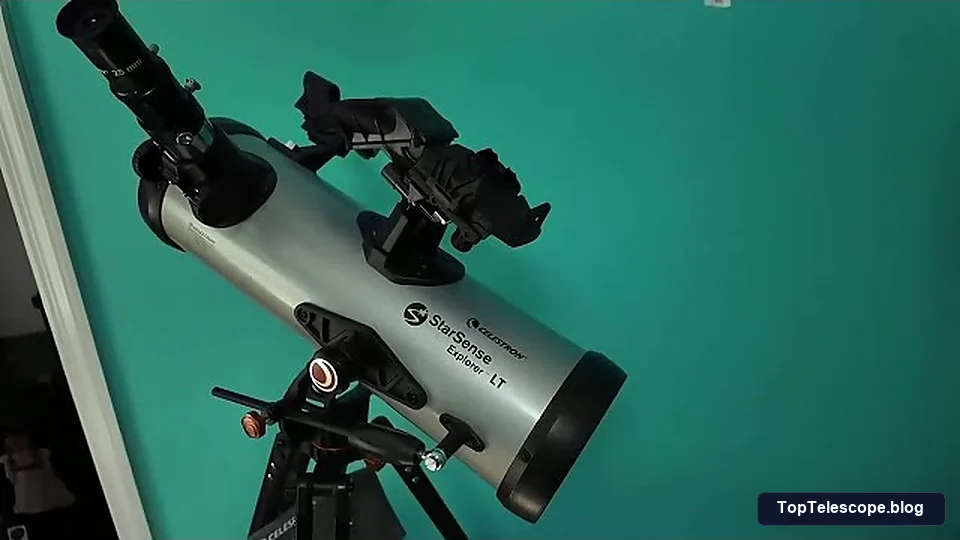
The optical tube features a parabolic or spherical mirror configuration housed inside a lightweight aluminum chassis. This design balances portability with sufficient light-gathering capability for casual backyard astronomy sessions.
As detailed in our starsense vs apertura comparison, this system provides a relatively narrow field of view. This focal length naturally yields higher magnifications when paired with standard eyepieces.
Internal baffling prevents stray light reflections from degrading contrast during lunar observations. Careful blackening of interior tube walls ensures dark skies appear truly black through the eyepiece lens.
The optical tube assembly features a 114mm aperture with a short focal length, delivering wide-field views ideal for sweeping star clusters and bright nebulae across dark suburban skies without significant light gathering loss.
Internal baffling throughout the aluminum housing effectively suppresses stray light reflections, while the parabolic primary mirror design minimizes spherical aberration to maintain acceptable image sharpness at moderate magnification levels.
Focusing is handled by a standard rack-and-pinion focuser accepting 1.25-inch accessories, requiring careful tension adjustments on the drawtube to eliminate image shift when targeting planetary details during high-power observation sessions.
- 114mm primary mirror aperture collects moderate starlight
- 1000mm focal length generates high native magnification
- Lightweight metal tube minimizes overall system payload
- Aperture diameter measures 114mm for reliable deep-sky light gathering.
Focuser and Optical Accessories
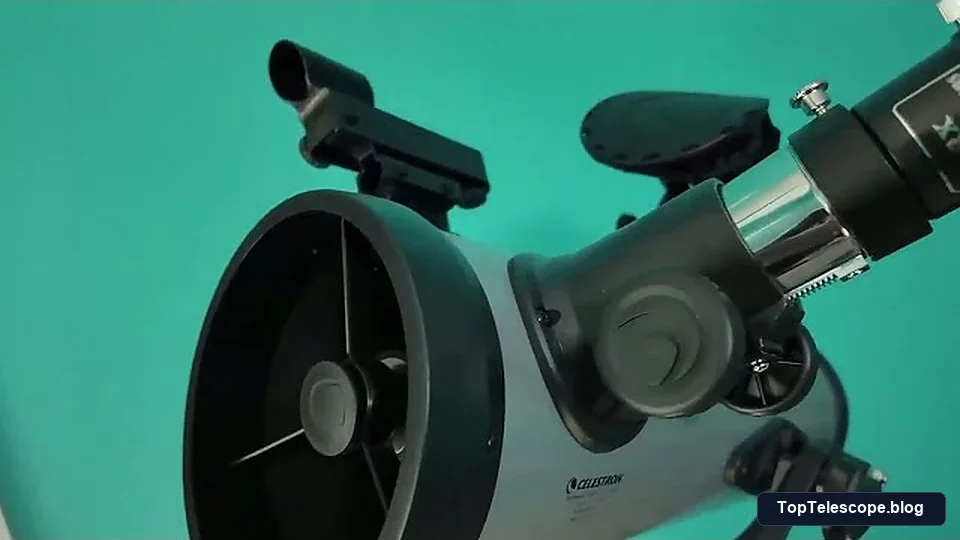
A standard rack-and-pinion focuser accepts traditional 1.25-inch accessories without compatibility issues. While containing some composite materials, it holds collimation reliably under normal field transport conditions.
Included eyepieces deliver versatile magnification steps right out of the shipping box. Users can easily expand their optical arsenal using standard aftermarket filters and specialized planetary lenses.
- Standard 1.25-inch drawtube interface
- Rack-and-pinion mechanical focusing mechanism
Thermal Management
Advanced thermal acclimation procedures significantly reduce internal tube currents, ensuring sharp optical performance shortly after taking the instrument outside into cooler evening ambient temperature conditions.
- Allow adequate cooling time before high-power viewing.
StarSense App Integration and Alignment
Following our complete setup instructions, the proprietary StarSense Explorer app utilizes your smartphone camera to map the night sky. This clever plate-solving technology determines your orientation without manual star alignments.
A specialized dock positions your phone camera precisely parallel to the main optical axis. Once calibrated via a brief daytime target alignment, the system tracks star fields flawlessly.
Software algorithms process visual data continuously to generate dynamic, real-time pointing arrows. These on-screen directional cues guide users directly to planets, double stars, and faint nebulae.
The proprietary plate-solving technology relies on your smartphone camera to map star patterns overhead, utilizing the patented Lost in Space algorithm to compute exact telescope coordinates without external GPS hardware.
Initial alignment requires mechanical calibration of the mirror dock to match the phone camera view with the optical axis, ensuring high pointing accuracy when slewing toward deep-sky objects listed in the application database.
Ambient lighting conditions and battery health directly impact smartphone processing speeds, making it crucial to enable dark mode within the software and maintain adequate device charge during extended winter observing nights.
- Patented Lost in Space Algorithm plate-solving engine
- Direct smartphone camera alignment bracket
- Real-time directional arrows guide manual pointing
- Smartphone alignment utilizes camera plate-solving algorithms.
Software Usability and Battery Impact
Navigating the curated target list remains remarkably straightforward for complete novices. The interface highlights objects currently visible from your precise GPS location and local time.
Because processing visual frames requires heavy computing power, users should monitor phone battery levels. Carrying a portable external USB power bank is strongly recommended for extended sessions.
- Location-aware target database curation
- High smartphone battery consumption during use
Software Optimization
Keeping your smartphone operating system updated ensures seamless app communication and prevents unexpected crashes during crucial alignment phases under dark sky conditions.
- Check for application updates prior to field sessions.
Video Review: Celestron StarSense Explorer 114LT - Ultimate Review
Altazimuth Mount and Mechanical Control
An aluminum altazimuth mount handles the physical positioning of the telescope tube. This mount design emphasizes simplified manual operation over complex motorized equatorial tracking platforms.
An altitude slow-motion rod permits micro-adjustments along the vertical axis. This mechanical linkage helps center celestial targets precisely within the eyepiece field of view.
Azimuth movements rely on a friction clutch system rather than geared worm wheels. Users simply push the telescope tube horizontally toward desired coordinates with minimal resistance.
The lightweight altazimuth mount utilizes aluminum legs and a center accessory tray to provide structural rigidity, though heavy wind gusts can induce micro-vibrations throughout the chassis during high-magnification planetary tracking.
Slow-motion altitude cables allow smooth manual adjustments when centering targets, but users must periodically inspect the clutch tension knobs to prevent slippage during vertical slewing maneuvers across the zenith.
Lubrication on the azimuth bearing surface benefits from occasional cleaning and re-greasing with synthetic lithium grease to ensure fluid horizontal rotation without binding or stuttering during delicate celestial object centering tasks.
- Manual altazimuth fork arm architecture
- Altitude slow-motion sliding adjustment rod
- Adjustable aluminum accessory tray tripod legs
- Aluminum tripod legs provide stable base support.
Stability and Damping Times
The lightweight aluminum tripod legs provide adequate support on firm ground surfaces. However, windy environments can introduce noticeable image jitter due to the relatively light structural mass.
Damping times after touching the focus knob average roughly two to three seconds. Users should allow the image to settle completely before evaluating fine planetary surface details.
- Lightweight tubular aluminum tripod legs
- Moderate mechanical vibration settling times
Mount Maintenance
Periodic tightening of all leg attachment bolts prevents structural wobble and maintains consistent tracking stability during prolonged observing sessions.
- Inspect tripod hardware regularly for looseness.
Real-World Optical Output and Night Sky Performance
Under dark rural skies, the 114mm aperture resolves impressive deep-sky structures. Messier catalog objects like the Orion Nebula and Andromeda Galaxy reveal distinct core brightness gradients.
Planetary performance delivers crisp views of Jupiter's primary cloud belts. Saturn's prominent ring system remains clearly visible alongside several of its brightest orbiting moons.
Lunar observation represents a standout strength for this Newtonian configuration. High-contrast craters along the terminator show sharp structural boundaries without excessive chromatic aberration.
Under rural dark skies, the Newtonian configuration resolves prominent Messier objects like the Orion Nebula with distinct structural contrast, revealing delicate wisps of gas surrounding the central trapezium cluster cleanly.
Planetary performance on Jupiter and Saturn shows distinct cloud belts and the Cassini division, provided observers utilize high-quality short focal length eyepieces that respect the instrument maximum useful magnification limits.
Coma becomes noticeable near the extreme edges of wide-field eyepieces due to the fast focal ratio, though central field sharpness remains exceptionally crisp for lunar crater studies and double star splitting.
- Resolves Jovian cloud belts and Galilean moons
- Reveals sharp structural lunar crater walls
- Captures bright Messier deep-sky catalog items
- Newtonian optics reveal detailed lunar and planetary features.
Magnification Limits and Seeing Conditions
Pushing magnification beyond theoretical limits degrades image brightness and sharpness noticeably. Staying within optimal operating ranges ensures clean views across most atmospheric conditions.
Local atmospheric seeing directly dictates maximum usable power on any given night. Turbulent upper-air currents will blur planetary features regardless of telescope optical quality.
- Theoretical maximum magnification limits near 269x
- Atmospheric seeing dictates practical high-power limits
Eyepiece Synergy
Matching your choice of ocular lenses to local seeing conditions maximizes image contrast and reveals finer planetary details without introducing excessive optical distortion.
- Use moderate focal length eyepieces for stable viewing.
Setup, Ergonomics and Practical Usability
Unboxing and assembling the telescope package requires minimal technical expertise. Reviewing our dx 130az operation guide helps beginners properly attach the accessory tray and optical tube assembly.
Ergonomic placement of the smartphone dock keeps the screen easily viewable. Users can consult alignment instructions without straining their neck or awkward body positioning.
Portability remains a major asset for users needing transportable equipment. The entire assembly breaks down quickly into manageable components for car trunk storage.
Total system weight remains remarkably manageable for transport, allowing beginner astronomers to carry the fully assembled tripod and optical tube outside in a single trip without undue physical strain.
Ergonomic placement of the smartphone dock ensures easy alignment access, but users must verify secure clamp tension to prevent accidental phone displacement during rapid altitude adjustments across the celestial sphere.
Integrating a red flashlight into your field gear preserves night vision while manipulating accessory trays or swapping eyepieces during extended stargazing sessions away from artificial street lighting sources.
- Tool-free accessory tray and leg attachment
- Lightweight components facilitate easy field transport
- Ergonomic smartphone dock positioning
- Lightweight construction facilitates effortless transport.
Field Deployment Workflow
Setting up in the field takes less than ten minutes from trunk to viewing. Levelling the tripod carefully ensures smooth altazimuth tracking movements during extended sessions.
Launching the application and verifying camera alignment completes the pre-flight checklist. You are immediately ready to explore guided astronomical targets across the cosmos.
- Rapid ten-minute field setup procedure
- Streamlined digital alignment workflow
Field Ergonomics
Arranging your observing accessories on the central tray before dark minimizes fumbling and keeps essential items within arm reach.
- Organize eyepieces on the built-in accessory tray.
Maintenance, Durability and Collimation
Newtonian reflectors require occasional optical alignment checks known as collimation. User-accessible adjustment screws on the primary mirror cell simplify this routine maintenance task.
Protecting optical surfaces from dust accumulation preserves light transmission efficiency over time. Always replace dust caps securely whenever the telescope is stored indoors.
Composite external materials resist minor bumps during transport and handling. However, harsh impacts can knock internal mirrors out of alignment, requiring recalibration.
Routine maintenance requires checking the primary and secondary mirror alignment using a collimation cap to ensure optical rays converge perfectly for optimal high-contrast planetary and lunar image formation.
Dust accumulation on exposed optical surfaces should be removed using a bulb blower rather than compressed air cans, avoiding chemical residues that might damage specialized mirror coatings over time.
Storing the optical tube assembly in a padded carrying case protects exterior aluminum finishes and prevents moisture condensation from degrading internal mechanical components between weekend observing expeditions.
- User-adjustable primary mirror collimation screws
- Durable composite and aluminum construction
- Essential dust cap protection for optics
- Regular collimation ensures sharp optical alignment.
Long-Term Storage and Care
Storing the optical tube in a climate-controlled room prevents internal moisture condensation. Avoiding extreme temperature swings protects optical coatings from premature degradation.
Routine cleaning of glass surfaces should occur only when dust becomes heavy. Compressed air bulbs remove loose particles safely without scratching delicate reflective coatings.
- Climate-controlled indoor storage recommended
- Safe optical cleaning using compressed air
Mirror Care
Never touch bare reflective mirror surfaces with your fingers, as natural skin oils can permanently etch protective coatings and degrade overall image brightness.
- Keep mirror surfaces untouched during cleaning.
Comparative Verdict and Final Recommendation
Consulting our lt 114az setup guide helps beginners eliminate traditional star-hop frustration. This accessible telescope represents an exceptional entry point into amateur observational astronomy.
While manual tracking and composite parts reflect its budget-friendly market positioning, optical performance excels. Users prioritizing guided convenience will find tremendous value in this bundle.
Advanced astrophotographers may desire motorized equatorial mounts and larger apertures. However, casual backyard astronomers will thoroughly enjoy exploring the night sky with this setup.
When compared against traditional manual Dobsonian setups, this model introduces unmatched smartphone navigation convenience that drastically reduces learning curves for absolute beginners entering amateur astronomy.
While the altazimuth mount and plastic smartphone dock require gentle handling, the overall optical return justifies the investment for casual backyard observers seeking guided tour capabilities.
Ultimately, educators and families will find this reflector telescope package an exceptionally rewarding entry point into deep-sky exploration, provided realistic expectations are maintained regarding aperture limitations and local light pollution.
- Eliminates frustrating manual star-hop searches
- Delivers strong optical performance for beginners
- Exceptional value in guided entry-level astronomy
- Smart technology bridges the gap for novice users.
Ideal Buyer Profile
Novice stargazers wanting instant success without complex alignment procedures will love this kit. It bridges the gap between traditional manual optics and modern digital technology.
Families and educational groups benefit from its user-friendly smartphone integration. Multiple observers can take turns locating celestial wonders with minimal instruction.
- Perfect for absolute astronomy beginners
- Great for family educational stargazing nights
Final Assessment
Careful evaluation of optical performance versus mechanical trade-offs confirms this setup delivers reliable guided stargazing for entry-level enthusiasts.
- Ideal entry point for smartphone-guided astronomy.
Frequently Asked Questions
Do I need an active internet connection to use the StarSense app?
No cellular data or active internet connection is required outdoors. The app relies entirely on your phone's internal GPS and camera to perform plate-solving calculations. Offline star maps function perfectly in remote dark-sky locations.
Can I use this telescope for daytime terrestrial viewing?
Newtonian reflectors invert images upside down natively, making terrestrial viewing difficult. You would need an erecting lens accessory to correct the orientation for viewing distant landscapes. Standard astronomical use remains the primary design intention.
How often do I need to collimate the mirrors?
Collimation checks are recommended whenever the telescope is transported in a vehicle. Frequent handling can shift optical alignment slightly over time. Routine mirror adjustments take only a few minutes with simple tools.
Will my specific smartphone model fit the StarSense dock?
The adjustable spring-loaded clamp accommodates almost all modern smartphones. Cases up to standard thicknesses fit securely without removing protection. Universal smartphone compatibility is built into the mounting bracket.
What can I realistically expect to see from a city backyard?
Light pollution washes out faint galaxies and distant nebulae significantly. However, the Moon, bright planets, and major star clusters remain clearly visible. Bright celestial targets cut through urban light pollution successfully.