Celestron StarSense Explorer 10-Inch Dobsonian Review
Combining powerful 10-inch optics with a brilliant plate-solving app, this Dobsonian simplifies deep-sky location. It redefines manual telescope usability for amateur astronomers seeking deep-space views.

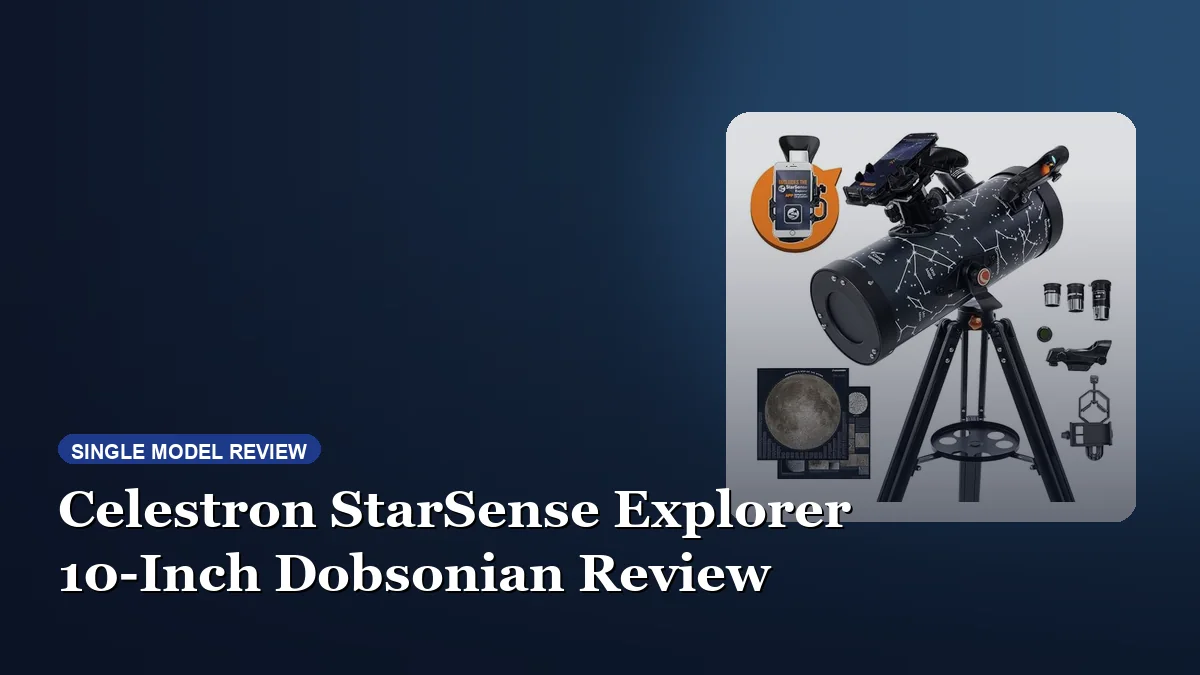

This massive reflector delivers breathtaking deep-space clarity backed by intuitive smartphone alignment. Exceptional light grasp makes it a premier choice for serious visual observers.
Explore related alternatives in our Best 10 Inch Dobsonian Telescope.
Verified Specifications
| Category / Type | Newtonian Reflector Dobsonian |
|---|---|
| Aperture | 254 mm (10 inches) |
| Focal Length | 1200 mm (f/4.7) |
| Mount Type | Manual Altazimuth Rocker Box |
| Optical Coatings | Enhanced Aluminum with Silicon Dioxide |
| Focuser | 2-inch Crayford with 1.25-inch adapter |
| App Compatibility | Celestron StarSense Explorer |
| Optical Tube Weight | Approx. 32 lbs |
| Base Weight | Approx. 25 lbs |
| Warranty | 2-Year US Warranty |
What We Liked
- Massive 10-inch aperture reveals faint deep-sky nebulae and galaxies
- Innovative StarSense smartphone app eliminates tedious star-hopping
- Smooth Teflon-bearing rocker box ensures effortless manual tracking
- Dual-speed Crayford focuser handles heavy accessories without slipping
- Tool-free primary mirror collimation knobs simplify maintenance
Trade-Offs
- Combined assembly is heavy and requires physical effort to transport
- Lacks motorized tracking for long-exposure astrophotography applications
- Large optical tube demands ample storage and vehicle space
- Requires cooldown time before achieving optimal thermal equilibrium
Optical Engineering and Tube Construction
Engineering a 10-inch optical tube requires balancing rigidity with manageable field weight. Celestron constructs this Newtonian reflector using durable rolled steel, minimizing flexure during transport and intense vertical repositioning.
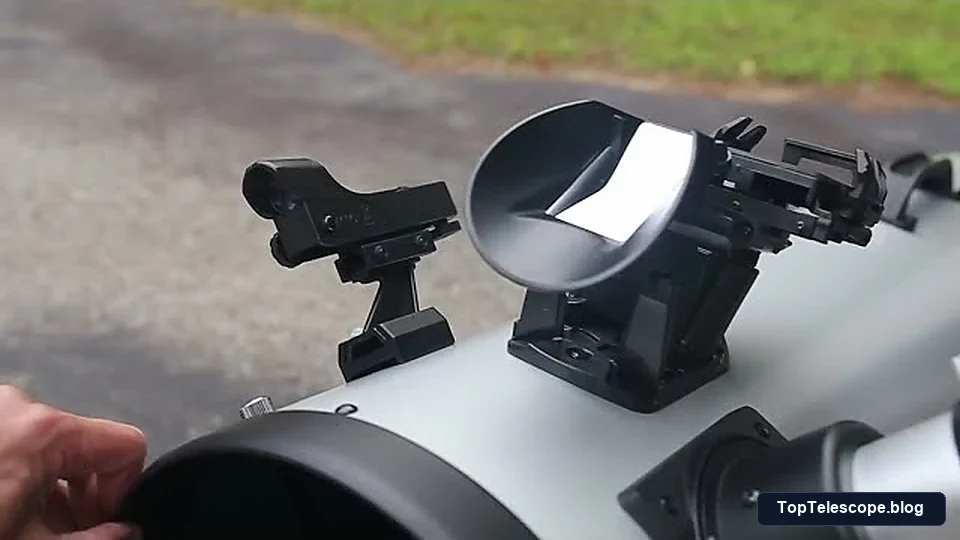
The primary mirror features enhanced aluminum coatings protected by a specialized silicon dioxide overcoat. This configuration maximizes reflectivity across the visible spectrum while defending against environmental degradation over time.
Internal baffling is meticulously placed opposite the focuser to eliminate stray light reflections. This optical treatment significantly boosts contrast levels when observing faint lunar details or distant planetary nebulae.
While smaller instruments like the best 8 inch dobsonian telescope offer great portability, the 10-inch aperture parabolic primary mirror delivers superior light-gathering power for deep-sky resolution.
Constructed from rolled steel plate, the optical tube assembly weighs approximately 31 pounds and measures 47 inches in length, requiring careful handling when mounting into the rocker box base.
Internal baffling utilizes flat black anti-reflective paint combined with a series of knife-edge rings to suppress stray light scatter, ensuring maximum image contrast for planetary and lunar observation.
- Aperture: 254mm (10 inches) primary mirror
- Focal Length: 1200mm operating at f/4.7
- Chassis: Rolled steel optical tube assembly
Focuser Mechanics and Eyepiece Compatibility
A robust dual-speed Crayford focuser manages heavy eyepiece pairings without slipping or image shift. The micro-adjustment knob enables precise focus locking on faint stellar targets during high-magnification sessions.
The included 2-inch adapter accommodates wide-field oculars effortlessly, expanding your maximum true field of view. Every mechanical interface uses brass compression rings to prevent marring expensive barrel assemblies.
- 2-inch Crayford focuser with 1.25-inch reducer
- Micro-focus reduction gear for precision adjustments
Mirror Coatings and Thermal Management
Large parabolic mirrors trap thermal energy inside the steel chassis during initial transport from indoor environments. Achieving optimal visual clarity requires allowing adequate cooling time before beginning critical planetary observations.
Active thermal management remains absent, forcing users to rely on natural ambient air circulation around the open cell. Integrating a rear cooling fan can drastically shorten stabilization periods during sharp temperature drops.
Maintaining proper thermal equilibrium prevents internal air currents from degrading high-magnification planetary resolution. Boundary layer dissipation is essential for resolving tight double stars and subtle Jovian cloud belts.
Aluminum reflective coatings feature a protective silicon dioxide overcoat that shields the fragile optical surface from oxidation, atmospheric moisture, and minor particulate abrasion during regular transport.
Managing thermal equilibrium is crucial for a mirror of this physical thickness; allowing at least forty-five minutes of ambient acclimatization prevents internal glass currents from degrading high-magnification views.
The rear cell includes an integrated cooling fan mount, permitting users to attach an optional DC-powered fan to accelerate temperature matching between the massive glass substrate and outside air.
- Parabolic primary mirror profile
- Open-cell rear mirror support design
- Thermal acclimatization required before viewing
Managing Environmental Temperature Shifts
Rapid ambient temperature drops cause glass substrates to contract, altering optimal focal points temporarily. Observers should monitor thermal adaptation to maintain pinpoint star images throughout long viewing sessions.
Storing the instrument in a cool garage minimizes temperature differentials before field deployment begins.
- Glass thermal expansion management
- Pre-session cooling protocols
Video Review: Unboxing
Mount Mechanics and Ergonomic Handling
The classic rocker box design utilizes friction-adjustable altitude bearings for exceptionally smooth vertical motion tracking. Teflon pads ensure seamless horizontal rotation, letting users easily nudge the scope toward targets.
Carrying handles integrated directly into the wooden base simplify field transport despite the substantial aggregate weight. Ergonomic balance prevents accidental tipping when moving the heavy assembly across uneven ground.
When evaluating options in any best 10 inch dobsonian telescope roundup, note that altitude tension knobs let observers customize resistance based on heavy accessory payloads.
The particle-board rocker box utilizes Teflon bearing pads paired with a large azimuth friction clutch to deliver smooth, stutter-free manual tracking adjustments across wide horizontal azimuth sweeps.
Altitude tension knobs on both side trunnions allow observers to dial in precise resistance, preventing heavy dual-inch eyepieces from causing unexpected optical tube droop during zenith observations.
Carrying handles built directly into the side panels significantly ease transport logistics, though the combined system weight still demands a two-person lift for safe vehicle loading.
- Laminate particle board rocker box construction
- Adjustable altitude tension clutch system
- Integrated composite carrying handles
StarSense Explorer App Integration
Traditional star-hopping can intimidate beginners tackling faint objects. Following our guide on mastering the starsense explorer, the proprietary StarSense app bypasses this learning curve via smartphone plate-solving.
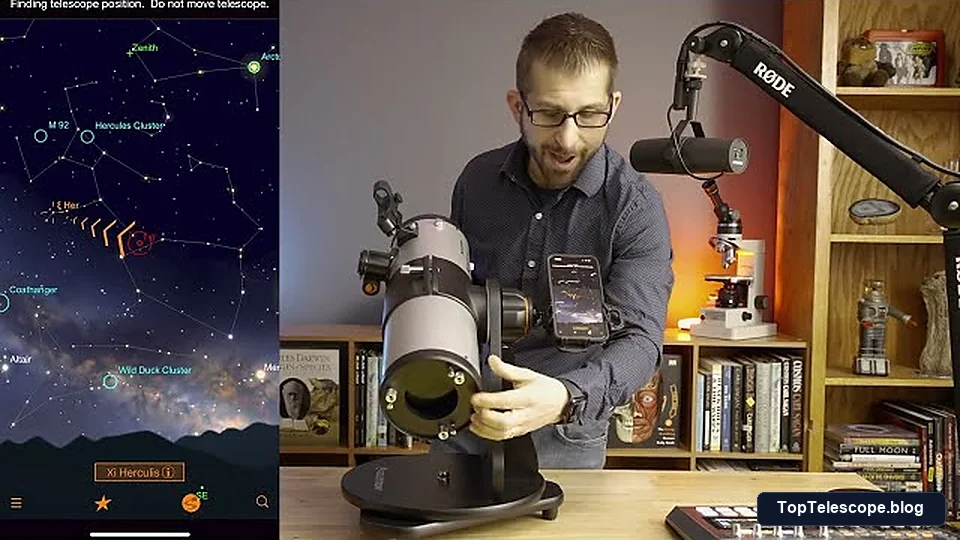
The physical dock aligns your mobile device precisely with the main optical tube's focal axis. Once calibrated, the software generates on-screen directional arrows guiding you directly to your desired celestial destination.
GPS integration calculates exact overhead positioning without requiring complex multi-star alignment procedures or compass calibrations. This digital assistance drastically increases the number of observable targets during a single night.
Operating via proprietary plate-solving technology, the smartphone dock captures wide-field star patterns through your phone camera, instantly calculating exact celestial coordinates without requiring complex multi-star alignment routines.
The software interface provides intuitive directional arrows guiding manual slewing movements, making it exceptionally straightforward for novice astronomers to locate faint Messier objects under urban skies.
Phone camera alignment verification requires a brief daytime calibration procedure using a distant terrestrial landmark to ensure exact optical axis parallelism with the primary mirror assembly.
- Smartphone dock with mirror alignment assembly
- Plate-solving sky-mapping software algorithm
- Real-time directional target arrow guidance
Real-World Deep-Sky Visual Performance
While stepping up to a best 12 inch dobsonian telescope offers greater reach, this 10-inch aperture reveals intricate spiral structure within Messier galaxies with stunning clarity.
Lunar and planetary observation benefits tremendously from the generous focal length and high light grasp. Jupiter displays rich cloud banding, while Saturn exhibits the distinct Cassini Division under steady atmospheric seeing conditions.
City light pollution filters mount easily into standard 1.25-inch or 2-inch eyepieces to enhance contrast. Observers situated in suburban backyards will still access hundreds of stellar clusters and prominent emission nebulae.
Gathering massive amounts of light, this optical configuration resolves individual stars within globular clusters like Messier 13 while revealing delicate spiral structure in bright galaxies under dark skies.
Planetary performance benefits from the generous focal length, delivering crisp contrast on Jupiter's cloud belts and sharp Cassini division details on Saturn when atmospheric seeing conditions remain stable.
Utilizing wide-angle eyepieces creates an immersive spacewalk visual effect, though peripheral coma aberration becomes subtly apparent near the edges without a high-grade coma corrector lens installed.
- Resolves faint deep-sky Messier and NGC catalog objects
- High-contrast planetary details under steady seeing
- Accepts standard 2-inch filtration accessories
Maintenance, Collimation, and Long-Term Durability
Fast Newtonian reflectors operating at f/4.7 demand regular optical alignment to preserve sharp diffraction patterns. The primary cell features convenient hand-turn collimation knobs that simplify field adjustments without requiring tools.
Storing the optical tube upright with dust caps secured protects sensitive mirror coatings from airborne contaminants. Routine inspection of mechanical fasteners prevents structural loosening caused by frequent vehicular transport over rough roads.
Cleaning glass surfaces should occur sparingly using dedicated optical microfiber cloths and specialized cleaning solutions. Protecting the reflective aluminum layers guarantees sustained optical performance across many years of heavy astronomical use.
Routine alignment checks using a laser collimator ensure optical precision is maintained before every viewing session, correcting any minor tilt introduced during transport over bumpy roads.
Primary mirror cell adjustments feature convenient tool-free knobs, allowing precise collimation tweaks under low-intensity red flashlights without ever requiring loose screwdrivers in cold outdoor environments.
Properly storing the optical tube vertically with dust caps securely attached prevents particulate accumulation on delicate glass surfaces and extends the operational lifespan of reflective coatings.
- Tool-free primary mirror adjustment screws
- Secondary mirror four-vane spider assembly
- Protective dust covers for optical elements
Final Verdict: Who Should Buy This Reflector
Intermediate astronomers seeking dramatic light-gathering power without computerized goto motor noise will find immense satisfaction here. Visual purists who appreciate manual operation paired with modern alignment aids will thrive.
Transporting a large Dobsonian requires adequate vehicle storage space and sufficient physical strength for lifting components. Those seeking grab-and-go portability should consider smaller tabletop alternatives instead of this heavy instrument.
Combining massive aperture optics with intuitive smartphone navigation establishes a new benchmark for manual astronomy gear. This telescope delivers exceptional value for dedicated stargazers wanting deep-sky views without electronic complexity.
This optical instrument suits intermediate to advanced amateur astronomers seeking maximum light grasp and intuitive smartphone navigation without the high costs associated with computerized goto mounts.
Users must evaluate physical storage space and lifting capacity before purchasing, as the sizeable tube and base require dedicated vehicle room for dark-sky site excursions.
Ultimately, the combination of a large light bucket and modern plate-solving assistance delivers an unmatched observing experience for backyard stargazers eager to explore deep space.
- Ideal for backyard deep-sky and planetary visual study
- Requires two-piece transport due to overall weight
- Delivers exceptional light grasp per unit cost
Frequently Asked Questions
Does the StarSense Explorer app require cellular service to locate celestial targets in the field?
No cellular data is needed because the app uses your phone's built-in GPS and camera to solve the star field. Offline star-plate technology ensures you can navigate remote dark sky sites seamlessly without any wireless signal whatsoever.
How difficult is it to manually collimate the primary and secondary mirrors on this instrument?
Collimation is remarkably straightforward using the tool-free primary hand knobs and a standard hex wrench for the secondary mirror. Routine optical alignment checks performed before every observing session guarantee consistently sharp planetary and deep-sky high-magnification views.
Can experienced astrophotographers use this Dobsonian base platform for long-exposure deep-sky imaging?
This manual Dobsonian mount completely lacks the motorized equatorial tracking required for long-exposure deep-sky astrophotography work. However, lunar and planetary snapshotting using a specialized smartphone adapter remains entirely feasible for capturing bright solar system targets.
What physical storage space is necessary to transport this large telescope safely in a vehicle?
The massive optical tube measures roughly four feet long, requiring a spacious backseat or flat trunk configuration. Careful padding and secure placement during transit prevent accidental denting or alignment shifts of the rolled steel chassis.
Are additional eyepieces necessary immediately, or do the stock inclusions suffice for beginners?
The included eyepieces provide a solid baseline for wide-field scanning and moderate planetary magnification right out of the box. Upgrading to premium wide-field oculars later will further enhance optical contrast and edge-to-edge sharpness across your views.