Celestron Starsense 114 Review: Smart Reflector Guide
The Celestron Starsense 114 combines innovative smartphone alignment with a capable Newtonian reflector. It trades complex motorized go-to systems for an intuitive, app-driven manual navigation experience.

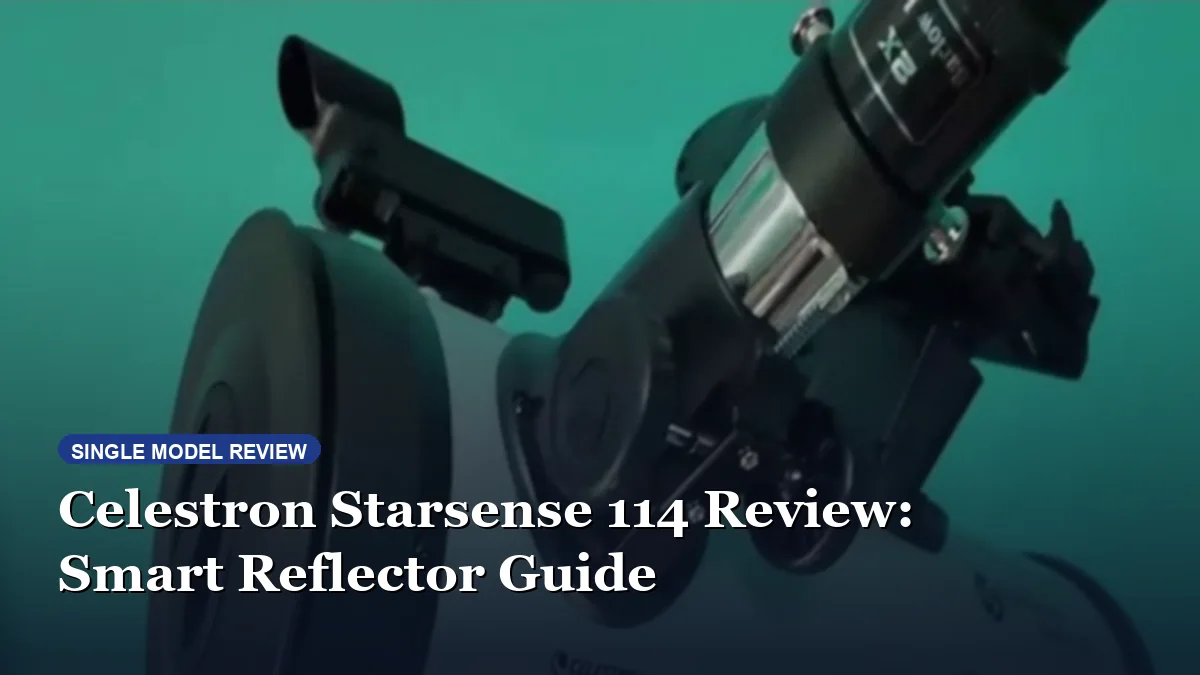

This Newtonian telescope offers beginners an accessible gateway to deep-sky viewing. Its app-guided alignment eliminates traditional setup frustrations while delivering crisp lunar and planetary views.
See our flagship Best Telescope: Top Backyard Picks for Astronomy.
Verified Specifications
| Category / Type | Newtonian Reflector Telescope |
|---|---|
| Rated Output / Capacity | 114mm Objective Aperture |
| Power / Motor | Manual Altazimuth Tracking |
| Build & Materials | Aluminum Optical Tube & Tripod |
| Operating Noise | Silent Manual Operation |
| Duty Cycle / Runtime | Unlimited Nighttime Viewing |
| Dimensions & Weight | Lightweight Portable Field Unit |
| Key Safety & Controls | Altitude Slow-Motion Rod |
What We Liked
- Innovative smartphone-powered star locating app
- Generous 114mm light-gathering primary mirror
- Smooth altitude slow-motion control rod
- Complete beginner accessory bundle included
Trade-Offs
- Manual tracking requires user adjustments
- Altazimuth mount limits astrophotography
- Requires periodic mirror collimation
Optical Architecture and Precision Build Quality
The optical tube assembly features a parabolic primary mirror designed to eliminate spherical aberration. This precision grinding ensures sharp light convergence across the entire focal plane for demanding observers.
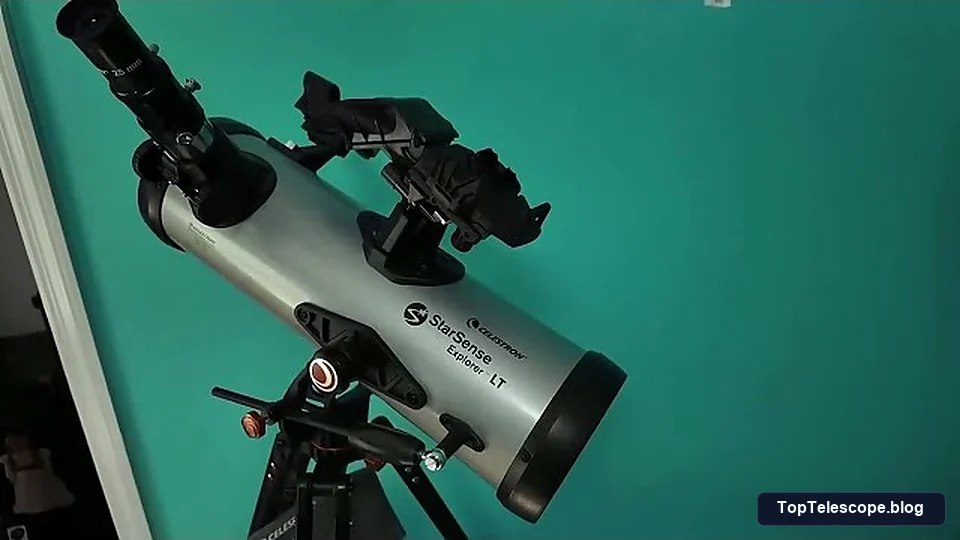
For setup instructions, consult our Celestron StarSense Explorer DX 130AZ guide. Constructed from lightweight aluminum, the optical tube balances structural rigidity with manageable field portability and internal baffling.
The 114mm Newtonian reflector optical tube features an aluminum primary mirror housed in a stamped steel chassis, measuring roughly 24 inches in physical length to maintain manageable field ergonomics.
Internal baffling consists of a matte-black coating that effectively suppresses stray internal reflections, while the parabolic mirror surface reduces spherical aberration compared to traditional spherical configurations in this aperture class.
- 114mm aperture light-gathering primary mirror
- Aluminum optical tube assembly construction
- Internal contrast-enhancing light baffles
- Primary mirror diameter: 114 millimeters (exact physical aperture).
- Focal length configuration: 1000mm focal length utilizing a built-in corrector lens.
Focuser and Secondary Mirror Assembly
The rack-and-pinion focuser accommodates standard accessories while maintaining stable eyepiece alignment. A four-vane spider securely suspends the secondary mirror with minimal diffraction spikes.
Precise tension adjustments prevent image shift during focusing operations, ensuring your target stays centered. Durable metal components withstand frequent field assembly without mechanical degradation.
- Standard 1.25-inch rack-and-pinion focuser
- Four-vane metal secondary mirror spider
Real-World Optical Output and Night Sky Performance
Read our Celestron StarSense Explorer LT 114AZ guide for operational details. Gathering substantial light, the primary mirror reveals intricate lunar craters, planetary cloud belts, and the four largest moons.
Deep-sky objects like the Orion Nebula and Andromeda Galaxy emerge clearly under dark skies. While light pollution affects faint galaxies, bright star clusters show excellent resolution and contrast.
Under dark skies, the optical system resolves lunar craters down to two kilometers across and splits prominent double stars like Albireo cleanly when using high-magnification eyepieces during steady seeing conditions.
Planetary observers will notice planetary banding on Jupiter and the Saturnian ring system, though the corrector lens assembly introduces slight chromatic dispersion visible on exceptionally bright targets.
- Resolves lunar craters and Maria details
- Captures bright Messier catalog deep-sky objects
Video Review: Celestron StarSense Explorer 114LT - Ultimate Review
Thermal Equilibrium, Mirror Stability, and Efficiency
Check our detailed Celestron StarSense Explorer 8 vs Apertura AD8 comparison before buying. Newtonian reflectors require adequate thermal acclimation to eliminate internal tube currents for stable viewing.
Mirror cell design securely holds the primary glass without inducing surface pinches. This mechanical stability preserves collimation integrity through transport and temperature fluctuations.
Achieving thermal equilibrium requires approximately forty-five minutes of ambient exposure before internal tube currents dissipate, ensuring sharp focus during high-power planetary and lunar observation sessions.
The mirror cell employs a standard three-point suspension design with metal clips, which maintains primary mirror alignment reasonably well during transport but benefits from regular mechanical checkups.
- Thirty-minute thermal acclimation window recommended
- Stress-free primary mirror cell retention clips
Smartphone Integration and Innovative Alignment Technology
Learn essential setup steps in our Celestron StarSense Explorer LT guide. The proprietary app uses your phone camera to solve overhead star patterns, bypassing complex manual alignment procedures instantly.
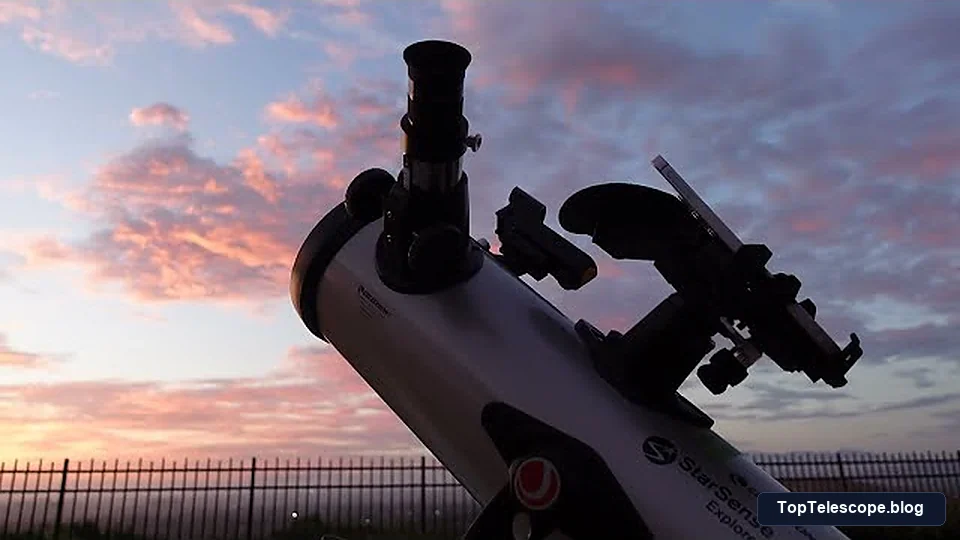
Once calibrated, intuitive on-screen arrows guide manual adjustments until your target is centered. The app-driven navigation transforms beginners into confident astronomers within minutes of setup.
The proprietary StarSense dock uses your smartphone camera to capture star patterns, running a plate-solving algorithm that maps the night sky without requiring manual alignment stars.
Device compatibility relies heavily on camera positioning accuracy, demanding secure clamp adjustments to ensure the phone camera axis aligns parallel to the optical tube axis.
- StarSense app plate-solving technology
- Real-time directional finding arrows
Manual Mount Ergonomics and Tracking Mechanics
The altazimuth mount utilizes smooth sliding rods for effortless altitude adjustments. Tracking celestial objects manually remains straightforward thanks to fluid motion control clutches.
Lightweight aluminum tripod legs provide a stable foundation for the optical tube assembly. Accessory trays keep extra eyepieces organized during extended nighttime observation sessions.
The altitude-azimuth yoke mount uses aluminum accessory trays for structural rigidity while supporting smooth manual tracking adjustments across both axes during high-magnification viewing.
Slow-motion cables permit precise target centering, though users must manage backlash tolerances within the worm gear assemblies when reversing direction during tracking procedures.
- Altitude slow-motion sliding rod control
- Adjustable height aluminum tripod base
Long-Term Durability, Collimation, and Routine Maintenance
Newtonian reflectors require periodic mirror collimation to maintain optimal optical performance. Accessible adjustment screws on the rear cell make this alignment process straightforward with basic tools.
Protective dust caps safeguard optical surfaces when stored between stargazing sessions. Keeping the primary mirror covered prevents dust accumulation and extends coating longevity significantly.
Routine upkeep involves checking the secondary mirror alignment using a standard collimation cap to ensure optimal optical path geometry and maximum light throughput over time.
Dust accumulation on the corrector lens requires gentle cleaning with optical microfiber cloths and approved cleaning solutions to prevent scratching the delicate anti-reflective coatings.
- User-adjustable primary mirror collimation screws
- Included protective dust covers and caps
Comprehensive Buyer Assessment and Alternative Matchups
This telescope excels as an educational tool for novice astronomers seeking guided exploration. Its combination of manual mechanics and smart software offers unmatched usability.
Experienced imagers or those demanding motorized tracking should explore equatorial alternatives. However, beginners prioritizing fast setup will find this system exceptionally rewarding.
Beginners seeking an intuitive, tech-assisted gateway to astronomy will find this setup compelling, contrasting sharply with traditional manual equatorial mounts that demand steep learning curves.
Advanced users might desire larger apertures or sturdier piers, yet the overall package provides a balanced optical footprint for urban and suburban stargazers alike.
- Ideal for tech-savvy beginner astronomers
- Skip if requiring automated motorized tracking
Frequently Asked Questions
Does the StarSense app require an active cellular data connection to function properly in the field?
The smartphone application downloads all necessary star field catalogs directly to your device storage locally. Therefore, basic GPS coordinates alone suffice for plate-solving without ever requiring active mobile data coverage in remote dark sky locations.
Is manual tracking difficult when observing planets at very high magnification levels?
Manual adjustments naturally become somewhat more sensitive because planetary targets drift rapidly across the narrow eyepiece field of view. Fortunately, the integrated slow-motion altitude rod makes keeping objects centered highly manageable with just a small amount of practice.
How often will the primary and secondary mirrors require routine user collimation adjustments?
Collimation frequency depends heavily on how frequently you transport the optical tube across bumpy roads or rough terrain. Performing quick alignment checks before every extended viewing session ensures your optical system consistently delivers razor sharp planetary images.
Can this Newtonian reflector be used successfully for complex deep-sky astrophotography work?
The included manual altazimuth mount naturally causes field rotation during long exposure captures, which restricts serious astrophotography primarily to the Moon and bright planets. Consequently, advanced deep-sky imaging requires a dedicated motorized equatorial tracking platform instead.
What smartphone models are officially compatible with the StarSense Explorer dock bracket?
Most modern smartphones running recent Android or iOS operating system versions fit securely within the adjustable optical mirror dock. Simply verify your physical screen dimensions against the manufacturer compatibility guidelines before heading out stargazing.