Celestron Rasa 8 Review: Elite Wide-Field Astrograph Performance
The Celestron Rasa 8 delivers blistering f/2 imaging speeds and a flat, illuminated field. It redefines modern backyard deep-sky astrophotography.


This specialized astrograph offers unrivaled speed for wide-field imaging, though users must accept dedicated mono-camera constraints and precise backfocus requirements.
See our flagship Best Telescope: Top Backyard Picks for Astronomy.
Verified Specifications
| Category / Type | Rowe-Ackermann Schmidt Astrograph |
|---|---|
| Rated Output / Capacity | 203mm (8-inch) Clear Aperture |
| Power / Motor | Integrated 12V DC MagLatch Fan |
| Build & Materials | Aluminum Optical Tube Assembly |
| Operating Noise | Low-decibel auxiliary cooling fan |
| Duty Cycle / Runtime | Continuous night-sky imaging capability |
| Dimensions & Weight | 17.7 pounds (8.0 kg) OTA weight |
| Key Safety & Controls | Custom T-adapter and camera clearance ring |
What We Liked
- Extremely fast f/2 focal ratio cuts required exposure times drastically
- Exception flat field across large sensor formats without field flatteners
- Sturdy aluminum optical tube assembly maintains structural rigidity
- Integrated MagLatch cooling fan accelerates thermal equilibrium effectively
Trade-Offs
- Optimized solely for astrophotography with no visual capability
- Strict backfocus tolerances demand precise spacing adapters
- Front-mounted camera placement introduces slight diffraction spikes
Optical Architecture and Chassis Engineering
The Celestron Rasa 8 utilizes a sophisticated four-element optical design featuring rare-earth glass lenses. For more details, consult our celestron rasa 8 vs hyperstar c8 comparison to evaluate imaging performance.
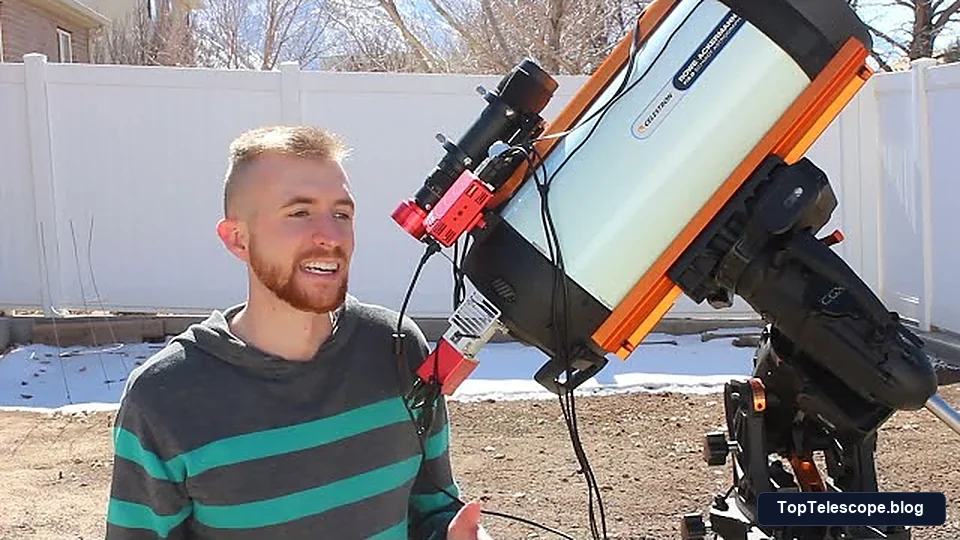
Engineered specifically for digital sensors, the optical tube eliminates traditional eyepiece constraints. Every internal surface is blackened to minimize stray reflections and boost contrast.
The robust aluminum chassis protects precision optics from mechanical flexure during heavy tracking sessions.
The Rowe-Ackermann Schmidt Astrograph utilizes a fast f/2.2 focal ratio paired with an 8-inch aperture. This optical design requires precision aluminum casting to maintain structural integrity across wide thermal shifts.
Internal baffling is engineered to suppress stray light reflections before photons reach the primary mirror. The corrector plate features StarXcel optical coatings designed to maximize total light transmission throughout the visible spectrum.
Mechanical tolerances inside the optical tube assembly prevent primary mirror shift during focusing maneuvers. A robust locking mechanism secures the mirror position once optimal focus is achieved for long imaging sessions.
- 203mm aperture collects ample faint photons
- Proprietary StarFast secondary mirror configuration
- Massive 42mm imaging circle coverage
Aperture and Fast Focal Ratio Mechanics
Operating at an ultra-fast f/2 focal ratio, the system gathers light exponentially faster than standard f/10 Schmidt-Cassegrain telescopes.
This incredible speed allows deep-sky imagers to capture faint nebulosity in single-minute exposures.
- 400mm focal length provides expansive sky views
- Drastically reduced sub-exposure integration times
Field Performance and Imaging Metrics
When paired with modern CMOS sensors, the telescope delivers pinpoint stars right into the extreme corners of the frame. Beginners can also explore options within the best celestron telescope for beginners guide.
Vignetting is tightly controlled across APS-C and select full-frame sensors. Users experience consistent illumination across wide star fields and sprawling emission nebulae.
The optical prescription effectively eliminates coma and astigmatism for clean scientific analysis.
Delivering a 43mm image circle, the astrograph illuminates modern large-format CMOS sensors effortlessly. Spot diagrams confirm exceptionally tight star images across APS-C and full-frame sensor boundaries without noticeable corner degradation.
Chromatic aberration is rigorously controlled through specialized glass types utilized in the multi-element corrector lens group. Astrophotographers will notice pinpoint stellar profiles even when imaging narrow-band emission lines under dark skies.
Vignetting remains minimal when matching the optical system with standard filter drawers and camera adapters. Maintaining clean sensor tilt adjustments is critical to preserving corner sharpness across ultra-wide field exposures.
- Flawless star shapes across large sensor chips
- Exceptional RMS spot sizes for sharp details
- High light transmission through advanced coatings
Resolution and Deep-Sky Clarity
Resolution limits allow faint galactic arms and tiny planetary nebulae to resolve clearly. High contrast optics separate tight stellar clusters effortlessly.
The wide field embraces expansive cosmic structures like the Veil Nebula in a single frame.
- Resolves intricate interstellar dust lanes
- Delivers high contrast on emission targets
Video Review: Search filters
Thermal Management and Internal Airflow
Managing temperature differentials is vital for fast optical systems to prevent boundary layer disturbances. An integrated MagLatch cooling fan pulls air through a micromesh filter.
This active ventilation system accelerates thermal equilibrium with the ambient outdoor environment. Air filtration ensures dust particles never settle on primary optical surfaces.
Quiet electrical operation prevents unwanted mechanical vibrations during long exposure sequences.
Rapid temperature acclimation is assisted by an integrated MagLev fan system powered by external DC sources. This quiet fan draws ambient air through filtered vents to stabilize internal optics quickly.
Managing thermal gradients prevents boundary layer turbulence from distorting high-magnification photographic data frames. Users should activate ventilation cycles at least forty-five minutes before starting operational imaging sequences.
Dust mitigation filters protect the delicate interior optical surfaces while allowing continuous airflow during operation. Periodic inspection of these intake mesh screens prevents particulate accumulation inside the sealed tube.
- Integrated 12V DC cooling fan system
- Micromesh filter blocks unwanted dust ingress
- Rapid temperature acclimation for evening sessions
Fan Efficiency and Noise Profiles
The low-vibration fan operates silently while clearing warm air from inside the tube. Continuous airflow maintains stable focal positioning throughout the night.
Power draw remains minimal, running safely from standard portable field battery packs.
- Whisper-quiet operational decibel level
- Low power draw preserves battery longevity
Rigging, Mechanical Setup, and Backfocus Mechanics
Mounting a camera at the front of the telescope requires careful cable management to prevent diffraction anomalies. Precise backfocus spacing must be measured exactly to 55mm.

A heavy-duty dovetail bar securely locks the optical tube onto equatorial mounts without flexing. Balancing the front-heavy assembly requires shifting the OTA along the saddle.
Solid focus knobs provide ultra-fine adjustments for critical image sharpness.
Mounting a heavy cooled camera requires precise backfocus spacing measured strictly from the front lens cell. Using custom threaded adapters ensures your image train remains completely rigid and orthogonal.
Balancing the telescope on an equatorial mount demands careful counterweight positioning due to front-heavy loading characteristics. Cable management must prevent snagging during meridian flips under automated observatory control software.
The front lens mounting ring acts as the primary attachment point for imaging accessories and filter wheels. Engineers designed this interface to support substantial payloads without introducing flexure into the system.
- Exact 55mm backfocus requirement from adapter
- Vixen-style dovetail bar included standard
- Smooth internal focusing mechanism prevents mirror shift
Camera Integration and Cable Management
Routing USB and power cords safely around the front aperture prevents obstruction of incoming light. Custom adapters ensure rigid camera alignment.
Careful balancing guarantees tracking accuracy on motorized equatorial mounts.
- Custom T-ring adapters available separately
- Low-profile cable routing minimizes diffraction
Collimation Protocols and Optical Maintenance
Factory alignment holds remarkably well during transport, but the primary cell features adjustment screws for periodic tuning. Maintaining factory collimation ensures optimal optical performance.
Cleaning glass surfaces demands care due to specialized multi-coatings applied to corrector plates. Dust should be removed gently using bulb blowers before applying liquid cleaners.
Protective covers keep internal elements secure when stored between observing sessions.
Factory alignment is exceptionally stable, but rare transport impacts may require minor secondary mirror adjustments. Users must follow strict manufacturer guidelines to avoid scratching the delicate glass corrector plate during maintenance.
Cleaning optical surfaces should be done infrequently using specialized photographic cleaning solutions and microfiber cloths. Compressed air can safely remove loose dust particles without requiring direct physical contact with coatings.
Storing the optical tube assembly in a padded carrying case protects mechanical components from environmental moisture. Desiccant packs placed inside storage containers prevent mold growth on sensitive glass elements during humid months.
- Factory-aligned optical cell stays secure
- User-adjustable primary tilt screws available
- Durable multi-coatings resist minor environmental wear
Routine Care and Corrector Cleaning
The front corrector plate requires occasional cleaning to remove pollen and atmospheric residue. Using optical-grade micro-fiber cloths prevents micro-scratches.
Proper storage in a padded case protects optical alignment integrity over years of field use. You can also review our celestron starsense explorer lt guide for alignment instructions.
- Safe cleaning guidelines preserve optical coatings
- Padded transport cases prevent physical shock
Comparative Value and Final Purchasing Verdict
This specialized astrograph represents a significant investment for dedicated astrophotographers seeking uncompromising wide-field performance. Its exceptional speed justifies the lack of visual capability.
Traditional telescopes require expensive focal reducers to match this native f/2 optical speed. The system rewards patient users with breathtaking, publication-quality deep-sky images.
Evaluate your existing camera inventory and mount capacity before purchasing this advanced optical tube.
When evaluating wide-field astrographs, this system offers unmatched speed for deep-sky imaging enthusiasts. Its specialized design prioritizes photographic performance over visual observation, making it a dedicated tool for advanced astrophotographers.
Investing in a robust mount and power accessories is necessary to maximize the operational capabilities of this astrograph. Careful planning of your complete imaging ecosystem ensures seamless integration and reliable nightly performance.
Ultimately, the exceptional light-gathering power and sharp flat fields justify the technical learning curve. For alternative setups, read our celestron nexstar 6se vs 8se comparison to assess optical differences.
- Unmatched imaging speed for dedicated astrophotography
- Eliminates need for external focal reducers
- Requires compatible equatorial tracking mount
Who Should Invest in This System
Intermediate and advanced imagers wanting rapid data collection will find this instrument transformative. It suits portable field trips and permanent backyard observatories alike.
Avoid this model if you prefer traditional eyepiece viewing or casual stargazing sessions.
- Ideal for serious deep-sky astrophotographers
- Not recommended for visual-only astronomers
Frequently Asked Questions
Can the Celestron Rasa 8 be used for visual astronomy?
No, this specialized optical tube is engineered exclusively for astrophotography. The camera mounts directly at the front aperture, preventing the use of standard eyepieces completely, which ensures optimized imaging performance across wide sensor formats.
What camera types work best with this optical system?
Dedicated astronomical CMOS cameras with small to medium sensor formats perform exceptionally well. Full-frame sensors can be used, provided they feature small body diameters to minimize front-aperture central obstruction and maintain clean diffraction patterns.
How important is the exact backfocus measurement?
Achieving precise backfocus is critical for maintaining sharp corner stars across your images. You must maintain the exact manufacturer-specified distance using appropriate spacers to ensure flawless optical correction throughout your entire imaging session.
Does the internal fan require constant external power?
Yes, the integrated cooling fan operates on a standard 12-volt DC power source. Connecting it to a portable field battery accelerates thermal equilibrium and runs quietly to provide reliable environmental acclimation without causing vibrations.
How frequently does the optical system require collimation?
The factory alignment is exceptionally stable and rarely drifts during normal transport. Periodic checks using artificial star tests will confirm whether minor adjustments to the primary tilt screws are necessary for peak sharpness.