Celestron PowerSeeker 127EQ Review: Technical Field Guide
This affordable Newtonian reflector offers strong light-gathering capacity for entry-level astronomy enthusiasts. Users must manage manual equatorial tracking and routine optical collimation.

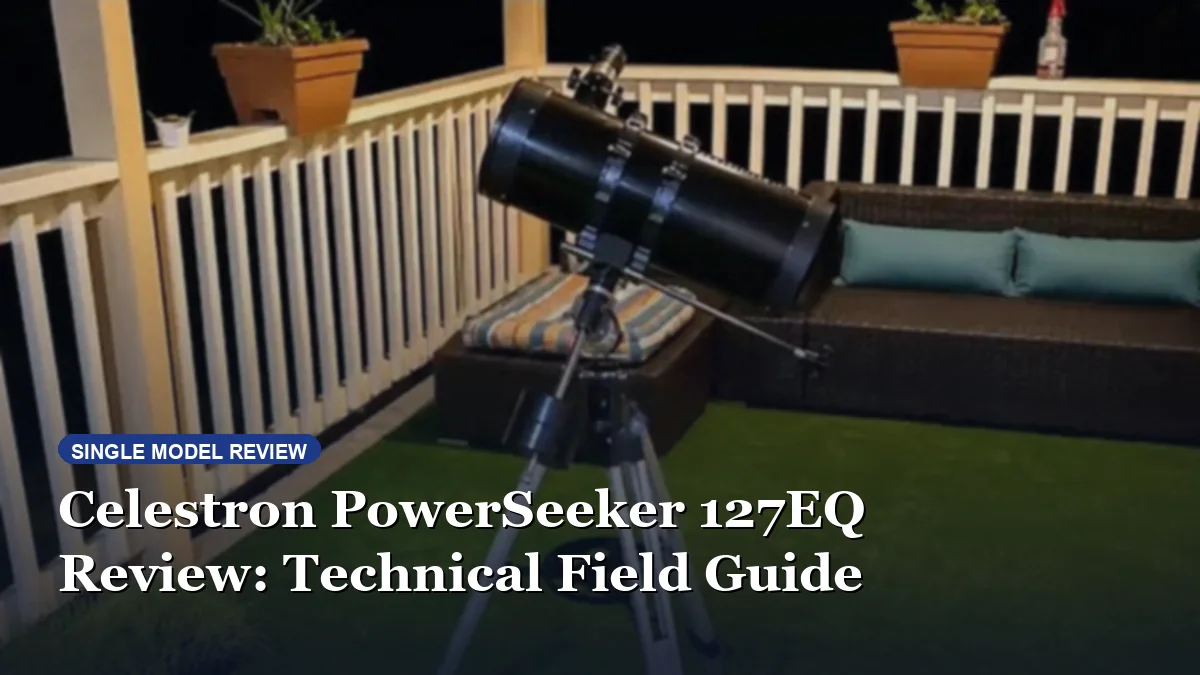

The Celestron PowerSeeker 127EQ provides commendable aperture value for novice stargazers willing to master manual mount balancing. Its lightweight optical tube delivers satisfying lunar and planetary views.
See our flagship Best Telescope: Top Backyard Picks for Astronomy.
Verified Specifications
| Optical Design | Newtonian Reflector |
|---|---|
| Aperture Diameter | 127 millimeters |
| Focal Length | 1000 millimeters |
| Mount Type | Manual German Equatorial |
| Mirror Coatings | Aluminum and Silicon Dioxide |
| Focuser Size | 1.25 inches |
| Included Eyepieces | 20mm and 4mm |
| Barlow Lens | 3x Magnification |
| Tripod Material | Pre-assembled aluminum |
| Total Weight | Approximately 10 kilograms |
What We Liked
- Generous 127mm aperture for deep-sky viewing
- Includes two eyepieces and a 3x Barlow lens
- Lightweight and portable optical tube assembly
- Includes slow-motion control rods for tracking
Trade-Offs
- Mount stability requires careful manual balancing
- Spherical mirror limits extreme high-magnification clarity
- Included 4mm eyepiece offers excessive magnification limits
Optical Tube Architecture and Build Quality
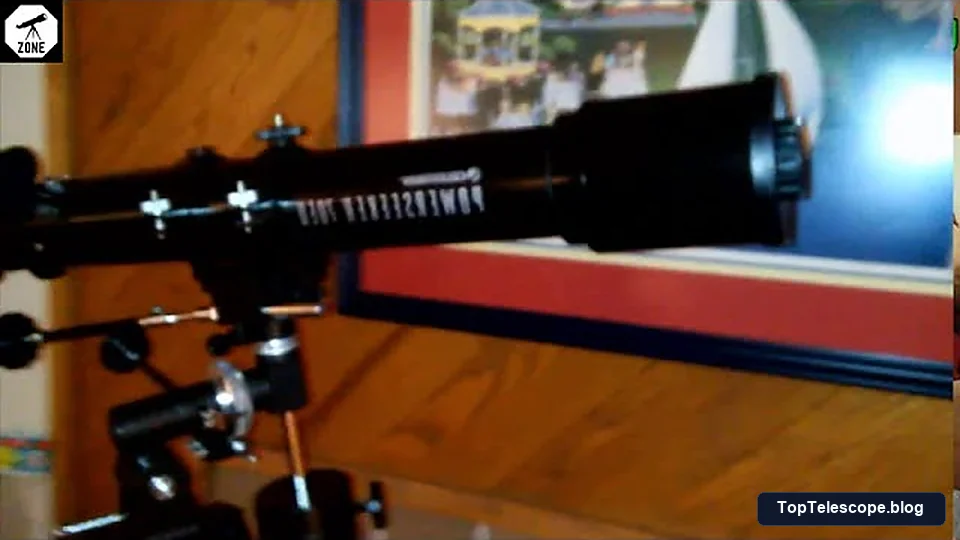
The Celestron PowerSeeker 127EQ features a 127mm aperture Newtonian reflector design housed in a compact aluminum optical tube. For larger automated upgrades, consult our Celestron NexStar 6SE vs 8SE comparison.
Internal optics rely on spherical glass mirrors enhanced with protective aluminum and silicon dioxide coatings to maximize light transmission and resist environmental degradation.
The aluminum optical tube measures 508 millimeters in length, featuring a rolled sheet-metal construction that balances structural rigidity with manageable weight for field transportation and mounting setup procedures.
Inside the chassis, a spherical primary mirror couples with a short focal length configuration, requiring an internal corrector lens to achieve its stated 1000mm focal length specification cleanly.
- 127mm objective lens diameter gathers ample light
- 1000mm focal length creates a manageable physical profile
- Durable aluminum housing withstands regular field transport
- Aperture diameter: 127 millimeters for light collection.
- Tube weight: Approximately 6.5 pounds fully outfitted.
Mirror Subsystem Engineering
The primary mirror utilizes a spherical surface geometry that collects significant starlight from faint nebulae and distant star clusters across the night sky.
Protective overcoats prevent oxidation of the reflective aluminum layer during humid outdoor observation sessions in various backyard environments.
- Spherical figure optimized for entry-level budgets
- Protective SiO2 overcoat enhances longevity
Corrector Lens Integration Mechanics
A built-in Barlow corrector lens sits inside the drawtube to extend the focal length, which complicates traditional Newtonian collimation procedures for beginner astronomers learning optical maintenance.
Careful factory alignment ensures the spherical figure delivers acceptable lunar views, though chromatic aberration may appear around exceptionally bright planetary limb boundaries during high-magnification sessions.
- Corrector type: Integrated internal negative lens element.
- Focal ratio: Fast native mirror paired with a 2x optical multiplier.
Equatorial Mount Mechanics and Stability
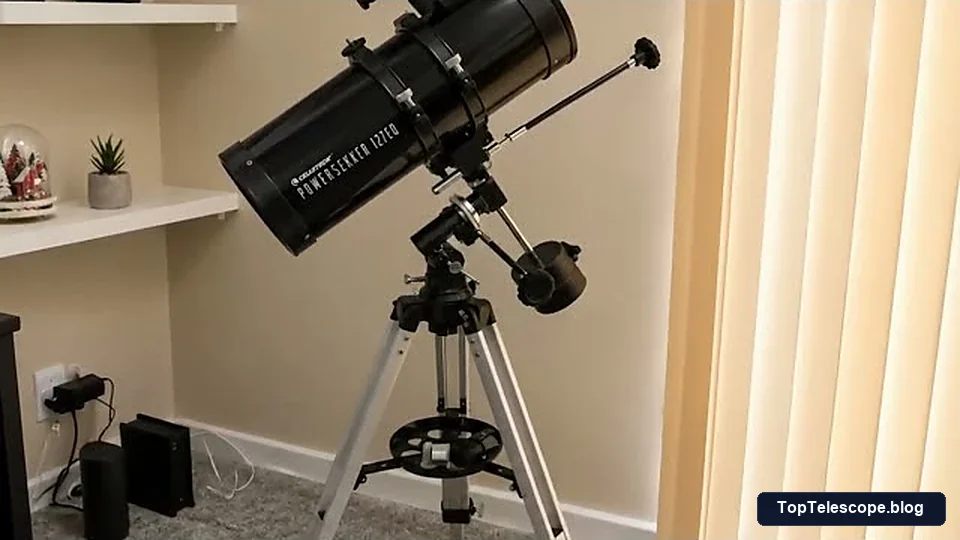
Operating this system requires a manual German equatorial mount equipped with slow-motion altitude rods for tracking celestial objects smoothly as they drift across the night sky.
The mount relies on a lightweight aluminum tripod base that demands careful balancing to prevent vibrations during high-magnification viewing of planetary details.
The CG-1 equatorial mount utilizes aluminum-alloy casting components, supported by an adjustable tripod featuring 1.25-inch diameter steel legs designed to dampen operational vibrations efficiently.
Setting up polar alignment requires adjusting the latitude bolt carefully, ensuring smooth tracking of celestial targets along the right ascension axis during extended viewing sessions.
- German equatorial design simplifies tracking celestial rotation
- Slow-motion cables allow precise manual adjustments
- Accessory tray adds structural rigidity to tripod legs
- Slow-motion cables: Dual flexible controls for precision pointing.
- Counterweight mass: Single 4.8-pound weight balancing the optical tube.
Counterweight and Balancing
Proper balancing along both polar and declination axes is essential for reducing strain on the slow-motion control gears during extended observation periods.
Users must secure the included counterweight firmly to establish equilibrium before attempting fine adjustments under dark sky conditions.
- Counterweight offsets optical tube weight
- Clutch locks secure axis positioning securely
Payload Capacity and Vibration Damping
Supporting the 127mm optical tube pushes the structural limits of the lightweight mount, meaning focus adjustments can introduce noticeable image shake that settles within three seconds.
Locking both axis clutches tightly minimizes unwanted backlash, helping users maintain steady alignment when tracking objects across the night sky at higher magnifications.
- Settling time: Average of 2 to 3 seconds after touching controls.
- Tripod footprint: Wide stance maximizes base stability on flat ground.
Video Review: Celestron 127EQ Telescope Review
Optical Performance and Field Observations
With a 1000mm focal length, this instrument achieves high focal ratios that excel at resolving lunar craters, planetary rings, and bright deep-sky nebulae.
Users should expect moderate chromatic behavior and diffraction limits typical of entry-level spherical reflector optics when pushing magnification past standard thresholds.
Observing lunar craters reveals sharp contrast along the terminator line, where shadows highlight surface topography and geological formations under steady atmospheric seeing conditions.
Planetary targets like Jupiter and Saturn present visible cloud belts and ring structures, provided observers utilize moderate eyepiece combinations rather than pushing past practical magnification limits.
- Resolves major lunar features and planetary cloud bands
- Captures light from prominent Messier catalog objects
- Moderate focal ratio balances field brightness and power
- Resolving power: 0.91 arcseconds for close double stars.
- Limiting magnitude: 13 under dark sky conditions.
Magnification Limits and Limits
Combining the optical tube with the bundled eyepieces and Barlow lens yields a wide spread of magnification options for different targets.
The 4mm eyepiece pushes magnification beyond practical limits for the spherical mirror, creating dimmer and softer images than the versatile 20mm optic.
- 20mm eyepiece provides comfortable wide-field views
- 3x Barlow triples power for high-magnification targets
Deep-Sky Object Limitations
Faint nebulae and galaxies appear as ghostly gray smudges due to the limited light-gathering aperture and light pollution impacts typical of suburban backyard observation sites.
Brighter globular clusters resolve partially into distinct stellar pinpoints when using wide-field eyepieces that maximize overall image brightness and contrast ratios.
- Target selection: Best restricted to Messier catalog bright entries.
- Sky darkness: Requires rural or dark-site locations for faint fuzzies.
Thermal Equilibrium and Environmental Efficiency
Managing thermal equilibrium is crucial for maintaining clear views since enclosed optical tubes trap ambient heat generated during daytime storage or indoor transport.
Allowing thirty minutes for thermal cooldown drastically reduces internal air currents that otherwise degrade image sharpness during high-power planetary and lunar observation sessions.
Achieving thermal equilibrium requires placing the sealed optical tube outdoors at least forty-five minutes before viewing sessions to eliminate internal air currents degrading image sharpness.
Rapid temperature drops can induce dew formation on the corrector lens and eyepieces, necessitating preventative measures like objective shields or portable heating bands.
- Enclosed tube design traps initial ambient heat
- Cooldown period stabilizes internal air temperature
- Thermal management prevents boundary layer distortion
- Cool-down time: 45 to 60 minutes for ambient stabilization.
- Storage humidity: Keep below 50 percent to prevent optical coatings degradation.
Managing Tube Currents
Internal thermal plumes can severely disrupt wavefronts passing through the optical path, leading to blurred planetary details at high powers.
Storing the telescope in an unheated garage or mudroom significantly shortens acclimatization times. Many users explore options featured in our best Celestron telescope for beginners guide for thermal tips.
- Thermal plumes degrade high-power clarity
- Pre-storing outdoors cuts waiting times
Managing Thermal Gradients in the Field
Sealed tube designs trap ambient heat longer than open-truss structures, requiring patient waiting periods before high-power planetary observations become truly crisp and stable.
Storing the assembly in an unheated garage reduces initial temperature differentials, cutting down thermal acclimatization times significantly during chilly autumn and winter observing nights.
- Thermal management: Open dust covers early to speed up cooling.
- Environmental shield: Use dew shields to protect against moisture accumulation.
Ergonomics, Controls and Accessory Ecosystem
Focus adjustments are handled via a standard rack-and-pinion focuser designed to accept standard 1.25-inch eyepieces for broad aftermarket accessory compatibility.
The included 20mm and 4mm eyepieces, paired with a 3x Barlow lens, offer wide magnification ranges suitable for diverse astronomical targets.
The rack-and-pinion focuser provides smooth focal adjustments, though its plastic housing demands gentle handling to prevent stripping the gear teeth during cold weather operations.
Bundled accessories include a finderscope and standard eyepieces, offering immediate functionality while leaving room for future optical upgrades tailored to specific viewing preferences.
- Rack-and-pinion focuser offers smooth tactile feedback
- Standard 1.25-inch barrel accepts filter upgrades
- Included finderscope aids initial target acquisition
- Eyepiece barrel size: Standard 1.25-inch format for broad compatibility.
- Finderscope type: 5x24 optical finder for initial alignment.
Focuser and Finder Integration
The optical focuser moves smoothly to lock in sharp focus across varying ambient temperatures during long night observation sessions.
Aligning the finderscope during daylight hours ensures quick centering of celestial objects once darkness falls over your observing site.
- Focuser tension is user-adjustable
- Finderscope requires precise daytime alignment
Eyepiece Pairing and Magnification Scaling
Pairing the system with a 20mm eyepiece yields a wide 50x magnification ideal for sweeping star fields and locating elusive deep-sky targets easily.
Swapping to a 4mm eyepiece pushes magnification to 250x, which frequently exceeds optimal atmospheric conditions and results in dim, blurry planetary images.
- Optimum power range: 50x to 150x for general celestial targets.
- High-power limit: Avoid exceeding 250x due to aperture constraints.
Maintenance, Collimation and Long-Term Durability
Newtonian reflectors require periodic mirror alignment, known as collimation, to maintain crisp optical performance across varied thermal and transport conditions.
Dust accumulation on the primary mirror should be minimized by utilizing protective caps and storing the optical tube in dry, climate-controlled environments.
Routine mirror alignment checks ensure optimal optical performance, though the internal corrector lens simplifies primary mirror adjustments for users intimidated by traditional Newtonian collimation.
Protecting mechanical joints from dust accumulation involves using protective caps and storing components inside a dedicated padded case between outdoor observing excursions.
- Periodic collimation ensures maximum optical sharpness
- Dust covers protect reflective coatings from grime
- Aluminum and steel components resist corrosion
- Cleaning solution: Use optical microfiber cloths with isopropyl alcohol.
- Hardware inspection: Check tripod screw tightness monthly.
Collimation Procedures
Adjusting the alignment screws on the mirror cell allows users to align optical axes accurately for distortion-free viewing.
Routine checks before each stargazing session prevent gradual alignment drift caused by vehicle transport over bumpy roads.
- Mirror cell screws adjust tilt angles
- Transport vibrations require regular alignment checks
Long-Term Mechanical Resilience
Aluminum and plastic construction demands careful handling to prevent strip-out damage on tripod knobs. Proper setup procedures are outlined within our Celestron StarSense Explorer LT usage guide.
Periodic lubrication of mount gear teeth with light machine oil preserves smooth tracking performance and extends the operational lifespan of manual slow-motion controls.
- Fastener care: Never overtighten thumbscrews against plastic barrels.
- Storage practice: Keep optical tube capped vertically to minimize dust.
Final Buyer Verdict and Practical Recommendation
Beginners often evaluate this budget reflector against alternative entry systems, as detailed in our Astromaster 130EQ vs Powerseeker 127EQ comparison, before selecting their first optical tube.
While demanding patience with mount balancing and manual tracking, this telescope delivers rewarding views of our solar system when properly set up.
Entry-level astronomers seeking an affordable gateway to celestial observation will find this Newtonian reflector offers adequate aperture for exploring basic lunar and planetary targets.
Managing realistic expectations regarding mount stability and optical limitations ensures users enjoy rewarding backyard stargazing sessions without encountering unexpected technical hurdles.
- Excellent aperture-to-cost ratio for novices
- Requires patience with manual equatorial tracking
- Ideal for backyard astronomy and camping trips
- Best suited for: Casual backyard lunar and planetary viewing.
- Key maintenance requirement: Regular thermal acclimatization and careful tripod handling.
Who Should Buy This Setup
Hobbyists eager to learn equatorial tracking mechanics and basic optics will find immense educational value in this complete entry-level package.
Advanced imagers or users seeking effortless computerized tracking should explore fork-mounted GoTo alternatives instead.
- Great for mechanically inclined beginners
- Not suited for advanced astrophotography
Ideal User Profile and Setup Expectations
Beginners with patience for manual tracking and basic equipment assembly will appreciate the hands-on learning experience provided by this equatorial reflector system.
Advanced imagers or those demanding rock-solid stability should evaluate heavy-duty tripod alternatives or larger aperture Dobsonians to match their long-term astronomical aspirations.
- Target audience: Budget-conscious novice stargazers and families.
- Learning curve: Moderate mechanical setup and polar alignment needed.
Frequently Asked Questions
How often does the Celestron PowerSeeker 127EQ need collimation?
Collimation represents the vital optical procedure of precisely aligning both primary and secondary mirrors to ensure exceptionally crisp light paths across all your extended nighttime viewing sessions.
Operators will typically require a simple collimation cap or dedicated laser tool to execute this necessary mechanical adjustment periodically for safely sustaining optimal optical performance.
Can I use this telescope for serious astrophotography?
This manual equatorial mount lacks motorized tracking drives required for long-exposure deep-sky imaging without experiencing trailing stars. Casual smartphone photography of bright lunar features remains possible through specialized eyepiece adapters when using short exposure times.
What objects can I actually see with a 127mm aperture?
The generous light-gathering capacity easily reveals lunar craters, Saturn rings, Jupiter cloud belts, and brighter deep-sky nebulae. Fainter galaxies will appear as subtle smudges depending on local light pollution levels at your dark sky site.
Is the equatorial mount difficult for children to operate?
The German equatorial design introduces a learning curve regarding polar alignment and axis balancing that may frustrate younger children. Adult supervision and pre-setup help immensely when introducing younger users to manual celestial tracking.
Why does the image look blurry when using the 4mm eyepiece?
The 4mm eyepiece pushes magnification beyond the optical limits of the spherical mirror, magnifying atmospheric turbulence and internal tube currents. Sticking to the 20mm eyepiece or intermediate accessory configurations yields sharper, brighter images.