Celestron Nexstar 8 Review: Expert Engineering Breakdown
The Celestron NexStar 8SE combines a classic 8-inch Schmidt-Cassegrain optical tube with automated GoTo tracking. It delivers exceptional planetary detail while remaining compact enough for enthusiastic backyard observers.



This computerized telescope offers brilliant optical performance and rapid alignment. However, users must manage its power consumption demands and field stability carefully during high-magnification viewing sessions.
See our flagship Best Telescope: Top Backyard Picks for Astronomy.
Verified Specifications
| Category / Type | Schmidt-Cassegrain GoTo Telescope |
|---|---|
| Rated Output / Capacity | 203mm Objective Aperture |
| Power / Motor | 12V DC Servomotor Drive |
| Build & Materials | Aluminum Optical Tube, Stainless Steel Tripod |
| Operating Noise | Moderate Slewing Decibel Level |
| Duty Cycle / Runtime | 4 to 6 Hours on Standard AA Batteries |
| Dimensions & Weight | 53.4 Pounds Total System Weight |
| Key Safety & Controls | NexStar+ Hand Controller, CPWI Software |
What We Liked
- Sharp 203mm StarBright XLT optical coatings maximize light throughput
- Intuitive SkyAlign technology enables fast, beginner-friendly alignment routines
- Sturdy stainless steel tripod minimizes vibration during focusing tasks
- Comprehensive accessory bundle includes multiple eyepieces and planetary filters
- Compatible with advanced PC control via CPWI astronomical software
Trade-Offs
- Motorized single-fork mount creates moderate noise during high-speed slewing
- Internal battery compartment requires frequent power management adjustments
- Substantial total weight requires careful two-piece transport by users
Optical Architecture and Tube Construction
The optical tube assembly utilizes a folded Schmidt-Cassegrain design measuring 2032mm in focal length. This configuration packs significant focal reach into a remarkably compact orange tube without sacrificing image contrast.
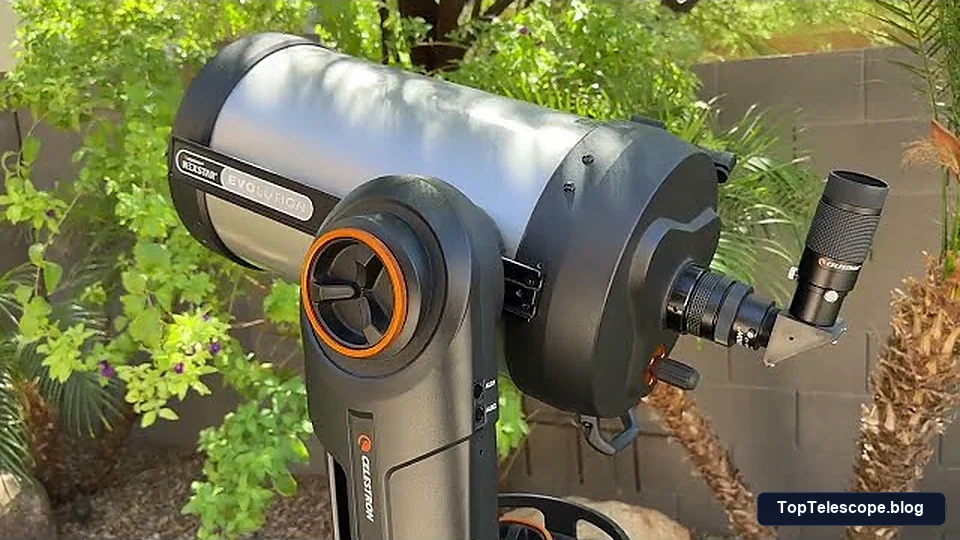
Celestron applies proprietary StarBright XLT coatings across all optical surfaces. Read our Celestron Nexstar 8Se vs Evolution 8 verdict to compare mount stability, power options, and overall optical performance.
The Schmidt-Cassegrain optical design utilizes an 8-inch aperture paired with a focal length of 2032mm, yielding a focal ratio of f/10 for balanced planetary and deep-sky imaging sessions.
Aluminum tube assemblies undergo rigorous thermal stabilization testing to minimize internal air currents, while the StarXcite coatings maximize light transmission across the entire visible spectrum for optimal contrast.
- 203mm aperture gathers ample light for deep-sky objects
- Fast f/10 focal ratio balances planetary and wide-field use
- Compact aluminum tube resists thermal expansion shifts
Correktor Plate and Mirror Precision
Up front, a specialized Schmidt corrector plate eliminates spherical aberration effectively. This precision glass element ensures pinpoint star images across the entire visual field of view.
The primary mirror moves smoothly along a robust baffle tube during manual focusing. Users must account for minimal image shift during fine adjustments at high magnifications.
- Hand-corrected optics minimize optical aberrations
- Smooth focus knob allows precise planetary tuning
Automated GoTo Performance and Tracking Mechanics
A motorized single-fork Alt-Az mount drives the system using internal brass gears. This automated architecture lets the telescope locate over forty thousand celestial targets with minimal user intervention required.
The included NexStar+ hand controller communicates efficiently with internal optical encoders. Consult our Celestron CPC 800 vs NexStar 8SE comparison to evaluate fork arm rigidity and overall system weight.
Internal brass worm gears drive both axes via DC servo motors, delivering smooth slew speeds up to five degrees per second when navigating standard astronomical catalogs via the hand controller.
Alignment routines rely on SkyAlign technology, requiring users to center three bright celestial objects to calculate precise celestial coordinates and ensure accurate sidereal tracking throughout prolonged observation sessions.
- Database contains over 40,000 celestial objects
- Dual-axis servomotors ensure accurate tracking rates
- Hand controller features upgradable flash memory firmware
Alignment Protocols and SkyAlign Technology
SkyAlign technology simplifies the initial setup procedure remarkably for beginners. Operators simply center any three bright celestial objects to establish internal alignment references instantly.
Advanced users can also utilize solar system align or one-star methods. This flexibility accommodates various observing conditions and obstructed backyard horizons seamlessly.
- Three-star alignment requires no prior constellation knowledge
- Solar system align permits safe daytime observation
Video Review: Celestron NexStar 8SE Telescope Review
Real-World Visual Output and Resolution Limits
Under dark skies, the eight-inch aperture resolves globular clusters into individual stars. Lunar craters display sharp shadow details, while planetary features like Jovian cloud belts appear crisp.
Magnification limits depend heavily on local atmospheric seeing conditions. Pairing the system with quality eyepieces unlocks deep-sky details that smaller entry-level telescopes routinely miss entirely.
Rayleigh criterion calculations dictate a theoretical resolution limit of 0.57 arcseconds, allowing advanced observers to resolve tight double stars and intricate lunar craterlet walls under steady atmospheric conditions.
Field curvature becomes noticeable at the extreme edges of wide-field eyepieces, but axial sharpness remains pristine, rendering high-contrast planetary details like the Great Red Spot with exceptional clarity.
- Resolves faint Messier catalog objects easily
- Shows distinct Cassini division in Saturn's rings
- Supports high magnification with stable seeing conditions
Planetary Contrast and Deep-Sky Reach
Planetary contrast remains high despite central obstruction from the secondary mirror. The included filter kit helps isolate specific atmospheric features on Mars and Jupiter.
Faint galaxies appear as delicate smudges requiring dark adaptation. Extended observation reveals spiral structure in brighter targets like the Whirlpool galaxy.
- Planetary filters enhance surface band visibility
- Wide aperture excels at gathering faint starlight
Mechanical Stability, Ergonomics, and Field Setup
A heavy-duty stainless steel tripod provides a stable foundation for the optical tube. Review our Celestron NexStar 4SE vs 5SE optical duel to understand aperture scaling and portability tradeoffs before buying.
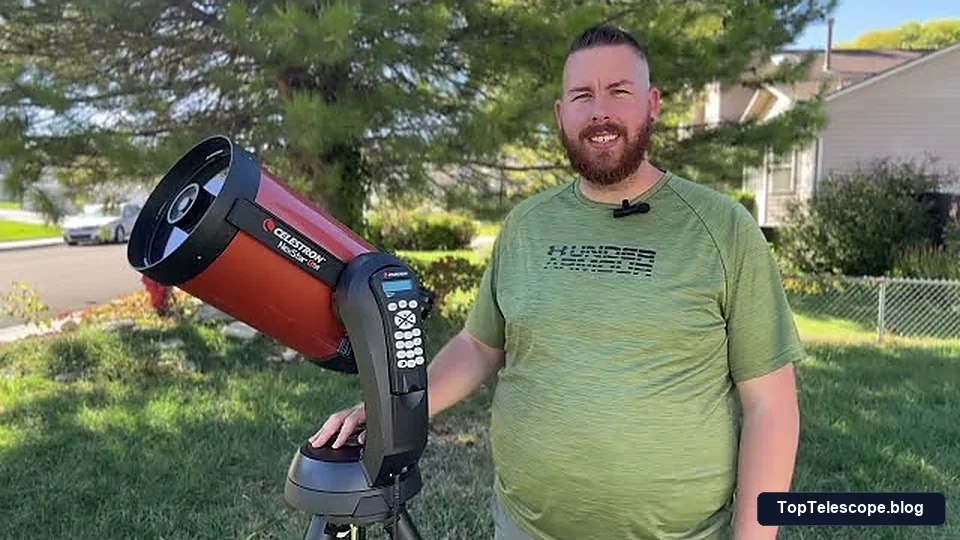
The quick-release fork arm design allows rapid separation from the tripod base. This modular approach makes field transport manageable for single operators without heavy lifting strain.
Steel tripod legs provide a rigid foundation that dampens vibrations within two seconds of heavy focusing adjustments, while the fork arm base features an integrated carrying handle for transport.
Quick-release clamps secure the optical tube assembly onto the mount without tools, though field assembly requires careful attention to the azimuth alignment pin during nighttime setup procedures.
- Stainless steel legs dampen wind-induced vibrations
- Quick-release clamp speeds up field assembly
- Spacious accessory tray holds multiple eyepieces securely
Weight Distribution and Transport ergonomics
Total system weight reaches over fifty pounds when fully assembled. Transporting the equipment requires two separate trips to prevent accidental drops or mechanical impacts.
Ergonomic carrying handles built into the optical tube simplify mounting. Careful attention to weight distribution prevents strain on the single-fork arm mechanism.
- Modular design separates heavy components safely
- Built-in handles improve optical tube grip
Power Management, Duty Cycle, and Thermal Dynamics
Internal battery compartments house eight AA cells to power the servomotors. However, cold weather rapidly drains standard alkaline batteries, necessitating external power source upgrades for reliability.
Thermal equilibrium requires adequate time for the heavy glass mirror to cool down. Leaving the telescope outside before viewing prevents internal air currents from blurring planetary details.
Operating the computerized mount demands a reliable 12-volt power supply drawing roughly 750 milliamps during active slewing, necessitating high-capacity lithium field batteries for extended imaging marathons.
Primary mirror cooldown requires approximately forty-five minutes to reach ambient outdoor temperatures, and utilizing an optional ventilation fan accelerates thermal equilibration for immediate high-magnification planetary viewing.
- Consumes significant electrical current during high-speed slewing
- Optional AC adapters prevent unexpected field power loss
- Thermal cooldown improves high-magnification image sharpness
Power Efficiency and Thermal Management
Using a rechargeable lithium power tank ensures stable voltage delivery throughout long nights. Consistent voltage prevents erratic GoTo motor behavior and alignment data loss.
Dew formation on the corrector plate represents another operational challenge. Investing in a heated dew shield protects optics during humid evening observation sessions.
- Rechargeable power tanks outperform standard batteries
- Heated dew shields prevent moisture obstruction
Maintenance Protocols and Long-Term Durability
Routine maintenance preserves optical coatings and mechanical gear integrity over years of use. Users should clean corrector plates sparingly using specialized optical solutions and microfiber cloths.
Mechanical gears benefit from periodic inspection and dust protection during storage. Storing components in padded cases prevents moisture accumulation and accidental mechanical misalignment.
Corrective maintenance involves periodic inspection of the corrector plate for dust accumulation, requiring gentle cleaning with optical microfiber solutions to prevent scratching delicate anti-reflective coatings over time.
Periodic gear backlash adjustments ensure the internal drive mechanisms maintain optimal mesh tolerance, preventing tracking errors during long-exposure astrophotography sessions governed by autoguiding software interfaces.
- Optical cleaning requires specialized non-abrasive solutions
- Dust caps protect internal optics during transport
- Padded aluminum cases safeguard delicate accessory filters
Collimation and Mechanical Adjustments
Secondary mirror collimation remains remarkably stable under normal transport conditions. When adjustment becomes necessary, accessible thumb screws simplify minor optical alignment procedures.
Checking tripod fastener tightness prevents loosening from motor vibrations. Regular hardware inspections ensure long-term mechanical reliability during frequent field deployments.
- Secondary mirror screws allow straightforward collimation
- Regular hardware checks maintain structural rigidity
Comprehensive Buyer Verdict and Recommendations
The Celestron NexStar 8SE remains a premier choice for dedicated backyard astronomers. Before buying, check out our Celestron NexStar 6SE vs 8SE technical comparison to evaluate aperture differences and payload limits.
While power demands and weight require careful management, the optical rewards justify the effort. Serious stargazers will find this versatile instrument capable of satisfying years of astronomical exploration.
Intermediate astronomers seeking a portable yet powerful optical system will find this telescope delivers exceptional aperture efficiency, provided they invest in proper dew mitigation accessories for humid environments.
Dedicated astrophotographers should consider pairing the fork mount with a heavy-duty equatorial wedge to eliminate field rotation during long-exposure deep-sky imaging runs exceeding several minutes.
- Delivers professional-grade aperture in a portable format
- Balances automated convenience with optical performance
- Suits both planetary and deep-sky observation goals
Ideal User Profile and Alternatives
Beginners with patience and intermediate observers will master its features quickly. Users prioritizing ultra-lightweight travel might prefer smaller refractor alternatives instead.
Investing in essential accessories like power tanks transforms this telescope into a formidable observatory tool. Proper setup habits guarantee rewarding celestial discoveries every clear night.
- Best suited for backyard and dark-site observation
- Upgrades unlock advanced astrophotography capabilities
Frequently Asked Questions
Can I use this telescope for astrophotography?
Yes, it handles lunar and planetary imaging exceptionally well. However, long-exposure deep-sky astrophotography requires an optional equatorial wedge to eliminate field rotation during tracking.
How long do the batteries last during field use?
Standard alkaline batteries typically last between four and six hours depending on slewing frequency. Using an external rechargeable power tank is strongly recommended for reliable performance.
Is the telescope difficult for beginners to assemble?
No, the modular design allows quick assembly without specialized tools. The intuitive SkyAlign software makes initial star calibration straightforward for users with zero prior experience.
How often does the optical system require collimation?
Collimation holds remarkably well thanks to the sturdy Schmidt-Cassegrain tube design. Users generally only need minor optical adjustments after transporting the telescope across bumpy roads.
Can I control the telescope using a computer?
Yes, operators can connect a laptop directly via USB cable. The included CPWI control software provides advanced planetarium mapping and precise automated telescope positioning.