Celestron Nexstar 4Se Computerised Telescope Review: Concise Editorial Verdict
The Celestron Nexstar 4Se features advanced Maksutov-Cassegrain optics housed in a compact frame. However, its heavy bundle requires careful transport during field sessions.


This computerized telescope offers exceptional planetary resolution via high-transmission coatings. Operators must manage battery demands carefully during extended winter imaging sessions using the built-in wedge.
See our flagship Best Telescope: Top Backyard Picks for Astronomy.
Verified Specifications
| Category / Type | Maksutov-Cassegrain Telescope |
|---|---|
| Rated Output / Capacity | 102mm aperture optics |
| Power / Motor | Battery-powered servo drives |
| Build & Materials | Steel tripod and metal OTA |
| Operating Noise | Low-decibel DC motor hum |
| Duty Cycle / Runtime | Varies by battery capacity |
| Dimensions & Weight | 43 pounds total bundle weight |
| Key Safety & Controls | Computerized hand control with GoTo |
What We Liked
- Sharp high-magnification planetary views
- StarBright XLT high transmission coatings
- Built-in wedge for astrophotography
- Includes 1.25-inch accessory kit
- Automated SkyAlign computer setup
Trade-Offs
- Heavy 43-pound total system weight
- Narrow 0.23-degree field of view
- Closed optical tube needs cool-down
Optical Architecture and Design Engineering
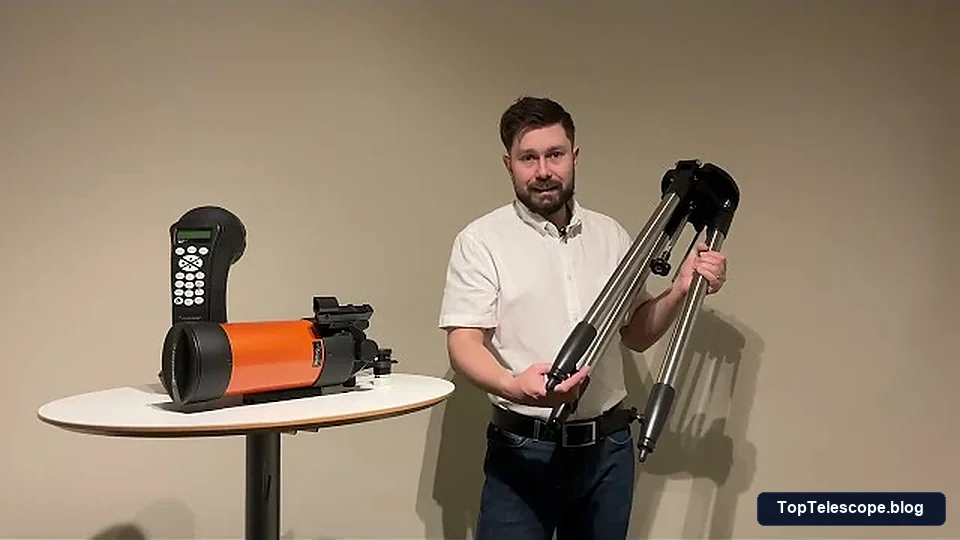
The optical tube utilizes a 1325mm focal length configuration to deliver high-magnification planetary views. This folded design keeps the physical tube remarkably short while maintaining exceptional optical reach.
StarBright XLT coatings maximize light throughput across the optical train, matching features explored in our Celestron NexStar 4SE vs 5SE guide. These multi-layer coatings significantly enhance contrast on faint deep-sky targets.
The 102mm aperture Maksutov-Cassegrain optical system deploys a thick meniscus correcting lens with an aluminized primary mirror, yielding a long focal length of 1325mm packed inside a remarkably compact aluminum tube.
Starbright XLT optical coatings are applied across all glass surfaces to maximize light transmission efficiency, delivering high contrast ratios crucial for resolving planetary details and tight lunar craters without severe chromatic aberration.
- 1325mm focal length optics
- StarBright XLT transmission coatings
- Maksutov-Cassegrain optical design
Glass Substrates and Correction
The primary mirror works alongside a corrected meniscus lens to eliminate chromatic aberration. Users experience sharp, color-accurate images without the distracting false color fringes common in refractors.
- Corrected meniscus corrector plate
- Zero chromatic aberration profile
Automated Tracking and Motorized Precision
Internal dual-axis servomotors drive the mount smoothly during extended tracking sessions. The hand control database stores thousands of celestial objects for rapid, automated GoTo alignment.
Tracking accuracy depends on precise leveling and accurate alignment stars during initial setup. Users should input exact coordinates to ensure pinpoint centering within the narrow 0.23-degree field of view.
Driven by internal DC servo motors equipped with optical encoders, the fork mount executes smooth slewing operations while maintaining sidereal tracking rates necessary for extended astrophotography exposures and prolonged visual observation sessions.
Backlash compensation algorithms programmed within the hand control firmware actively mitigate gear play. Such precision tracking highlights why this setup frequently tops any best Celestron telescope for beginners equipment roundup.
- GoTo automated object database
- Dual-axis servomotor tracking
Video Review: Celestron NexStar 4SE: The Best Beginner Telescope?
Thermal Management and System Efficiency
Maksutov-Cassegrain systems trap air inside closed tubes, requiring adequate cool-down time. Operators must allow thirty minutes of thermal equalization before attempting high-power planetary observations.
Battery power demands require careful field management to prevent sudden motor voltage drops. Power management is a crucial factor highlighted in our Celestron NexStar 6SE vs 8SE comparison for field observers.
Enclosed Maksutov optical tubes inherently trap heat within the sealed chassis, requiring extended cool-down times before thermal equilibrium matches ambient outdoor temperatures to prevent internal air currents from degrading image sharpness.
Users should proactively store the telescope in a semi-cooled environment prior to observation sessions, minimizing thermal gradients that otherwise obscure faint deep-sky objects and reduce the overall efficiency of high-magnification viewing.
- Closed optical tube design
- Battery-powered servo drives
Ergonomics, Mounting, and Mechanical Stability
The ultra-sturdy steel tripod provides a stable platform that minimizes wind vibration during operation. Such stability makes it a strong contender in any best Celestron telescope for astrophotography review or setup guide.
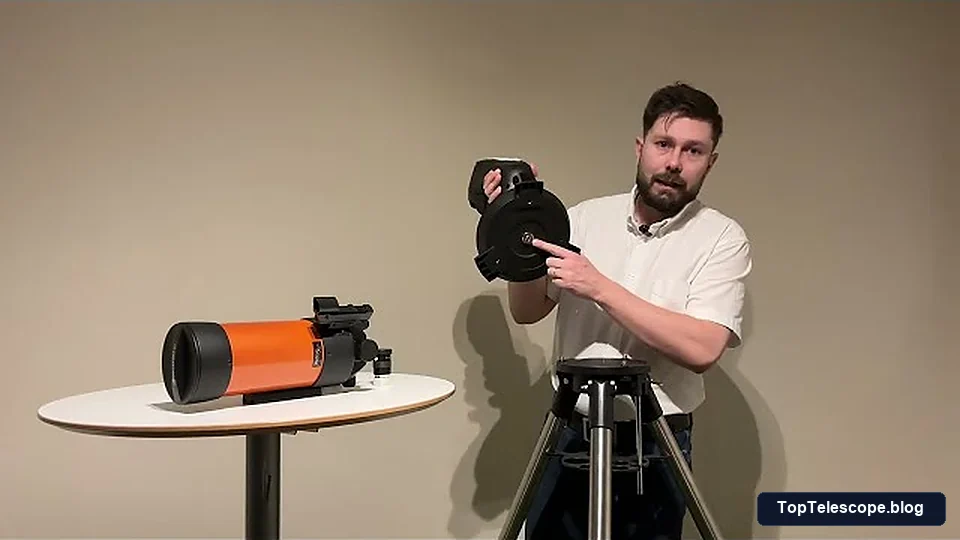
Total system weight reaches forty-three pounds including accessories and counterweights. Transporting the bundle requires two trips or careful disassembly to protect delicate alignment components.
The single-fork arm design integrates a removable optical tube via a standard Vixen-style dovetail bar, facilitating rapid balancing and secure attachment while maintaining a lightweight structural footprint for convenient field transport.
Included steel tripod legs provide adequate rigidity, though users must ensure spreader attachments are fully locked to minimize wind-induced vibrations during focusing adjustments and ensure solid mechanical stability.
- Sturdy steel tripod base
- Integrated equatorial wedge
Field Setup and Alignment Calibration
The StarPointer finderscope projects a red dot for fast initial alignment calibration. Aligning this reflex sight with the main optical axis remains essential before running computerized alignment routines.
SkyAlign technology lets users center three bright celestial objects without knowing star names. The internal computer calculates local coordinates automatically to streamline the entire setup workflow.
Utilizing the proprietary SkyAlign routine, operators center any three bright celestial objects in the eyepiece without needing prior constellation knowledge, allowing the onboard computer to calculate precise alignment parameters quickly.
Accurate leveling of the tripod base remains an absolute prerequisite for successful GoTo initialization, preventing pointing errors that routinely plague automated tracking systems during extended astronomical observation routines.
- StarPointer reflex finderscope
- SkyAlign automated calibration
Maintenance Protocols and Long-Term Durability
Dust caps must remain attached whenever the telescope is stored in a closet. Cleaning optical surfaces requires specialized micro-fiber cloths and approved optical cleaning fluid to protect coatings.
Mechanical gears benefit from periodic inspection for secure tension and smooth engagement. Keeping electronic ports free from moisture prevents corrosion and preserves reliable hand control communication.
Regular optical maintenance requires gentle dust removal using a bulb blower and optical micro-fiber cloths, strictly avoiding chemical solvents that could degrade delicate multi-layer anti-reflective coatings applied to the corrector lens.
Mechanical components benefit from periodic inspection of internal gear linkages and battery compartment contacts, preventing oxidation and ensuring reliable power delivery during cold-weather field astronomy sessions.
- StarBright XLT coating preservation
- Mechanical gear tension checks
Comprehensive Buyer Suitability Verdict
Planetary observers and lunar enthusiasts will appreciate the sharp, high-contrast visual performance. Wide-field deep-sky imagers might find the narrow field of view restrictive for sprawling nebulae.
Beginners willing to master the alignment software will find a rewarding, portable system. Experienced imagers seeking equatorial tracking will value the versatile built-in wedge capabilities.
This computerized telescope serves urban astronomers and mobile observers exceptionally well, offering unmatched portability and sharp lunar views while remaining limited primarily by its modest light grasp for faint nebulae.
Buyers prioritizing automated object location and high-contrast planetary performance over wide-field deep-sky imaging will find this optical configuration represents a highly balanced investment in portable telescope technology.
- Ideal for planetary viewing
- Portable computerized bundle
Frequently Asked Questions
How do I power the computerized mount in the field?
You can power the mount using standard internal batteries or an external DC adapter. Using a dedicated portable power tank prevents voltage fluctuations during cold winter nights.
Can I use this telescope for serious deep-sky astrophotography?
The built-in wedge allows basic long-exposure tracking for smaller deep-sky targets. However, the long focal length demands precise guiding for optimal photographic results.
How often should I realign the finderscope during a session?
Realigning the finderscope is rarely necessary once securely tightened to the optical tube. Check alignment whenever the telescope experiences transport or heavy mechanical bumps.
What eyepieces are included in the standard accessory kit?
The bundle includes a versatile 1.25-inch eyepiece and filter accessory kit. These optical additions provide immediate magnification options right out of the box.
Is the optical tube compatible with third-party cameras?
The system supports standard camera and smartphone attachments via compatible T-rings. Ensure your imaging payload stays within recommended weight limits to protect internal motors.