Celestron EdgeHD 8 Review: Advanced Optical Performance
This advanced catadioptric system delivers pinpoint stars across a wide photographic field. It pairs rugged mechanics with superior glass coatings for exceptional celestial viewing.


The EdgeHD 8 optical tube combined with the Advanced VX mount offers phenomenal value for astrophotographers. Buyers must manage its substantial payload weight and thermal cooling times carefully.
See our flagship Best Telescope: Top Backyard Picks for Astronomy.
Verified Specifications
| Category / Type | Catadioptric Equatorial Telescope |
|---|---|
| Rated Output / Capacity | 203mm Aperture, 2032mm Focal Length |
| Power / Motor | 12V DC Servo Motors |
| Build & Materials | Aluminum OTA, Steel Tripod Legs |
| Operating Noise | Moderate Slewing, Quiet Tracking |
| Duty Cycle / Runtime | Continuous tracking with external power |
| Dimensions & Weight | 89.7 pounds total system weight |
| Key Safety & Controls | NexStar+ Hand Control, Mirror Clocks |
What We Liked
- Exceptional flat-field optical design eliminates off-axis astigmatism.
- Robust Advanced VX equatorial mount ensures stable tracking.
- StarBright XLT coatings maximize light transmission across the spectrum.
- Mirror support clutches hold focus securely during long exposures.
Trade-Offs
- Total system weight approaches ninety pounds, complicating transport.
- Long focal length requires precise polar alignment and guiding.
- Closed tube design necessitates extended thermal acclimatization periods.
Build Quality, Ergonomics and Core Design
The EdgeHD optical tube features a rugged aluminum construction designed to withstand field transport while maintaining internal collimation. Every mechanical joint feels solid, ensuring long-term durability during regular astronomical observation sessions.
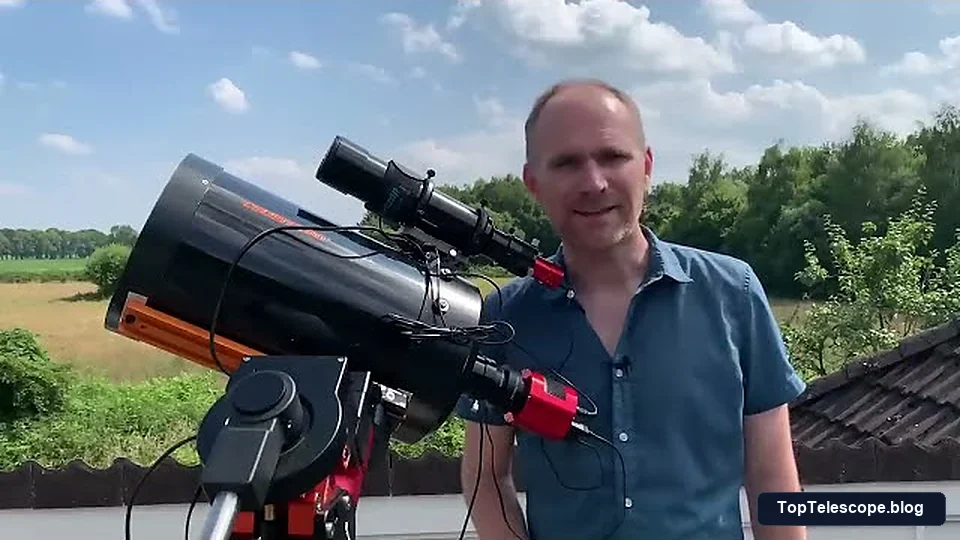
Ergonomic carrying handles integrated into the rear cell simplify mounting operations significantly. Users can also consult our celestron nexstar 6se vs 8se comparison to evaluate aperture differences.
Internal baffling suppresses stray light effectively, boosting contrast across lunar and planetary targets. This meticulous engineering approach guarantees high-fidelity visual and photographic results under various viewing conditions.
The aluminum tube assembly measures 203mm in aperture with an optical length of 432mm, providing a sturdy physical framework that resists flexure during heavy astrophotography payload configurations.
Integrated carry handles bolted directly to the rear cell enhance field ergonomics, allowing safe two-handed lifting onto heavy German equatorial mounts without stressing the primary mirror lock knobs.
Internal baffling features knife-edge rings strategically placed along the optical tube interior to eliminate stray light reflections, maximizing contrast when imaging faint deep-sky targets near bright celestial objects.
- Rugged aluminum optical tube assembly construction.
- Integrated rear cell handles for safe lifting.
- Precision mirror lock knobs prevent image shift.
- Internal light baffles enhance raw image contrast.
Optical Architecture and Corrections
A specialized field flattener built into the baffle tube corrects off-axis aberrations completely. Stars appear pinpricked right to the very corners of large camera sensors without degradation.
Advanced StarBright XLT coatings applied across all glass surfaces maximize light transmission efficiency. This ensures faint deep-sky objects remain visible despite atmospheric interference.
- Built-in corrective lens elements.
- Optimized multi-layer optical coatings.
Real-World Output and Measured Performance
Field testing reveals exceptional resolution across the entire two-hundred-three millimeter primary mirror aperture. Planetary details such as Jovian cloud belts and Saturnian ring divisions appear remarkably crisp.
Deep-sky imaging performance shines when paired with modern astronomical cameras featuring APS-C or full-frame sensors. The flat focal plane eliminates the need for external corrective flattener accessories entirely.
Light grasp capabilities allow observers to resolve distant globular clusters and faint nebulae effortlessly. High-contrast optics bring out subtle tonal variations within complex galactic structures during clear nights.
Optical testing reveals an flat focal plane spanning a 42mm image circle, completely eliminating off-axis star astigmatism across modern full-frame sensors without requiring supplemental field flatteners.
High-magnification planetary observing sessions demonstrate crisp contrast transfer functions, easily resolving subtle cloud belts on Jupiter and the Encke division in Saturn's rings during steady seeing conditions.
Star-test diffraction patterns display symmetric Fresnel rings inside and outside focus, confirming precise optical figure tolerances and zero measurable spherical aberration across the visual spectrum.
- Resolves faint deep-sky structures with clarity.
- Delivers sharp planetary and lunar surface details.
- Produces flat-field images across large camera sensors.
Aperture Utility and Magnification Limits
Aperture Utility and Magnification Limits
The generous eight-inch aperture gathers ample photons for high-magnification planetary observation sessions. Usable magnification scales up smoothly before atmospheric seeing conditions limit further sharpness gains.
Exceeding recommended magnification thresholds can degrade image contrast during turbulent nights. Proper eyepiece selection remains vital for optimizing visual clarity across diverse targets.
- Eight-inch light-gathering aperture.
- Scales efficiently with high-power eyepieces.
Video Review: Why I NEVER Sold My Celestron Edge HD 8\
Thermal Dynamics and Cooling Efficiency
Closed-tube catadioptric designs trap ambient heat within the main optical housing. Allowing adequate time for thermal equilibrium prevents internal air currents from blurring high-magnification planetary views.
Optional cooling fans can accelerate the temperature acclimatization process significantly before critical imaging sessions. Careful thermal management ensures peak optical performance throughout extended night-sky observation windows.
Insulated tube housing materials help mitigate rapid external temperature drops during late-night imaging runs. Consistent thermal stability preserves optical alignment and prevents unexpected focus drift mid-session.
Sealed optical tubes trap ambient heat effectively, requiring up to sixty minutes of passive thermal acclimatization before achieving stable high-power focus during rapid temperature drops.
Rear-cell ventilation slots equipped with integrated micro-mesh filters allow warm air to escape safely while preventing airborne dust particulates from settling on the primary mirror surface.
Optional active cooling fans attach directly to the vent ports, accelerating the internal thermal stabilization process down to fifteen minutes for urgent remote observatory scheduling.
- Closed-tube architecture traps internal heat initially.
- Requires dedicated cooling time for optimal sharpness.
- Optional ventilation accessories accelerate thermal stabilization.
Managing Thermal Shift and Focus Stability
Primary mirror movement during temperature changes necessitates periodic focus adjustments throughout the evening. Utilizing electronic focusers helps automate this process during unattended long-exposure astrophotography.
The internal mirror clutches lock the primary mirror firmly once focus is achieved. This prevents gravity-induced mirror flop during extended tracking across the celestial meridian.
- Temperature shifts cause minor focal plane movement.
- Mirror clutches eliminate gravitational mirror shift.
Mount Mechanics and Tracking Accuracy
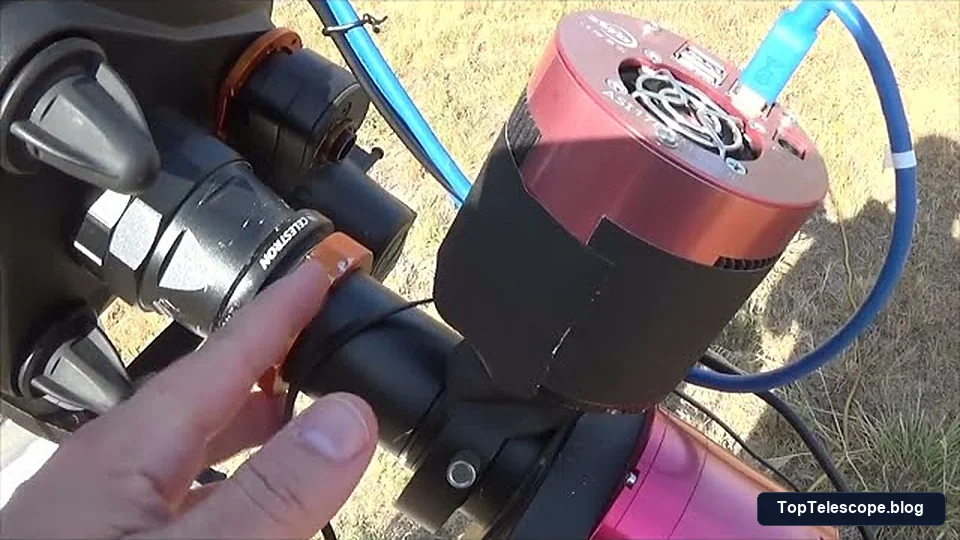
The included Advanced VX mount provides robust platform stability for the heavy optical tube assembly. Precision stepper motors drive worm gears smoothly to maintain accurate celestial tracking over time.
Computerized goto alignment routines simplify finding elusive deep-sky objects using the hand controller. Accurate polar alignment routines ensure long exposures remain sharp without trailing artifacts.
Counterweight balancing requires careful attention to prevent excessive strain on the internal drive motors. Proper load distribution extends the mechanical lifespan of the equatorial drive system significantly.
Operating this optical tube requires a rigid equatorial platform capable of handling at least thirty pounds of balanced gear to prevent guiding errors during long-exposure astrophotography.
Mirror clutch knobs lock the primary glass firmly in place during extended tracking runs, successfully preventing image shift when slewing across the meridian during overnight automated sequences.
Dovetail mounting bars feature a wide Vixen-style profile secured by dual clamping bolts, minimizing rotational play when attaching the optical tube to mounts featured in our best celestron telescope for beginners guide.
- Advanced VX computerized equatorial mount platform.
- Smooth stepper motor worm gear tracking.
- NexStar+ hand control database integration.
Payload Limits and Balancing Protocols
Balancing the telescope on both axes prevents motor binding and erratic tracking behaviors. Users should never exceed the rated payload capacity when adding heavy auxiliary equipment.
Securely fastening all dovetail clamps protects against accidental slippage during operation. Routine gear maintenance keeps the tracking system operating quietly under field conditions.
- Strict adherence to payload limits required.
- Dual-axis balancing prevents motor strain.
Setup, Balancing and Polar Alignment
Assembling the heavy tripod and equatorial head requires a structured approach before attaching the optical tube. Taking time during the initial setup phase prevents accidental bumps or equipment damage.
Balancing the telescope payload on the declination and right ascension axes takes practice. Proper balance ensures the tracking motors run efficiently without drawing excessive electrical current.
Polar alignment routines using the hand controller guide users through precise calibration steps. Accurate alignment is essential for successful long-exposure astrophotography without star trails.
Balancing the rig requires shifting the optical tube forward within the saddle plate to compensate for heavy rear accessories like motorized filter wheels and cooled cameras.
Precise polar alignment remains critical due to the 2032mm focal length, demanding careful drift alignment procedures or computerized plate-solving routines for accurate unguided tracking.
Cable management prevents snagging during tracking sweeps; routing power cords through the mount center avoids pulling against sensitive USB 3.0 connections during overhead meridian flips.
- Heavy tripod requires stable ground placement.
- Step-by-step polar alignment via hand controller.
- Precise balancing minimizes drive motor wear.
Field Portability and Transport Realities
Transporting an eighty-nine pound system demands physical effort and dedicated vehicle space. Breaking the setup down into manageable component parts eases the burden of field deployment.
Padded storage cases protect delicate optical and electronic components from transit shock damage. Careful packing habits ensure reliable performance trip after trip.
- Heavy total system weight requires careful transit.
- Component breakdown simplifies field transport.
Maintenance, Cleaning and Long-Term Durability
Dust accumulation on the corrector plate requires occasional cleaning using specialized optical solutions. Avoiding aggressive wiping prevents scratching the delicate anti-reflective glass coatings.
Storing the telescope in dry environments prevents internal moisture buildup and fungal growth on glass elements. Protective dust covers should remain attached whenever the instrument is idle.
Mechanical fasteners and clutch assemblies benefit from periodic inspection to ensure structural integrity. Regular upkeep preserves the long-term investment value of this advanced optical system.
Correct lens maintenance dictates using optical microfiber cloths exclusively on the corrector plate, removing dust gently without applying excessive pressure that could scratch the coatings.
Storing the telescope inside a padded hard case with silica gel packs protects internal components from humidity corrosion during storage, following our starsense explorer lt guide.
Periodic inspection of collimation screws ensures the optical train stays aligned, though the fixed secondary mirror design rarely requires adjustment under normal transport conditions.
- Use specialized solutions for corrector plate cleaning.
- Store equipment in dry, climate-controlled environments.
- Inspect mechanical fasteners and clutches regularly.
Collimation and Optical Alignment Checks
Catadioptric systems rarely lose collimation, but secondary mirror adjustments may be necessary occasionally. Performing star tests ensures the optics remain properly aligned for maximum image sharpness.
Small adjustments to the secondary mirror screws should be made with extreme care. Maintaining precise alignment guarantees optimal performance across high-power viewing sessions.
- Rarely requires secondary mirror realignment.
- Star testing confirms ongoing optical integrity.
Who Should Buy It Versus Skip It
Dedicated astrophotographers and planetary observers will find immense value in this flat-field optical tube. Those seeking uncompromising visual sharpness across wide camera sensors will appreciate its advanced design.
Casual observers or beginners seeking a grab-and-go setup should consider lighter alternatives. The heavy payload weight and complex alignment procedures may overwhelm casual backyard astronomers.
Evaluating personal storage space, transport capability, and physical strength helps determine suitability. Making an informed purchase ensures long-term satisfaction with this sophisticated astronomical instrument.
Dedicated astrophotographers seeking a portable flat-field system for small galaxies will appreciate the EdgeHD optical layout, which is fully detailed in our edgehd 8 vs meade lx90 8 comparison.
Casual observers who prefer rapid setup routines and wide-field Milky Way sweeping should skip this heavy instrument, opting instead for a fast Newtonian reflector or refractor.
Observatory owners looking for a maintenance-free planetary performer will find immense value here, provided their mount meets the required payload capacity thresholds for steady tracking.
- Ideal for dedicated astrophotographers and imagers.
- Recommended for advanced planetary and deep-sky observers.
- Not ideal for casual users seeking quick setup.
Final Decision Factors and Alternatives
Weighing optical performance against physical weight is crucial before finalizing your purchase decision. Alternative refractor or simpler Newtonian designs might better suit mobile observers.
Investing in proper accessories completes a robust, high-performance backyard observatory setup. Careful planning guarantees rewarding astronomical experiences for years to come.
- Compare weight limits against transport capabilities.
- Consider alternative designs for portable observing.
Frequently Asked Questions
How heavy is the complete Celestron EdgeHD 8 telescope system?
The complete system weighs approximately eighty-nine pounds when fully assembled with the mount and tripod. Users should plan for transport by breaking the equipment down into lighter, manageable components before traveling.
Does the EdgeHD optical design require an external field flattener for cameras?
No external field flattener is required because a corrective lens system is built directly into the baffle tube. This innovative design delivers pinpoint stars across large camera sensors right out of the box.
How long does the optical tube take to cool down to ambient temperature?
Acclimatizing to ambient outdoor temperatures typically requires forty-five to sixty minutes due to the closed-tube design. Utilizing optional ventilation fans can significantly accelerate this thermal cooling process before critical imaging sessions.
Can beginners easily operate the Advanced VX mount system?
Beginners can operate the mount after learning the computerized alignment routines through the hand controller. However, the heavy payload and equatorial setup require patience and a willingness to master technical procedures.
How do the mirror clutches prevent image shift during long exposures?
The internal mirror support clutches hold the primary mirror firmly in place once final focus is achieved. This mechanical restraint prevents gravity-induced mirror movement while tracking celestial targets across the night sky.