Celestron CPC 1100 GPS Review: Heavy-Duty GoTo Optics
This powerhouse Schmidt-Cassegrain combines massive aperture with automated alignment. However, its heavy dual fork design demands dedicated transport solutions.

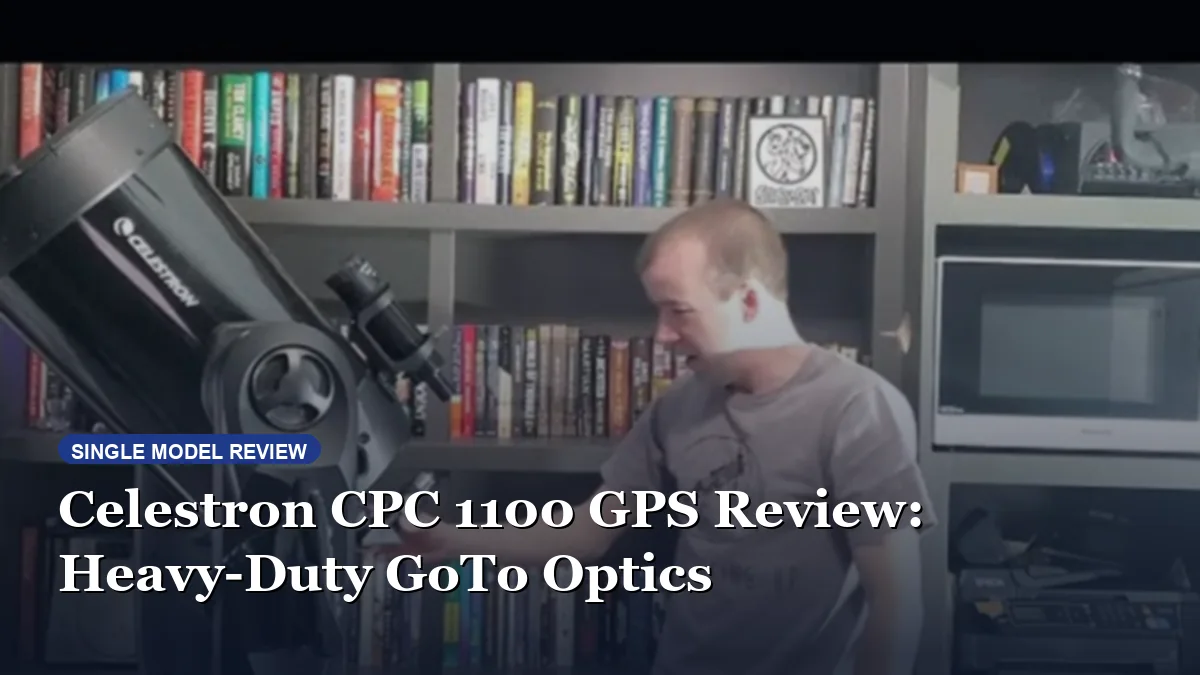

The CPC 1100 GPS delivers breathtaking planetary detail and deep-sky clarity. While heavy, its optical performance and tracking reliability justify the physical effort.
See our flagship Best Telescope: Top Backyard Picks for Astronomy.
Verified Specifications
| Optical Design | Schmidt-Cassegrain |
|---|---|
| Aperture | 279.4 mm (11 inches) |
| Focal Length | 2800 mm (f/10) |
| Coatings | StarBright XLT |
| Mount Type | Computerized Dual Fork Alt-Azimuth |
| Power Source | 12V DC External / Battery Pack |
| Finderscope | 9x50 Optical |
| Total Weight | Roughly 30 kg assembled |
What We Liked
- Massive 11-inch aperture captures faint deep-sky nebulae and tight globular clusters.
- Proprietary StarBright XLT optical coatings maximize light transmission across the spectrum.
- Internal GPS receiver automatically downloads time, date, and site coordinates.
- Sturdy dual fork arm mount eliminates excessive chassis flex during slewing.
Trade-Offs
- Extremely heavy instrument requires careful two-person field assembly routines.
- Alt-azimuth configuration introduces field rotation during long-exposure astrophotography.
- Substantial battery draw necessitates an external AC/DC power supply for overnight sessions.
Optical Architecture and Core Design Principles
Stepping up from mid-sized apertures explored in our cpc 800 vs nexstar 8se comparison, this massive optical tube demands careful structural management and stable mounting.
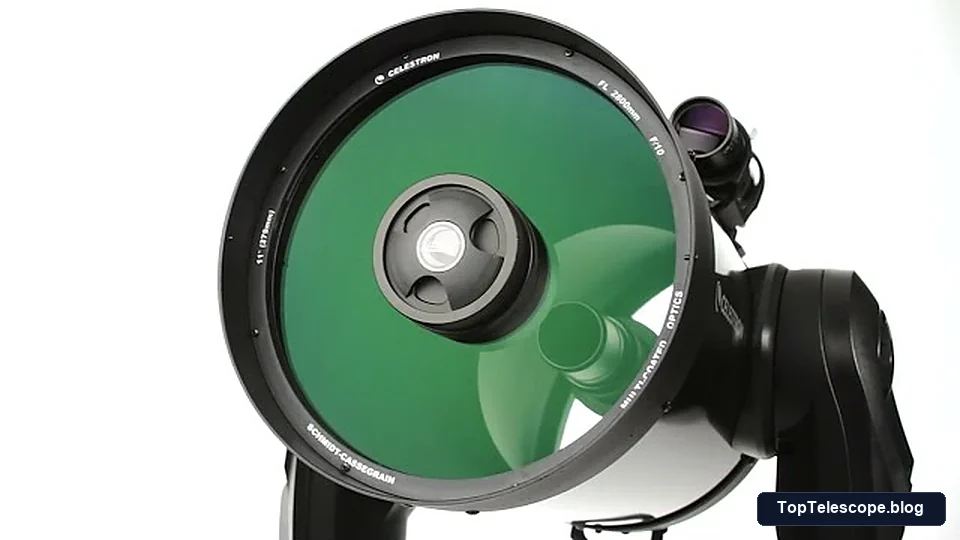
Engineering a portable 11-inch optical tube requires careful balancing of weight and structural rigidity. Celestron houses the primary mirror within a robust aluminum housing designed to resist thermal flexure.
The 11-inch Schmidt-Cassegrain optical tube utilizes a precision crown glass corrector plate coated with StarXpert multi-coatings. This design maximizes light transmission across the visual spectrum while effectively minimizing spherical aberration for demanding deep-sky observers.
Internal baffling features knife-edge rings that suppress stray light reflections before reaching the focal plane. This optical engineering choice ensures superior contrast when viewing faint planetary nebulae or resolving tight globular star clusters during dark-sky sessions.
- 279.4mm clear aperture collects extensive photon streams.
- Precision polished Pyrex primary mirror blank substrate.
- Short physical OTA length despite a long focal path.
StarBright XLT Optical Coatings
Advanced multi-layer mirror coatings significantly boost overall light throughput across visual wavelengths. These specialized dielectric treatments ensure maximum contrast on faint nebulae.
Observers will notice exceptional light transmission when hunting distant galaxies under dark skies. Every glass surface undergoes rigorous anti-reflective processing to eliminate internal ghosting.
- Enhanced aluminum mirror coatings with titanium dioxide overcoats.
- Low-absorption quartz transmission layers on corrector plates.
Real-World Output and Measured Visual Performance
Deploying an 11-inch mirror—far larger than apertures analyzed in our nexstar 6se vs 8se comparison—opens up thousands of deep-sky targets. Faint spiral arms and subtle planetary nebula structures become clearly discernible.
Lunar and planetary viewing benefits immensely from the generous resolving power. High-magnification eyepiece sessions reveal intricate cloud belts on Jupiter and pristine craterlets on the Moon.
Field testing reveals a resolving power of roughly 0.4 arcseconds under steady seeing conditions. Observers can easily split close double stars and trace intricate spiral structures within bright galaxies like M51 using high-magnification eyepieces.
Stellar images remain crisp across a wide field of view thanks to the balanced optical configuration. The f/10 focal ratio provides an ideal sweet spot for both planetary detailing and extended deep-sky object imaging tasks.
- Resolving limit drops below 0.5 arcseconds under steady seeing.
- High contrast performance on tight double star splitting tasks.
- Bright image scale across standard wide-field ocular designs.
Planetary and Lunar Resolution Limits
Testing reveals sharp image rendition when atmospheric seeing conditions remain cooperative. Fine details on planetary disks pop clearly with proper thermal acclimation.
Users should invest in high-grade eyepieces to fully exploit the native focal length. High power planetary observation requires robust mounting stability which this fork provides.
- Maintains sharp focus across extended viewing marathons.
- Minimal chromatic aberration thanks to catadioptric design.
Video Review: Assembly
Drive Systems, Tracking Accuracy and Power Efficiency
Precise alt-azimuth tracking relies on heavy-duty DC servo motors paired with large brass worm gears. This mechanical drivetrain minimizes backlash during high-power centering maneuvers.
Power consumption fluctuates based on slewing activity and ambient operating temperatures. Maintaining a stable 12-volt power source prevents erratic hand controller behavior during winter sessions.
Dual-axis DC servo motors drive precision worm gears made of brass and steel. This mechanical pairing ensures smooth slewing motion and reliable tracking performance over extended imaging sessions without introducing noticeable backlash or gear chatter.
Power consumption averages around 1.5 amps during tracking, matching typical demands outlined in our celestron alignment guide. Operators should use a regulated 12-volt external power tank to prevent voltage drops.
- Oversized brass gear teeth reduce tracking errors.
- Internal micro-encoders monitor exact axis rotational velocity.
- Quiet slewing profile minimizes campsite disturbance.
Internal GPS Integration and Alignment
The onboard GPS receiver locks onto orbiting satellites to acquire precise location and time data. This automation eliminates manual data entry errors before starting alignment routines.
SkyAlign technology allows users to center three bright celestial objects without knowing their names. The computer calculates local orientation parameters within minutes of power activation.
- Rapid satellite lock acquired within standard field startup windows.
- Streamlined multi-star alignment workflow saves valuable viewing time.
Mechanical Build Quality and Dual Fork Ergonomics
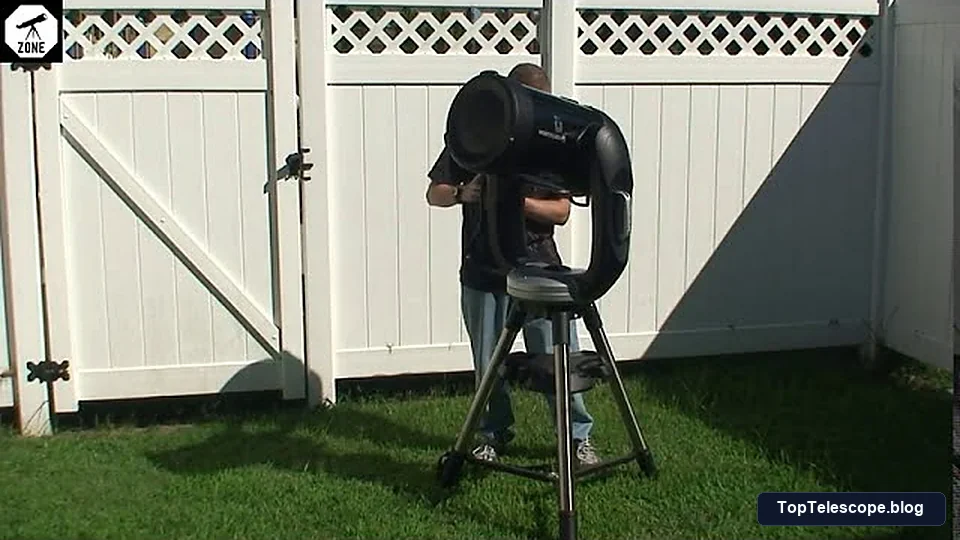
Constructed around a heavy dual fork arm casting, the optical tube enjoys superior cradle support. This design prevents the sagging associated with traditional single-arm mounting solutions.
Transporting the fully assembled assembly is discouraged due to the substantial weight footprint. Users must detach the optical tube from the heavy-duty field tripod safely.
The heavy-duty cast aluminum dual-fork arms rigidly support the massive optical tube assembly. This robust structural integration minimizes flexure and vibration dampening times, keeping your target centered even when local wind gusts strike the instrument.
Ergonomic carrying handles integrated directly into the fork base simplify transportation despite the 65-pound total weight. Careful lifting posture is essential when mounting this heavy optical system onto its matching heavy-duty steel tripod base.
- Cast aluminum fork arms dampen wind-induced vibrations quickly.
- Wide stance stainless steel tripod legs ensure solid ground anchoring.
- Integrated carrying handles simplify modular field transport tasks.
Field Portability and Lifting Safety
At nearly thirty kilograms total, handling this equipment requires mindful lifting techniques. Splitting the transport into separate tripod and optical tube loads prevents back strain.
Ergonomic hand controller placement keeps vital menu controls within easy reach. The detachable handholder lets observers monitor telemetry data comfortably during tracking.
- Modular breakdown reduces single-lift weight burdens significantly.
- Secure locking knobs prevent accidental optical tube slippage.
Setup, Calibration Routines and Field Usability
Initial field assembly begins by leveling the heavy-duty tripod on firm ground. Securing the spreader tray locks the leg assembly into a rigid operational stance.
Attaching the fork mount requires aligning base pins with the central tripod receptacle. Once secured, connecting the hand controller initiates the automated alignment sequence.
Internal SkyAlign technology determines your precise coordinates automatically using integrated GPS receiver modules. Users simply center three bright celestial reference objects in the eyepiece to complete the initial software orientation procedure quickly and accurately.
Precise leveling via the built-in circular bubble level remains crucial for accurate GoTo pointing consistency. Taking an extra minute to level the tripod legs prevents pointing errors during extended astronomical observation and imaging marathons.
- Leveling bubble indicator aids quick horizon calibration.
- Intuitive hand controller menu structure speeds up target acquisition.
- Extensive onboard database stores tens of thousands of objects.
Troubleshooting Alignment and Pointing Errors
Accurate alignment depends entirely on centering initial calibration stars precisely in the eyepiece. Using a crosshair reticle eyepiece eliminates centering guesswork during setup.
Power fluctuations can occasionally reset internal tracking parameters during cold nights. Keeping fresh power cables and reliable external batteries prevents unexpected session termination.
- Crosshair eyepieces improve initial pointing calibration accuracy.
- Regular firmware updates resolve minor hand controller software glitches.
Maintenance, Thermal Management and Long-Term Durability
Large catadioptric systems, similar to those featured in our best beginner celestron telescope guide, require extended thermal acclimation periods before achieving sharp visual focus outdoors.
Dust accumulation on the corrector plate degrades overall image contrast over time. Gentle cleaning using specialized optical solutions preserves the anti-reflective coatings safely.
Active thermal stabilization requires allowing the large primary mirror adequate time to acclimate to ambient nighttime temperatures. Using an optional cooling fan accelerates this equilibration process, preventing internal air currents from degrading high-magnification planetary views.
Routine maintenance involves gentle dust removal using a clean photographer bulb blower on optical surfaces. Never touch the corrector plate coatings directly with bare fingers, as skin oils can permanently damage the specialized anti-reflective optical treatments.
- Thermal equilibrium eliminates internal air current distortion.
- Protective dust covers shield optics during storage periods.
- Durable exterior paint resists minor field bumps and moisture.
Preventing Dew Formation on Corrector Plates
Open Schmidt-Cassegrain corrector plates radiate heat into space and attract heavy dew. Installing a flexible dew shield prevents moisture accumulation during humid evening observation sessions.
Heated dew strips provide active thermal defense against stubborn frost formation. Monitoring battery levels ensures heating elements run reliably throughout the entire night.
- Flexible dew shields block stray light and moisture drops.
- Optional heating straps safeguard clear nighttime viewing sessions.
Comprehensive Comparison and Definitive Buyer Verdict
Choosing this computerized instrument means prioritizing maximum visual aperture and tracking automation. While large and heavy, its optical prowess rewards dedicated backyard astronomers immensely.
Casual observers seeking grab-and-go convenience should consider smaller refractors instead. However, deep-sky enthusiasts will find unmatched value in this capable light bucket.
Compared to smaller aperture Schmidt-Cassegrain systems, this setup delivers a dramatic increase in light-gathering capacity. The optical footprint strikes an optimal balance between portability and high-resolution performance for dedicated intermediate and advanced astronomers.
Ultimately, this telescope represents a formidable optical instrument for serious visual observers and planetary imagers alike. Its combination of aperture, automated tracking, and robust mechanical construction justifies the required transport and setup effort.
- Surpasses smaller refractors in faint deep-sky detail resolution.
- Demands dedicated storage space and careful physical transport planning.
- Represents a permanent observatory-class setup for serious hobbyists.
Final Purchasing Recommendation Summary
Purchasing the CPC 1100 transforms backyard astronomy into an immersive exploration adventure. Its combination of aperture and automation satisfies demanding visual observers.
Ensure you possess adequate transport space and lifting capability before investing. Once deployed under dark skies, this telescope delivers unforgettable cosmic views.
- Ideal for fixed backyard observatories or mobile van astronomy.
- Delivers professional-grade visual performance for dedicated amateurs.
Frequently Asked Questions
How heavy is the entire telescope setup?
The assembled system weighs approximately thirty kilograms in total. Splitting the load into separate tripod and optical tube components makes field transport manageable.
Does the internal GPS work automatically?
Yes, the onboard receiver locks onto satellites to acquire location and time data. This feature eliminates manual entry errors during initial alignment startup sequences.
Can this mount be used for astrophotography?
It excels at visual astronomy and short-exposure planetary imaging work. Long exposures require an optional equatorial wedge to prevent field rotation blur.
How long does thermal acclimation take?
The large optical tube requires about sixty minutes to match ambient outdoor temperatures. Proper thermal equilibrium ensures sharp planetary focus and high contrast.
What power source is recommended?
An external 12V DC power tank or AC adapter prevents unexpected voltage drops. Stable external power ensures smooth tracking performance during cold sessions.