Celestron C8 Edge Hd Review: Advanced Flat-Field Optical Tube
The Celestron C8 EdgeHD delivers uncompromising flat-field astrophotography performance across modern large sensors. However, its substantial focal length demands precise guiding and meticulous thermal acclimatization before critical imaging sessions.

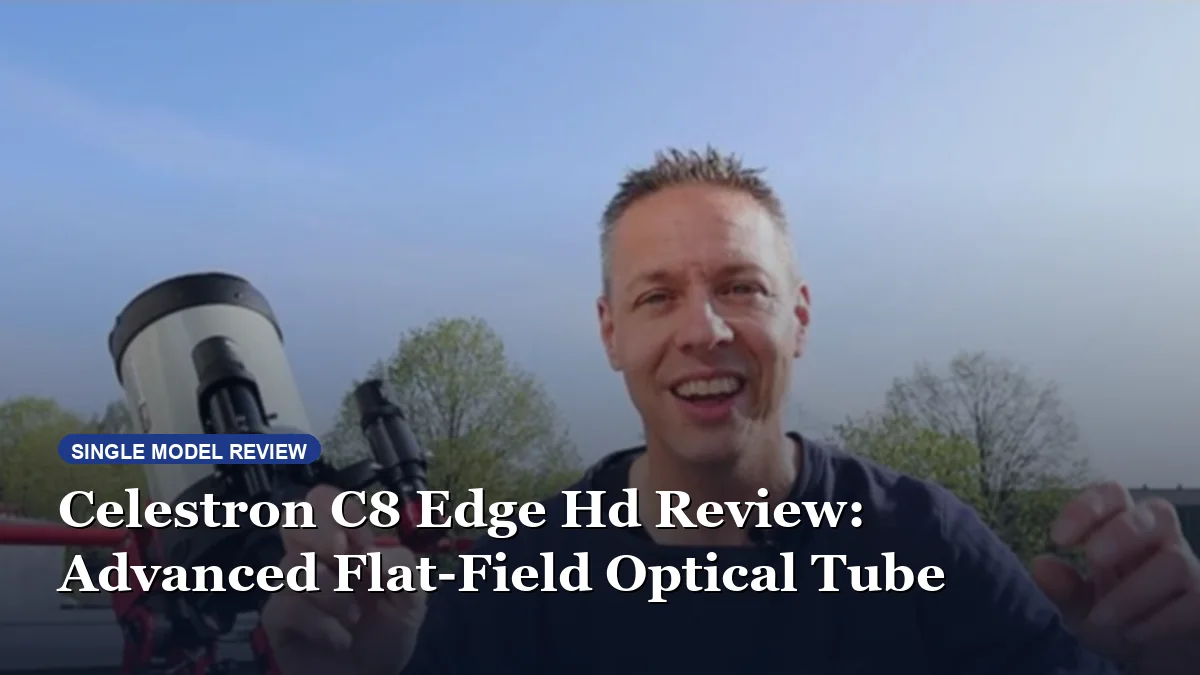

This Schmidt-Cassegrain optical tube excels at high-resolution planetary and deep-sky imaging. Its advanced optical design eliminates off-axis coma while maintaining exceptional mechanical rigidity for demanding field setups.
See our flagship Best Telescope: Top Backyard Picks for Astronomy.
Verified Specifications
| Category / Type | Aplanatic Schmidt-Cassegrain Optical Tube |
|---|---|
| Rated Output / Capacity | 2032mm Focal Length, f/10 Focal Ratio |
| Power / Motor | Passive Optical System (Optional Focus Motor) |
| Build & Materials | Aluminum Tube with StarBright XLT Coatings |
| Operating Noise | Silent Passive Operation |
| Duty Cycle / Runtime | Continuous Nighttime Field Operation |
| Dimensions & Weight | 17 Inches Length, 20 Pounds Weight |
| Key Safety & Controls | Mirror Clutches and Integrated Cooling Vents |
What We Liked
- Completely eliminates off-axis coma and field curvature
- StarBright XLT coatings maximize photon transmission efficiently
- Primary mirror clutches prevent image shift during exposures
- Compact optical tube design simplifies transport and mounting
Trade-Offs
- Demands a sturdy equatorial mount for reliable tracking
- Long focal length requires careful guiding and seeing conditions
- Requires significant cool-down time before reaching thermal equilibrium
Optical Architecture and Precision Tube Design
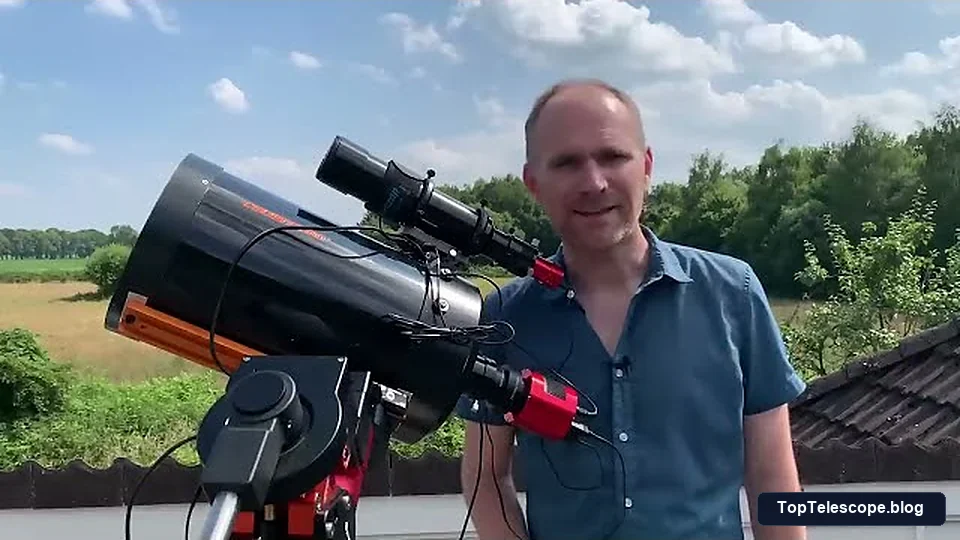
The Celestron C8 EdgeHD utilizes a modified Schmidt-Cassegrain configuration featuring built-in corrector lenses. This specialized design effectively eliminates optical aberrations to ensure pinpoint star images across the entire field.
Aluminum tube construction provides structural rigidity and manageable weight. Internal baffles suppress stray light, matching insights from our Celestron Edge HD 8 vs 8SE technical comparison when observing faint deep-sky targets.
Primary mirror support clutches secure the optical surface during long exposures. These mechanical locks prevent image shift when the telescope points toward various zenith angles throughout a standard imaging session.
The 203mm aperture Schmidt-Cassegrain system deploys a specialized corrector plate paired with internal field flattener lenses. This native design effectively eliminates off-axis optical aberrations across a large 42mm image circle.
StarBright XLT coatings applied to every glass surface maximize light transmission up to 97 percent. Such multi-layer dielectric enhancements ensure faint deep-sky structures reach the focal plane without unnecessary photon loss.
Mirror lock knobs secure the primary optical element against gravity shifts during long exposures. Engaging these heavy-duty mechanical clamps prevents image migration when tracking targets near the zenith for hours.
- Modified aplanatic Schmidt-Cassegrain optical system
- Proprietary StarBright XLT multi-layer coatings
- Internal baffle system for enhanced contrast
- Durable aluminum optical tube construction
Corrector Plate Mechanics
The corrective lens group is permanently mounted near the rear baffle of the optical tube. This optical placement guarantees absolute flatness right to the edge of modern imaging sensors.
StarBright XLT coatings maximize photon transmission across every glass surface. Users gain enhanced light gathering power, translating directly into shorter integration times for faint astrophotography targets.
- Rear-mounted corrector lens group
- Broadband anti-reflective glass treatments
Real-World Output and Astrophotography Performance
Operating at a focal length of 2032 millimeters, the system delivers incredible image scale for planetary details. Such optical performance parallels trends noted in our Celestron NexStar 6SE vs 8SE technical comparison.
Field curvature and off-axis coma are completely neutralized by the internal optical elements. Astrophotographers no longer require external field flatteners to achieve pin-point stars in the corners of frames.
Light transmission efficiency remains exceptionally high due to specialized broadband anti-reflective coatings. Every photon captured by the aperture reaches your imaging sensor with minimal internal scattering or signal loss.
Operating at a focal length of 2032mm, the instrument resolves tight planetary details with remarkable contrast. High-frequency atmospheric turbulence remains the primary limiting factor for visual observation of lunar craters.
Astrophotographers pairing modern APS-C sensors will appreciate pinpoint stars right to the extreme corners. Modern CMOS cameras exploit the flat focal plane to capture expansive nebulae without cumbersome external field flatteners.
Achieving optimal deep-sky tracking necessitates an equatorial mount with robust payload capacity. Guiding accuracy requires a dedicated off-axis guider to compensate for any lingering flexure in the imaging train.
- Zero off-axis coma across large sensors
- Consistent high-resolution planetary imaging output
- Optimized back-focus distance for cameras
Sensor Compatibility and Field Illumination
The optical back-focus distance is strictly specified to ensure optimal performance with dedicated astronomy cameras. Maintaining precise spacing from the visual back guarantees maximum corner sharpness during long exposures.
Vignetting is kept to a minimum when paired with standard APS-C sensors. Larger full-frame sensors may require careful flat-field calibration frames to correct minor edge illumination falloff effectively.
- Compatible with APS-C and full-frame sensors
- Precise back-focus spacing requirements
Video Review: Introduction
Thermal Management, Cooling Vents, and Airflow
Enclosed optical tubes require adequate time to reach ambient temperatures before imaging. Dual ventilation cooling fans and tips from our Celestron Starsense Explorer LT technical guide help expel trapped heat efficiently.
Thermal equilibrium prevents internal air currents from degrading high-magnification planetary resolution. Astrophotographers should allow at least forty-five minutes of cool-down time before beginning serious deep-sky imaging sequences.
Enclosed aluminum optical tubes trap ambient heat, leading to internal thermal gradients that degrade planetary resolution. Integrated mesh-filtered vents promote passive air circulation to help equalize internal and external temperatures efficiently.
Users should deploy low-vibration USB cooling fans for at least forty-five minutes before imaging sessions. This proactive ventilation step prevents boundary layer turbulence from ruining high-magnification planetary observation sessions.
- Integrated tube ventilation cooling fans
- Micromesh filtered air exhaust ports
- Fast thermal acclimatization support
Managing Mirror Shift and Focus Stability
Mirror-flop is a common challenge in traditional movable mirror designs during focusing. The EdgeHD incorporates mirror locks that rigidly clamp the primary glass in place after final focus.
The coarse-to-fine focusing mechanism operates smoothly without introducing unwanted backlash into the optical train. Precise adjustments allow users to nail critical focus on faint guide stars effortlessly.
- Rigid primary mirror locking clutches
- Smooth zero-backlash focusing mechanics
Mechanical Mounting, Balancing, and Rig Ergonomics
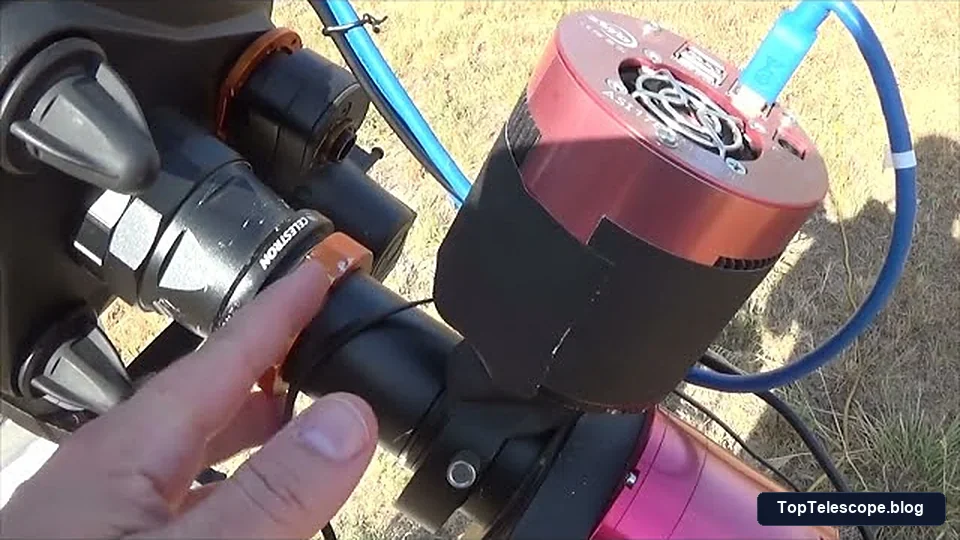
Weighing approximately twenty pounds, the optical tube requires a sturdy equatorial mount for tracking. The integrated CGE dovetail bar fits recommendations found inside our best Celestron telescope for beginners guide.
Balancing the rig demands careful attention due to the rear-heavy nature of Schmidt-Cassegrain designs. Adding dew shields or heavy cameras requires shifting the optical tube forward within the mounting saddle.
The optical tube assembly incorporates a robust Vixen-style dovetail bar for secure attachment to compatible mounts. Proper balancing along the declination axis prevents excessive strain on internal gear drives during tracking.
Weighing roughly 14 kilograms, the assembly demands careful handling when mounting solo in dark field conditions. Ergonomic carrying handles simplify transport, reducing accidental impacts against tripod legs during assembly.
- Standard CGE mounting dovetail rail
- Manageable twenty-pound optical tube weight
- Balanced ergonomic rail positioning
Field Portability and Handle Integration
Transporting the telescope to dark-sky locations is manageable thanks to robust carrying handles. These ergonomic grips prevent accidental drops during field assembly and teardown in dark environments.
Protective dust covers safeguard the corrector plate and rear visual back during transit. Keeping optical surfaces clean ensures long-term performance without requiring frequent, risky cleaning procedures.
- Built-in ergonomic carrying handles
- Durable protective dust covers
Collimation Rigidity and Long-Term Durability
Maintaining optical alignment is critical for achieving optimal resolution during high-magnification viewing sessions. The secondary mirror adjustment screws allow for precise collimation tuning using an artificial star.
Mechanical components feature rugged anodized aluminum finishes that resist corrosion and minor impacts. This durable construction ensures the optical tube withstands frequent travel to remote dark-sky observing sites.
Factory collimation holds exceptionally well thanks to the fixed secondary mirror assembly design philosophy. Periodic alignment checks using artificial stars ensure optimal performance without requiring constant mechanical tool adjustments.
Regular maintenance involves keeping the corrector plate free from dust accumulation using compressed air bulbs. Storing the tube with dust caps sealed prevents moisture ingress and preserves internal optical coatings.
- Accessible secondary mirror collimation screws
- Corrosion-resistant anodized aluminum exterior
- Rugged field-ready structural chassis
Routine Optical Maintenance Best Practices
Cleaning the corrector plate should be approached cautiously using specialized optical cleaning solutions. Avoid touching the delicate multi-coatings to preserve the maximum light transmission efficiency over time.
Storing the optical tube in a padded hard case protects against vibration damage. Proper storage conditions prevent internal dust accumulation and maintain optimal mechanical performance for years.
- Gentle corrector plate cleaning protocols
- Padded hard case storage recommendations
Who Should Buy It Versus Who Should Skip
Dedicated astrophotographers seeking flat-field performance on a budget will find immense value here. Planetary observers also benefit greatly from the long focal length and exceptional optical resolution.
Wide-field deep-sky observers searching for expansive visual vistas should look toward shorter refractors. Beginners unwilling to master polar alignment and guiding will find the focal length challenging.
Dedicated astrophotographers seeking a portable flat-field setup will find this optical tube an unmatched travel asset. Lunar observers and galaxy hunters also benefit immensely from the high-resolution focal length.
Beginners preferring wide-field Milky Way imaging should skip this heavy, long-focal-length system entirely. Wide celestial structures demand shorter refractors that offer forgiving tracking tolerances for novice equipment operators.
- Ideal for dedicated astrophotography enthusiasts
- Recommended for high-magnification planetary observers
- Skip if wide-field deep-sky nebulae are primary goals
Final Investment and Operational Summary
This optical tube represents a serious commitment to advanced astronomical imaging and observation. Users willing to invest time in setup are rewarded with breathtaking, coma-free celestial imagery.
- Rewarding long-term astronomical imaging tool
- Requires patience during initial setup
Frequently Asked Questions
How does the EdgeHD design differ from a standard Schmidt-Cassegrain telescope?
The large enclosed optical tube typically requires at least forty-five minutes to adjust fully to ambient outdoor temperatures. Utilizing the built-in ventilation fans accelerates this critical cooling process while expelling trapped internal heat efficiently before beginning your imaging sessions.
Do I need an external field flattener for astrophotography with this telescope?
No external field flattener is ever required for this optical tube because the built-in corrector lens group handles field flattening automatically.
This integrated design ensures perfect flat-field performance across both APS-C and full-frame camera sensors without requiring complex back-focus spacing calculations from users.
How do the mirror locks prevent image shift during long exposures?
The manual mirror clutches mechanically clamp the primary mirror tightly against the rear cell structure. This robust mechanical mechanism successfully prevents gravitational mirror flop and unwanted image shift while tracking targets across the night sky during long exposures.
What kind of mount is required to support this optical tube properly?
A sturdy German equatorial mount with a high payload capacity is essential for achieving steady tracking performance. Using a robust mounting platform minimizes wind vibrations and ensures accurate guiding accuracy during extended deep-sky astrophotography sessions throughout the night.
How long does the optical tube take to reach thermal equilibrium outdoors?
The EdgeHD incorporates a specialized corrector lens group built directly into the internal rear baffle system.
This advanced optical engineering completely eliminates off-axis coma and field curvature, delivering razor-sharp star profiles right to the extreme corners of large modern imaging sensors without external corrective accessories.