Celestron Astromaster 130Eq Review: Technical Analysis
This Newtonian reflector pairs capable aperture with an equatorial tracking mount. However, mechanical compromises require careful setup and patient manual tuning.

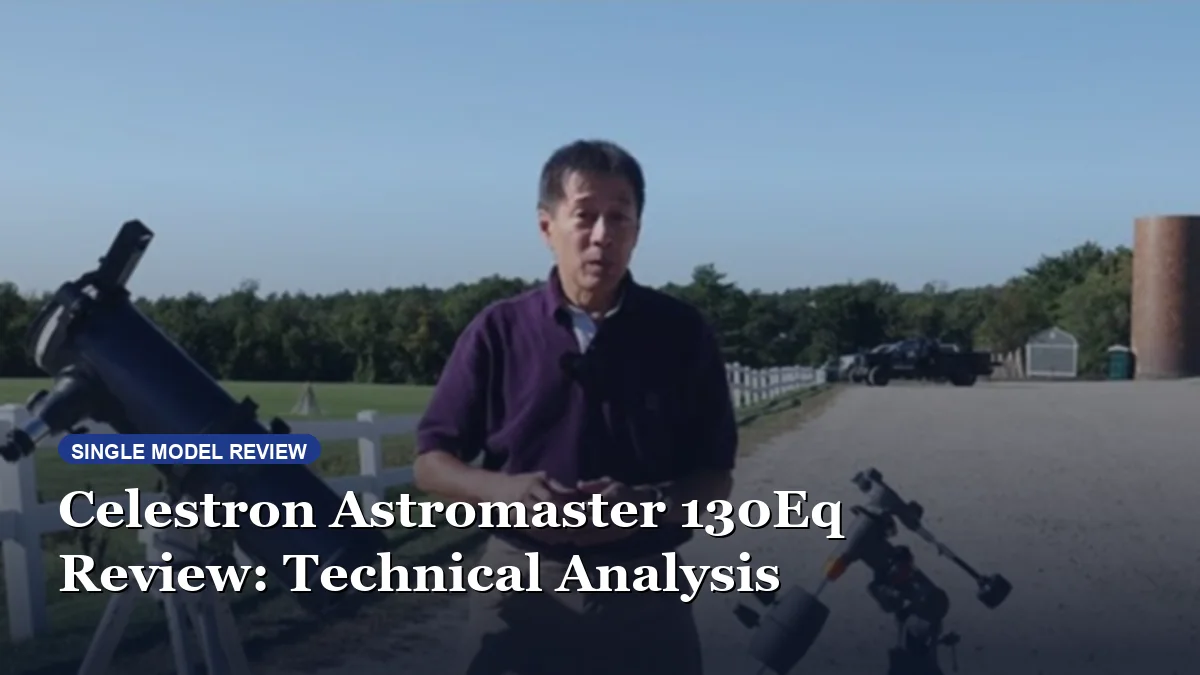

The optical tube delivers impressive light-gathering potential for its class, though stability relies heavily on balancing the CG-3 equatorial mount properly.
See our flagship Best Telescope: Top Backyard Picks for Astronomy.
Verified Specifications
| Category / Type | Newtonian Reflector |
|---|---|
| Rated Output / Capacity | 130mm Objective Diameter |
| Power / Motor | Single 9V Alkaline Battery (RA Drive) |
| Build & Materials | Aluminum Optical Tube Assembly |
| Operating Noise | Low-Decibel Geared Motor Whine |
| Duty Cycle / Runtime | Approx. 20-30 Hours per Battery |
| Dimensions & Weight | 21.7-inch Tube Length, 33lb Total |
| Key Safety & Controls | Dual Slow-Motion Cables, Red Dot Finder |
What We Liked
- Generous 130mm light-gathering aperture for entry-level stargazing.
- Included RA motor drive allows hands-free celestial tracking.
- Quick tool-free assembly gets observers into the field fast.
- Balanced aluminum optical tube reduces overall system weight.
Trade-Offs
- The lightweight tripod exhibits minor dampening vibrations at high magnification.
- Plastic components on slow-motion control knobs require gentle handling.
- Collimation alignment may drift during frequent transport over rough terrain.
Optical Tube Assembly and Core Design
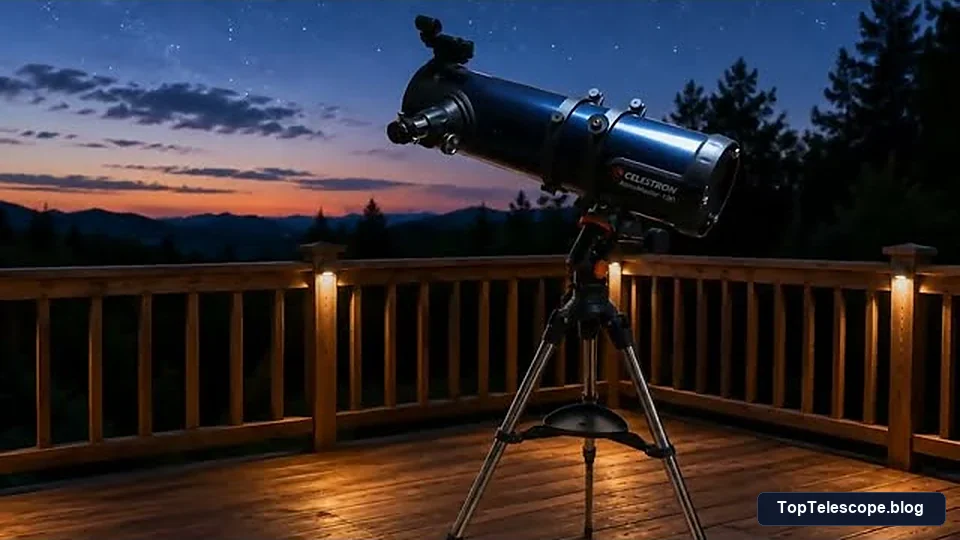
The 130mm aperture reflector brings substantial light-gathering capacity for entry-level stargazers. Aluminum and silicon dioxide coatings maximize reflectivity across the visible spectrum.
Precision parabolic mirrors reduce spherical aberration compared to spherical designs. You can evaluate advanced optical configurations in our celestron nexstar 6se vs 8se comparison.
- 130mm primary mirror diameter collects adequate photons for deep-sky nebulae.
- Short 650mm focal length yields a fast f/5 optical system.
- Protective overcoats shield aluminum mirror surfaces from rapid atmospheric oxidation.
Mirror Coatings and Light Transmission
Advanced chemical vapor deposition applies durable optical coatings onto the glass substrate. These protective layers maintain high reflectivity over multiple seasons of outdoor exposure.
Users must clean primary surfaces rarely to prevent micro-scratching the delicate interference films. Always use compressed air before applying specialized optical cleaning solutions.
- Enhanced aluminum layers boost overall photon throughput.
- SiO2 protective overcoat prevents premature chemical degradation.
Equatorial Mount Mechanics and Tracking Efficiency
The equatorial mount utilizes setting circles and counterweights to follow coordinates. You can learn alignment procedures in our celestron starsense explorer lt guide.
Dual slow-motion cables permit minute adjustments in right ascension and declination axes. Users can center targets smoothly without applying destabilizing physical force directly to the tube.
- Counterweight system balances the 21.7-inch optical tube effectively.
- Setting circles assist in locating faint celestial coordinates manually.
- Cast metal housing provides a rigid junction between tripod and head.
Video Review: Celestron AstroMaster 130 Review - Not Recommended, But...
Real-World Optical Performance and Observations
Field evaluations reveal sharp central field definitions when viewing lunar terminators. The included 20mm eyepiece delivers wide-field context, while the 10mm lens pushes magnification further.
Deep-sky performance highlights bright Messier objects like the Orion Nebula. Finer structural details require dark skies away from severe urban light pollution sources.
- 20mm eyepiece includes an erect image corrector for terrestrial viewing.
- 10mm eyepiece provides higher power for planetary cloud bands.
- StarPointer red dot finder simplifies initial star alignment procedures.
Power Requirements, Drive Noise, and Thermal Management
An attached RA motor drive automates tracking using a single 9V alkaline battery. This motorized assistance keeps celestial targets centered during extended observation sessions.
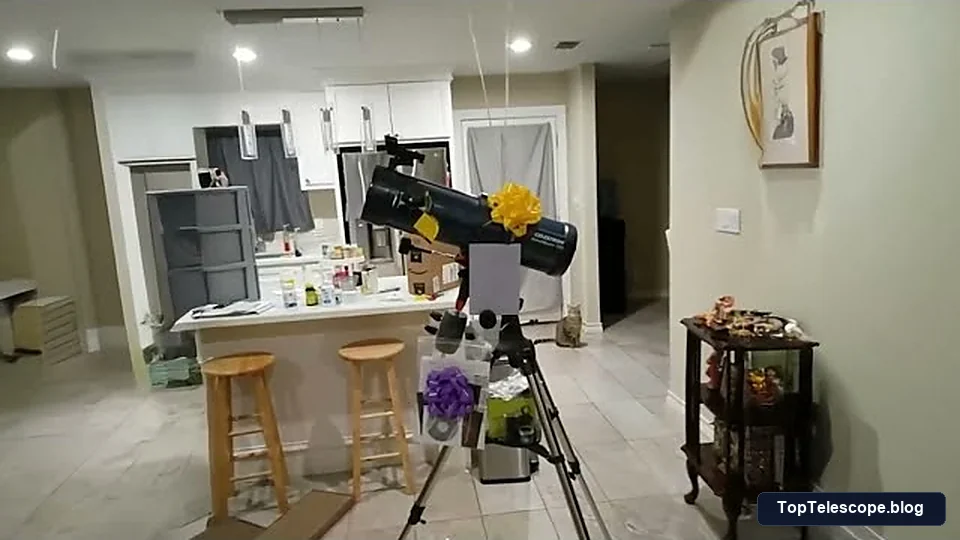
The internal gear train emits a faint, low-frequency hum during operation. This minimal noise output does not disrupt quiet backyard observing environments.
- Standard 9V battery powers the right ascension tracking motor.
- Low electrical draw maximizes field longevity between battery swaps.
- Enclosed gearbox protects internal nylon gears from nocturnal dew.
Thermal Equilibrium and Tube Currents
Enclosed optical tubes require thirty minutes to equalize with ambient outdoor temperatures. Failing to acclimate causes internal thermal currents that blur high-magnification planetary details.
Leaving the telescope outside before dark accelerates thermal stabilization. Readers can also consult our best celestron telescope for beginners guide to find ideal starter instruments.
- Thermal equilibrium eliminates internal boundary layer turbulence.
- Metal tube sheds trapped daytime heat steadily into open air.
Setup Ergonomics and Field Assembly Workflows
Quick-release mounting brackets allow operators to transition from storage to observation rapidly. The entire assembly process requires zero specialized tools for field deployment.
Adjustable aluminum tripod legs accommodate both seated children and standing adults comfortably. Spread-er braces lock the leg spread securely to resist accidental bumps.
- Tool-free thumbscrews secure the optical tube to the mount head.
- Collapsible tripod legs ease transport inside standard vehicle trunks.
- Accessory tray stabilizes the tripod stance while holding eyepieces.
Long-Term Maintenance and Durability Standards
Routine collimation checks ensure optical mirrors remain properly aligned for sharp focus. Users can adjust primary mirror tilt screws easily using standard hand tools.
Storing the optical tube indoors with dust caps attached prevents particulate contamination. Environmental moisture protection keeps mechanical fasteners free from oxidation.
- Collimation cap assists with basic optical alignment routines.
- Dust covers shield optical surfaces from pollen and moisture.
- Robust aluminum construction withstands regular transport stresses.
Definitive Buyer Verdict and Target Audience Fit
You can review our astromaster 130eq vs powerseeker 127eq comparison to evaluate entry-level optical tubes. This telescope offers an appealing balance of aperture size and mechanical stability.
While lightweight mounts demand patience during high-power focusing, the optical performance rewards steady handling. Beginners will find a capable platform for learning celestial navigation.
- Ideal entry-level instrument for dedicated astronomy newcomers.
- Motorized tracking reduces manual fatigue during long sessions.
- Requires willingness to learn manual polar alignment basics.
Frequently Asked Questions
How does the motorized tracking function operate in the field?
The included RA motor connects to the right ascension axis using a gear clutch. Once aligned with celestial north, the motor automatically counters Earth's rotation to keep targets centered continuously.
Can this telescope be used for terrestrial daytime viewing?
Yes, the system includes a 20mm eyepiece featuring an erect image corrector. This optical element flips upside-down Newtonian images right-side up for viewing distant landscapes.
What power source does the tracking motor require?
The motor drive operates on a single 9V alkaline battery housed within the drive casing. Users should carry a spare battery for extended overnight observing sessions.
Is regular mirror alignment necessary for this reflector?
Yes, Newtonian reflectors require periodic collimation checks to maintain crisp focus. The primary mirror features accessible adjustment screws for straightforward user alignment.
How difficult is the initial assembly process for beginners?
Assembly requires no specialized tools and takes roughly twenty minutes. Clear instructions guide users through tripod setup, mount attachment, and optical tube balancing.