Celestron Astromaster 130Eq Md Telescope Review
This Newtonian reflector pairs a generous 130mm aperture with a motor drive. Beginners must master polar alignment for optimal tracking performance.

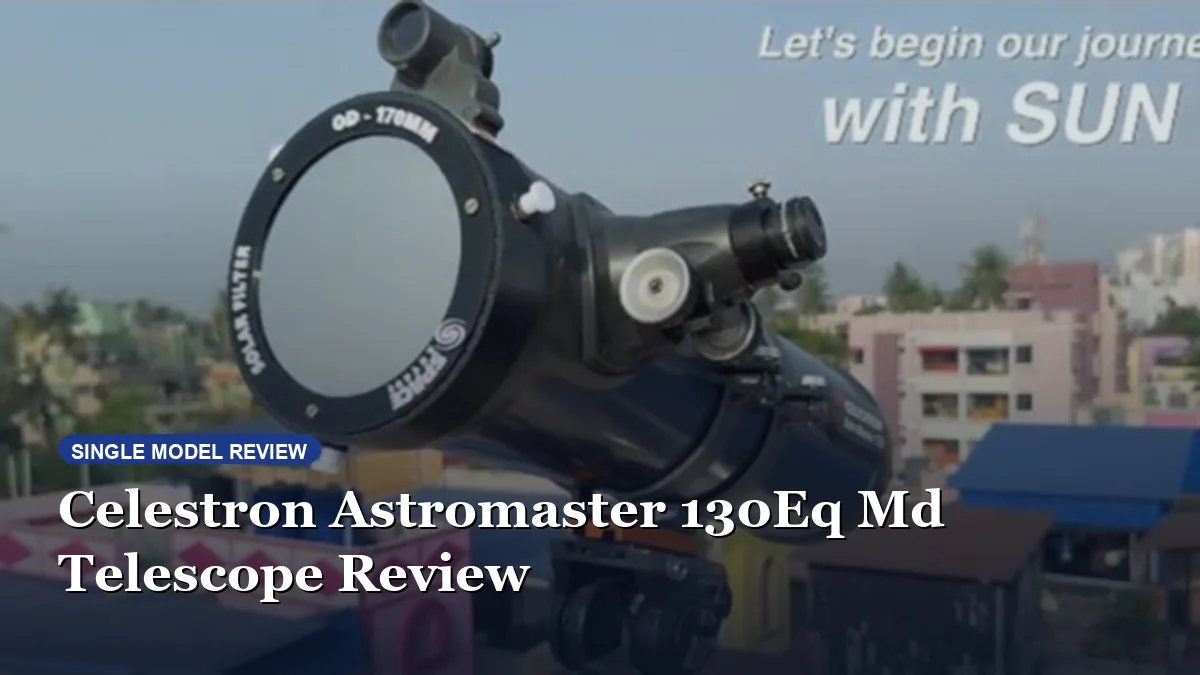

The Celestron AstroMaster 130EQ MD offers exceptional light gathering for its price class. However, its equatorial mount learning curve requires patience from novice stargazers.
See our flagship Best Telescope: Top Backyard Picks for Astronomy.
Verified Specifications
| Optical Design | Newtonian Reflector |
|---|---|
| Aperture | 130 mm (5.1 inches) |
| Focal Length | 650 mm (f/5) |
| Mount Type | CG-3 Equatorial with Motor Drive |
| Tripod Material | Pre-assembled steel tube legs |
| Highest Useful Magnification | 307x |
| Lowest Useful Magnification | 19x |
| Optical Tube Weight | 7 lbs (3.18 kg) |
| Total Assembled Weight | 27 lbs (12.25 kg) |
| Included Power | RA Motor Drive (9V battery) |
What We Liked
- Generous 130mm aperture resolves faint deep-sky nebulae and galaxies.
- Included motor drive enables hands-free right ascension tracking.
- Sturdy steel-legged tripod provides better stability than aluminum alternatives.
- Fast f/5 focal ratio delivers wide fields of view for star clusters.
- Comes bundled with basic eyepieces and a finderscope.
Trade-Offs
- Equatorial mount setup involves a steep learning curve for absolute beginners.
- Included stock eyepieces are basic and benefit from eventual upgrades.
- Newtonian optics require periodic user collimation to maintain sharpness.
Optical Architecture and Construction Quality
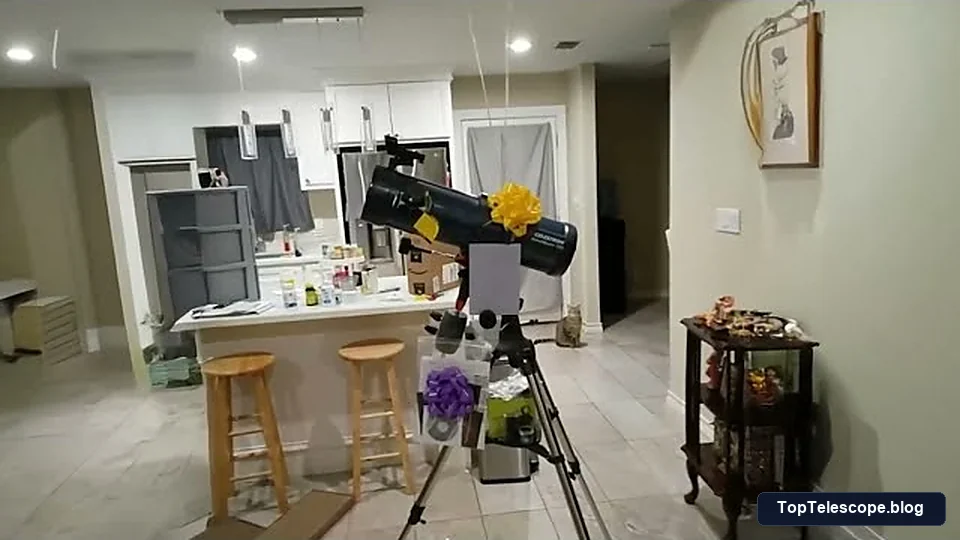
The optical tube assembly utilizes a spherical primary mirror housed inside a robust metal chassis. This material choice protects the delicate glass optical elements during transport and field use.
Aperture size dictates light-gathering capability, a core factor noted in our best budget celestron telescope roundup. The 130mm primary mirror captures significantly more photons to resolve faint Messier objects.
The optical tube assembly utilizes a 130mm aperture parabolic primary mirror housed within a rolled steel chassis. This Newtonian reflector design gathers ample light while maintaining a manageable physical length for field transport.
Internal baffling consists of matte black plastic rings designed to suppress stray light reflections. A spider vane assembly secures the secondary mirror with three thin struts, minimizing diffraction spikes around bright celestial targets during high-magnification viewing sessions.
- 130mm clear aperture collects bright, detailed images.
- Durable rolled-steel optical tube protects internal alignments.
- Fast f/5 focal ratio minimizes overall tube length.
- Includes a standard rack-and-pinion focuser accepting 1.25-inch accessories.
- Primary mirror cell features open ventilation ports for thermal acclimatization.
Focuser and Secondary Mirror Assembly
A standard rack-and-pinion focuser accepts 1.25-inch eyepieces securely. While constructed partly from engineering plastics, it maintains acceptable alignment under normal operating conditions.
The secondary mirror sits on a stable four-vane spider. This configuration minimizes diffraction spikes while securely anchoring the optical path for consistent alignment.
- Standard 1.25-inch rack-and-pinion focuser mechanism.
- Four-vane spider effectively holds the secondary mirror.
Real-World Visual Output and Optical Performance
Observing lunar craters reveals sharp shadow details along the terminator line. The moderate focal length delivers bright planetary views without excessive image degradation.
Deep-sky performance shines brightly, as noted in our best celestron telescope under 500 review, when targeting faint nebulas. Stars appear as sharp pinpoint sources across the central field of view.
Lunar observations reveal crisp crater walls and rilles when paired with a 650mm focal length configuration. The fast focal ratio produces wide star fields, though slight coma becomes visible near the extreme edges of standard eyepieces.
Planetary details on Jupiter and Saturn remain discernible if seeing conditions allow steady atmospheric transparency. Globular clusters resolve into individual pinpricks of light, benefiting directly from the light-gathering power of the primary aperture.
- High contrast views of lunar highlands and maria.
- Bright presentation of major planets like Jupiter and Saturn.
- Capable of resolving the brighter Messier deep-sky targets.
- Performs best with wide-field eyepieces for rich-field deep-sky scanning.
- Resolves tight double star systems cleanly under high magnification.
Magnification Limits and Eyepiece Pairing
Pushing magnification past three hundred power exceeds the theoretical limits of this aperture. Pairing the scope with quality Plössl eyepieces yields cleaner images than stock Kellner designs.
Atmospheric seeing conditions often dictate maximum usable power during planetary sessions. Keeping magnifications reasonable ensures steady, high-contrast visual experiences.
- Avoid exceeding maximum useful magnification ratings.
- Upgraded eyepieces dramatically improve visual clarity.
Video Review: What Can You See Through a 130mm Telescope? (Real Views!) | Celestron Astromaster 130EQ
Equatorial Mount Mechanics and Motor Drive Efficiency
The CG-3 equatorial mount utilizes manual slow-motion cables for precise adjustments. Adding the included motor drive automates right ascension tracking to keep celestial targets centered indefinitely.
Tracking accuracy depends entirely on proper polar alignment of the polar axis. Users must align the mount with celestial north to eliminate rotational drift during long observations.
The CG-3 equatorial mount utilizes aluminum setting circles and manual slow-motion cables for tracking objects. Integration of the included RA motor drive removes the necessity for constant manual adjustments during extended planetary imaging sequences.
Counterweight balancing requires careful adjustment along the declination shaft to prevent excessive strain on the internal worm gear. Proper torque distribution ensures that tracking rates stay remarkably consistent despite minor shifts in load distribution.
- CG-3 mount provides smooth manual slow-motion control.
- RA motor drive runs reliably on standard battery power.
- Accurate polar alignment is mandatory for tracking.
- Motor drive runs reliably on standard battery power for field portability.
- Setting circles assist in locating faint Messier catalog objects manually.
Power Management and Duty Cycle
The motor drive operates using an easily replaceable nine-volt battery source. Conserving power involves turning off the unit during extended eyepiece swaps or adjustments.
Cold weather conditions can noticeably reduce internal battery lifespan during winter stargazing sessions. Carrying spare batteries ensures uninterrupted tracking throughout long nights outdoors.
- Standard nine-volt battery powers the tracking motor.
- Cold temperatures reduce effective battery runtime capacity.
Setup Procedures, Collimation, and Ergonomics
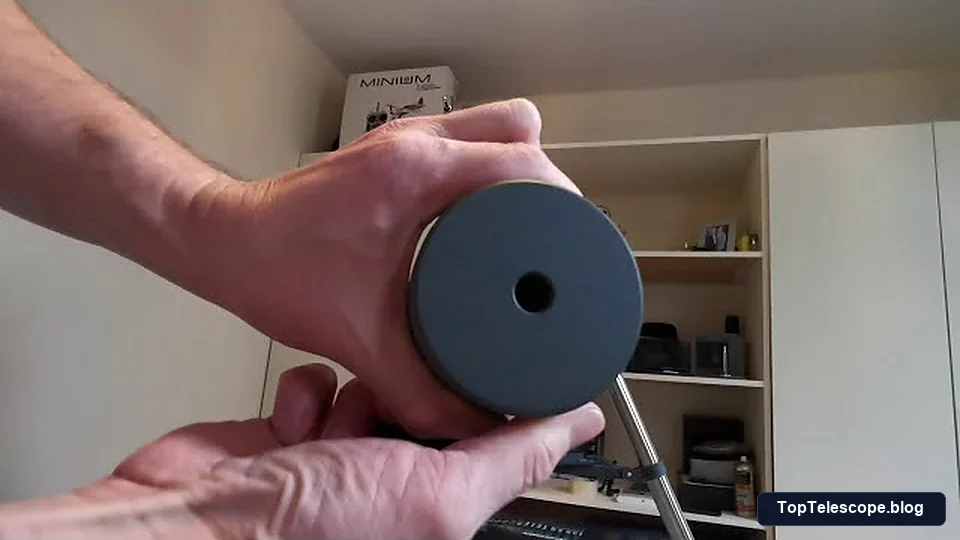
Assembly requires attaching the tripod accessory tray and mounting the equatorial head securely. The pre-assembled steel legs provide a rigid foundation that resists minor physical bumps.
Newtonian reflectors require regular mirror alignment checks using a collimation cap. Maintaining this optical alignment ensures maximum sharpness during high-magnification planetary viewing sessions.
Initial assembly demands a stable flat surface and basic hex tools to secure the accessory tray. Polar alignment relies on adjusting the latitude bolt while sighting Polaris through the rough polar axis bore of the mount head.
Maintaining optical alignment requires periodic adjustment of the primary mirror collimation screws located at the rear cell. Utilizing a Cheshire eyepiece or simple laser collimator guarantees pinpoint stellar images across the entire visual field.
- Steel tripod legs dampen ground vibrations quickly.
- Periodic collimation maintains peak optical performance.
- Accessory tray securely locks the tripod spreaders.
- Tool-free secondary mirror alignment adjustments save time in the field.
- Tripod spreader bar locks firmly to eliminate lateral leg wobble.
Balancing the Equatorial Payload
Properly balancing the optical tube along both axes prevents excessive gear wear. Adjusting the counterweight position ensures smooth movement across the entire celestial sphere.
Improper balance forces the slow-motion cables to bind up during manual tracking. Taking time to balance the rig makes observing sessions much more enjoyable.
- Balance declination and right ascension axes carefully.
- Counterweight position prevents internal gear strain.
Maintenance, Storage, and Long-Term Durability
Protecting optical surfaces from dew and dust prolongs mirror coating lifespan. Always replace dust caps immediately after completing an outdoor observing session to prevent contamination.
Store the telescope carefully, a practice emphasized in our best celestron telescope for astrophotography guide, to prevent internal condensation buildup. Keeping the primary mirror clean ensures consistent long-term performance.
Aluminum tripod legs withstand outdoor moisture when wiped clean after damp observing sessions. Storing optical tubes vertically in a climate-controlled environment prevents dust accumulation on the exposed primary mirror surface over extended storage periods.
Grease on the equatorial mount gears should be inspected annually and replaced with synthetic lithium lubricant if stiffness develops. Proper mechanical upkeep ensures smooth slow-motion cable response during freezing winter nights in the field.
- Always replace dust caps after stargazing sessions.
- Store indoors to prevent humidity and dust damage.
- Clean optics only when absolutely necessary with proper tools.
- Dust caps must remain on the corrector and focuser during storage.
- Avoid touching optical glass surfaces directly to prevent oil transfer.
Comparative Buyer Verdict and Target Audience
This model is frequently featured in our best celestron telescope for beginners review. Its large light grasp satisfies stargazers eager to explore deep-sky objects.
Absolute novices seeking a simple grab-and-go experience might prefer an alt-azimuth mount. However, patient hobbyists will find this motor-driven reflector to be a rewarding optical platform.
Intermediate hobbyists seeking a dedicated Newtonian system will appreciate the balance between aperture size and physical portability. The motorized tracking system transforms visual astronomy into a relaxing experience without requiring complex computer alignment routines.
Beginners must acknowledge the learning curve associated with equatorial mounts and manual polar alignment procedures. Patience during setup yields rewarding views of deep-sky phenomena that smaller refractors simply cannot resolve under identical suburban skies.
- Ideal for dedicated hobbyists entering astrophotography.
- Requires patience to master equatorial mount mechanics.
- Ideal platform for aspiring astrophotographers learning manual tracking basics.
- Offers substantial light grasp compared to entry-level tabletop reflectors.
Frequently Asked Questions
Can I use this telescope for serious astrophotography?
The included motor drive tracks right ascension for basic lunar imaging. However, deep-sky astrophotography requires an equatorial tracking platform with autoguiding capabilities.
How often do I need to collimate the mirrors?
Collimation checks should happen before every major observing session, especially after transport. Maintaining mirror alignment is essential for sharp planetary focus.
What powers the included motor drive unit?
The motor runs on a single standard nine-volt battery located inside the housing. Always keep a spare battery handy during cold winter observing nights.
Is this telescope difficult for absolute beginners to set up?
Equatorial mounts require polar alignment which involves a slight learning curve. Beginners should read the manual carefully to understand tracking mechanics before heading outside.
Can I upgrade the eyepieces later on?
Yes, the focuser accepts standard 1.25-inch accessories. Upgrading to wide-field eyepieces will vastly improve visual contrast and comfort.