Celestron 4Se Review: Compact GoTo Mastery
This compact Maksutov-Cassegrain telescope merges iconic orange-tube styling with automated GoTo precision. It offers sharp lunar views while trading away wide-field deep-sky clarity due to its long focal length.

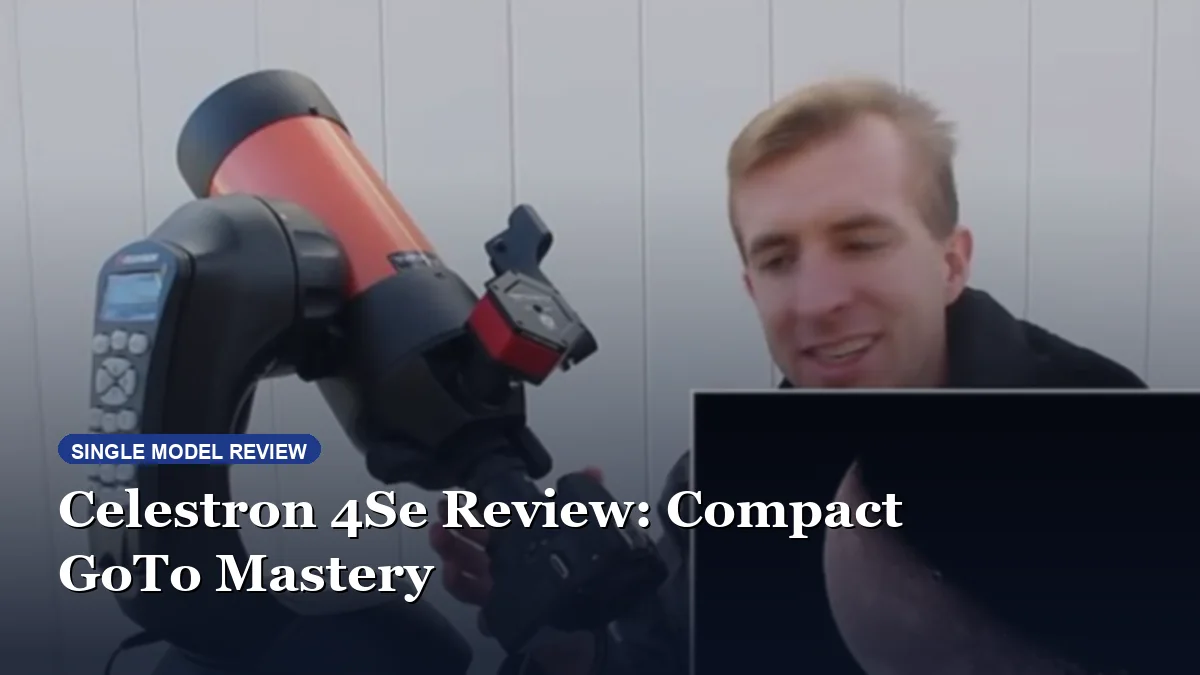
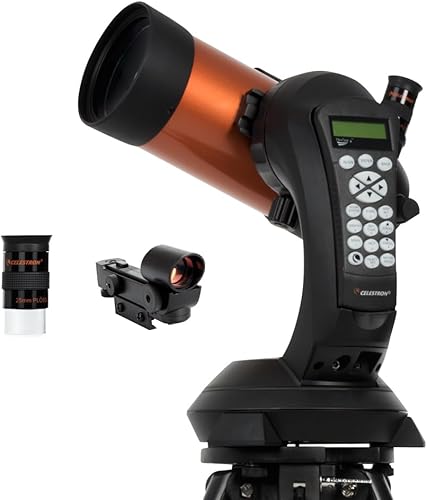
The Celestron 4Se delivers exceptional optical sharpness for planets in a portable frame. However, its high focal length restricts wide-field views and requires careful power management during extended field sessions.
See our flagship Best Telescope: Top Backyard Picks for Astronomy.
Verified Specifications
| Category / Type | Maksutov-Cassegrain Catadioptric Telescope |
|---|---|
| Rated Output / Capacity | 102mm Objective Aperture |
| Power / Motor | 8 AA Batteries or 12V DC Adapter |
| Build & Materials | Aluminum Optical Tube with Steel Tripod |
| Operating Noise | Moderate Motor Slewing, Quiet Tracking |
| Duty Cycle / Runtime | Variable based on external power source |
| Dimensions & Weight | 34.3 cm optical tube length, highly portable |
| Key Safety & Controls | NexStar+ Hand Control with SkyAlign |
What We Liked
- Sharp, high-contrast planetary and lunar views
- Compact and lightweight transportable optical tube
- Fully automated GoTo tracking with huge database
- Built-in wedge for entry-level astrophotography
Trade-Offs
- Narrow field of view restricts large nebulae
- Internal batteries drain quickly in cold weather
- Center column tripod tripod vibration at high power
Optical Engineering and Tube Construction
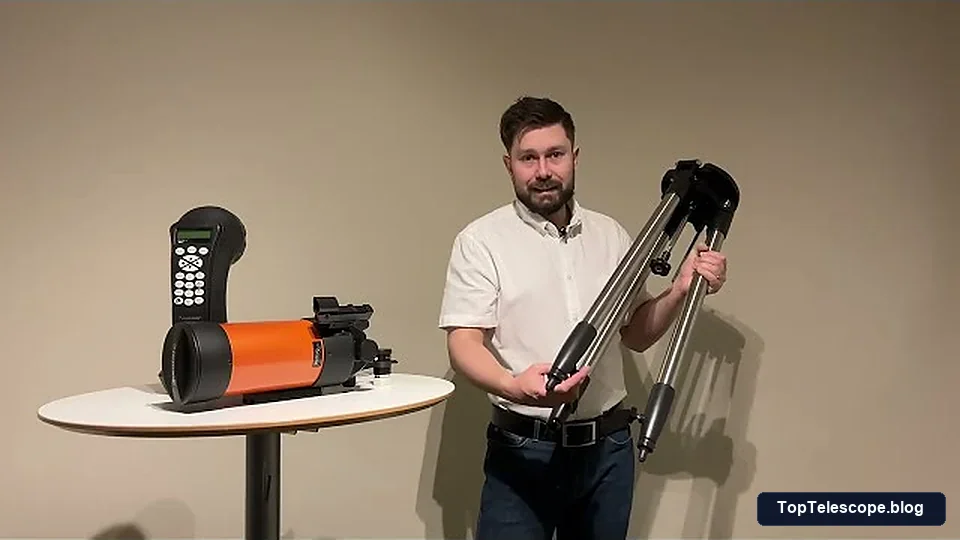
The optical tube assembly features a 102mm aperture enclosed in the classic orange housing. This Maksutov-Cassegrain design folds light efficiently, achieving a long focal length within a remarkably short physical tube length.
Internal baffling minimizes stray light reflections, significantly boosting contrast during lunar viewing sessions. Read our NexStar 4SE vs 5SE comparison to evaluate optical upgrades and aperture differences.
The 102mm aperture Maksutov-Cassegrain optical tube utilizes a thick meniscus corrector lens to eliminate chromatic aberration while folding light into a compact 1325mm focal length design for sharp planetary observations.
Aluminum casting and internal baffle systems minimize stray light penetration, ensuring high contrast levels when viewing lunar craters and resolving tight stellar binaries against dark suburban backgrounds during night sessions.
- 102mm Maksutov-Cassegrain optics
- Folded light path design
- Internal contrast baffling
- Thick meniscus corrector lens for aberration control
- Compact optical path suitable for transport
Mirror Shift Mitigation
Primary mirror shifting is controlled via a tension mechanism that reduces image flip during coarse focus adjustments, maintaining optical alignment under field conditions.
- Internal tension design
- Stable focusing range
Mount Mechanics and GoTo Tracking Precision
Automated tracking relies on a single fork arm altitude-azimuth mount driven by internal brass gears. You can explore our NexStar 6SE vs 8SE comparison to evaluate larger motorized bases and payloads.
Slewing speeds reach rapid levels while maintaining manageable operational decibel outputs during late-night observations. Pointing accuracy depends heavily on precise leveling and accurate initial alignment procedures in the field.
Driven by brass gears and DC servo motors, the single-fork arm mount executes smooth slewing operations while maintaining accurate tracking speeds across celestial coordinates throughout long imaging runs.
The internal SkyAlign technology requires users to center three bright celestial objects sequentially, calculating precise geographical orientation without demanding prior knowledge of specific star names or constellations.
- Single fork arm alt-az mount
- Internal brass gear system
- NexStar+ hand controller
- Reliable DC servo motor drives
- Automated celestial calibration sequences
Backlash Management
Programmable backlash compensation settings can be entered directly into the hand control unit to minimize gear slop during directional reversals and ensure immediate target acquisition.
- Hand control adjustments
- Reduced directional lag
Video Review: Celestron NexStar 4SE: The Best Beginner Telescope?
Real-World Optical Performance and Planet Views
Planetary targets like Saturn and Jupiter reveal crisp cloud belts through the bundled eyepiece. Follow our StarSense Explorer setup guide to ensure accurate alignment before starting your observation window.
Deep-sky performance remains limited to brighter Messier objects due to the modest light-gathering aperture. Wide-field nebulae cannot fit comfortably into the narrow focal field of view offered by this system.
Planetary observers will appreciate the clean diffraction rings and lack of false color when resolving cloud belts on Jupiter and the razor-sharp Cassini Division within Saturn’s distinct ring system.
Although limited by its modest aperture for faint deep-sky nebulae, the system easily splits tight double stars and reveals fine structural details across bright Messier catalogue targets.
- High contrast planetary details
- Sharp lunar crater views
- Limited deep-sky light gathering
- High-contrast planetary views
- Crisp double star separation
Magnification Limits
Atmospheric seeing conditions heavily dictate maximum useful magnification, meaning that users must swap eyepieces carefully to maintain optimal image brightness and sharp contrast.
- Seeing-dependent performance
- Eyepiece selection guidelines
Power Efficiency, Noise Profiles and Thermal Management
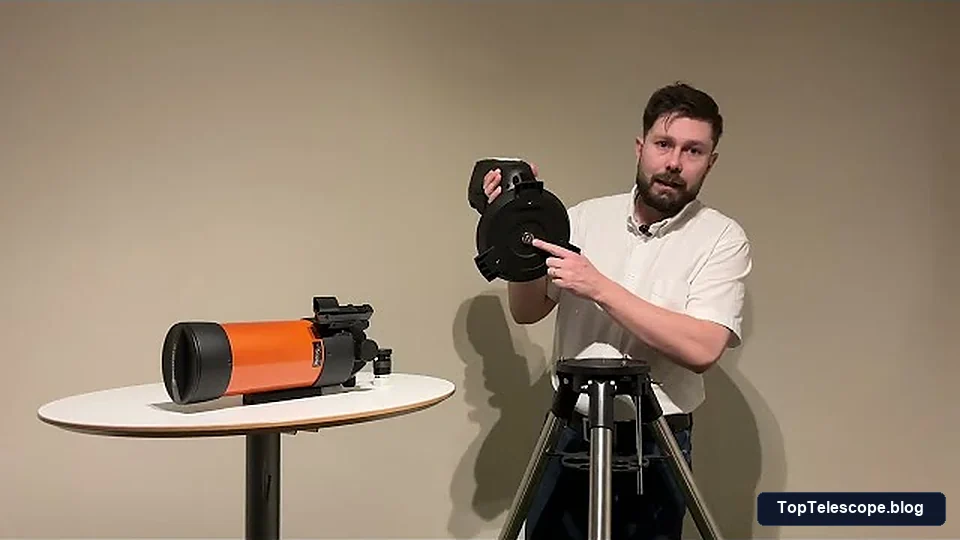
Power management requires proactive planning because internal battery compartments drain quickly during cold weather. Using an external AC adapter or a dedicated lithium power tank ensures stable tracking voltage.
Motor noise during fast alignment slews remains noticeable but rarely intrusive for nearby neighbors. Acoustic signatures drop significantly during sidereal tracking as the drive gears move at very slow speeds.
Operating on eight AA batteries or an external 12V power supply, the mount draws minimal current during idle tracking but requires fresh cells to prevent erratic GoTo computer behavior.
The enclosed tube design requires extended thermal acclimation periods. Beginners should review our best Celestron telescope guide before placing the optical tube outside thirty minutes prior to viewing sessions.
- External power tank recommended
- Low sidereal tracking noise
- Cold-weather battery drain
- Dual power options available
- Thermal equilibrium requirements
Internal Thermal Equilibrium and Cooling Times
Thick corrector lenses require adequate thermal acclimation time before delivering pristine high-power images. Allowing thirty minutes of stabilization outdoors eliminates internal tube currents and preserves critical optical sharpness.
- Thirty minute acclimation window
- Eliminates internal tube currents
Acoustic Profiles
Motor noise remains low during standard slew rates, though maximum speed maneuvers produce a distinct mechanical whirring sound that is typical for enclosed planetary gearboxes.
- Quiet tracking operations
- Standard slew sound output
Setup Rigidity, Ergonomics and Alignment Workflows
Transporting the lightweight optical tube and steel tripod requires minimal effort for mobile astronomers. The SkyAlign technology simplifies setup by letting users center three bright celestial objects without knowing their names.
Tripod stability is adequate, though extending the center column introduces minor damping vibrations during focusing. Keeping legs retracted enhances overall structural rigidity when working at high magnifications on windy nights.
The lightweight steel tripod provides adequate torsional rigidity for visual astronomy, though securing the accessory tray is vital for dampening vibrations during windy weather conditions.
Quick-release coupling mechanisms allow the optical tube to attach securely to the fork arm within seconds, streamlining transport and field assembly for mobile astronomers.
- Lightweight transportable design
- SkyAlign fast alignment
- Steel tripod foundation
- Sturdy steel tripod legs
- Fast tube attachment system
Alignment Workflow Efficiency
Following the standard alignment prompt on the computerized handset guarantees pinpoint goto accuracy for extended observing windows without requiring complex polar wedge setups.
- Simplified handset prompts
- Alt-azimuth orientation speed
Maintenance Protocols and Long-Term Durability
Routine maintenance involves gentle dust removal from the external corrector plate using specialized optics brushes. Never touch optical surfaces directly to preserve protective coatings and prevent permanent scratching over time.
Mechanical components benefit from periodic gear inspection to ensure smooth tracking across all altitude axes. Storing components in padded cases protects sensitive electronics from moisture during humid outdoor storage conditions.
Routine maintenance requires minimal effort beyond occasional exterior dusting and storing the corrector lens with its protective cover attached to prevent airborne residue accumulation.
Mechanical components benefit from periodic inspection of mounting fasteners and power ports to ensure electrical continuity and reliable structural integrity throughout years of regular field transport.
- Corrector plate dust care
- Mechanical gear inspections
- Padded storage protection
- Simple exterior surface care
- Protective dust cover usage
Optical Care Standards
Never touch the optical glass surfaces directly, opting instead for professional optical cleaning solutions and clean microfiber cloths to remove stubborn debris safely.
- Avoid direct finger contact
- Use approved cleaning cloths
Definitive Buyer Verdict: Who Should Invest
Urban astronomers seeking a compact telescope for planetary and lunar exploration will find immense value here. The combination of automated GoTo tracking and sharp optics suits dedicated beginner to intermediate hobbyists.
Deep-sky astrophotographers or wide-field enthusiasts should bypass this system in favor of larger Newtonian reflectors. Match your specific celestial observation goals against these optical trade-offs before making a final purchase.
This computerized telescope suits urban astronomers and travelers seeking sharp planetary views within a highly portable, user-friendly package that minimizes complicated setup procedures.
Astrophotography enthusiasts should note the alt-azimuth mount limitations for long exposures, making this instrument ideal for visual lunar exploration rather than deep-sky imaging.
- Ideal for urban planetary observers
- Great automated GoTo learning tool
- Skip for wide-field astrophotography
- Ideal for urban stargazers
- Portable travel friendly build
Investment Value
Anyone prioritizing grab-and-go convenience alongside automated object location systems will find immense value in this specialized optical and mechanical configuration.
- Automated targeting value
- Reliable optics package
Frequently Asked Questions
Can this telescope track celestial objects automatically?
Yes, the advanced computerized single fork arm mount utilizes a comprehensive internal database containing over forty thousand celestial targets to accurately locate and track your desired night sky objects automatically.
This powerful motorized tracking system entirely eliminates tedious manual star chart searching during your extended nighttime observation sessions across various dark sky locations.
What power sources are compatible with the mount?
The computerized mount natively accepts eight standard alkaline AA batteries, an optional twelve-volt wall AC adapter, or portable lithium power tanks to maintain completely stable operational voltage.
Utilizing reliable external power solutions is strongly recommended to prevent unexpected voltage drops and tracking errors during extended cold weather nighttime observing sessions.
Is this model suitable for deep-sky astrophotography?
While the integrated wedge allows basic polar alignment for casual lunar imaging, serious deep-sky astrophotography remains quite challenging due to the slow focal ratio and narrow field.
Dedicated wide-field deep-sky imagers will typically achieve much better results by using significantly faster Newtonian optical tube assemblies instead of this Maksutov design.
How long does it take for the optics to cool down?
Thick corrector lenses require approximately thirty to forty-five minutes of thermal acclimation outdoors to completely stabilize internal air currents and optical temperatures.
Allowing this necessary cooling period effectively prevents internal thermal distortion and ensures maximum optical sharpness for your demanding high-power planetary viewing sessions under dark skies.
What is SkyAlign technology and how does it work?
SkyAlign is an innovative automated alignment method that requires you to simply center any three bright celestial objects in the eyepiece without knowing their specific names.
The internal computer automatically calculates your exact geographic position and precise time parameters without ever requiring prior star name identification from the user.