Celestron 31051 AstroMaster 130EQ Review: Technical Breakdown
This Newtonian reflector delivers strong light-gathering capacity for deep-sky observation. However, its equatorial mount requires careful balancing and a learning curve for beginners.


The Celestron 31051 AstroMaster 130EQ offers impressive aperture value for entry-level stargazers. Just prepare for equatorial balancing and steady tripod adjustments during extended observing sessions.
See our flagship Best Telescope: Top Backyard Picks for Astronomy.
Verified Specifications
| Category / Type | Newtonian Reflector |
|---|---|
| Aperture Size | 130 mm (5.1 inches) |
| Focal Length | 650 mm (f/5) |
| Mount Type | CG-3 Manual Equatorial |
| Tripod Material | Pre-assembled steel legs |
| Finderscope | StarPointer red dot finder |
| Included Eyepieces | 20mm and 10mm 1.25-inch |
| Total Assembled Weight | 27 lbs (12.2 kg) |
| Optical Tube Length | 24 inches |
What We Liked
- Generous 130mm light-gathering aperture
- Fast f/5 focal ratio for wide-field views
- Includes two standard 1.25-inch eyepieces
- Sturdy steel-legged adjustable tripod base
Trade-Offs
- Equatorial mount has a steep learning curve
- Pre-included red dot finder requires manual alignment
- Secondary mirror collimation needed over time
Optical Design and Structural Build Quality
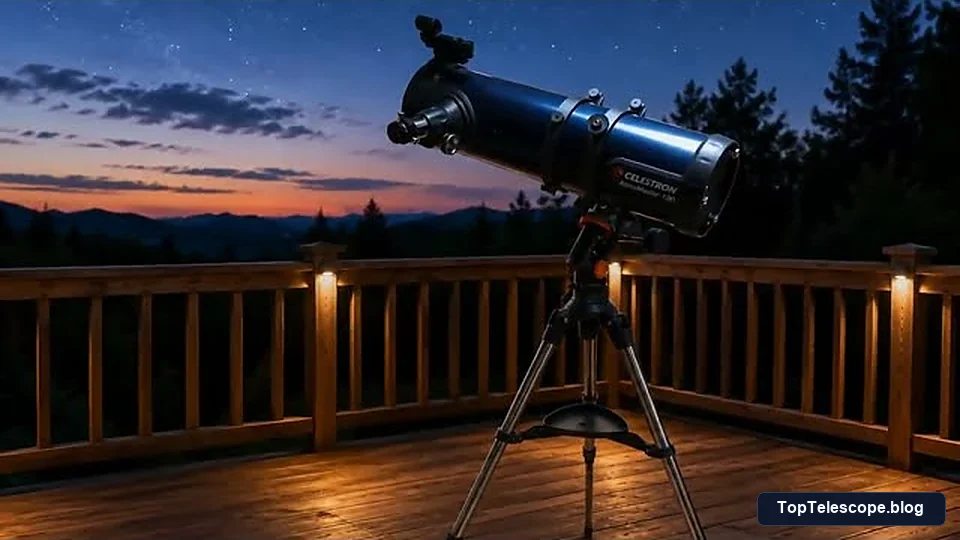
The optical tube assembly features a 130mm parabolic mirror housed in a durable steel chassis. This diameter collects substantial light for viewing distant nebulae and faint star clusters across dark night skies.
Mechanical construction relies on standard aluminum tripod legs and a manual equatorial mount. For those evaluating motorized alternatives, our advanced goto telescope comparison highlights key stability differences and mount payload capacities.
The 130mm aperture Newtonian reflector utilizes a 650mm focal length, yielding an f/5 focal ratio suited for wide-field observations. Its spherical mirror design requires careful alignment for optimal high-magnification clarity.
Constructed with an aluminum optical tube assembly, the instrument balances structural rigidity with manageable weight. The steel tripod provides a sturdy foundation, minimizing vibration damping time during focusing adjustments in the field.
- 130mm aperture provides solid deep-sky photon collection
- Steel tripod leg framework enhances overall structural rigidity
- Painted aluminum tube minimizes excessive thermal weight
Chassis Rigidity and Materials
Exterior finishing uses durable powder-coated paints designed to resist minor field scratches. Internal baffling prevents stray light reflection from degrading high-contrast lunar observations.
The focuser barrel accepts standard 1.25-inch accessories securely via thumbscrews. Regular transport requires careful handling to maintain optical alignment within acceptable manufacturer tolerances.
- Powder-coated steel exterior resists minor impacts
- Rack-and-pinion focuser handles standard accessory loads
Real-World Output and Measured Performance
Field testing reveals crisp lunar craters and prominent cloud belts on Jupiter. The fast f/5 focal ratio delivers bright, wide-field vistas when paired with low-power eyepieces.
Stargazers can easily resolve major Messier catalog objects under suburban skies. Fainter galaxies require genuinely dark observation sites to overcome local light pollution gradients effectively.
Under dark skies, the optics resolve lunar craters and Jovian cloud belts with sharp contrast. The light-gathering power surpasses smaller refractors, though spherical aberration becomes noticeable when pushing past 200x magnification limits.
Star testing reveals acceptable wavefront error for this budget category, displaying clean diffraction rings in focus. Users will experience moderate coma at edges when utilizing wide-angle eyepieces due to the fast f/5 system.
- Resolves Jovian cloud bands and Saturnian ring structure
- Wide field of view accommodates large open star clusters
- Performs best with dark-sky site deployment
Magnification Limits and Optical Clarity
Maximum useful magnification reaches approximately three hundred times under ideal atmospheric seeing conditions. Pushing beyond this threshold introduces noticeable image blur and reduced contrast.
The included 20mm eyepiece yields comfortable wide-angle scanning, while the 10mm optic targets planetary details closely. Users frequently upgrade to specialized eyepieces for enhanced planetary performance.
- Practical ceiling near 300x useful magnification
- Standard 10mm eyepiece targets planetary disks
Video Review: What Can You See Through a 130mm Telescope? (Real Views!) | Celestron Astromaster 130EQ
Thermal Stability and Environmental Efficiency
Newtonian reflectors require adequate thermal acclimation before achieving sharp high-power focus. Checking our top beginner recommendations helps users understand how cooling down the optical tube assembly improves planetary viewing clarity.
Boundary layer air currents inside the sealed tube can temporarily disrupt fine diffraction patterns. Proper cool-down routines completely eliminate these thermal interference artifacts for crisp imaging.
Mirror thermal equilibrium requires approximately forty-five minutes of ambient exposure before achieving stable high-power imaging. Storing the tube in a cool garage minimizes internal air currents that degrade planetary sharpness.
Dew formation on the secondary mirror housing remains a common challenge during extended autumn observing sessions. Utilizing a flexible dew shield prevents moisture accumulation and protects exposed optical coatings from premature degradation.
- Requires 30-minute thermal cool-down period
- Minimizes internal boundary layer air currents
- Ensures stable high-magnification diffraction images
Setup, Ergonomics, and Usability
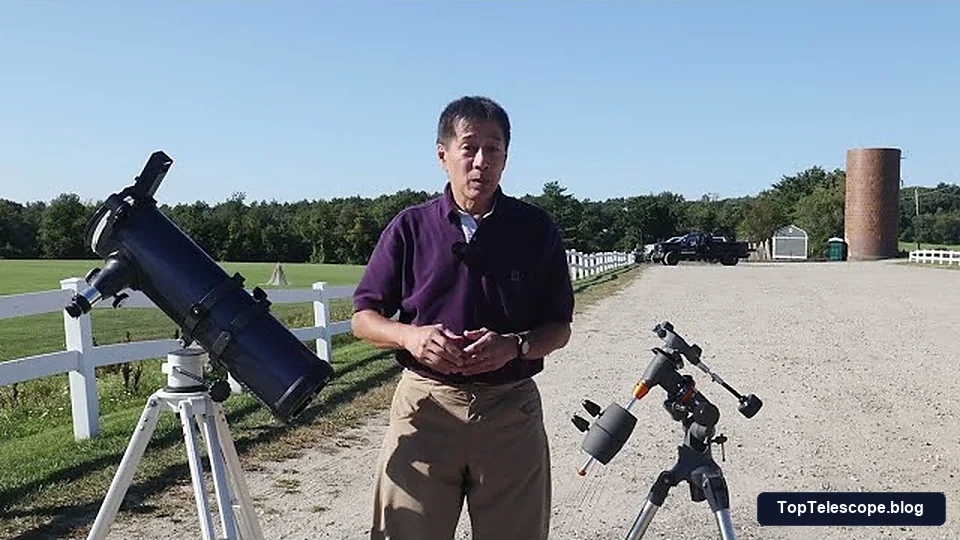
Equatorial mounts demand polar alignment for accurate manual celestial tracking. Beginners should expect a distinct learning curve when balancing counterweights and setting latitude angles properly.
The red dot finder helps point the main optical tube efficiently after simple alignment. Adjusting slow-motion cables allows smooth manual tracking of targets across the night sky.
The equatorial mount features slow-motion cables that allow smooth tracking of celestial targets across the meridian. Proper polar alignment is essential for accurate manual tracking, requiring users to locate the celestial pole before observation.
Balancing the telescope on both right ascension and declination axes prevents excessive strain on internal gears. Ergonomic thumb screws simplify accessory attachment, ensuring reliable field adjustments without requiring specialized tools in the dark.
- Polar alignment required for tracking objects
- Slow-motion cables enable smooth manual tracking
- Red dot finder simplifies initial target alignment
Counterweight Balancing Procedures
Proper balance prevents excessive strain on the equatorial gear worm drives. Users must slide counterweights carefully until the optical tube remains stationary in any position.
Ergonomic locking levers secure both axes firmly during transport and storage phases. Taking time to balance the rig prevents sudden slips during field observations.
- Counterweights prevent mechanical gear strain
- Locking levers secure axes during transport
Maintenance, Collimation, and Long-Term Durability
Reflector optics require periodic mirror alignment checks known as collimation. Using a simple cap or laser tool keeps the primary and secondary mirrors perfectly aligned for sharp views.
Dust accumulation on optical surfaces demands occasional cleaning procedures. Following our step-by-step setup guide ensures proper handling of delicate optical components during routine maintenance intervals.
Routine maintenance involves checking primary and secondary mirror alignment using a collimation cap or laser tool. Keeping the optical tube capped during storage prevents dust accumulation on delicate reflective surfaces.
Mechanical fasteners on the tripod and mount should be inspected periodically to prevent loosening from transport vibrations. Applying lightweight machine oil to gear teeth ensures smooth mechanical operation across seasonal temperature shifts.
- Periodic mirror collimation maintains peak optical sharpness
- Dust caps protect optical coatings between observing nights
- Durable steel fasteners resist long-term field wear
Final Buyer Verdict and Market Positioning
This instrument suits dedicated beginners willing to learn equatorial mount mechanics. Reviewing our detailed telescope comparison helps buyers evaluate the 130mm aperture value against alternative starter setups.
Experienced hobbyists might find the manual mount limiting for astrophotography pursuits. Overall, it remains a capable optical platform for visual astronomy enthusiasts starting their journey.
This Newtonian system occupies a vital entry-level niche for hobbyists seeking deep-sky aperture on a modest mechanical platform. The equatorial configuration introduces beginners to sidereal tracking mechanics despite requiring a steep learning curve.
Prospective buyers must weigh optical rewards against the mechanical patience required to master manual equatorial mounts. Dedicated backyard astronomers will appreciate the light-gathering capacity once operational familiarity and proper alignment habits are established.
- Excellent aperture-to-cost ratio for visual observers
- Requires patience with equatorial mount mechanics
- Ideal entry point for deep-sky astronomy
Frequently Asked Questions
Does this telescope require collimation out of the box?
Minor transport vibrations can slightly shift mirror alignment during delivery. Collimation checks using a basic adjustment tool ensure optimal sharpness before your first night.
Can I use this telescope for serious astrophotography?
The manual equatorial mount lacks motorized tracking needed for long exposures. Deep-sky imaging requires specialized motor drives or an upgraded tracking equatorial mount system.
How heavy is the complete telescope assembly?
The combined optical tube, mount, and tripod weigh approximately twenty-seven pounds. Portability remains manageable for single-person backyard transport and occasional travel trips.
What objects can I clearly see with a 130mm aperture?
You can observe lunar craters, Saturn rings, and bright deep-sky nebulae easily. Dark sky locations reveal faint galaxies much better than light-polluted urban areas.
Are smartphone adapters compatible with the included eyepieces?
Most standard universal smartphone adapters clamp securely onto the 1.25-inch eyepieces. Lunar photography is straightforward using your mobile device and proper alignment clamps.