Askar FRA400 Review: Quintuplet Astrograph Evaluated
The Askar FRA400 delivers exceptional astrophotography performance through a custom quintuplet optical design. It balances compact portability with full-frame imaging circles for demanding users.



This astrograph provides remarkable flat-field performance across a 44mm image circle. Despite its heavy weight, it remains a premier choice for modern deep-sky imagers.
See our flagship Best Telescope: Top Backyard Picks for Astronomy.
Verified Specifications
| Category / Type | Quintuplet Air-Spaced APO Astrograph |
|---|---|
| Rated Output / Capacity | 72mm Aperture, 400mm Focal Length |
| Power / Motor | Manual Rack-and-Pinion Focuser |
| Build & Materials | CNC Machined Aluminum with Anodized Finish |
| Operating Noise | Silent Manual Operation |
| Duty Cycle / Runtime | All-Night Deep-Sky Imaging Sessions |
| Dimensions & Weight | 14.6" Length, ~3.6kg Tube Weight |
| Key Safety & Controls | Dual-Speed Focus, 360-Degree Rotator |
What We Liked
- Integrated flat-field design covers full-frame sensors natively
- Robust CNC tube construction with versatile mounting handle
- Dual ED glass elements deliver superior color correction
- Smooth dual-speed rack-and-pinion focuser prevents slipping
Trade-Offs
- Slightly heavy for a small 72mm aperture telescope
- Requires sturdy equatorial mount for long exposure tracking
- Limited back-focus adjustment due to integrated optics
Optical Architecture and Engineering Design
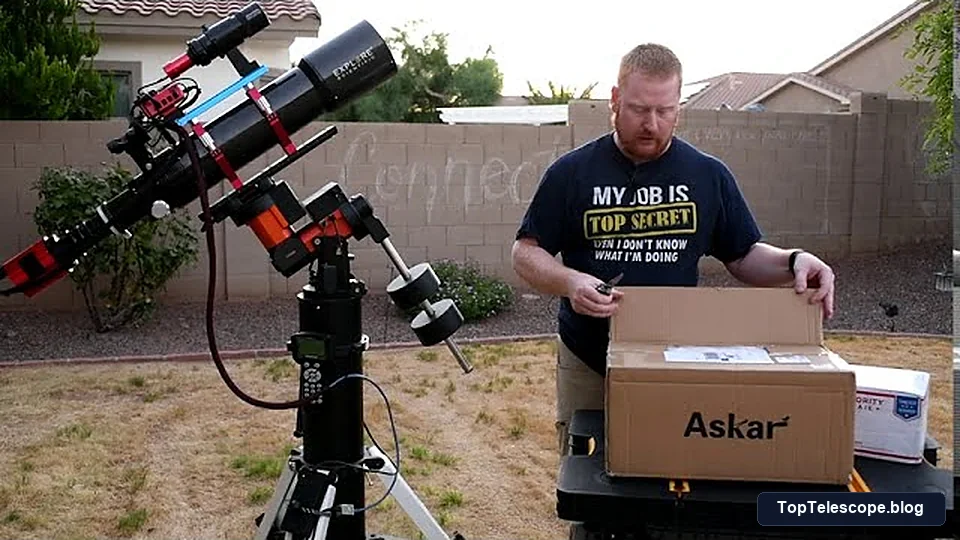
The Askar FRA400 features a sophisticated quintuplet air-spaced APO design utilizing two special ED elements. This advanced configuration effectively eliminates chromatic aberration while maintaining exceptional color correction.
Operating at a native focal length of 400mm with an f/5.6 aperture, this tube covers a full-frame circle. New users can also consult our curated best telescope for beginners guide for alternative gear options.
Internal baffling is meticulously engineered to suppress stray light reflections and maximize contrast during faint nebula captures. Every glass surface receives multi-layer coatings to optimize light transmission across the visible spectrum.
The Askar FRA400 utilizes a quintuplet air-spaced Petzval design, integrating a built-in field flattener that eliminates backfocus calculation errors while maintaining a 400mm focal length at f/5.6.
Two pieces of ED glass are incorporated into the primary objective lens assembly, actively minimizing chromatic aberration across the visible spectrum to ensure tight stellar profiles on modern CMOS sensors.
Optical coatings applied to each air-to-glass surface maximize light transmission efficiency, preventing internal reflections and stray light degradation during deep-sky imaging sessions under challenging urban light pollution conditions.
- Quintuplet lens configuration with dual ED elements
- Native focal length of 400mm at f/5.6
- Supports full-frame 44mm image circles natively
- Multi-layer anti-reflection broadband lens coatings
Glass Element Placement and Alignment
The dual ED glass elements are strategically positioned within the quintuplet cluster to manage thermal expansion. This precision alignment ensures optical stability during sudden temperature drops in outdoor observation sessions.
Precision manufacturing tolerances prevent internal element shifting during transport, preserving your collimation settings over bumpy backroad transit to remote dark-sky observing locations.
- Strategic glass spacing for thermal compensation
- Factory-aligned optical cell for rugged transport
Mechanical Rigidity and Tube Assembly
Mechanical construction relies on high-grade CNC machining with a durable matte black anodized finish. The physical structure resists flexing even when supporting heavy dedicated monochrome cameras and filter wheels.
An expandable tube ring assembly provides four sets of M4 and M6 threaded mounting holes for secure accessory attachment. Two integrated finder bases allow simultaneous mounting of guidescopes and electronic focusers.
CNC-machined aluminum components form the structural backbone of the optical tube, offering exceptional torsional rigidity to prevent flexure when heavy filter wheels and cooled cameras are attached.
The retractable dew shield locks securely via a smooth friction collar, reducing the total transport length while protecting the front objective element from moisture accumulation during extended overnight imaging runs.
- High-grade CNC aluminum mechanical tube assembly
- Expandable tube rings with multiple threaded connection points
- Dual integrated finder bases for auxiliary equipment
Accessory Integration Points
Engineers designed the mounting rings with abundant connection threads to accommodate complex imaging trains. Users can easily bolt on guide cameras, power hubs, and cable management brackets without crowding.
The secure attachment points prevent accessory rotation or sag during long multi-hour imaging sequences under changing gravitational loads.
- Four sets of M4 and M6 accessory holes
- Rigid ring clamps eliminate mechanical flexure
Video Review: This telescope does it all! But is it a good astrograph? TEST of the ASKAR FRA400C
Field Performance and Imaging Output
Field flattening is built directly into the optical train, ensuring pinpoint star profiles right to the corners of full-frame sensors. Users do not need to calculate precise back-focus distances for external flatteners.
Contrast levels remain exceptionally high when imaging emission nebulae or dense star clusters under suburban skies. The optical system delivers crisp detail separation that satisfies advanced astrophotography workflow demands.
Full-frame sensor illumination is fully supported by the optical circle, producing minimal vignetting and maintaining pinprick star shapes right into the extreme corners of large imaging formats.
Astrophotographers will appreciate the generous 44mm image circle, which accommodates modern high-resolution cameras without requiring external flattener adjustments or tedious spacer ring combinations during optical train assembly.
- Built-in optical field flattening correction
- Pinpoint star shapes across full-frame corners
- High contrast performance for faint nebulae
Focusing Mechanics and Fine Adjustments
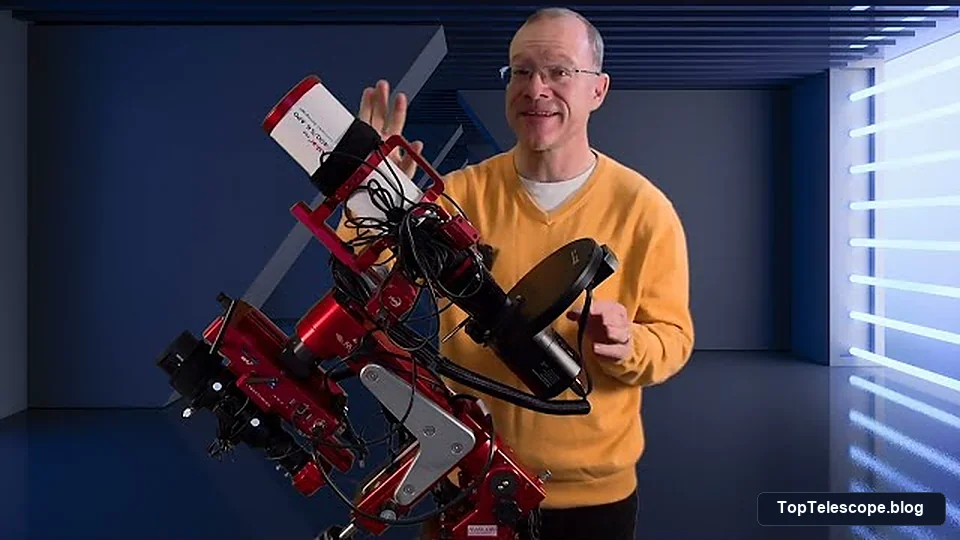
A robust rack-and-pinion focuser handles heavy imaging payloads without slipping or image shift during long exposures. Smooth dual-speed coarse and fine focus knobs enable exact critical focus adjustments with minimal backlash.
The focuser drawtube features a 360-degree rotator, allowing precise framing of your target object without loosening camera connections. Integrated scale markings help record your optimal focus position for rapid setup sessions.
A robust 3-inch rack-and-pinion focuser handles heavy imaging payloads smoothly, featuring a dual-speed reduction knob that allows precise micro-adjustments for critical focus acquisition on faint deep-sky targets.
The focuser drawtube incorporates a 360-degree rotator with locking thumbscrews, enabling effortless framing adjustments of complex nebulae without disturbing the optical alignment or introducing mechanical tilt into the camera train.
- Rigid rack-and-pinion mechanical focusing unit
- Dual-speed coarse and fine adjustment knobs
- Integrated 360-degree camera angle rotator
Thermal Management and Environmental Resilience
Aluminum tube construction facilitates rapid thermal equilibrium when moving gear. To see how these materials rank among top systems, check our guide to the best telescope options for backyard astronomy.
Protective dew shields slide smoothly and lock firmly into place to block stray ambient light and moisture condensation. Exterior finishes resist chipping and corrosion during heavy dew seasons and coastal imaging runs.
Rapid ambient temperature drops require stable thermal equilibrium to maintain focus; the aluminum tube contracts uniformly, keeping focal shifts to a minimum throughout chilly autumn and winter observing sessions.
Protective anodized finishes shield the external metal surfaces from corrosive dew and minor impacts, ensuring the telescope withstands the demanding rigors of remote field deployment and frequent transit.
- Rapid thermal stabilization via aluminum chassis
- Sliding dew shield to block stray light
- Corrosion-resistant exterior anodized coatings
Mounting Options and Rig Integration
A multi-functional handle at the base of the tube ring includes diverse threaded holes for standard dovetail plates. This versatile mounting geometry accommodates various equatorial mounts and robust altazimuth photographic tripods.
The handle doubles as a secure carrying grip when the optical tube is dismounted from your tracking mount. This ergonomic integration simplifies field transport and reduces accidental drop risks during teardown.
Standard Vixen-style dovetail bars integrate seamlessly with most equatorial mounts, while the included ring set features multiple mounting points for guidescopes, handle bars, and accessory plates.
The modular handle doubles as a secure mounting platform for mini-guide cameras, streamlining cable management and maintaining a balanced center of gravity across your entire imaging rig.
- Multi-functional handle with diverse thread options
- Compatible with standard equatorial dovetail bars
- Ergonomic grip for safe transport and setup
Maintenance Protocols and Long-Term Care
Regular maintenance requires gentle dust removal using a specialized bulb blower rather than compressed gas cans. Never touch exposed glass surfaces directly with bare fingers to prevent oil transfer on coatings.
Store the telescope inside a padded hard case with desiccant packs to prevent mold during humid months. For beginners seeking reliable hardware, explore our recommendations for the best starter telescope models for stargazing.
Routine maintenance involves gently brushing dust from the objective lens using a clean optical bulb blower, strictly avoiding compressed air cans that might deposit propellant residues on glass.
Storing the optical tube inside a padded, moisture-controlled hard case prevents internal lens fungus and protects delicate mechanical threads from accumulating particulate grit over extended periods of non-use.
- Gentle optical cleaning with bulb air blowers
- Padded hard case storage with moisture control
- Periodic fastener checks for mechanical stability
Comprehensive Buyer Verdict
When evaluating compact astrophotography setups, our William Optics Redcat 51 vs Askar FRA400 comparison highlights why this quintuplet delivers exceptional wide-field performance for demanding mobile imagers.
While the system carries significant weight for its aperture size, its optical prowess justifies the heft. Serious imagers will appreciate the seamless workflow and stellar imaging output delivered session after session.
Advanced astrophotographers seeking a dependable, wide-field imaging platform will find this optical tube delivers exceptional performance, combining sharp chromatic correction with robust mechanical engineering for hassle-free operation.
By eliminating external flattener spacing hassles, the system empowers users to focus entirely on data acquisition, making it a standout investment for dedicated mobile and permanent observatory setups alike.
- Exceptional wide-field optical performance
- Reliable mechanical build for mobile rigs
- Ideal investment for dedicated deep-sky imagers
Frequently Asked Questions
Does this telescope require a separate field flattener?
No, the advanced quintuplet optical design features a built-in flattening element that natively supports a full-frame 44mm image circle without requiring any external corrector lenses.
You simply need to attach your dedicated astronomy camera using the appropriate adapter to immediately capture sharp, pinpoint stars across the entire field of view during every single clear-night session.
Can I use this optical tube for visual observation?
Yes, the versatile mechanical layout accommodates diagonal mirrors and eyepieces for traditional stargazing sessions. However, its primary design optimization targets high-end deep-sky astrophotography work rather than casual planetary visual inspection.
What type of mount is recommended for this setup?
A sturdy computerized equatorial mount with at least a ten-kilogram payload capacity ensures accurate tracking during long exposures. Using a reliable tracking mount prevents star trailing and guarantees optimal performance from your imaging rig.
How does the dual-speed focuser handle heavy cameras?
The robust rack-and-pinion mechanism utilizes a tension adjustment screw to support heavy cooled cameras without slippage. This heavy-duty design maintains focus position securely throughout temperature shifts and meridian flips.
Is the dew shield retractable for easy storage?
Yes, the integrated dew shield slides smoothly back over the main optical tube to reduce overall physical length. This compact storage profile fits easily into standard transport cases for remote travel.