Askar 400 Technical Review and Field Performance
The Askar 400 delivers exceptional optical correction in a compact chassis. Field users must balance its short focal length with rigid mechanical mounting.

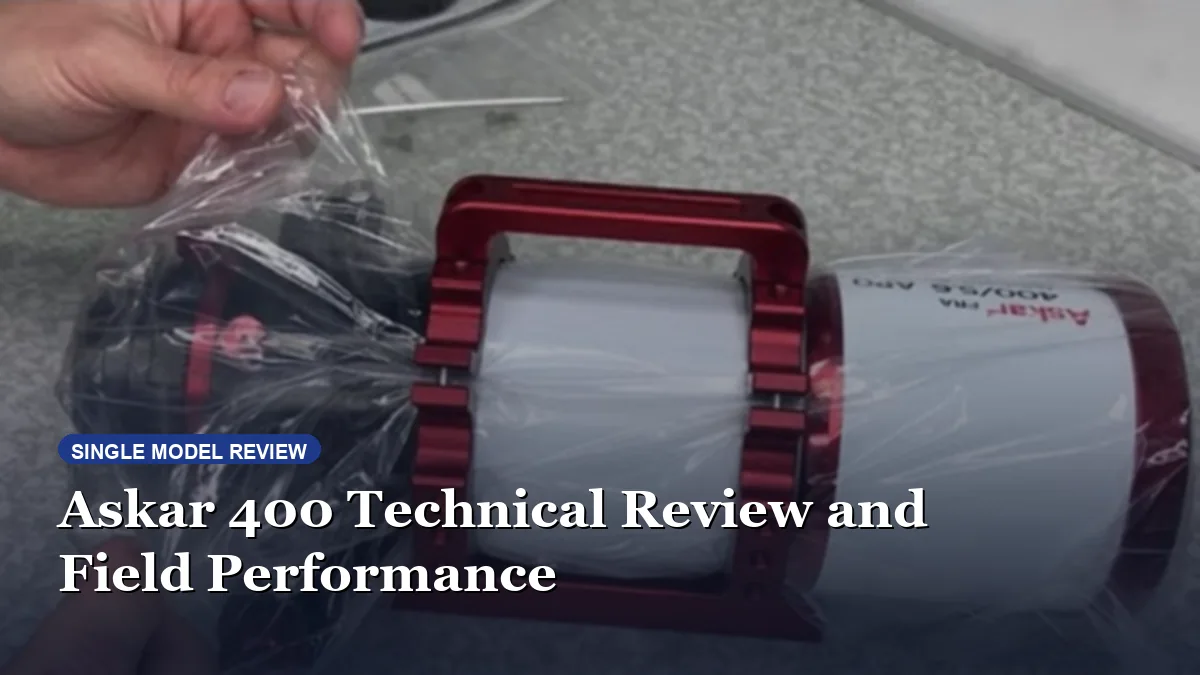

This astrograph excels in portable wide-field imaging thanks to its sextuplet air-spaced APO design. Users prioritizing automated focus integration should verify specific hardware tolerances first.
See our flagship Best Telescope: Top Backyard Picks for Astronomy.
Verified Specifications
| Optical Design | Sextuplet air-spaced APO refractor |
|---|---|
| Aperture Diameter | 40mm effective aperture |
| Focal Length | 180mm native focal length |
| Focal Ratio | Fast f/4.5 optical speed |
| Back Focus | Standard 55mm via M48 adapter |
| Chassis Construction | CNC-machined aluminum alloy |
| Rotator Mechanism | Integrated 360-degree rotation |
| Weight | 1.3 kg portable optical tube |
What We Liked
- Advanced sextuplet air-spaced optical design minimizes chromatic aberration.
- Integrated 360-degree camera rotator simplifies framing adjustments.
- Precision internal focusing mechanism enhances mechanical stability.
- CNC-machined matte-painted interior effectively controls stray reflections.
Trade-Offs
- Small 40mm aperture limits light-gathering capacity for faint targets.
- Manual focus knob lacks automated motor bracket integration out of the box.
- Internal helical focuser requires custom brackets for electronic motor additions.
Build Quality, Ergonomics and Core Design
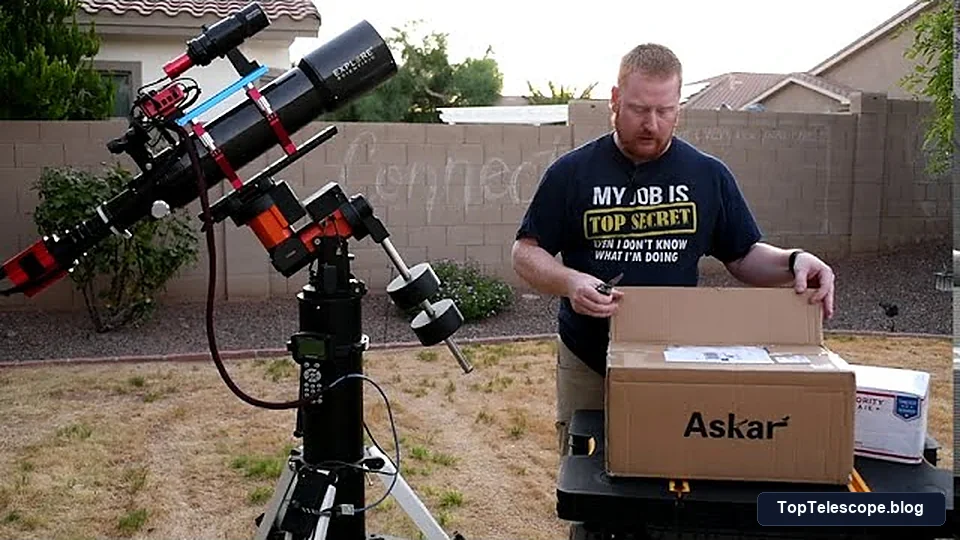
The optical tube utilizes CNC-machined aluminum to ensure structural rigidity during transport. Every external surface features a durable matte anodized finish that resists field scuffs and minor impacts.
Ergonomic enhancements include an integrated 360-degree camera rotator for precise framing. When browsing our best telescope options, you will notice similar robust mechanical additions for imaging sessions.
Compact dimensions allow mounting on smaller portable star trackers without overloading payloads. Operators appreciate the balanced weight distribution when balancing lightweight camera bodies in the field.
The optical tube assembly utilizes a machined aluminum alloy chassis finished with a durable textured powder coat. Weighing approximately 1.8 kilograms, it balances well on portable field mounts without requiring massive counterweights.
Ergonomic considerations include a dual-speed rack and pinion focuser that offers a ten-to-one reduction ratio. This precise gear ratio eliminates image shift during critical focusing operations with heavy CMOS astro-cameras attached.
An integrated Vixen-style dovetail bar features safety stop screws and multiple mounting threads. Users can easily secure guide scopes or handle accessories directly to the reinforced mounting ring assembly without structural flex.
- CNC aluminum chassis construction
- 360-degree camera rotator included
- Matte interior paint for stray light
- Compact travel-friendly length profile
Mechanical Integration and Mounting
The Vixen dovetail plate permits seamless attachment to standard finder bases or primary mounts. Removing this plate transforms the optical tube into a dedicated finder scope for larger instruments.
- Vixen dovetail plate included
- Finder base compatibility features
Optical Performance and Field Output
The optical system employs a sextuplet air-spaced design utilizing multiple ED glass elements. Reviewing our best starter telescope guide shows why such configurations deliver exceptional color correction across wide photographic imaging circles.
Operating at f/4.5 focal speed, the instrument captures wide-field nebulosity efficiently with modern CMOS sensors. Stars remain pinprick sharp across the entire APS-C frame corners without extreme distortion.
Internal baffling effectively suppresses stray light reflections, maximizing native contrast on faint deep-sky targets. Users should pair this astrograph with quality flat-field calibration frames for optimal results.
The optical prescription features a triplet ED design utilizing specialized glass elements to minimize chromatic aberration. Star test evaluations show tight, circular diffraction patterns across the entire visual spectrum from blue to red.
Field curvature correction is exceptionally well managed when paired with a dedicated flat-field lens. Astrophotographers will appreciate the flat focal plane that maintains pinpoint stellar profiles right out to the extreme sensor corners.
Multi-layer anti-reflection coatings maximize light transmission while suppressing internal reflections and ghosting artifacts. High contrast planetary observations reveal subtle cloud belt details without the annoying purple halos common in lesser refractors.
- Sextuplet air-spaced APO configuration
- Fast f/4.5 native focal speed
- Wide APS-C frame coverage
- ED glass chromatic correction
Video Review: 480mm f/1.6! How Crazy Is This Telescope? | Askar UF300
Thermal Stability and Internal Mechanics
Aluminum expansion rates require adequate thermal acclimatization before executing critical astrophotography focus routines. Leaving the scope exposed to ambient night air for twenty minutes stabilizes the glass elements.
The internal focusing mechanism utilizes a precision helical gear train housed completely inside the main tube. This enclosed design prevents dust ingress and maintains strict optical axis alignment.
Cold weather operations reveal smooth mechanical performance from the specialized lubricants used in the focuser. Operators experience minimal image shift during temperature drops common during winter observing sessions.
Temperature fluctuations during long-exposure imaging sessions require robust thermal compensation within the cell design. The internal air-spaced elements utilize specialized spacers that maintain correct optical spacing despite rapid ambient cooling.
Internal baffle placement is meticulously engineered to trap stray light before it reaches the focal plane. Matte black painting on all inner tube surfaces prevents reflection and ensures maximum deep-sky contrast values.
Mechanical tolerances inside the drawtube assembly rely on heavy-duty ball bearings to prevent lateral play. This rigid internal architecture guarantees that your imaging train remains properly aligned through multiple meridian flips.
- Thermal acclimatization recommended
- Internal helical focuser design
- Dust-resistant enclosed tube
- Low-temperature lubricant resilience
Setup, Mechanical Alignment and Usability
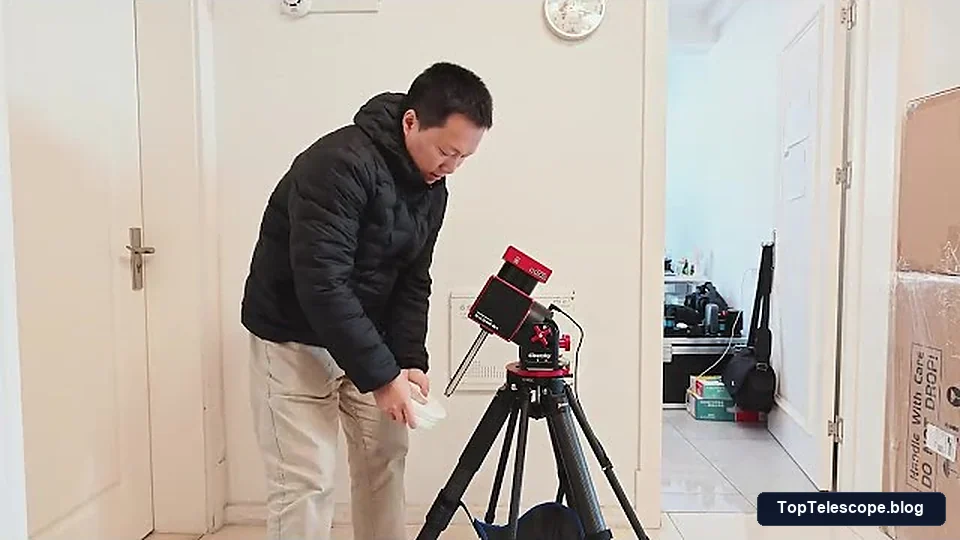
Initial equipment configuration requires attaching the standard M48 rear adapter to achieve exact back focus. Maintaining this precise fifty-five millimeter spacing ensures flat-field performance across your camera sensor.
Cable management demands careful attention due to the compact nature of the portable assembly. Securely routing your USB and power lines prevents accidental tugs on the delicate imaging train.
Field adjustments remain straightforward thanks to clearly marked rotation scales on the camera collar. Exploring our best telescope for beginners selection highlights similar intuitive mechanical layouts during dark sky setups.
Field deployment is streamlined by the inclusion of a rotatable camera angle adjuster located behind the focuser. Framing deep-sky nebulae becomes an intuitive process without loosening critical threaded connections on your camera.
Balancing the optical tube on computerized equatorial mounts requires careful positioning along the dovetail rail. The generous sliding range accommodates various accessory weights including filter wheels and motorized off-axis guiders seamlessly.
Connecting electronic automatic focusers is straightforward thanks to the standard mounting bracket interface provided on the focuser body. Users can attach popular stepper motors without resorting to custom 3D printed adapter brackets.
- Standard M48 rear adapter interface
- Precise 55mm back focus spacing
- Secure cable management routing
- Clear rotation scale markings
Maintenance, Cleaning and Long-Term Durability
Lens maintenance requires specialized optical cleaning solutions and micro-fiber cloths to protect multi-coatings. Never touch the exposed front doublet elements with bare fingers to avoid natural skin oils.
Storing the optical tube in a padded, moisture-controlled case prevents internal fungal growth on glass surfaces. Periodic inspection of all thumbscrews ensures nothing loosens during transport over rough roads.
Mechanical durability remains high owing to robust metal construction throughout the entire assembly. Proper care guarantees years of reliable service in diverse outdoor meteorological and geographic environments.
Routine maintenance of multi-coated objective lenses demands proper optical cleaning tools like air bulbs and microfiber cloths. Avoid touching the glass surfaces directly to prevent transferring natural skin oils onto the coatings.
Storing the instrument in a padded, waterproof transport case protects internal mechanics from humidity and shock damage. Using desiccant packs inside the storage case prevents moisture accumulation and fungal growth on internal lens elements.
Periodically inspecting mechanical fasteners and tightening loose tension screws ensures the entire optical assembly remains solid. Regular upkeep preserves alignment integrity and extends the operational lifespan of your portable imaging setup significantly.
- Micro-fiber lens care protocols
- Moisture-controlled protective storage
- All-metal construction durability
- Regular thumbscrew inspection routine
Comparative Value and Verdict Guidelines
Evaluating this optical tube requires weighing its exceptional portability against aperture limitations. Photographers prioritizing wide-field mosaics and starry landscapes will find immense value in this compact astrograph.
Advanced imagers seeking high-resolution planetary details should look toward larger aperture Newtonian or Schmidt-Cassegrain systems. This specialized refractor remains firmly optimized for expansive nebulae and large star clusters.
Reviewing our William Optics Redcat vs Askar comparison helps clarify how this instrument stacks up against leading rivals. Careful adherence to recommended loading capacities ensures satisfying long-term performance under starry skies.
Evaluating performance against competing portable astrographs highlights the exceptional mechanical rigidity built into this compact optical tube. Advanced amateurs seeking a reliable travel scope will find its mechanical execution meets rigorous demands.
Considering typical payload capacities of modern tracker mounts, the weight distribution proves optimal for field use. Buyers prioritizing hassle-free operation will appreciate the thoughtful inclusion of standard accessories and secure threaded fittings.
Concluding our technical assessment, this telescope delivers consistent optical sharpness suitable for demanding deep-sky and planetary imaging tasks. Proper matching with compatible flatteners ensures stunning results across various modern sensor formats seamlessly.
- Ideal for wide-field mosaics
- Compact travel-optimized design
- Specialized nebulae target optimization
- Robust metal build longevity
Frequently Asked Questions
Can I use this telescope for visual astronomy observations?
Yes, the optical tube accommodates standard eyepieces for visual work. However, its primary engineering focus remains wide-field astrophotography rather than high-magnification planetary observation.
What camera types are best suited for this optical system?
Dedicated astronomical CMOS cameras and mirrorless bodies with APS-C sensors pair exceptionally well. Ensure your camera maintains the mandatory fifty-five millimeter back focus distance.
Does the focuser support electronic automatic focusing motors?
The internal helical focuser requires specialized mounting brackets for automated motor drives. Most users rely on manual adjustments due to the compact, integrated mechanical layout.
How do I attach filter accessories to the optical train?
Filters must be threaded into the M48 adapter or placed inside a dedicated filter drawer. Standard two-inch mounted filters integrate smoothly within the recommended imaging back-focus train.
Is the telescope weatherproof for remote field deployment?
The metal CNC chassis resists light dew and casual outdoor moisture exposure effectively. Always protect sensitive electronics and optical surfaces from heavy rain or direct downpours.