Apertura AD12 Dobsonian Review: Deep-Sky Powerhouse
The Apertura AD12 delivers exceptional light grasp and precision optics. It demands a dedicated transport strategy for field use.


This massive Dobsonian offers phenomenal value for advanced astronomers. Its optics and accessories outshine competing reflectors.
Explore related alternatives in our Best Deep Sky Telescope.
Verified Specifications
| Category / Type | Newtonian Reflector |
|---|---|
| Primary Mirror Diameter | 305 mm (12 inches) |
| Focal Length | 1520 mm |
| Focal Ratio | f/5 |
| Focuser Type | 2-inch Dual-Speed Crayford |
| Finderscope | 8x50 Right-Angle Correct-Image |
| Mount Type | Dobsonian Altazimuth Base |
| Total Weight | Approx. 83 lbs combined |
What We Liked
- Massive 12-inch aperture collects deep-sky light brilliantly.
- Included dual-speed Crayford focuser ensures precise adjustments.
- Comprehensive accessory package features multiple eyepieces.
- Sturdy roller-bearing altitude base provides smooth motion.
- Built-in cooling fan accelerates thermal equilibrium times.
Trade-Offs
- Heavy optical tube requires significant lifting strength.
- Large footprint takes up substantial vehicle trunk space.
- Requires regular primary mirror collimation checks.
Optical Architecture and Primary Mirror Engineering
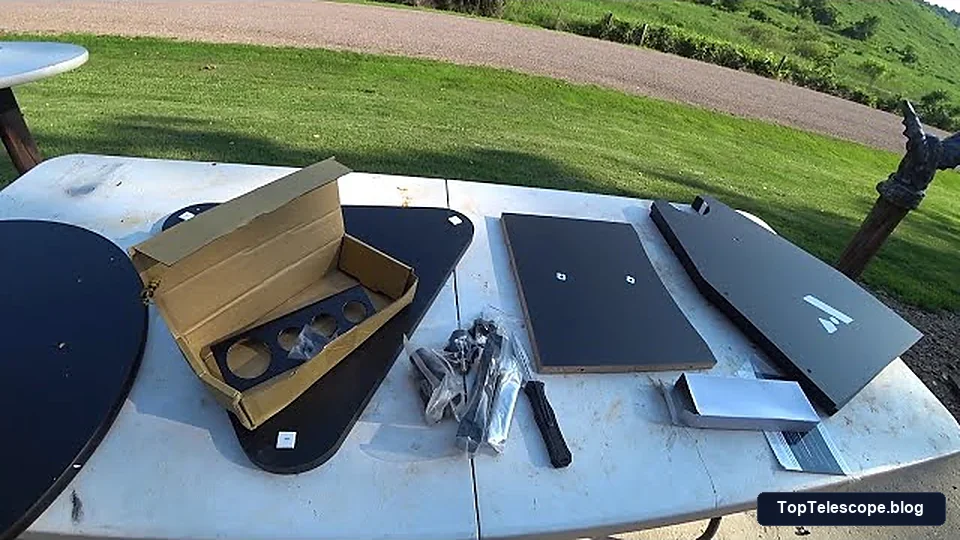
The Apertura AD12 utilizes a parabolic primary mirror crafted from high-grade optical glass. This 305mm aperture gathers immense light, revealing faint nebulae and distant galaxies with stunning clarity.
Advanced aluminum coatings deliver high reflectivity across the visible spectrum. When exploring our dobsonian vs newtonian comparison, enhanced glass surfaces ensure that incoming photons reach the eyepiece with minimal light loss.
Operating at an f/5 focal ratio, the system strikes a fine balance between wide-field views and high-magnification planetary tracking. Collimation stability remains dependable throughout temperature shifts.
- 305mm aperture diameter
- f/5 focal ratio design
- Enhanced aluminum coatings
- Parabolic glass substrate
Mirror Substrate and Coating Resilience
Protective overcoats shield the delicate reflective layers from atmospheric moisture and environmental pollutants. Regular cleaning is rarely required if proper storage caps remain engaged between sessions.
Thermal expansion is minimized by stable glass blanks, preventing focus drift during extended autumn viewing runs. This engineering precision directly supports high-power planetary imaging.
- Protective quartz overcoat
- Low thermal expansion glass
Mechanical Build Quality and Base Stability
The heavy-duty particle board base utilizes a roller-bearing altitude system for effortless movement. This innovative design prevents sticking and jerking when tracking celestial targets at high magnifications.
Tension clutches on both altitude bearings allow users to adjust resistance based on accessory weight. Adding a heavy eyepiece will not cause the optical tube to sink unintentionally.
Steel support plates reinforce structural stress points across the rocker box assembly. Such robust reinforcement ensures years of reliable field operation without developing structural slack or wobble.
- Roller-bearing altitude system
- Adjustable tension clutches
- Reinforced steel plates
- Heavy-duty rocker box
Base Ergonomics and Motion Control
Teflon pads combined with azimuth roller bearings deliver exceptionally smooth panning actions. Readers exploring our best dobsonian telescope guide will note how easily observers can nudge this hardware across the night sky.
Balancing handles integrated into the base panels simplify lifting and repositioning tasks. These thoughtful touches reduce strain during hurried backyard setup routines before stargazing begins.
- Teflon azimuth pads
- Integrated transport handles
Video Review: 【AD12 Dobsonian】| VLOG EP3 | Introducing my Dob | Apertura AD12 Dobsonian Telescope
Focuser Performance and Accessory Integration
A smooth dual-speed Crayford focuser manages image sharpness with a ten-to-one reduction gear. This mechanical advantage eliminates image shift during delicate focusing adjustments under high power.
The standard two-inch drawtube accommodates large-format eyepieces for expansive sky vistas. An included one-and-quarter-inch adapter ensures seamless compatibility with smaller standard optical accessories.
Brass compression rings secure eyepieces firmly without marring chrome barrels. This thoughtful clamping mechanism protects your valuable optical investments from unnecessary wear over time.
- Dual-speed 10:1 gear
- Two-inch drawtube
- Brass compression rings
- Included adapter sleeves
Factory-Included Optical Accessories
The accessory bundle features a wide-field ocular and a high-magnification Plossl design. These additions provide functional starting points for observing planets and sprawling star clusters immediately.
A robust right-angle correct-image finder simplifies celestial navigation by matching star charts directly. Users avoid awkward neck strain while locating elusive deep-sky objects overhead.
- Wide-field eyepiece included
- Right-angle finder scope
Thermal Management and Cool-Down Dynamics
Massive glass mirrors require adequate time to acclimate to ambient outdoor temperatures. A rear-mounted cooling fan accelerates this thermal equalization process by expelling trapped heat efficiently.
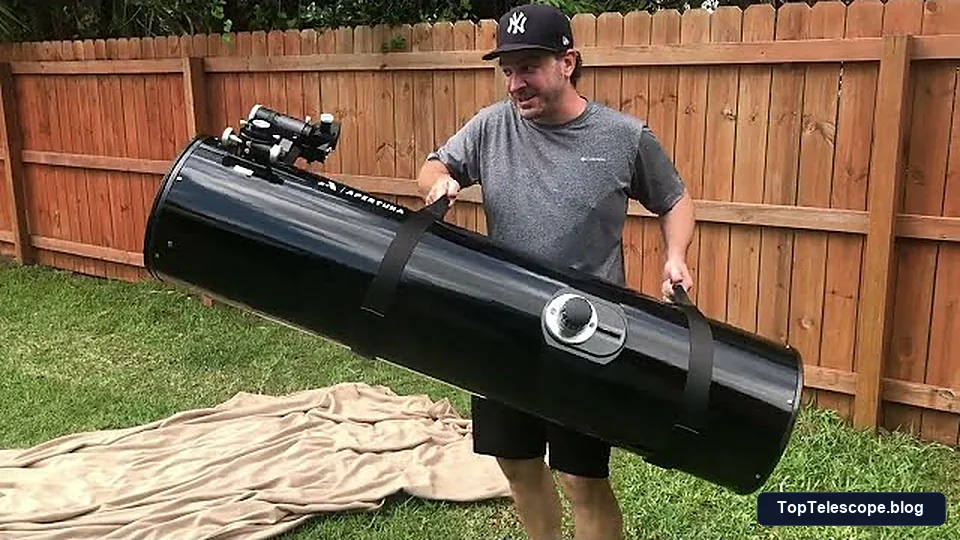
Running the battery-powered fan for thirty minutes before viewing prevents troublesome internal air currents. Eliminating thermal plumes guarantees sharper planetary details from the very first observation.
Ventilation mesh covers protect the mirror cell while maintaining proper airflow through the rear assembly. This protective design keeps dust and insects away from delicate optical surfaces.
- Rear cooling fan
- Battery-powered operation
- Protective mesh covers
- Rapid thermal equilibrium
Managing Local Thermal Currents
Observing over concrete patios introduces radiant heat that degrades high-power telescopic resolution. Moving the instrument to a grassy surface helps mitigate localized thermal interference completely.
Keeping the OTA capped in shade prior to dusk minimizes solar heat absorption during hot summer afternoons. Proper thermal prep ensures maximum optical contrast after nightfall.
- Grassy placement advantage
- Pre-dusk shade storage
Visual Performance Across Solar System Targets
The twelve-inch aperture resolves intricate cloud belts on Jupiter and delicate Saturn ring structures. Exceptional light-gathering capacity reveals subtle color variations across planetary disks during optimal seeing conditions.
Lunar craters display breathtaking relief when observed along the shifting shadow terminator line. High-contrast optics render mountain peaks and crater floors with crisp, three-dimensional depth.
Solar observation requires certified front aperture filters to prevent permanent eye damage. Once properly equipped, sunspot umbrae and solar granulation patterns appear with striking clarity.
- Planetary cloud detail
- High-contrast lunar views
- Certified solar filtering
- Crisp shadow boundaries
Overcoming Atmospheric Turbulence
High-magnification planetary viewing depends heavily on steady atmospheric seeing conditions overhead. Selecting nights with minimal jet stream interference unlocks the true resolving power of this giant mirror.
Lower magnification eyepieces serve as useful diagnostic tools to gauge local air stability before committing to high-power planetary studies. Patience yields rewarding moments of crystal-clear vision.
- Seeing condition checks
- Diagnostic low-power scanning
Deep-Sky Observations and Resolution Limits
Faint deep-sky objects benefit immensely from the massive light grasp of this optical tube. Spiral arms in Messier galaxies emerge from dark skies with distinguishable structural detail.
Globular clusters resolve into thousands of individual pinpoint stars across the focal plane. Nebula filters enhance contrast on emission targets by isolating specific hydrogen emission wavelengths.
Dark sky travel transforms this telescope into an elite instrument for hunting obscure celestial wonders. Consult our best dobsonian telescope for beginners guide before reaching deep into the cosmos for NGC targets.
- Galaxy spiral structure
- Globular cluster resolution
- Nebula filter compatibility
- Dark sky performance
Star Hopping and Field Navigation
Manual tracking requires familiar star-hopping techniques using reliable printed celestial atlases. The optical finder scope provides bright reference stars to guide your journey across constellations.
Practicing smooth adjustments helps maintain centered targets at high magnification without losing your bearings. Field experience turns manual tracking into an intuitive, highly rewarding skill.
- Star-hopping mastery
- Optical finder utility
Transport, Ergonomics, and Field Setup
Transporting an instrument of this size requires careful vehicle packing and physical effort. The optical tube and wooden base separate easily into two manageable, albeit heavy, components.
Lifting straps or a dedicated utility cart simplifies moving the heavy base across uneven terrain. Planning your transport strategy prevents accidental bumps against doorframes or vehicle panels.
Assembling the system at your observing site takes mere minutes without requiring any specialized tools. Quick setup procedures ensure more time is spent exploring the cosmos.
- Two-piece breakdown
- Utility cart recommended
- Tool-free assembly
- Vehicle space planning
Storage and Routine Upkeep
Storing the optical tube vertically in a dry environment prevents dust accumulation on the primary mirror. Keeping optical surfaces clean prolongs mirror coating longevity significantly over years.
Periodic collimation checks using a laser tool ensure peak optical alignment before every serious observing session. Maintaining proper alignment guarantees consistently sharp, aberration-free celestial views.
- Vertical storage method
- Routine laser collimation
Definitive Editorial Verdict
The Apertura AD12 stands out as an exceptional instrument for dedicated amateur astronomers. Reviewing our dobsonian vs newtonian reflector verdict highlights its unmatched optical performance and comprehensive accessory suite.
Prospective buyers must account for the physical size and weight before committing to purchase. Those with adequate transport space will find this telescope an endlessly rewarding window.
- Exceptional value ratio
- Comprehensive accessories
- High light grasp
- Physical size demands
Final Recommendations
Invest in a quality collimation tool and a padded transport cover to protect your investment. With proper care, this optical powerhouse provides decades of breathtaking views.
- Collimation tool essential
- Padded cover recommended
Frequently Asked Questions
How difficult is it to transport the Apertura AD12?
Transporting this telescope requires two people due to its substantial weight and bulk. Using a utility cart makes moving the heavy base across uneven ground much easier.
Does the telescope require frequent collimation?
Mirror alignment holds reasonably well during normal transport, but you should check collimation before every session. A simple laser tool makes this adjustment quick and straightforward.
Can I use this telescope for astrophotography?
While it excels at visual astronomy, the manual Dobsonian mount limits long-exposure deep-sky imaging. It works well for high-speed lunar and planetary webcam photography.
What accessories are included in the standard package?
The package includes a dual-speed Crayford focuser, a right-angle finder scope, a cooling fan, and standard eyepieces. These items provide everything needed for immediate night sky viewing.
How does the cooling fan improve performance?
The rear fan accelerates mirror acclimation to ambient outdoor temperatures. Eliminating internal heat currents ensures sharp planetary views from the very beginning of your session.