Apertura AD10 Review: Ultimate Deep-Sky Performance
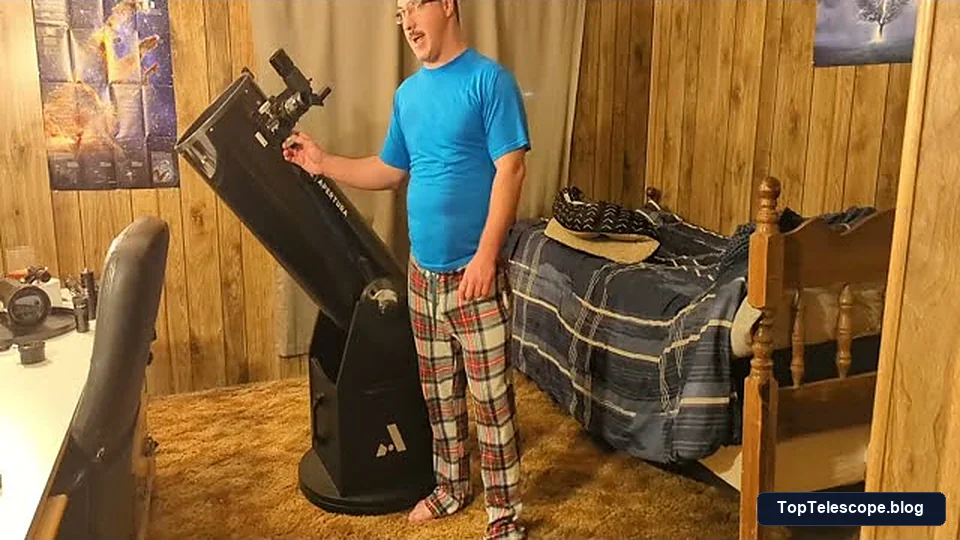
The Apertura AD10 delivers exceptional light gathering through a massive primary mirror. However, its heavy optical tube demands dedicated storage space and robust transport considerations.

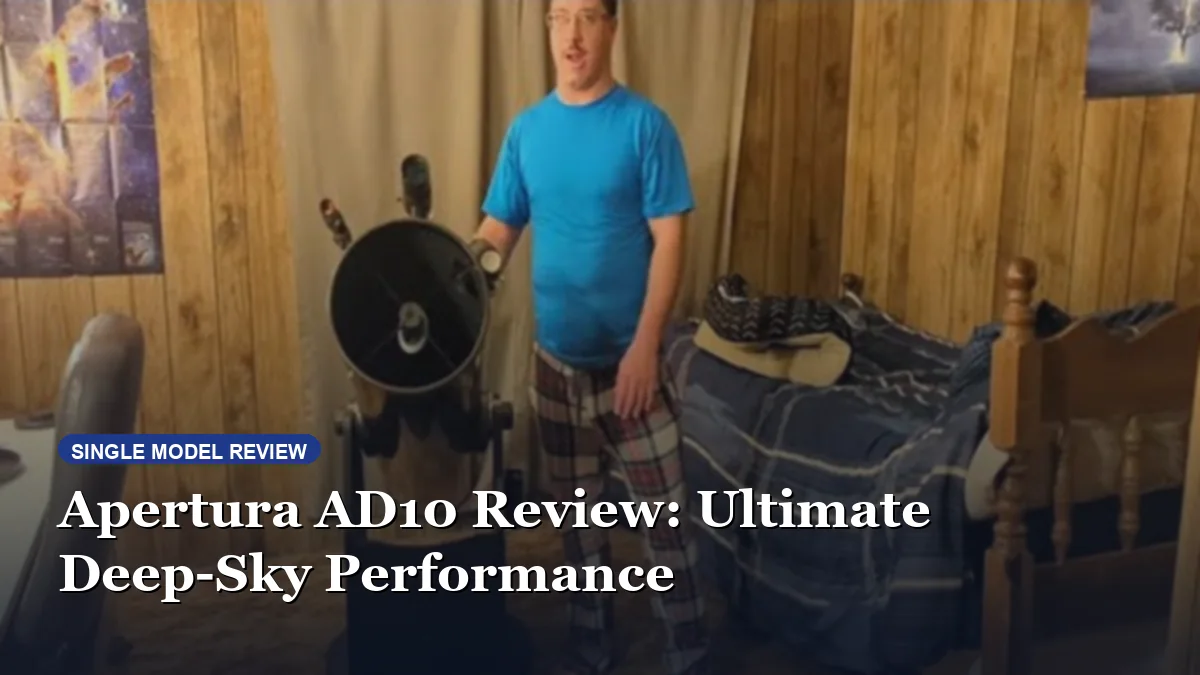
This 10-inch Dobsonian excels at resolving faint nebulae and distant galaxies with stunning clarity. Its smooth Crayford focuser and sturdy base make it a top-tier choice for serious stargazers.
See our flagship Best Telescope: Top Backyard Picks for Astronomy.
Verified Specifications
| Optical Design | Newtonian Reflector |
|---|---|
| Aperture Diameter | 254 mm (10 inches) |
| Focal Length | 1250 mm (f/4.9) |
| Mount Type | Dobsonian Rocker-Box |
| Focuser | 2-inch Dual-Speed Crayford |
| Optical Coatings | Aluminium with Silicon Dioxide |
| Included Finderscope | 8x50 Right-Angle Correct-Image |
| Cooling Fan | Built-in 9V battery-powered rear fan |
| Total Weight | Approx. 80 lbs assembled |
What We Liked
- Massive 10-inch aperture reveals faint deep-sky objects
- Smooth 10:1 dual-speed Crayford focuser for precision
- Includes high-end accessories like a laser collimator
- Active cooling fan speeds up thermal acclimatization
- Sturdy rocker-box base with tension adjustment clutches
Trade-Offs
- Heavy overall assembly requires two-part transport
- Manual tracking lacks computerized GoTo capabilities
- Large optical tube demands ample vehicle storage room
Optical Design and Primary Mirror Engineering

The optical tube houses a precision parabolic primary mirror measuring 254 millimeters in diameter. This generous light-gathering surface reveals faint deep-sky structures that smaller instruments simply cannot resolve under standard suburban night skies.
Thermal management is supported by a built-in rear cooling fan powered by a battery pack. Review our ad8 vs orion xt8 showdown for comprehensive optical testing and performance data.
Multi-layer aluminum coatings with a protective silicon dioxide overcoat maximize reflectivity across the visible spectrum. Users experience bright, high-contrast images free from chromatic aberration inherent in traditional refracting telescope optical systems.
The parabolic primary mirror features a robust 10-inch aperture crafted from low-expansion optical glass. This precise substrate minimizes thermal distortion during rapid ambient temperature drops across extended evening observing sessions.
Advanced aluminum coatings deliver a high reflectivity rating exceeding ninety-three percent. A protective quartz overcoat safeguards the delicate reflective layers against atmospheric oxidation, dust accumulation, and routine cleaning procedures over years of use.
The open-tube truss or solid metal OTA design relies on a thick four-vane secondary spider. This configuration minimizes diffraction spikes while holding the 2.5-inch minor axis diagonal mirror securely in precise alignment.
- 254mm parabolic primary mirror configuration
- Silicon dioxide protective overcoat for durability
- Integrated 9V battery-powered rear cooling fan
Mirror Substrate and Optical Alignment
Constructed from low-expansion optical glass, the primary mirror maintains its parabolic figure during temperature drops. This thermal stability prevents focus drift and ensures crisp stellar pinpoint images throughout extended evening observation sessions.
Collimation bolts on the rear cell allow straightforward optical alignment adjustments using standard hand tools. Maintaining proper alignment guarantees optimal performance when pushing magnification limits on tight double stars or lunar craters.
- Low-expansion thermal glass substrate
- Accessible rear-cell collimation thumb screws
Mechanical Build and Dobsonian Mount Engineering
The heavy-duty particle board base utilizes a traditional rocker-box design engineered for operational stability. Explore our celestron starsense vs apertura ad8 comparison to analyze base mechanics.
Tension clutches on both altitude hubs let users adjust resistance to match heavy eyepiece loads. This prevents unwanted tube slippage when swapping massive ultra-wide oculars, ensuring your target stays centered without frustrating drift.
Assembly requires minimal hardware, allowing quick field setup without tools. The rotating ring system on the optical tube further enhances ergonomics by letting users adjust eyepiece height for comfortable viewing angles.
Heavy-duty particle board and metal hardware form a stable rocker box designed to suppress persistent ground vibrations. The heavy OTA rests securely on teflon bearing pads paired with a smooth azimuth roller bearing.
Altitude tension clutches allow users to adjust vertical friction manually when swapping heavy eyepieces. This mechanical feature prevents unwanted tube droop and ensures balanced weight distribution across extreme viewing altitude angles.
Carrying handles mounted directly to the rocker base improve field ergonomics during transport. Steel reinforcement plates prevent structural flexing around the crucial altitude trunnion pivot points during regular assembly and teardown operations.
- Robust wooden rocker-box assembly
- Teflon bearings for fluid movement
- Adjustable altitude tension clutches
Base Portability and Ergonomic handling
Weighing nearly thirty pounds, the base includes integrated carry handles for manageable transport to your observing site. While substantial, the balanced weight distribution prevents awkward lifting strains during car loading processes.
- Integrated side carry handles
- Balanced weight distribution profile
Video Review: Search filters
Focuser Performance and Precision Control Mechanics
Equipped with a dual-speed Crayford focuser, the system features a ten-to-one reduction knob. This micro-adjustment mechanism enables effortless focus tuning, eliminating image jitter even when handling high-power planetary magnifications.
The receiver accommodates both two-inch eyepieces and standard one-and-one-quarter-inch accessories via an included compression ring adapter. This design protects eyepiece barrels from set-screw marring while ensuring secure, concentric optical alignment every time.
A dual-speed Crayford focuser features a micro-reduction gear ratio of ten to one. This mechanical advantage eliminates image shift and lets astronomers achieve critical focus on faint planetary details easily.
The drawtube includes an internal brass compression ring that prevents thumb screws from marring eyepiece barrels. An integrated tension lock knob secures heavy imaging trains or large wide-field optics without slipping.
- 10:1 dual-speed micro-focus reduction knob
- Brass compression ring eyepiece security
Bundled Accessories and Optical Add-On Equipment
The accessory lineup includes an eight-by-fifty right-angle correct-image finder scope for comfortable targeting. Additionally, a laser collimator simplifies alignment checks, ensuring peak optical performance without complicated guesswork during pre-observation routines.
Two distinct eyepieces ship standard with the package, providing wide-field and high-power viewing options out of the box. Read our sky-watcher 200p vs ad8 comparison to evaluate bundled accessories.
The standard equipment package includes an eight-by-fifty finderscope featuring fully multicoated optics. Its broad field of view simplifies star-hopping routines across faint constellations under dark suburban night skies.
Included optical accessories feature a two-inch wide-field eyepiece alongside a high-magnification Plossl design. A standard cooling fan powered by battery packs accelerates primary mirror thermal equilibrium before serious viewing begins.
- 8x50 right-angle correct-image finderscope
- Included laser alignment collimator tool
- 30mm Erfle and 9mm Plossl eyepieces
Real-World Visual Output and Deep-Sky Performance
Under dark skies, the ten-inch aperture resolves spiral arms in galaxies like Messier fifty-one with breathtaking detail. Globular clusters resolve into thousands of distinct pinpoint stars right to their brilliant cores.
Planetary performance remains sharp, revealing subtle cloud bands on Jupiter and the Cassini Division in Saturn's rings. Atmospheric seeing conditions ultimately limit maximum magnification, but the optics easily handle high-power demands.
Light-gathering capacity reveals spiral arm structures in prominent galaxies like Messier fifty-one under rural skies. Globular clusters resolve cleanly into thousands of individual stars right down to the bright core regions.
Planetary performance benefits from the large aperture and sharp optics, exposing subtle cloud belts on Jupiter. High-contrast filters snap lunar surface features into sharp relief during high-magnification terminator viewing sessions.
- Exceptional galaxy spiral arm resolution
- Clear planetary cloud band visibility
Setup, Maintenance, and Long-Term Durability Standards
Routine maintenance involves occasional mirror cleaning and periodic collimation checks using the supplied laser tool. Keeping dust covers securely attached during storage preserves optical coatings and extends overall lifespan significantly.
The rugged metal optical tube withstands occasional bumps during transport, though treating the glass surfaces with extreme care remains essential. Proper storage in temperature-stable environments prevents moisture condensation and mold growth on mirrors.
Routine collimation relies on straightforward thumb screws located on the primary mirror cell. Using a reliable laser collimator ensures optical alignment remains crisp before every scheduled night of deep-sky observation.
Protective caps and proper indoor storage prevent dust buildup on optical surfaces between sessions. Periodic inspection of the electrical fan contacts prevents corrosion and maintains reliable mirror cooling performance over time.
- Laser collimation upkeep procedures
- Protective metal optical tube construction
Comprehensive Buyer Verdict and Recommendations
Representing exceptional value for serious astronomers, this telescope balances raw aperture with intuitive manual control. Review our apertura ad10 vs orion xt10 comparison to evaluate key optical specs and mount designs.
This optical system offers unmatched aperture value for intermediate amateur astronomers seeking deep-sky performance. Solid mechanical engineering and reliable optical components make it a premier choice for dedicated visual observers worldwide.
- Exceptional aperture-to-cost value ratio
- Ideal for dedicated visual deep-sky observers
Frequently Asked Questions
How difficult is it to collimate the Apertura AD10 primary mirror?
Collimating the primary optical mirror is remarkably straightforward thanks to the convenient rear-mounted thumb screws and the professionally included laser alignment accessory.
Most experienced astronomers can easily complete this essential optical tuning procedure in under five minutes before launching their exciting nightly deep-sky stargazing observation sessions across local dark sky locations.
Can I connect a DSLR camera to this telescope for deep-sky astrophotography?
While the dual-speed Crayford focuser easily supports standard DSLR cameras for lunar and planetary imaging, long-exposure deep-sky astrophotography is strictly limited by the manual Dobsonian mount.
The basic alt-azimuth base introduces natural field rotation over extended time periods, making this powerful instrument primarily optimized for rich visual astronomy rather than tracking faint distant nebulae and galaxies.
How heavy is the entire telescope setup for transport purposes?
The complete apparatus weighs approximately eighty total pounds when fully assembled, split evenly between the optical tube and the heavy wooden base.
Transporting the system usually requires two separate trips to your vehicle, ensuring that lifting individual components remains safe and manageable for most adult observers during field travel.
Does the cooling fan require an external power source to operate?
The integrated rear cooling fan operates smoothly using a dedicated battery pack that easily accommodates eight standard AA batteries for convenient remote field use.
This active cooling system helps bring the massive primary glass mirror to ambient outdoor nighttime temperatures much faster, effectively reducing thermal distortion during critical high-magnification planetary viewing sessions.
What kind of targets are best viewed with a ten-inch reflector?
A ten-inch reflector truly excels at capturing faint deep-sky targets including distant spiral galaxies, glowing planetary nebulae, and sprawling dense globular star clusters across the night sky.
Additionally, the generous light-gathering aperture resolves fine planetary and lunar surface details with exceptional optical contrast whenever local atmospheric seeing conditions remain completely stable.