Zwo Seestar S50 vs Vaonis Vespera: Smart Scope Comparison
Smart telescopes integrate optics, cameras, and mount automation into single packages. Choosing between these systems requires balancing focal length, sensor specs, and software ecosystems.

Choose the ZWO Seestar S50 for lightweight portability and exceptional value, or pick the Vaonis Vespera for modular flexibility and premium optical engineering.
Compare all top models in our Best Telescope: Top Backyard Picks for Astronomy.
Side-by-Side Breakdown
| Criteria | Zwo Seestar S50 | Vaonis Vespera | Edge |
|---|---|---|---|
| Core Design / Build | Compact integrated alt-az unit with lightweight aluminum alloy chassis. | Modular design featuring premium quadruplet glass and robust housing. | Vaonis Vespera |
| Real-World Performance | Utilizes a sensitive Sony sensor for deep-sky imaging. | Employs high-resolution sensors tailored for crisp galaxy details. | Zwo Seestar S50 |
| Ease of Setup & Use | Automated plate-solving and intuitive app interface for rapid deployment. | Streamlined proprietary application focused on guided exploration. | Zwo Seestar S50 |
| Durability & Reliability | Weather-resistant construction built for regular outdoor transport. | Rigorous mechanical engineering designed for long-term field endurance. | Vaonis Vespera |
| Efficiency / Operating Footprint | Highly compact battery-powered footprint for quick backyard sessions. | Efficient power management system supporting extended observation periods. | Zwo Seestar S50 |
| Maintenance Requirements | Minimal upkeep involving routine lens cleaning and firmware updates. | Standard optical care and battery cycle monitoring required. | Zwo Seestar S50 |
| Best Ideal Use Case | Budget-conscious beginners and mobile dark-sky travelers. | Enthusiasts prioritizing premium optics and automated mosaic imaging. | Zwo Seestar S50 |
Core Design and Optical Engineering
Early automated systems, detailed within our Vaonis Stellina review, combined an alt-azimuth mount, a small refractor OTA, and a digital sensor to simplify deep-sky imaging for modern astronomy beginners.
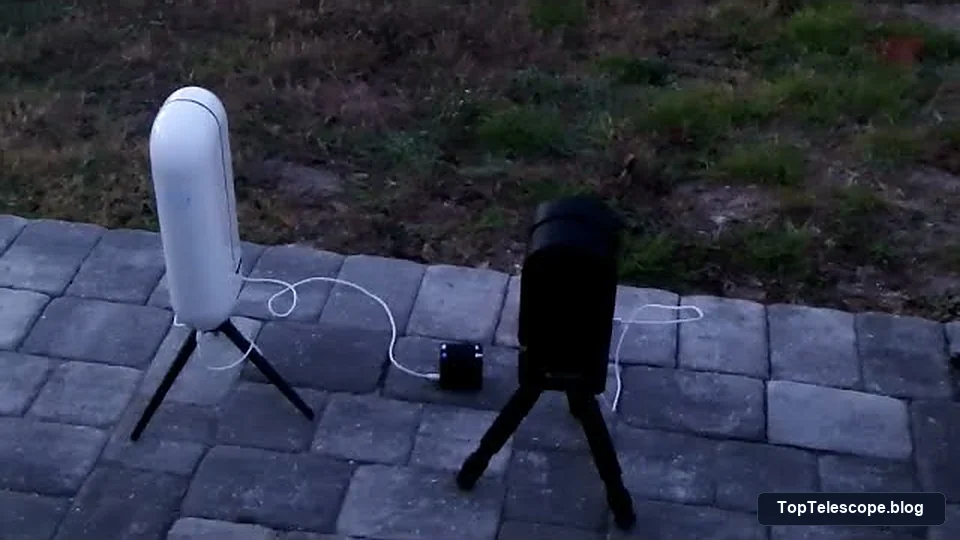
Engineering choices dictate how effectively light travels from distant galaxies through internal glass elements onto the digital chip. Comparing these designs reveals distinct priorities in manufacturing philosophy.
Our detailed ZWO Seestar S50 review highlights its compact 50mm triplet apochromatic refractor design paired with specialized extra-low dispersion glass elements to effectively control chromatic aberration during complex imaging.
Conversely, the Vaonis Vespera architecture incorporates a larger quadruplet lens system featuring high-grade lanthanum glass, delivering exceptional flat-field illumination across the entire sensor surface without requiring manual correction filters.
- Integrated alt-azimuth mount architecture
- Enclosed optical tube assembly designs
- Internal computer and battery systems
Optical Layouts and Glass Quality
The ZWO model utilizes a triplet apochromatic design using ED glass to control chromatic aberration. This configuration delivers sharp stellar pinpoints across a relatively wide field of view.
Vaonis employs a quadruplet astrograph design optimized for flat-field performance. Premium glass elements ensure minimal light distortion right up to the sensor corners without requiring field flatteners.
- ED glass triplet configuration
- Quadruplet flat-field lens systems
Mechanical Chassis and Build Materials
Aluminum alloys and reinforced engineering plastics form the primary structural housings for both units. Sealing against dust and moisture remains a critical consideration for outdoor night operations.
Rigid internal bracing prevents optical misalignment during transit across bumpy roads to remote dark-sky observing sites.
- Durable aluminum alloy frames
- Weather-sealed structural joints
Real-World Performance Comparison
Evaluating field performance involves analyzing how these automated systems handle light pollution, tracking drift, and image stacking. Software algorithms play a massive role in final picture quality.
Night-to-night consistency depends heavily on firmware stability and mechanical tracking precision under varying wind conditions.
Under moderate suburban light pollution, the Seestar manages sky gradients using an integrated dual-band filter mechanism that automatically drops into the optical train during emission nebula captures.
Vespera counters this with sophisticated software processing routines that stack hundreds of short exposures while dynamically rejecting satellite trails and wind-induced frame blurring during prolonged observing sequences.
- Light pollution suppression algorithms
- Automated stacking performance metrics
- Tracking drift compensation routines
Sensor Sensitivity and Resolution
ZWO integrates a sensitive Sony IMX462 back-illuminated sensor suited for capturing deep-sky nebulae. Its small pixel pitch matches the short focal length to capture fine celestial details.
As explored in our Vaonis Vespera II review, the manufacturer incorporates alternative high-resolution sensors depending on the specific variant chosen to prioritize dynamic range and precise color reproduction for extended galaxies.
- Back-illuminated CMOS sensor tech
- Optimized pixel-to-focal ratios
Image Processing and Stacking Pipelines
Both platforms stack short exposures internally to build clean final images over time. Users can download raw files for advanced post-processing using standard desktop editing software.
Real-time stacking feedback allows observers to gauge integration progress directly on their mobile screens.
- Internal live image stacking
- RAW file export capabilities
Ease of Setup and Automated Alignment
Smart telescopes eliminate manual polar alignment through automated plate-solving routines. Users simply level the tripod, power on the unit, and initiate alignment via a smartphone application.
Streamlined workflows reduce frustrating setup delays in cold weather conditions.
Initial alignment relies on internal inertial measurement units and star pattern recognition algorithms to map the night sky completely autonomously without user intervention or manual star hopping.
Connecting via the companion mobile application establishes a secure wireless link, letting operators select celestial targets from an extensive database while tracking hardware telemetry and battery status.
- Automated plate-solving routines
- Level-sensor assisted leveling
- Rapid smartphone connectivity
Software Ecosystems and User Interfaces
ZWO provides an intuitive app interface featuring comprehensive object databases and observation recommendations. Connectivity relies on reliable Wi-Fi networks generated directly by the telescope base.
Vaonis offers a streamlined proprietary application focused on guided exploration and curated targets. The software handles mosaic imaging automatically to expand the visible framing boundaries.
- Comprehensive object databases
- Automated mosaic stitching tools
Field Portability and Weight Footprint
Weight management dictates how easily you can transport your gear to dark-sky locations. Both systems integrate handles and compact form factors that easily fit inside standard backpacks.
Lightweight carbon or aluminum tripods further reduce the total travel burden for mobile astronomers.
- Backpack-friendly physical dimensions
- Lightweight collapsible tripods
Maintenance, Efficiency, and Longevity
Proper upkeep ensures your investment delivers reliable performance across hundreds of observing sessions. Routine optical checks and battery management form the foundation of long-term equipment health.
Protecting sensitive electronics from heavy dew accumulation extends operational lifespans significantly.
Routine maintenance requires keeping the sealed optical window clean using optical microfiber cloths and compressed air to prevent dust accumulation on internal corrector plates over time.
Power management demands attention during extended cold-weather imaging sessions, where external USB-C power banks prevent premature shutdown caused by lithium-ion battery capacity loss in freezing temperatures.
- Routine optical surface checks
- Battery health monitoring protocols
- Moisture and dew protection
Power Management and Battery Endurance
Internal rechargeable lithium batteries power the internal computer, motors, and camera cooling systems. Field sessions lasting several hours require external USB power banks to prevent sudden shutdowns.
Smart power distribution circuits protect internal cells from overcharging and deep discharge cycles.
- Rechargeable internal lithium cells
- External USB power compatibility
Optical Care and Environmental Exposure
Dust accumulation on the objective lens requires careful cleaning using optical-grade microfiber cloths. Never touch coated glass surfaces directly with bare fingers to avoid transferring skin oils.
Storing units in climate-controlled environments prevents internal mold growth on lens coatings.
- Microfiber optical cleaning
- Dry storage humidity control
Which Option Fits Your Setup
Matching telescope capabilities to your observing environment ensures long-term satisfaction and frequent usage. Urban balcony astronomers face different challenges than rural travelers seeking dark skies.
Evaluating your primary observing location helps clarify which hardware feature set matters most.
Amateur observers prioritizing ultra-portable grab-and-go convenience will deeply appreciate the lightweight chassis and fully integrated accessories of the ZWO platform for spontaneous backyard astronomy observing trips.
Conversely, advanced imagers seeking sophisticated automated mosaic modes and premium optical fidelity will find the modular Vaonis configuration much better suited for permanent backyard observatory deployments.
- Urban light pollution mitigation
- Rural dark-sky travel suitability
- Balcony space constraints
Backyard Astrophotography and Light Pollution
Heavy urban light pollution demands effective digital filters and robust stacking algorithms, a topic covered inside our comprehensive Vaonis Vespera Pro 2 review, as these units cut through glowing city skies.
Compact footprints easily fit on cramped balconies without obstructing surrounding neighborhood views.
- Internal narrowband light filters
- Cramped balcony footprint management
Travel and Mobile Astronomy Expeditions
Compact dimensions and lightweight tripods make airline travel feasible for mobile astrophotographers. Airline carry-on compatibility is a major advantage for remote dark-sky expeditions.
Quick deployment times let travelers maximize precious clear hours under pristine skies.
- Airline carry-on size compliance
- Rapid field deployment speeds
Technical Specifications Breakdown
Comparing core specifications highlights the engineering trade-offs made by each manufacturer. Aperture size directly influences light-gathering power for faint deep-sky objects.
Understanding these metric differences ensures you select hardware matching your celestial photography goals.
Reviewing core hardware metrics reveals significant differences in sensor formats, focal lengths, and physical payload weights that directly dictate your overall field of view during astrophotography imaging sessions.
Careful evaluation of these internal electronics, power requirements, and mounting interfaces ensures you select an integrated smart telescope matching your specific astronomical expectations and workflow.
- Objective lens aperture measurements
- Focal length and focal ratio specs
- Internal data storage capacities
Focal Length and Aperture Metrics
A 50mm aperture paired with a short focal length provides a wide field for large nebulae. Shorter focal lengths are exceptionally forgiving of tracking errors during long integrations.
Larger focal lengths zoom in on compact planetary nebulae and distant galaxy clusters with enhanced detail.
- Aperture diameter comparisons
- Focal length operational ranges
Connectivity and Data Storage Options
Internal storage capacity determines how many image stacks you can save before transferring files. Built-in USB ports simplify data offloading and external power connectivity in cold conditions.
Stable wireless protocols prevent dropped connections during extended imaging runs.
- Onboard data storage capacity
- Wired and wireless connectivity
Frequently Asked Questions
Can these telescopes run without internet access?
Yes, both units create their own local Wi-Fi networks for smartphone control. An active internet connection is completely unnecessary during field operations.
Do I need an equatorial wedge for deep-sky imaging?
No wedge is required because internal software compensates for field rotation. Alt-azimuth tracking handles short sub-exposures automatically without polar alignment.
Can I capture images of the Moon and planets?
Both systems can photograph lunar craters and bright planets using specialized camera modes. However, planetary imaging requires very high focal lengths, limiting fine detail.
How do these systems handle battery charging in the field?
Internal batteries charge via standard USB-C connections using portable power banks. This setup extends operational runtimes during multi-hour night sessions.
Are these telescopes suitable for complete beginners?
Absolutely, automated plate-solving and guided mobile apps make deep-sky imaging completely accessible. Beginners can successfully capture colorful nebulae within minutes of initial unboxing.