William Optics Redcat 51 vs Spacecat 51
Choosing between these portable astrographs requires evaluating finish aesthetics and optical coatings. Both share identical internal optics.

Pick the Redcat 51 for its classic red anodized aesthetic and matching mounting rings. Choose the Spacecat 51 if you prefer a stealthy, matte gray finish for field work.
Compare all top models in our Best Telescope: Top Backyard Picks for Astronomy.
Side-by-Side Breakdown
| Criteria | William Optics Redcat 51 | Spacecat 51 | Edge |
|---|---|---|---|
| Core Design / Build | Red anodized aluminum | Space gray anodized finish | Tie |
| Real-World Performance | Petzval triplet design | Petzval triplet design | Tie |
| Ease of Setup & Use | Integrated tilt adapter | Integrated tilt adapter | Tie |
| Durability & Reliability | CNC machined housing | CNC machined housing | Tie |
| Efficiency / Operating Footprint | 250mm focal length | 250mm focal length | Tie |
| Maintenance Requirements | Standard dust removal | Standard dust removal | Tie |
| Best Ideal Use Case | Astrophotography purists | Field astrophotographers | Tie |
Core Optical Engineering and Petzval Design
Both instruments share the exact same 51mm objective lens configuration utilizing synthetic fluorite glass. This design delivers exceptional color correction across a flat field without requiring a separate field flattener lens element.
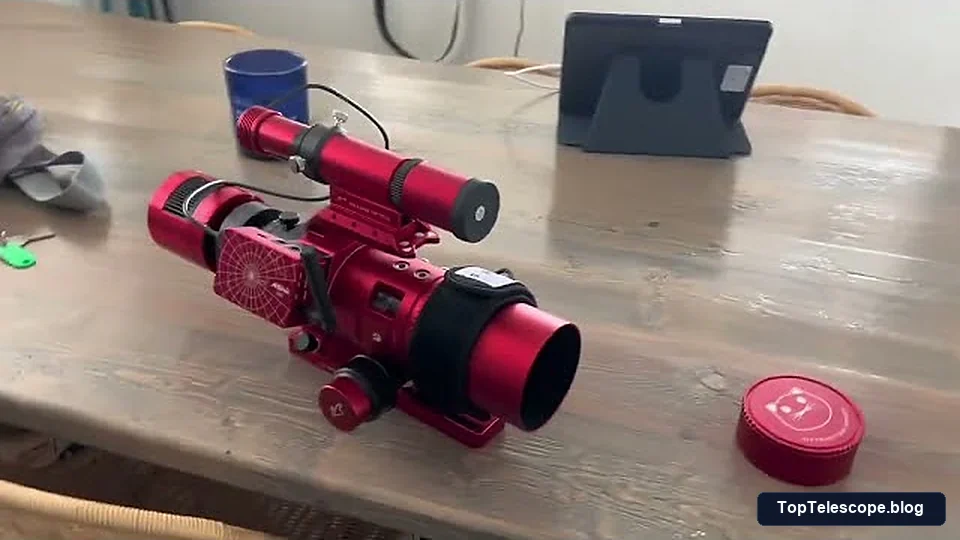
As examined in our Redcat 51 review, the internal four-element Petzval design guarantees pinpoint star shapes right into the corners of modern full-frame sensors, avoiding complex backfocus calculations for users.
Both astrographs utilize a 4-element Petzval design containing synthetic fluorite or FPL-53 glass. This configuration inherently flattens the optical field without requiring external correctors, guaranteeing pinpoint stars across full-frame sensors.
The optical cell maintains precise air-spacing between lens groups to eliminate chromatic aberration. Users benefit from exceptional transmission rates exceeding 99% through specialized multi-layer coatings applied to every air-to-glass surface.
- 51mm clear aperture with 250mm focal length
- Native f/4.9 focal ratio for fast data collection
- Integrated flat-field design eliminating spacing errors
Glass Types and Multi-Coatings
Premium FPL-53 glass elements minimize chromatic aberration effectively during long exposure imaging sessions. Advanced multi-coatings maximize light transmission across the visible spectrum for optimal contrast and faint nebula details.
- Synthetic fluorite FPL-53 glass
- Broadband multi-coatings on all surfaces
Mechanical Build Quality and Anodized Finishes
You can read our William Optics Redcat 71 review for complete build specifications. Both models utilize high-grade CNC machined aluminum for their tubes to ensure structural integrity during cold nighttime imaging sessions.
Redcat models feature a vibrant red anodized finish that stands out under dark sky observation sites. Spacecat variants opt for a subtle space gray coating favored by astronomers seeking a low-profile aesthetic.
William Optics constructs these optical tubes from marine-grade aluminum using high-precision CNC machining. The robust housing protects internal alignment against thermal shock and mechanical impacts during transport to dark sky sites.
The signature red and space gray anodized finishes provide superior corrosion resistance over standard paint. This chemical passivation layer hardens the outer metal surface, preventing scratches and withstanding harsh outdoor dewing conditions.
- Durable aerospace aluminum construction
- Scratch-resistant anodized surface treatments
- Identical internal structural metalwork
Ring Systems and Dovetails
Both telescopes incorporate a patented saddle handle bar that doubles as a guide scope mount. The included Vixen-style dovetail bar features multiple threaded mounting points for secure tracker attachment.
- Multifunctional saddle handle bar
- Vixen-style mounting plate included
Field Performance and Astrophotography Integration
As highlighted in our Williams Optics Redcat 51 review, operating these short focal length scopes reveals exceptional tracking stability on lightweight star trackers, reducing moment arms during multi-minute sub-exposures.
Astrophotographers shooting wide-field constellations will appreciate the generous imaging circle covering full-frame camera sensors seamlessly. Vignetting remains manageable when utilizing standard calibration frames during post-processing routines.
Imaging setups achieve optimal performance when paired with standard 44mm image circles that illuminate modern CMOS sensors evenly. Vignetting remains minimal, allowing flat-field calibration frames to easily correct minor residual edge falloff.
Backfocus spacing requirements are strictly standardized at 55mm from the M48 thread, simplifying connection with dedicated cooled cameras and filter wheels. Astrophotographers avoid complex shimming procedures during the initial gear train assembly phase.
- Compatible with DSLR, mirrorless, and dedicated cooled cameras
- Low weight profile under four pounds fully loaded
- Exceptional thermal stability during temperature drops
Sensor Coverage and Vignetting
The generous image circle illuminates APS-C and full-frame sensors evenly without dramatic light falloff. Proper flat fielding eliminates minor corner dimming effortlessly during standard image processing workflows.
- Full-frame sensor illumination
- Smooth off-axis illumination curve
Focus Mechanics and Helical Focuser Operation
Precise focus acquisition relies on a smooth helical mechanism featuring a built-in tension ring lock. This design prevents slippage of heavy camera trains when pointing near the zenith during long imaging runs.
Fine adjustment markings engraved on the barrel allow repeatable focus positioning across different temperature gradients. Users transitioning from traditional rack-and-pinion focusers will adapt quickly to this robust ring-based system.
The internal helical focuser relies on a smooth rotating ring rather than a traditional rack and pinion system. This design prevents image shift and provides micro-metric adjustment precision for nailing critical sub-micron stellar focus.
Integrated tension locks secure the focus position firmly once optimal sharpness is achieved across the frame. Operators must engage the locking ring gently to avoid disrupting the delicate optical train alignment during long exposures.
- Patented helical focusing mechanism with lock
- Graduated scale for precise position logging
- Zero image shift during focus adjustments
Tilt Adjustment Ring
An integrated camera angle adjuster includes a built-in tilt tuning mechanism for sensor alignment. This professional feature helps correct minor optical train misalignments without requiring aftermarket tilt plates.
- Rotatable camera angle adjuster
- Built-in optical tilt correction
Mounting Footprint and Rig Compatibility
As detailed in our William Optics Zenithstar 73 review, integrating either telescope into a mobile setup requires minimal counterweight balancing due to their featherlight mass, mounting easily onto portable equatorial trackers.
The included L-type mounting base offers versatile connection options for photographic tripods and astronomical mounts. This versatility makes both units excellent grab-and-go travel companions for eclipse chasers and dark sky travelers.
A patented Vixen-style mounting foot incorporates a built-in finder saddle and multiple 1/4-inch threads for universal tripod attachment. This versatile base plate integrates seamlessly with most equatorial mounts and star trackers available today.
The compact physical footprint reduces moment arms, allowing lightweight portable mounts to track smoothly without guiding errors caused by excessive payload leverage. Photographers appreciate the balanced weight distribution during field deployments.
- Under four pounds total tube weight
- Includes standard Vixen dovetail mounting plate
- Compatible with popular mobile equatorial trackers
Travel and Transport Security
Each telescope ships inside a fitted hard carrying case lined with custom protective foam padding. This robust packaging ensures safe airline transport and rugged field deployment during remote expeditions.
- Custom-fitted hard transport case
- High-density protective foam interior
Maintenance, Cleaning, and Environmental Resilience
Routine maintenance for these precision petzval systems involves basic exterior dusting and optical lens care. Keeping exposed glass surfaces free from dew residue preserves multi-coating integrity over years of intensive usage.
The sealed front cell design prevents dust and insects from migrating into internal optical cavities during field operations. Proper storage inside temperature-controlled environments prevents internal condensation and mold growth on glass elements.
Routine maintenance requires gentle removal of surface dust using a specialized photographic air blower rather than compressed air cans. Proper lens hygiene prevents micro-abrasions on the costly multi-coated glass elements over years of service.
Environmental sealing protects internal components from ambient moisture and dust ingress during overnight imaging sessions. Owners should store the telescope inside a padded hard case with fresh desiccant packs to control humidity.
- Sealed front lens cell design
- Durable scratch-resistant exterior coatings
- Included padded hard transport case
Dew Shield Management
A retractable dew shield integrated into the tube assembly blocks stray light and moisture effectively. Adding an optional dew heater band around the barrel prevents frost accumulation during frigid winter nights.
- Retractable integrated dew shield
- Threaded front ring for accessories
Choosing the Right Model For Your Rig
Deciding between these two exceptional instruments ultimately depends entirely upon your personal visual preference. Optical performance, mechanical tolerances, and included accessories remain completely identical across both product variations.
Select the red variant if you love traditional astronomical equipment styling that catches the eye. Choose the space gray option if discretion or a stealthy tactical appearance matters more for your specific imaging sites.
Selecting between these two variants largely depends on your aesthetic preference rather than any underlying optical capability. Both models deliver identical focal lengths of 250mm and matching apertures tailored for wide-field astrophotography.
Evaluate your existing mounting hardware and aesthetic gear theme before making a final purchasing decision. Reviewing your cable management strategy ensures the integrated camera angle rotator operates without snagging power cords.
- Identical optical performance and glass elements
- Different cosmetic anodizing colors only
- Same included accessories and mounting hardware
Final Investment Considerations
Both choices deliver exceptional wide-field imaging capabilities that satisfy demanding astrophotographers worldwide. Evaluate your aesthetic preferences and select the colorway that best matches your existing telescope accessories and personal style.
- Professional astrophotography results
- Matching ecosystem of accessories
Frequently Asked Questions
Do the Redcat 51 and Spacecat 51 use different optical glass types?
No, both telescopes share the exact same internal optical design featuring premium FPL-53 synthetic fluorite glass elements. You will experience identical optical performance, sharp flat-field correction, and stellar spot sizes regardless of your color choice.
Can I attach a standard full-frame DSLR camera to these astrographs?
Yes, both models feature a robust camera angle adjuster with a standard M48 threaded connection adapter ring. This allows seamless attachment of full-frame DSLRs and mirrorless camera bodies without encountering vignetting issues.
Are the mounting rings and dovetail plates interchangeable between models?
Absolutely, because the mechanical tube dimensions are identical across both the red and space gray editions. You can easily swap accessories, handles, and mounting plates between either telescope housing without any modification.
How do I clean the objective lens if dust accumulates during field use?
You should always use a clean optical bulb blower to gently remove loose surface dust particles first. Follow this by applying specialized optical cleaning solution with a microfiber cloth using light circular motions.
Do I need to purchase a separate field flattener lens for astrophotography?
No additional field flattener is required because both instruments feature an integrated four-element Petzval design. This built-in optical arrangement delivers a naturally flat imaging circle straight to the corners of your camera sensor.