Sky-Watcher Evostar 72ED vs 80ED: Direct Technical Comparison
Choosing between these refractors demands balancing portability against light-gathering power. Every technical specification impacts your field performance under dark skies.

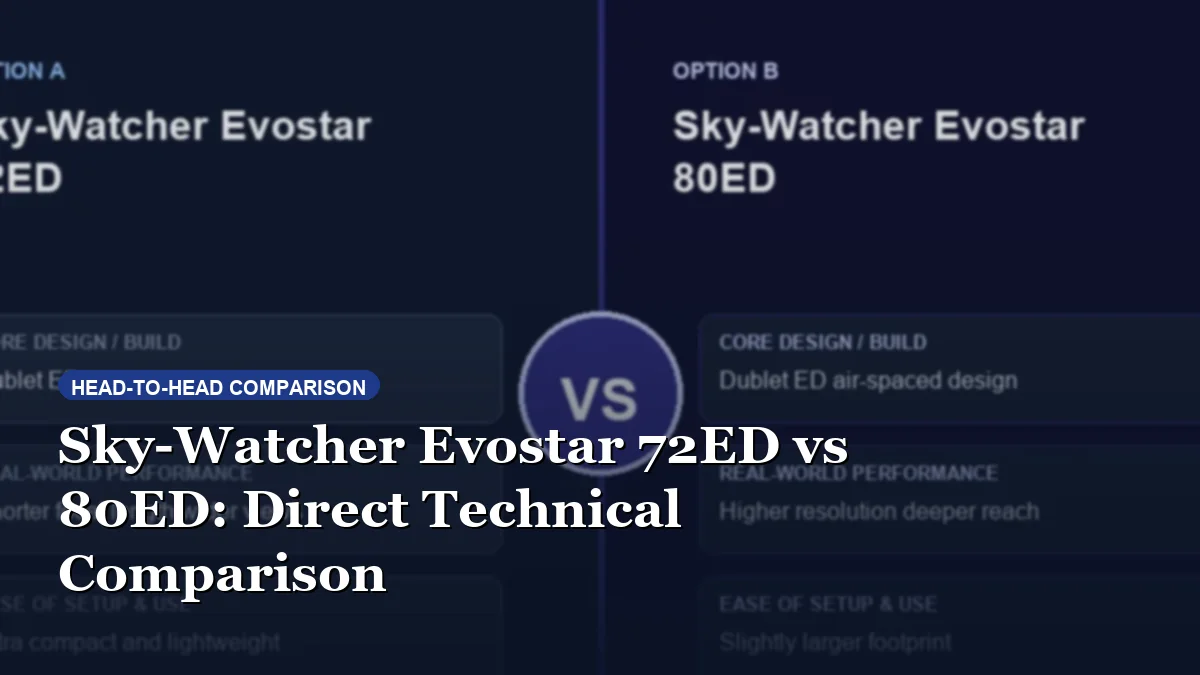
Choose the 72ED for unmatched travel readiness and wide-field imaging. Opt for the 80ED if you require deeper reach and higher planetary magnification.
Compare all top models in our Best Telescope: Top Backyard Picks for Astronomy.
Side-by-Side Breakdown
| Criteria | Sky-Watcher Evostar 72ED | Sky-Watcher Evostar 80ED | Edge |
|---|---|---|---|
| Core Design / Build | Dublet ED air-spaced design | Dublet ED air-spaced design | Tie |
| Real-World Performance | Shorter focal length wider views | Higher resolution deeper reach | 80ED |
| Ease of Setup & Use | Ultra compact and lightweight | Slightly larger footprint | 72ED |
| Durability & Reliability | Cast aluminum tube assembly | Robust metal OTA construction | Tie |
| Efficiency / Operating Footprint | Mounts on lighter tracker heads | Requires sturdier field mount | 72ED |
| Maintenance Requirements | Standard dust and optics care | Standard dust and optics care | Tie |
| Best Ideal Use Case | Wide-field astrophotography travel | General visual and lunar viewing | 80ED |
Core Design And Optical Engineering
Evaluating optical layouts reveals fundamental differences in focal architecture. Both refractors use low dispersion glass elements to minimize chromatic aberration across the visible spectrum.
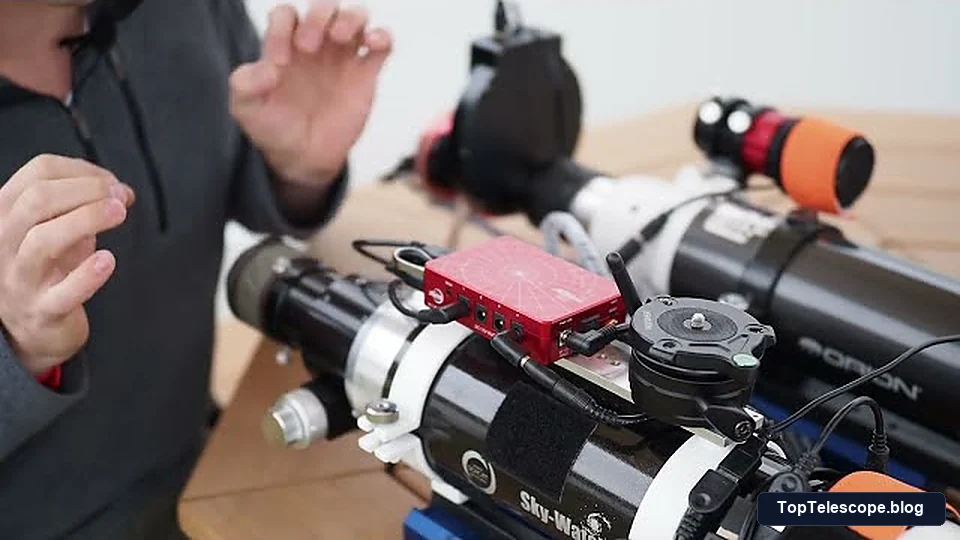
The 72ED features a compact tube length designed specifically for wide-field imaging workflows. Meanwhile, the larger aperture model extends your focal reach for detailed planetary observations.
Precision machining ensures both OTA housings maintain optical alignment during transport. Quality internal baffling suppresses stray light to boost high-contrast planetary viewing conditions.
Our detailed Sky-Watcher Evostar 72ED review highlights its extra-low dispersion doublet lens configuration, which minimizes chromatic aberration across the visible spectrum and maintains crisp contrast during high-magnification planetary observation sessions.
Conversely, the larger Evostar 80ED steps up the aperture while retaining a similar focal ratio, delivering a brighter image circle that enhances deep-sky object detection limits and improves resolving power for faint stellar companions.
Optical coatings applied to both refractors utilize proprietary metallic multi-layers to maximize light transmission efficiency across air-to-glass surfaces, significantly reducing internal reflections and ghosting when capturing high-contrast lunar terminator regions.
- Air-spaced doublet optical configurations
- Metallic dielectric multi-coatings applied
- Internal knife-edge baffle suppression systems
Glass Types And Dispersion Control
FLED or FPL-53 extra-low dispersion glass forms the heart of these optical systems. This specialized material controls secondary spectrum scattering effectively.
Rigorous manufacturing tolerances guarantee stable performance across changing ambient temperatures during overnight imaging sessions.
- Extra-low dispersion synthetic fluorite elements
- Thermal compensation cell design features
Focuser Mechanics And Load Capacity
Rack and pinion focusers provide slip-free mechanical movement for heavy camera rigs. Dual-speed fine focus knobs allow precise manual adjustments.
Tension locking screws secure your imaging train without introducing unwanted mechanical shift into the optical axis.
- Dual-speed 1:10 micro-focus reduction gears
- Rotatable mechanical camera collar rings
Real-World Field Performance Analysis
Dark sky testing highlights distinct advantages for each telescope configuration. Light grasp scales directly with aperture, affecting faint deep-sky object visibility.
The 80ED gathers more photons, rendering dimmer nebulae and globular clusters more apparent. The smaller model compensates with exceptionally sharp stellar pinpoints.
Field curvature requires dedicated field flatteners for optimal photographic performance across larger sensor formats.
As detailed in our Evostar 72ED review, this optical tube provides a remarkably wide field of view that easily accommodates expansive nebulae when paired with a dedicated focal reducer for remote astrophotography expeditions.
Stepping up to the Evostar 80ED yields a noticeable gain in optical resolution, allowing observers to resolve tighter globular cluster cores and subtle planetary details that push past the limits of smaller objective lenses.
Atmospheric seeing conditions heavily dictate performance, but both scopes maintain thermal equilibrium efficiently thanks to their cast aluminum tubes, which stabilize rapidly once moved from indoor storage to the chilly night air.
- Aperture diameter dictates raw light gathering
- Focal ratio controls photographic exposure speeds
- Image scale varies with focal length changes
Visual Observing Capabilities
Lunar craters and Jovian cloud belts appear remarkably crisp through both instruments. Higher magnification limits favor the larger objective lens.
Wide star fields look breathtakingly rich through the shorter focal length model using low power eyepieces.
- High contrast planetary detail rendering
- Rich field open cluster scanning performance
Astrophotography And Imaging Integration
Modern CMOS cameras pair wonderfully with these doublet optical tube assemblies. Balanced weight distributions simplify balancing on equatorial mounts.
Guiding accuracy remains high due to rigid mechanical construction and minimal mirror shift potential.
- Compatible with dedicated focal reducers
- Flat field imaging across APS-C sensors
Mechanical Build And Chassis Ergonomics
Physical dimensions dictate how easily you can transport your gear to remote dark sky locations. Aluminum tube assemblies offer durability without excessive weight penalties.
The 72ED slips easily into airline carry-on luggage with room to spare. Its sibling requires slightly more substantial transport cases.
Vixen-style dovetail bars come standard, enabling fast mounting on most modern astronomical mounts.
Mechanical stability starts at the focuser, where both models employ a dual-speed Crayford design that eliminates image shift and supports heavy cooled CMOS cameras without slipping during long-exposure tracked imaging runs.
The mounting foot incorporates a standard Vixen-style dovetail bar, ensuring secure attachment to most equatorial mounts while offering precise balancing adjustments to reduce strain on internal gears and motor drives during operation.
Retractable dew shields built into the OTA chassis provide vital protection against moisture buildup while drastically shortening the overall physical length for safe airline transport inside padded custom hard storage cases.
- Anodized aluminum optical tube assemblies
- Integrated mounting feet with safety stops
- Retractable dew shield mechanisms included
Mounting Requirements And Payload Limits
Lightweight tracking mounts handle the smaller refractor effortlessly without requiring heavy counterweights. Heavier mounts provide absolute stability for the 80mm variant.
Rigid ring clamps prevent flexure during long exposure astrophotography sessions under windy outdoor conditions.
- Compatible with lightweight star trackers
- Solid ring mounting hardware provided
Portability And Travel Readiness
Airline travel demands compact gear footprints that fit overhead storage compartments. Both scopes pack down small, but the smaller unit wins for minimalist travel.
Protective aluminum flight cases safeguard your investment against rough baggage handling routines.
- Compact storage lengths for transit
- Padded foam transit case availability
Maintenance Efficiency And Longevity
Routine equipment upkeep preserves optical integrity over many years of field use. Multi-coatings require gentle cleaning techniques using approved optical solutions.
Dew accumulation happens during humid nights, making dew shields essential accessories for protecting objective lenses from moisture damage.
Dust covers should always remain in place when storing your telescope in indoor environments.
Routine maintenance requires minimal effort beyond keeping exposed objective surfaces free of particulate dust using a bulb air blower and an optical-grade camel hair brush to prevent scratching delicate coatings.
Lens cell alignment on both instruments is secured via factory collimation screws, meaning users should avoid tinkering with these adjustment points unless severe impact occurs and professional optical realignment becomes strictly necessary.
Storing these optical tubes in climate-controlled environments with rechargeable silica gel packets prevents internal mold growth and preserves the lifespan of internal anti-reflective chemical treatments applied to the doublet lenses.
- Anti-reflective lens coating protection standards
- Collimation stability in doublet systems
- Moisture mitigation via proper dew shields
Optical Care And Cleaning Protocols
Compressed air removes loose dust particles before applying wet cleaning fluids to glass surfaces. Avoid touching delicate lens coatings with bare fingers.
Store optical tubes in temperature-controlled rooms to prevent internal condensation and mold growth.
- Microfiber cloth cleaning best practices
- Chemical solvent safety guidelines followed
Mechanical Adjustments And Servicing
Focuser tension can be adjusted via external set screws to accommodate heavier camera payloads over time. Regular inspection prevents loose fittings.
Lens cell alignment remains stable due to factory locking rings that prevent shifting during bumpy transit.
- Focuser tension adjustment hex screws
- Factory lens cell security checks
Matching Equipment To Your Specific Setup
Selecting the right telescope depends heavily on your existing astronomy gear and local light pollution levels. Urban observers benefit from portable setups.
Rural astronomers can leverage the extra light grasp of the larger aperture for deep-sky exploration tasks.
Consider your physical storage space and transportation methods before making a final purchasing decision.
Furthermore, our Evostar 80ED review explains how selecting the right OTA depends on your mount capacity, contrasting the lighter 72ED tracker setup with a sturdier heavy-duty tripod base for larger optics.
Astrophotographers utilizing APS-C sensors will need a matched field flattener to correct edge distortion, ensuring pinpoint stars span the entire imaging sensor area across both optical tube assembly choices.
Visual observers should prioritize adding a high-transmission dielectric diagonal and wide-field eyepieces to maximize the inherent contrast capabilities delivered by these air-spaced doublet optical systems under dark skies.
- Evaluate local light pollution constraints
- Assess available storage and transport space
- Check compatibility with current eyepieces
Beginner Versus Advanced User Considerations
Beginners appreciate the intuitive operation and low maintenance demands of these doublet refractors. Advanced imagers value their flat fields.
Upgrading accessories like diagonals and eyepieces enhances performance across both telescope models significantly.
- User-friendly operation for newcomers
- Scalable upgrade paths for accessories
Accessory Ecosystem Compatibility
Standard two-inch visual backs accept a wide variety of aftermarket diagonals, flatteners, and filter wheels. Universal threading standardizes connections.
Finding matching field flatteners is straightforward thanks to widespread manufacturer support and community documentation.
- Standard two-inch accessory barrel sizes
- Wide availability of dedicated flatteners
Final Technical Verdict And Recommendations
Both instruments offer exceptional optical quality within their respective size and weight classes. Your choice ultimately hinges on portability versus aperture.
Travel astrophotographers will find the ultra-compact design of the smaller refractor indispensable for remote expeditions. General observers prefer the reach.
Investing in quality mounting accessories ensures you extract maximum performance from either optical tube assembly.
Weighing the trade-offs reveals that the Evostar 72ED is the premier choice for mobile wide-field imaging enthusiasts prioritizing ultra-lightweight travel gear over maximum light-gathering power and ultimate optical resolution limits.
Conversely, our Sky-Watcher Virtuoso GTi 150P review outlines how choosing the Evostar 80ED satisfies astronomers seeking a balanced general-purpose telescope that bridges planetary magnification potential and deep-sky imaging versatility.
Evaluating your primary observing goals, available transport space, and mount payload will ultimately determine which refractor delivers the optimal balance of optical performance and mechanical reliability for your backyard observatory.
- Weigh portability against light grasp
- Match mount capacity to optical weight
- Consider primary observational goals carefully
Summary Of Key Advantages
The 72ED excels in mobility and wide-field imaging convenience. Its counterpart delivers superior resolution for lunar and planetary study.
Both units represent outstanding value for amateur astronomers seeking reliable glass performance.
- Unmatched travel readiness in class
- Superior planetary resolution in sibling
Making Your Ultimate Buying Choice
Review your travel habits and mount capacity before purchasing your new refractor system. Proper planning guarantees long-term observing satisfaction.
Enjoy crisp, color-free views of the cosmos regardless of which aperture you ultimately select for your journey.
- Analyze transport requirements thoroughly
- Prioritize optical goals over trends
Frequently Asked Questions
Which telescope is better for airline travel?
The 72ED is significantly more compact and easily fits into standard airline carry-on luggage without issues. This makes it ideal for mobile astronomers.
Do these telescopes require regular collimation?
Both feature rigid doublet lens cells that rarely require user collimation. This design stability saves time during field setups.
Can I use standard two-inch accessories with both models?
Yes, both instruments feature robust focusers accepting standard two-inch diagonals and flatteners. Universal compatibility simplifies your accessory choices.
Which model offers better planetary viewing performance?
The 80ED provides higher resolution and light grasp for planetary details. This extra aperture makes subtle cloud features more visible.
What kind of mount is needed for astrophotography?
A sturdy computerized equatorial mount with tracking capability is recommended for long exposures. Lighter trackers work well for the smaller unit.