Orion Xt8 vs Xt10: Choosing the Right Dobsonian
Comparing two premier Newtonian reflectors reveals stark differences in bulk and light grasp. Choosing between them depends entirely on your physical storage capacity.

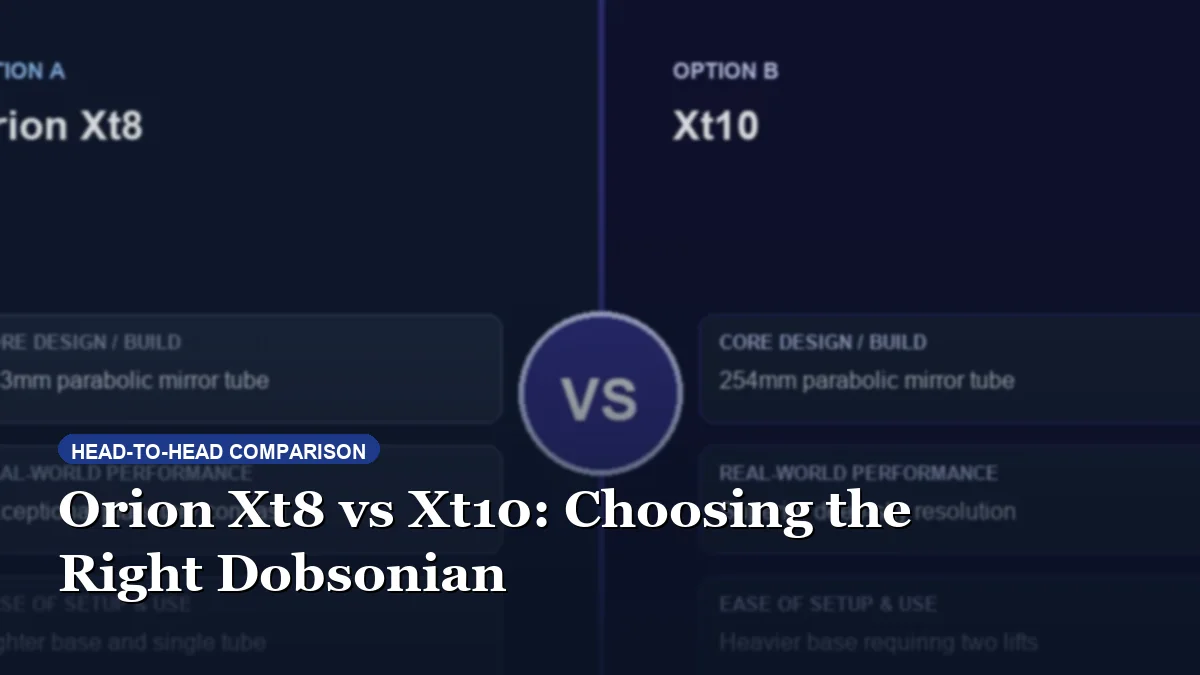
Select the Orion XT8 for manageable transport and reliable backyard planetary views. Choose the XT10 if you prioritize maximum photon collection for faint deep-sky nebulae.
Compare all top models in our Best Telescope: Top Backyard Picks for Astronomy.
Side-by-Side Breakdown
| Criteria | Orion Xt8 | Xt10 | Edge |
|---|---|---|---|
| Core Design / Build | 203mm parabolic mirror tube | 254mm parabolic mirror tube | Xt10 |
| Real-World Performance | Exceptional planetary contrast | Superior deep-sky resolution | Xt10 |
| Ease of Setup & Use | Lighter base and single tube | Heavier base requiring two lifts | Orion Xt8 |
| Durability & Reliability | Enamel-coated steel optical tube | Reinforced particle board base | Tie |
| Efficiency / Operating Footprint | Fits easily across back seats | Demands dedicated SUV trunk floor | Orion Xt8 |
| Maintenance Requirements | Standard secondary mirror collimation | Frequent primary mirror thermal cooling | Orion Xt8 |
| Best Ideal Use Case | Mobile backyard astronomy sessions | Stationary dark-sky observation hubs | Tie |
Optical Design and Digital Imaging Compatibility
Modern digital design principles heavily influence how these Newtonian reflectors handle optical alignment and mechanical stress. Both tubes utilize parabolic primary mirrors to eliminate spherical aberration across wide visual fields.
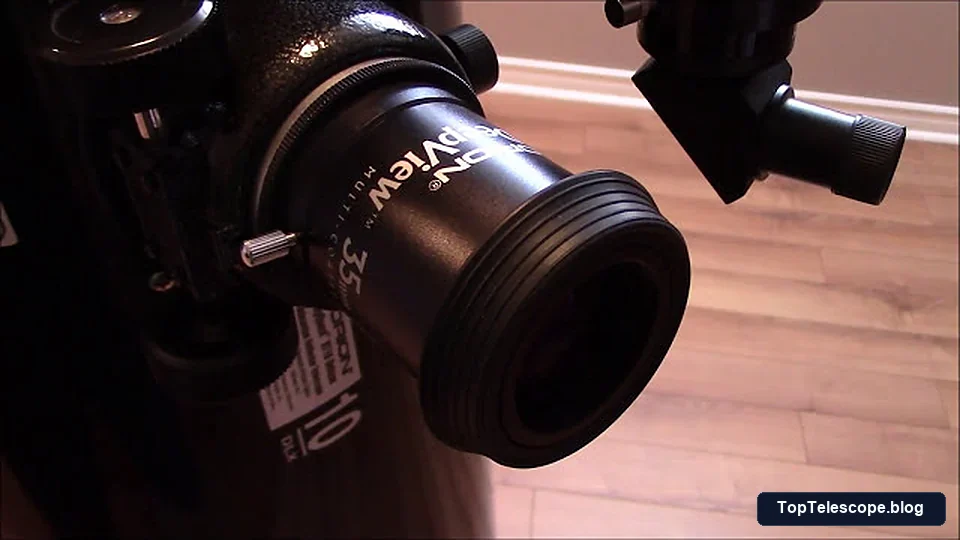
As noted in our Orion SkyQuest XT8 Classic review, capturing astrophotography images through a smartphone adapter offers good scale, though tracking remains constrained by the manual base.
Both Dobsonians utilize parabolic primary mirrors mounted in sturdy optical tubes, yet neither provides native backfocus travel for standard DSLR camera bodies without utilizing a low-profile 2-inch barlow lens.
Planetary imaging remains achievable using high-speed CMOS planetary cameras via a 1.25-inch adapter, though manual tracking requires patience when operating at extended focal lengths exceeding twelve hundred millimeters.
- Parabolic primary mirror tolerances checked via laser collimation.
- Focal ratios optimized for visual planetary detail and lunar study.
- Crayford focuser designs support heavy digital camera payloads securely.
Reflector Optics and Focal Lengths
The optical path requires precise alignment using standard collimation tools before every observing session to ensure sharp star images. Thermal equilibrium must also be reached for optimal high-magnification viewing.
Focal length variations change your overall eyepiece magnification dramatically when using identical 25mm plossl designs across both telescope optical tube assemblies during clear night sky observations.
- Primary mirror coatings feature high reflectivity aluminum layers.
- Secondary mirror spiders utilize thin vanes to minimize diffraction spikes.
K-12 Education and Classroom Integration
Integrating large reflectors into K-12 education programs requires balancing robust construction with safe student accessibility. Teachers must evaluate eyepiece height variations when younger students peer through the optical system.
Science instructors utilize these optical systems as comprehensive tools for teaching foundational physics principles, optics math, and astronomy basics to eager middle school and high school students.
Educational institutions benefit from the rugged particleboard rocker boxes and durable steel tubes, which withstand heavy student handling during introductory STEM astronomy laboratories and late-night campus observing sessions.
Teachers must account for the substantial physical footprint of these large manual reflectors, ensuring secure storage cabinets and adequate clearance pathways inside school science facilities before procurement.
- Sturdy particle board bases withstand regular schoolyard transport.
- Simple mechanical controls allow intuitive student handling during labs.
- Large apertures engage student interest with bright planetary views.
Classroom Deployment for K-12 Teachers
Dedicated K-12 teachers appreciate the straightforward mechanical setup that bypasses complex computerized alignment routines during brief evening stargazing club meetings.
Safety parameters demand strict supervision around the open optical tube assembly to protect delicate glass surfaces from accidental fingerprints and physical impacts during crowded events.
- Manual altitude friction adjustment prevents sudden tube drops.
- Enclosed mirror cells protect primary optics from stray fingers.
Mechanical Specifications and Core Features
Evaluating all features reveals substantial differences in physical weight and overall storage footprint between these two popular instruments. The eight-inch model weighs roughly forty pounds fully assembled.
Comprehensive solutions for stable tracking involve CorrecTrak friction optimization pads on the base, ensuring smooth manual slewing movements across the night sky without jerky mechanical stiction.
Evaluating larger Dobsonians like those detailed in our Orion SkyQuest XT10 review reveals how painted steel tubes and internal knife-edge baffles effectively suppress stray light to maximize contrast transfer.
Altitude tension control relies on CorrecTension brake systems, allowing operators to adjust friction manually and maintain smooth elevation movement even when heavy eyepieces are swapped rapidly.
- Two-inch Crayford focuser includes a 1.25-inch adapter ring.
- CorrecTrak clutch systems maintain balance with heavy eyepieces.
- Plywood base construction offers reliable vibration dampening traits.
Base Stability and Tube Rings
The particle board rocker box relies on Teflon bearings to deliver silky smooth horizontal panning motions during high-power planetary observations.
Secure metal tube rings clamp the optical assembly firmly, allowing rotational adjustment for comfortable eyepiece positioning under varied backyard viewing angles.
- Carrying handles attached to the base ease transport logistics.
- Rubber feet isolate ground vibrations from the viewing platform.
Setup Guides and Operational Footprint
Following clear create guides ensures your telescope assembly process remains safe and efficient during late-night arrivals at remote dark sky observing locations.
As highlighted in our Orion SkyQuest XT8 Plus review, utilizing proper field accessories like collimation caps and cooling fans helps maximize optical performance before targeting deep-sky objects.
Field assembly requires placing the circular base upon level terrain before lifting the heavy optical tube into side bearing slots, a procedure demanding proper ergonomic lifting techniques to protect your lower back.
Transporting these instruments demands careful vehicle loading, as the bulky base dimensions require an empty backseat or spacious trunk equipped with protective foam padding materials.
- Step-by-step balancing routines prevent accidental optical tube tipping.
- Quick-release base handles facilitate rapid vehicle loading sequences.
- Proper cool-down times eliminate internal thermal air currents.
Field Assembly and Ergonomic Transport
Carrying the heavier ten-inch tube assembly often demands two people to prevent accidental bumps against doorframes or vehicle bumpers during transport.
The eight-inch configuration easily splits into two manageable loads that fit across the backseat of compact sedans without requiring folding seats.
- Separate base and tube transport reduces single-load lifting strain.
- Ergonomic side grips integrated into the base simplify lifting.
Aperture Gathering Power and Performance
As detailed in our Orion SkyQuest XT8 review, combining superior light gathering power with high-quality wide-field eyepieces allows observers to successfully resolve distant globular clusters and faint galactic arms.
The 254mm aperture of the larger model captures significantly more photons, revealing subtle spiral structures in galaxies that appear as mere smudges in smaller instruments.
Stepping up from an eight-inch to a ten-inch primary mirror yields a significant fifty-six percent increase in light grasp, drastically improving threshold magnitude limits for faint nebulae and distant galaxies.
Resolving tight double stars and intricate lunar craters becomes notably sharper under steady atmospheric seeing conditions, provided the primary optics have achieved complete thermal equilibrium with ambient nighttime temperatures.
- Ten-inch optics gather roughly fifty percent more light than eight-inch mirrors.
- Exit pupil calculations determine ideal eyepiece pairings for nebulae.
- Resolving power separates tight double star systems cleanly.
Deep-Sky Resolution vs Planetary Contrast
Smaller mirrors frequently acclimate to ambient outdoor temperatures faster, delivering steady high-contrast planetary images during nights with turbulent atmospheric seeing conditions.
Larger primary mirrors demand extended thermal stabilization periods but reward patient observers with breathtaking brightness when viewing distant Messier catalog objects.
- Enhanced reflectivity coatings maximize photon transmission efficiency.
- Parabolic figure minimizes optical aberrations at fast focal ratios.
Maintenance Protocols and Ecosystem Durability
To successfully unlock your creative ecosystem, routine optical maintenance keeps mirror surfaces clean and mechanical bearings functioning smoothly season after season.
Utilizing pre-printed maintenance templates helps amateur astronomers track mirror cleaning intervals, collimation frequency, and mechanical fastener torque adjustments reliably.
Routine maintenance involves checking mirror cell collimation using laser tools and periodically cleaning dust accumulations from optical surfaces using specialized photographic grade blowers and lint-free microfiber optical cloths.
The exterior particleboard base requires protection from heavy morning dew and moisture exposure to prevent edge swelling, making weather-resistant sealants or waterproof storage covers essential accessories.
- Primary mirror cleaning requires distilled water and mild soap solutions.
- Spring-loaded collimation thumb screws simplify field adjustments.
- Particle board surfaces benefit from protective water-resistant sealants.
Mirror Coatings and Long-Term Care
Protecting aluminum mirror coatings from atmospheric dust requires using fitted dust covers whenever the optical tube assembly remains stored indoors between sessions.
Periodic lubrication of the azimuth base center bolt ensures smooth rotational tracking without developing irritating squeaks during long night-time observing marathons.
- Silica gel packets inside storage caps prevent moisture buildup.
- Avoid touching optical glass surfaces to preserve coating longevity.
Choosing the Right Instrument for Your Workflow
Before you start designing your backyard observatory setup, carefully measure your available vehicle cargo space and physical storage capacity to avoid buying an oversized telescope.
Think of this choice as an image generator for your visual astronomy passion, where physical portability directly dictates how often you actually take the equipment outside.
Selecting between these two reflectors depends heavily on your physical storage space, vehicle capacity, and personal willingness to manage heavy equipment transport during solo observing excursions.
Observers prioritizing maximum deep-sky visibility will appreciate the ten-inch variant, whereas users seeking rapid backyard deployment often prefer the manageable proportions of the lighter eight-inch model.
- Assess personal physical strength for lifting heavy optical tubes.
- Consider local light pollution levels when selecting aperture size.
- Factor in budget allowances for upgraded eyepieces and finders.
Final Decision Matrix for Observers
Choose the eight-inch variant if frequent travel to dark sky sites is your primary goal and physical simplicity matters most to your routine.
Select the ten-inch model if your observing site is permanently accessible via a backyard roll-off shed and you demand maximum photon collection.
- Weigh frequency of use against raw optical performance gains.
- Prioritize ergonomic comfort to ensure long-term observing enjoyment.
Frequently Asked Questions
Which telescope offers better transportability for frequent travel?
The Orion XT8 provides significantly better portability due to its lighter tube assembly. This smaller model fits easily across standard vehicle backseats without requiring special cargo configurations.
Is the ten-inch model difficult to collimate for beginners?
Collimating the XT10 is straightforward using standard laser tools, though its larger mirror requires careful handling. Regular alignment checks ensure sharp planetary views during every observing session.
Do these Dobsonian telescopes require external power sources?
Neither telescope requires external electrical power for basic manual operation. They rely entirely on smooth human guidance and Teflon bearings to track celestial targets across the night sky.
What accessories are essential for getting started immediately?
Investing in a comfortable adjustable observing chair and a red LED flashlight is crucial. These additional accessories improve your viewing ergonomics and preserve dark adaptation during long sessions.
How long do the primary mirror coatings typically last?
Properly maintained aluminum mirror coatings can last for over a decade if kept clean. Using fitted dust covers and avoiding direct glass contact preserves optimal light reflectivity.