Nexstar 127SLT vs 5SE: Catadioptric Showdown
Choosing between these portable GoTo telescopes demands evaluating optical focal lengths and mechanical mount housings. Both systems offer automated tracking for backyard astronomers.

Choose the 127SLT for maximum aperture and planetary reach on a budget, or select the 5SE for superior mechanical durability and stable single-arm casting performance.
Compare all top models in our Best Telescope: Top Backyard Picks for Astronomy.
Side-by-Side Breakdown
| Criteria | Nexstar 127Slt | 5Se | Edge |
|---|---|---|---|
| Core Design / Build | Maksutov-Cassegrain optical tube | Schmidt-Cassegrain optical tube | 5Se |
| Real-World Performance | Higher focal length for planets | Wider field of view versatility | Nexstar 127Slt |
| Ease of Setup & Use | SkyAlign software with hand control | Sturdy cast-metal fork arm base | 5Se |
| Durability & Reliability | Plastic housing components | Heavy-duty metal construction | 5Se |
| Efficiency / Operating Footprint | Compact tube with lightweight tripod | Compact tube with steel tripod | 5Se |
| Maintenance Requirements | Infrequent factory collimation checks | User-adjustable secondary mirror | Nexstar 127Slt |
| Best Ideal Use Case | Lunar and planetary observation | General backyard deep-sky viewing | 5Se |
Optical Design and Aperture Performance
The Celestron Nexstar 127SLT utilizes a Maksutov-Cassegrain design featuring a 127mm aperture and a 1500mm focal length, similar to optical standards found within the Celestron NexStar 8SE review for planetary observers.
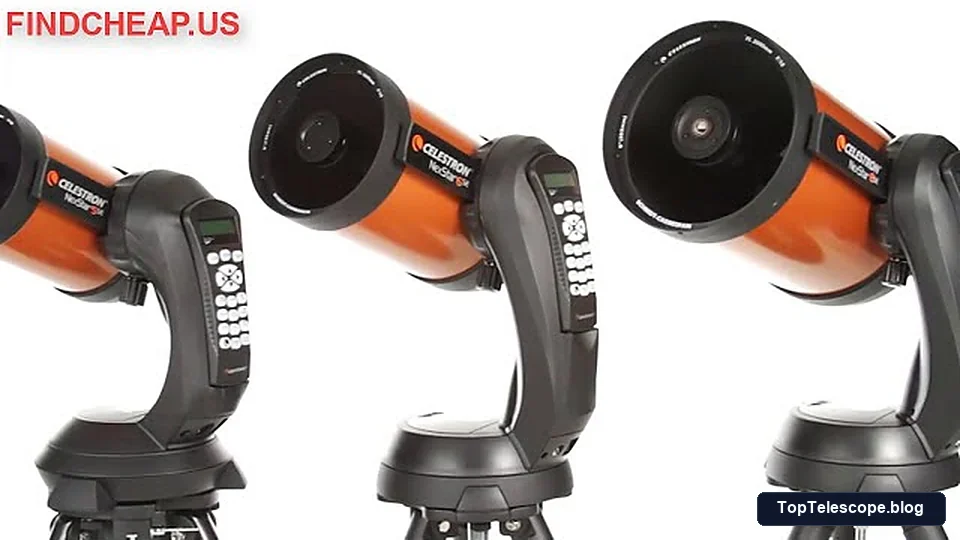
In contrast, the 5SE employs a traditional Schmidt-Cassegrain optical configuration with a 125mm aperture and a shorter 1250mm focal length, trading a tiny bit of reach for a wider photographic field.
Both systems gather adequate light for Messier catalog objects, but optical coatings and internal baffling dictate overall contrast when observing faint deep-sky nebulae under suburban light pollution.
The NexStar 127SLT features a Maksutov-Cassegrain optical tube configuration, offering a long focal length of 1500mm housed in a compact physical chassis designed for high-magnification planetary observation.
Conversely, the NexStar 5SE utilizes a Schmidt-Cassegrain system with a 1250mm focal length at f/10, providing a slightly wider baseline field of view and faster cool-down times in fluctuating ambient temperatures.
Optical throughput heavily depends on correct refractive coatings, where standard aluminum mirror coatings deliver decent reflectivity, though premium corrective plates require careful dew shielding to prevent internal moisture accumulation during long viewing sessions.
- Maksutov meniscus corrector plate seals the tube against dust.
- Schmidt corrector plate minimizes spherical aberration efficiently.
- Aperture differences remain negligible for resolving double stars.
Focal Length and Magnification Limits
A longer focal length naturally pushes eyepiece magnifications higher without requiring extreme Barlow lenses, making lunar craters appear remarkably crisp.
However, the wider focal ratio of the Schmidt system allows larger sensor formats to capture expansive star clusters without severe edge vignetting.
- Higher focal ratio reduces eyepiece sensitivity.
- Shorter focal length eases framing tasks.
Mount Mechanics and GoTo Tracking Accuracy
Automated telescope mounts rely heavily on internal gear tolerances and motor drives, as detailed in our Celestron Nexstar 8SE telescope review, to center celestial objects during viewing sessions.
The 5SE features a cast-metal single-fork arm that provides superior rigidity, minimizing mechanical backlash during slew operations across the night sky.
Meanwhile, the Nexstar 127SLT relies on a lighter plastic-composite fork housing that functions adequately but introduces slightly more flexure when loaded with heavy accessories.
Both telescopes rely on motorized altazimuth mounts driven by internal gears, but the single-fork arm design demands precise balancing to minimize backlash during slew operations and GoTo target centering.
Alignment routines like SkyAlign utilize multi-star positioning algorithms to calculate celestial coordinates, requiring users to center bright alignment stars accurately within the eyepiece to ensure reliable tracking throughout the night.
Gear train tolerances dictate tracking precision, and while internal DC servo motors maintain adequate sidereal rates, slight mechanical play can introduce minor jitter during high-power observations of lunar craters or tight binary systems.
- Metal gear construction improves long-term pointing precision.
- Composite housings reduce total shipping weight significantly.
- Both utilize the proven NexStar computer hand controller.
Alignment Protocols and Software
Celestron SkyAlign technology allows users to center any three bright celestial objects to initialize tracking without knowing star names.
Both mounts share identical firmware interfaces, ensuring a seamless transition for users upgrading or lateral-moving between these two popular systems.
- Three-star alignment handles field initialization fast.
- Solar system alignment aids daytime Venus tracking.
Portability, Weight, and Field Ergonomics
Transporting astronomical equipment to dark-sky locations requires evaluating total component weight, tripod footprint, and overall storage dimensions inside standard vehicle trunks.
The Nexstar 127SLT package includes a lightweight aluminum tripod that breaks down quickly, much like the hardware analyzed in our Celestron NexStar 4SE review, making it very portable.
The 5SE counters with a heavier steel tripod leg assembly that absorbs wind vibrations much better during breezy outdoor conditions.
Field portability remains a primary advantage for both systems, with the aluminum tripod legs collapsing easily for transport while supporting the optical tube assembly without excessive structural flexure or vibration damping issues.
Total assembled weight stays well below twenty pounds, allowing amateur astronomers to carry the complete telescope setup outdoors in a single trip without risking strain on delicate mechanical joints or electronic ports.
Ergonomic considerations include dovetail mounting clamps that secure the optical tube safely, though working in dark conditions requires careful handling of locking knobs to avoid pinched fingers or accidental alignment shifts.
- Steel tripod legs provide superior vibration dampening.
- Aluminum legs maximize portability for remote travel.
- Optical tube weights remain nearly identical overall.
Tripod Stability and Ground Footprint
A wide tripod spreader tray locks the legs securely into position while offering convenient temporary storage for stray eyepieces.
Uneven terrain requires careful leveling adjustments to prevent motor binding during high-speed GoTo slewing routines.
- Accessory tray locks legs into rigid geometry.
- Adjustable rubber feet enhance grip on concrete.
Power Management and Battery Efficiency
Internal computer drives and optical encoders demand a steady electrical current, similar to power systems noted in the Celestron NexStar 6SE review, to maintain accurate tracking during overnight runs.
Both systems operate via standard battery compartments holding multiple AA cells, though internal battery drain can occur rapidly during cold weather.
Experienced observers typically replace internal battery power with an external rechargeable power tank to prevent voltage drops and erratic motor behavior.
Internal battery compartments typically house eight AA batteries, but high current draws during rapid slew operations frequently cause voltage drops that trigger erratic hand control reboots and alignment memory loss.
Transitioning to an external 12V power tank or regulated AC adapter ensures stable voltage delivery, protecting sensitive circuit boards from brownouts and extending operational lifespan during extended astrophotography imaging sessions.
Cable management is crucial in the field, as dangling power cords can snag on the rotating fork arm, potentially ripping out DC input jacks or stalling the internal azimuth drive motors mid-track.
- Internal AA battery packs offer quick wireless setup.
- External DC power adapters prevent mid-session voltage drops.
- Low voltage triggers erratic hand controller error codes.
Cold Weather Electrical Performance
Sub-freezing winter temperatures severely reduce alkaline battery output, causing sudden reboots during crucial imaging sequences or alignment routines.
Lithium-ion power tanks maintain stable voltage output even when ambient temperatures plummet well below freezing in open fields.
- Alkaline cells fail rapidly in sub-zero weather.
- Lithium power banks sustain multi-hour imaging runs.
Collimation Maintenance and Optical Alignment
Maintaining optical alignment ensures pinpoint star images and maximum contrast when splitting tight double stars or observing planetary cloud belts.
The Maksutov design factory-sets the primary and secondary optics, meaning users rarely need to adjust alignment screws unless severe impacts occur.
Conversely, the Schmidt-Cassegrain system features an accessible secondary mirror cell allowing regular user collimation using a simple hex wrench.
Factory alignment on Maksutov and Schmidt systems is generally stable, but transport over rough terrain can knock primary or secondary mirrors slightly out of true optical collimation, degrading high-resolution planetary sharpness.
The 127SLT features a fixed primary mirror cell, meaning user adjustments are limited, whereas the 5SE allows secondary mirror collimation screws adjustment using specialized Allen wrenches under controlled artificial star testing conditions.
Performing routine star tests helps identify alignment errors early, ensuring that diffraction rings remain concentric and optical aberrations are minimized before undertaking detailed lunar or deep-sky observing marathons.
- Maksutov optics hold alignment through rough transport.
- Schmidt optics allow user adjustment for peak sharpness.
- Laser collimators simplify daytime optical tuning tasks.
Diagnostic Testing Procedures
Performing an out-of-focus star test on Polaris reveals whether the optical axis requires manual correction before starting planetary sessions.
Proper thermal equilibrium must be reached before evaluating collimation accuracy to avoid misleading atmospheric turbulence artifacts.
- Star testing confirms optical alignment instantly.
- Thermal cooling prevents false mirror distortion.
Accessorizing and Practical Astrophotography Limits
Entering the realm of astrophotography requires understanding mount payload capacities and field rotation limitations inherent in single-fork altazimuth bases.
Both telescopes handle lightweight planetary cameras exceptionally well, capturing stunning high-frame-rate videos of Jupiter, Saturn, and the lunar surface.
Long-exposure deep-sky imaging remains challenging without adding an optional equatorial wedge to counteract field rotation during extended shutter durations.
Altazimuth mounts inherently suffer from field rotation during long exposures, restricting practical astrophotography to short-exposure lunar, solar, and bright planetary imaging using specialized high-speed CMOS astronomical video cameras.
Adding a heavy-duty wedge can convert the altazimuth base into an equatorial platform, though weight limits and mechanical tolerances still challenge long-focal-length deep-sky imaging pursuits involving faint nebulae or galaxies.
Eyepiece upgrades, such as wide-field 68-degree oculars, enhance visual comfort, but users must respect maximum useful magnification limits dictated by aperture physics to avoid dim, blurry, and unresolvable planetary details.
- Altazimuth mounts induce field rotation during long exposures.
- Planetary video capture bypasses tracking rotation limits.
- Wedge additions enable basic deep-sky astrophotography.
Eyepiece Compatibility and Filtering
Standard 1.25-inch focusers accept a vast ecosystem of planetary filters, neutral density lunar filters, and wide-field ocular lenses.
Barlow lenses easily double or triple effective magnification, though atmospheric seeing conditions ultimately dictate usable power limits.
- Standard barrel sizes maximize aftermarket accessory choices.
- Planetary filters enhance subtle cloud belt contrast.
Frequently Asked Questions
Can both telescopes connect directly to a laptop computer for automated astronomy software control?
Yes, both systems include auxiliary communication ports that readily accept USB-to-serial adapters for complete planetarium software integration and firmware updates. This direct computer link enhances your backyard observing workflow significantly.
Which telescope handles high magnification viewing of planetary details more effectively during steady nights?
The Nexstar 127SLT generally pushes higher magnifications slightly better due to its longer focal length and smaller secondary mirror obstruction. This optical layout maximizes contrast on faint planetary features.
Are the mounting forks and optical tube assemblies interchangeable between these two specific Celestron models?
No, the optical tube dovetail bars and fork arm clearances are engineered specifically for their respective chassis dimensions. Attempting cross-mounting parts requires custom aftermarket bracket modifications.
Do these catadioptric telescope systems require lengthy cool-down periods before achieving sharp focus?
Closed optical tubes trap internal heat currents, meaning both systems benefit from sitting outside for thirty minutes before viewing. Thermal equilibrium prevents shimmering air currents from degrading planetary sharpness.
What is the primary mechanical advantage of choosing the heavier 5SE over the lighter SLT variant?
The 5SE incorporates a robust cast-metal fork arm and sturdier steel tripod legs that dramatically reduce wind vibration. This heavy-duty construction provides superior mechanical stability during outdoor sessions.