Maksutov Cassegrain vs Refractor: Optical Showdown
Choosing between these telescope designs shapes your entire stargazing experience. Understanding their distinct optical physics helps you select the right instrument for your backyard observatory.

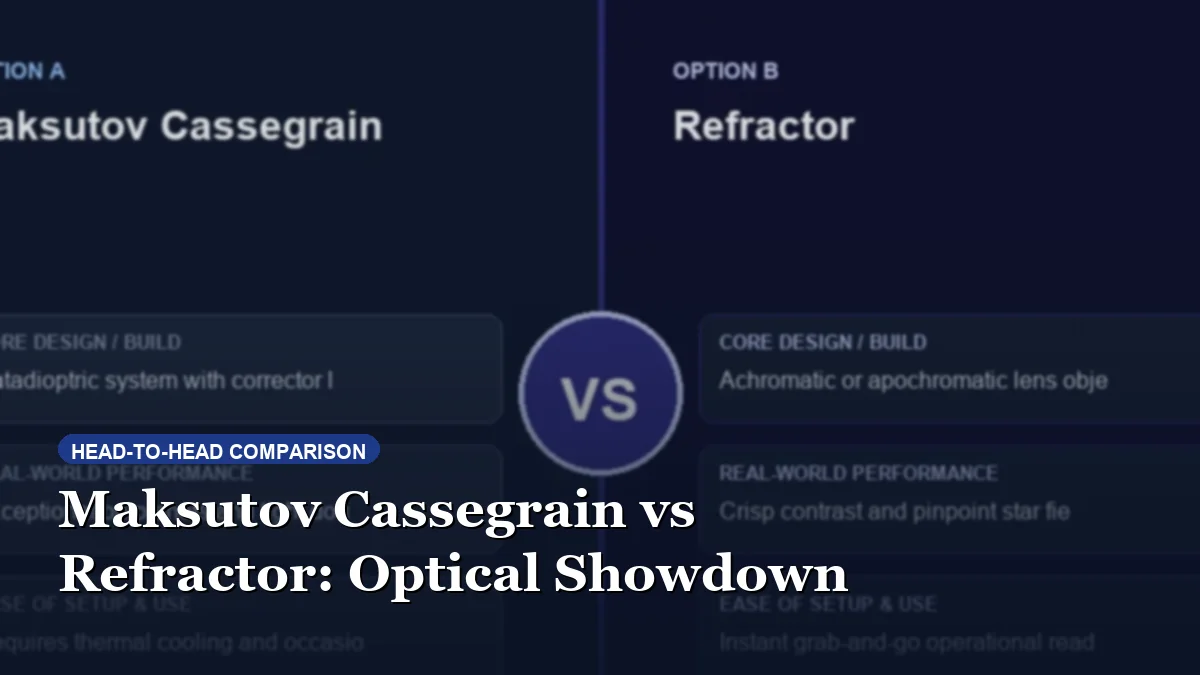
Choose the Maksutov Cassegrain for high-magnification planetary viewing in a compact tube. Select the refractor for wide-field astrophotography and zero collimation hassle.
Compare all top models in our Best Telescope: Top Backyard Picks for Astronomy.
Side-by-Side Breakdown
| Criteria | Maksutov Cassegrain | Refractor | Edge |
|---|---|---|---|
| Core Design / Build | Catadioptric system with corrector lens | Achromatic or apochromatic lens objective | Refractor |
| Real-World Performance | Exceptional on planets and tight double stars | Crisp contrast and pinpoint star fields | Tie |
| Ease of Setup & Use | Requires thermal cooling and occasional alignment | Instant grab-and-go operational readiness | Refractor |
| Durability & Reliability | Sealed tube protects optics from dust | Robust glass elements securely mounted in cell | Maksutov Cassegrain |
| Efficiency / Operating Footprint | Short physical tube with long focal length | Long physical tube requiring sturdy mounts | Maksutov Cassegrain |
| Maintenance Requirements | Infrequent mirror alignment needed over time | Virtually maintenance-free optical assembly | Refractor |
| Best Ideal Use Case | Lunar and planetary observation in tight spaces | Wide-field imaging and rapid field deployment | Tie |
Optical Design and Physics
Maksutov Cassegrain telescopes utilize a spherical primary mirror paired with a thick meniscus corrector lens. Check our best maksutov cassegrain picks to find compact systems utilizing this efficient folded optical path design.
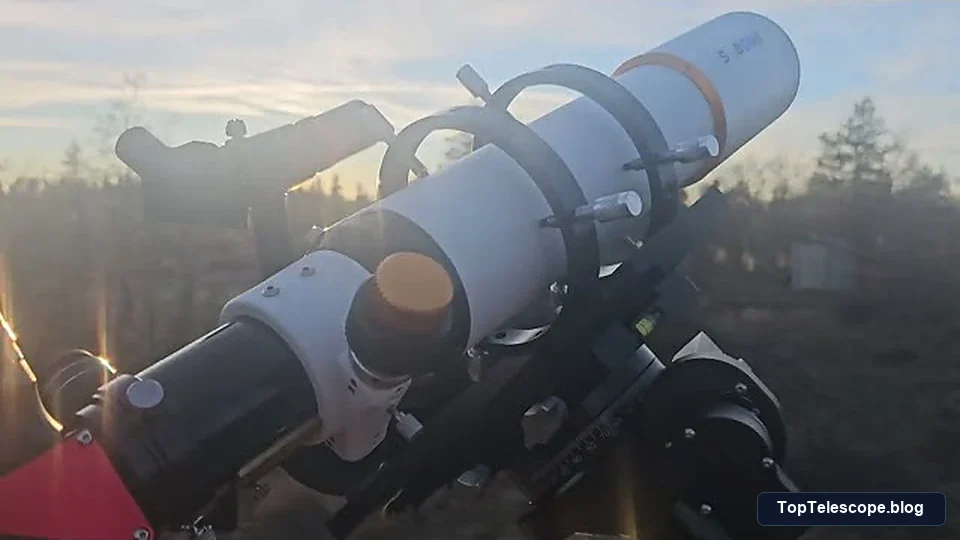
Refractors use a front objective lens to bend light directly down a straight tube to the eyepiece. This straightforward transmission avoids internal obstructions for maximum light throughput.
Maksutov-Cassegrains deploy a thick meniscus corrector lens to eliminate spherical aberration, folding the light path twice via mirrors. This configuration achieves long focal lengths inside a remarkably compact aluminum tube assembly.
Conversely, refractors utilize air-spaced doublets or triplets to bend incoming light straight to a rear focal plane. This traditional lens-based design completely avoids central obstructions, yielding high-contrast views of subtle planetary cloud details.
- Thick meniscus corrector lens reduces chromatic aberration significantly
- Straight-through refractor path eliminates central mirror obstruction
- Folded catadioptric design achieves long focal lengths in compact tubes
Light Gathering and Obstruction
Central obstructions in catadioptric systems scatter a small fraction of incoming light. Pure refractors avoid this entirely, delivering unhindered wavefronts to your eye.
Apochromatic refractor models use exotic glass types to eliminate false color fringes completely. Maksutov designs naturally control chromatic issues through their specific lens geometry.
- Secondary mirror spot creates minor diffraction effects
- Unobstructed refractor aperture maximizes theoretical contrast ratios
Planetary and Lunar Performance
Observing planetary details requires high focal lengths and sharp contrast. Explore our best maksutov cassegrain telescopes selection to find portable optical housings that pack massive focal lengths into compact tubes.
Refractors deliver breathtaking lunar vistas with stark shadows and clean whites. Premium triplet lenses rival catadioptric systems when managing high planetary magnifications.
High magnification is effortless with a Mak due to its f/15 focal ratio, cleanly resolving tight lunar craterlets and planetary storm belts. However, its small central obstruction slightly scatters light compared to pure lens systems.
Apochromatic refractors excel on the Moon by delivering pure chromatic correction, preventing false purple halos around dazzlingly bright high-contrast craters. Their unobstructed aperture preserves maximum edge-to-edge contrast across complex lunar highland formations.
- Long focal ratios easily achieve high planetary magnifications
- High contrast reveals subtle cloud bands on Jupiter
- Sharp lunar terminators show intricate crater wall details
Magnification Limits and Seeing
Atmospheric seeing conditions often limit maximum magnification before optics do. Both designs push past normal limits on exceptionally stable nights.
Small aperture refractors may struggle with extremely high magnification due to light starvation. Large Maksutov variants maintain image brightness much better at comparable powers.
- Steady atmospheric seeing unlocks ultimate resolving power
- Aperture size dictates practical high-magnification limits
Setup, Weight, and Portability
Weight distribution matters immensely when mounting any telescope for field use. Unlike choices in our best refractor telescope for viewing planets and galaxies roundup, short optical tubes reduce mechanical leverage and improve tracking stability.
Long refractor tubes act like wind sails during breezy observing sessions. Transporting large refractors demands bulky cases and robust equatorial mount systems.
Transporting a Mak is remarkably easy because the short optical tube fits onto lightweight alt-azimuth mounts. You avoid lugging heavy counterweights, making quick weeknight stargazing sessions entirely practical from urban apartment balconies.
Refractor OTUs are physically longer, demanding sturdy equatorial tripods with substantial counterweight shafts to prevent annoying operational vibrations. This length requires larger transport cases and extra care during field assembly operations.
- Compact tubes fit easily into airline carry-on luggage
- Longer moment arm requires heavier duty mounting hardware
- Balanced weight distribution minimizes counterweight requirements
Mount Requirements and Stability
A sturdy mount prevents annoying image vibrations at high magnifications. Refractors demand longer pier extensions to prevent the diagonal from hitting tripod legs.
Maksutov systems sit comfortably on smaller alt-azimuth or equatorial mounts due to their compact physical footprint and rear-cell eyepiece placement.
- Short moment arms reduce strain on motorized mounts
- Tripod height adjustments prevent awkward viewing angles
Thermal Acclimation and Maintenance
Sealed optical tubes trap ambient heat inside the chassis for hours. Thermal equilibrium must be reached before crisp high-power viewing becomes possible.
Open-air refractor designs, such as those featured in our best refractor telescope for beginners guide, acclimate to outdoor temperatures much faster. Their robust lens cells require virtually zero realignment over years of regular transport.
Thick corrector lenses and sealed tubes mean Maks require extended cooling periods to reach ambient outdoor temperatures. Without this thermal stabilization, internal air currents severely degrade high-magnification planetary viewing sharpness.
Refractors cool down much faster due to open-cell tube designs and exposed objective lens elements. Routine maintenance primarily involves dusting glass surfaces, while internal optical alignments rarely require user intervention.
- Thick corrector lenses require extended cooling periods
- Sealed tubes prevent dust accumulation on internal optics
- Open tube current management improves initial image sharpness
Collimation and Alignment Stability
Bouncing telescopes around in vehicles can knock sensitive optical mirrors out of alignment. Refractors generally hold their factory collimation through rough travel.
Many Maksutov models feature fixed primary mirrors that rarely require user adjustment. When collimation is needed, the process requires patience and precision.
- Fixed lens elements resist mechanical misalignment shock
- Mirror shift during focusing can plague lower-end catadioptrics
Astrophotography and Field of View
Wide-field astrophotography favors short focal length apochromatic refractors. Their flat field performance captures sprawling nebulae and large star clusters effortlessly.
Narrow field targets like planetary nebulae suit long focal length catadioptrics. Guiding systems require careful tuning to manage extended focal ratios effectively.
Narrow fields of view limit Maks to small deep-sky objects like planetary nebulae and globular clusters. Their slow focal ratios also demand autoguiding systems and long exposure times for successful imaging.
Short-tube refractors provide wide star fields, capturing sprawling constellations and massive nebulae with stellar pinpoint accuracy across APS-C sensors. Photographers appreciate the flat image scale and straightforward camera coupling adapters.
- Wide focal fields capture sprawling celestial dust clouds
- Slow focal ratios demand longer camera exposure times
- Flat field designs eliminate corner star distortion
Imaging Accessories and Field Flatteners
Achieving pinpoint stars across a camera sensor often requires additional field flatteners. Refractors pair seamlessly with dedicated corrective optics for imaging.
Long focal lengths amplify tracking errors, making autoguiding an absolute necessity for deep sky photography through catadioptric optical tubes.
- Field flatteners correct edge aberrations on large sensors
- Autoguiding compensates for slow focal ratio exposure lengths
Durability and Build Quality
Rugged field conditions test the mechanical integrity of every telescope component. Aluminum housings protect delicate optical coatings from moisture and accidental impacts.
Quality focuser mechanisms must handle heavy camera rigs without slipping. Premium rack and pinion focusers provide silky smooth adjustments under heavy loads.
Rugged metal construction allows Maks to withstand frequent transit shock without knocking primary mirrors out of alignment easily. Their enclosed optical tubes protect sensitive interior coatings from dust and ambient humidity.
Premium refractors rely on machined aluminum cells that securely lock heavy glass elements in place during temperature fluctuations. This robust mechanical engineering ensures lifetime reliability under demanding field conditions.
- Anodized aluminum tubes resist corrosion and daily wear
- Robust internal baffling stray light elimination enhances contrast
- Dust covers protect corrector plates during storage periods
Focusing Mechanisms and Image Shift
Internal mirror focusing eliminates external drawtube sag completely. However, some designs suffer from slight image shift when reversing focus direction.
Rack and pinion focusers offer direct control without shifting the primary mirror. Adding dual-speed micro-focusers ensures precise focal point acquisition every time.
- External focusers prevent image tile shifting issues
- Micro-focus knobs allow ultra-fine optical adjustments
Frequently Asked Questions
Why do Maksutov Cassegrain telescopes take longer to cool down outdoors?
Their thick meniscus corrector lens and sealed optical tube trap ambient heat inside the chassis for hours. Proper thermal acclimation is essential before achieving sharp planetary views.
Can I use a standard refractor for deep sky astrophotography?
Apochromatic refractors are actually considered the gold standard for wide-field deep sky imaging. Short focal lengths deliver sprawling vistas without tracking errors.
Do refractor telescopes ever need their optical alignment adjusted?
Factory-set lens cells securely mount glass elements and rarely require user collimation. Rigid mechanical cells hold alignment through years of regular transport.
Is a Maksutov Cassegrain suitable for viewing faint deep sky objects?
Their long focal ratios create narrow fields of view that struggle with large nebulae. Bright planetary targets remain their absolute strongest suit.
What mount size is required for a large optical tube assembly?
Heavy refractors demand substantial equatorial mounts to prevent long-moment arm vibrations. Sturdy mounting hardware ensures stable tracking during high-power viewing.