Explore Scientific ED80 vs Sky-Watcher Evostar 80ED
Two apochromatic refractors face off in this technical comparison. Discover which 80mm doublet delivers superior optical precision and mechanical reliability.

Choose the Explore Scientific ED80 for rugged field portability and carbon fiber styling. Opt for the Evostar 80ED if you prioritize classic glass performance and a traditional metal tube.
Compare all top models in our Best Telescope: Top Backyard Picks for Astronomy.
Side-by-Side Breakdown
| Criteria | Explore Scientific ED80 | Sky-Watcher Evostar 80ED | Edge |
|---|---|---|---|
| Core Design / Build | Air-spaced doublet with carbon fiber wrap | Air-spaced doublet with aluminum tube | Explore Scientific |
| Real-World Performance | Low chromatic aberration via ED glass | Excellent color correction with FPL-53 | Sky-Watcher |
| Ease of Setup & Use | Compact footprint with robust dovetail | Standard mounting rings and Vixen bar | Tie |
| Durability & Reliability | Resistant to thermal expansion changes | Traditional heavy-duty metal construction | Explore Scientific |
| Efficiency / Operating Footprint | Short focal length requires less clearance | Slightly longer tube demands balanced counterweights | Explore Scientific |
| Maintenance Requirements | Standard dust caps and lens pen care | Routine collimation checks and dew management | Tie |
| Best Ideal Use Case | Mobile wide-field astrophotography setups | Stationary backyard planetary visual sessions | Sky-Watcher |
Core Optical Design and Glass Formulations
Evaluating two high-grade apochromatic refractors requires looking closely at their primary lens elements. Both instruments utilize air-spaced doublet configurations designed to minimize false color effectively.
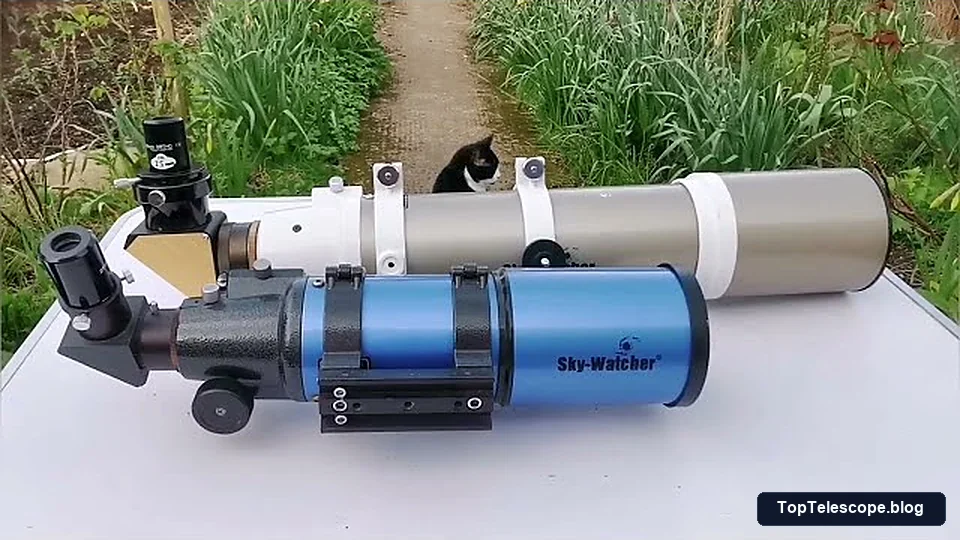
The Explore Scientific model incorporates specialized ED glass elements to suppress chromatic aberration across the visual spectrum. Meanwhile, its competitor relies on alternative high-index substrates for sharp contrast.
Optical coatings play a critical role in light transmission efficiency across these small-aperture telescopes. Proprietary multi-coatings on both tube assemblies ensure maximum photon throughput during deep-sky imaging.
As detailed in our Explore Scientific ED80 review, this air-spaced doublet uses FCD100 extra-low dispersion glass. The synthetic fluorite substitute suppresses chromatic aberration across the visible spectrum for crisp planetary views.
Conversely, the Sky-Watcher Evostar 80ED employs FPL-53 ED glass mated with a matching crown element. This legendary glass formulation yields an extremely high Abbe number, minimizing secondary spectrum color fringing during high-magnification lunar observing sessions.
Both optical tube assemblies apply advanced broadband multi-coatings to all air-to-glass surfaces. These proprietary chemical depositions maximize light transmission efficiency while preventing internal reflections and ghosting when imaging bright stellar targets.
- Air-spaced doublet optical layouts
- Specialized extra-low dispersion glass types
- Broadband anti-reflective multicoatings applied
- Optimized focal ratios for wide fields
Glass Quality and Color Correction
Achieving true apochromatic performance in an 80mm aperture demands tight tolerances. Manufacturers select glass types that minimize secondary spectrum residuals during high-power viewing.
Rigorous optical testing reveals minimal color fringing around bright stellar targets for both telescopes. Observers will notice exceptionally crisp planetary disks and dark sky backgrounds.
- Strict glass melt selections
- Suppression of secondary spectrum halos
Mechanical Construction and Focuser Rigidity
Mechanical integrity directly influences your imaging success when attaching heavy CMOS cameras. The Explore Scientific features a modern carbon fiber optical tube to reduce thermal expansion.
Conversely, the Sky-Watcher relies on a sturdy rolled-aluminum tube with internal baffling to eliminate stray reflections. Both systems provide solid protection for the delicate internal optics.
Focuser performance remains a vital differentiator for precise astrophotography focus acquisition. Rack-and-pinion and Crayford designs offer distinct tactile feedback during manual adjustments.
Mechanical housing integrity dictates field performance. As noted in our Sky-Watcher Evostar 72ED review, the optical tube features a robust cast aluminum chassis interiorly baffled to eliminate stray light during imaging sessions.
Explore Scientific counters with a rugged aluminum chassis finished in a durable powder coat. Their drawtube assembly incorporates a reliable dual-speed Crayford focuser with a 10:1 reduction knob for micro-metric focusing adjustments under load.
Sky-Watcher equips their refractor with a heavy-duty dual-speed Rack and Pinion focuser. This mechanical design eliminates slip entirely, supporting large format DSLR or cooled CMOS astronomy cameras without rotational sag or tilt issues.
- Carbon fiber versus aluminum tubes
- Precision dual-speed mechanical focusers
- Internal knife-edge baffle systems installed
- Rotatable camera angle adjustment rings
Focuser Load Capacities
Heavy imaging trains require robust drawtube support to prevent mechanical sagging. Both focusers feature tension adjustments to securely hold modern astronomical cameras.
Smooth 10-to-1 reduction gears allow users to achieve critical focus with absolute confidence. Slippage is virtually eliminated under normal operational payloads.
- Dual-speed 10:1 reduction knobs
- Secure brass compression ring clamps
Real-World Astrophotography Performance
Deep-sky imaging tests highlight the optical flatness and field illumination of these refractors. Adding a suitable field flattener unlocks pinpoint stars right into the corners.
Guiding accuracy benefits greatly from the lightweight nature of these optical tube assemblies. Smaller mounts handle these payloads effortlessly during long exposure tracking sequences.
Thermal acclimatization speeds differ based on the primary tube materials used in construction. Carbon fiber structures adapt to ambient temperatures slightly faster than thick metal cylinders.
Astrophotographers demand flat fields across modern large sensor formats. Pairing these small refractors with a matched field flattener is mandatory to eliminate edge astigmatism and corner star elongation during long-exposure deep sky imaging runs.
The Explore Scientific ED80 delivers exceptional point-source stars across APS-C sensors when utilizing their dedicated corrector. Vignetting remains remarkably low due to the generous clear aperture of the rear drawtube and threaded camera adapters.
Sky-Watcher optics shine when capturing narrowband nebulae. Highlighting this optical pedigree, our Sky-Watcher Virtuoso GTi 150P review notes that precise chromatic correction ensures tight star profiles through hydrogen-alpha and oxygen filters.
- Compatible with dedicated field flatteners
- Wide imaging circles for APS-C sensors
- Fast thermal adaptation rates achieved
- Minimal flexure across tracking mounts
Field Flatness and Sensor Coverage
Modern digital sensors demand high-correction optics to avoid elongated star shapes at edges. These refractors handle standard crop-sensor cameras remarkably well with proper spacing.
Backfocus distances must be measured accurately to achieve optimal performance during astrophotography sessions.
- Optimized for APS-C sensor formats
- Precise backfocus spacing requirements
Visual Astronomy and Field Usability
Visual observers seeking sharp lunar and planetary views will appreciate both instruments. High magnification yields crisp details on Jupiter and Saturn without excessive glare.
The compact dimensions make airline travel feasible for astronomers chasing dark skies worldwide. Setup times are remarkably fast when mounted on sturdy alt-azimuth tripods.
Ergonomic carrying handles and sliding dew shields enhance everyday usability in the field. Protecting the objective lens from stray ambient light is straightforward and reliable.
Visual observers appreciate wide-field framing. As highlighted in our Evostar 80ED review, the 600mm focal length provides rich star clusters and expansive sweeping views of the Milky Way using standard two-inch eyepieces.
Transporting these compact optical tubes requires minimal space in standard vehicle trunks. The Explore Scientific model includes a heavy-duty transport case, protecting the precision alignment during travel to dark sky observing sites.
Ergonomic focus knobs and smooth dew shield retraction mechanisms enhance overall user satisfaction during cold nighttime sessions. Both telescopes handle freezing temperatures without mechanical binding or grease stiffening affecting everyday field operations.
- Excellent high-magnification planetary clarity
- Airline-friendly transportable optical dimensions
- Retractable dew shields for storage
- Compatible with standard star diagonals
Eyepiece Pairing and Magnification
Selecting quality eyepieces maximizes the resolving power of these fine apochromatic doublets. Short focal length eyepieces deliver high power without severe image degradation.
Wide-angle oculars provide immersive views of sprawling galactic star clusters and bright nebulae.
- High-power planetary eyepiece compatibility
- Wide-field deep sky viewing options
Maintenance, Cleaning, and Longevity
Proper maintenance ensures your telescope delivers pristine views for many decades of service. Periodic lens cleaning should be performed only with specialized optical wipes.
Dust accumulation on the objective lens has minimal impact on visual contrast during nighttime use. Storing the assembly in a padded case prevents accidental mechanical impacts.
Dew heaters remain essential accessories during humid autumn and spring observing sessions. Keeping moisture off optical surfaces prevents fungal growth on internal lens coatings.
Proper lens maintenance preserves optical coatings and prevents permanent surface degradation. Users should utilize an air blower to remove loose particulate matter before applying optical cleaning solutions to the delicate glass surfaces.
Collimation retention is rarely an issue with these fixed doublet lens cells. However, checking the lens cell retaining rings annually ensures the optics remain securely seated without introducing pinch-induced astigmatism into stellar images.
Storing optical tubes in temperature-stable environments prevents internal moisture accumulation and mold growth on optical coatings. Always allow thermal equilibrium before sealing aluminum tubes inside their protective transport cases after night sessions.
- Routine lens dust removal protocols
- Padded storage case recommendations
- Dew mitigation heater strip usage
- Periodic mechanical fastener checks
Lens Care and Storage Best Practices
Never touch optical glass surfaces directly with bare fingers to avoid oil transfer. Use filtered air bulbs to blow away loose particles before wiping.
Store your equipment in climate-controlled environments to minimize thermal shock and moisture buildup.
- Compressed air bulb cleaning steps
- Controlled humidity storage environments
Matching Your Mount and Ecosystem
Choosing the right mount determines the overall stability of your portable telescope system. Lightweight equatorial mounts provide accurate tracking for long exposure deep sky images.
Vixen-style dovetail bars ensure quick attachment and secure balancing across various tripod platforms. Always verify weight capacities before assembling your complete optical train.
Integrating auto-guider cameras enhances tracking precision during extended imaging sessions under dark skies. Cable management prevents snagging during automated meridian flip sequences.
Selecting an appropriate equatorial mount ensures stable tracking during long photographic exposures. A sturdy Vixen-style dovetail bar comes standard on both telescopes, fitting securely into most lightweight portable GoTo tracking mounts.
Guiding accuracy depends on solid ring rings and mounting hardware. Upgrading factory rings to heavy-duty CNC machined cradle rings eliminates flexure when adding secondary guidescopes or electronic filter wheels to your imaging train.
Building a cohesive hardware ecosystem streamlines field setup and teardown procedures. Both refractors integrate seamlessly with popular electronic autofocus motors and computer control interfaces, modernizing your portable astrophotography workflow completely.
- Vixen dovetail mounting bar compatibility
- Lightweight tracking equatorial mount pairings
- Secure ring and dovetail clamping
- Efficient cable management routing
Mount Capacity and Balance
Proper balancing reduces strain on internal motor gears during tracking operations. Always adjust counterweights until the telescope floats freely in all axes.
Sturdy tripods eliminate wind vibrations during high magnification planetary observation sessions.
- Accurate axis balancing techniques
- Vibration-damping tripod leg design
Frequently Asked Questions
Which telescope is better for beginner astrophotography?
Both models excel for beginners due to their forgiving focal lengths. The Explore Scientific ED80 offers rugged carbon fiber styling while the rival provides classic metal construction.
Do these refractors require a field flattener?
Yes, dedicated field flatteners are recommended for APS-C sensors. Using flatteners ensures pinpoint stars across the entire photographic frame.
Can I use these telescopes for visual observing?
Both instruments deliver exceptional high-power planetary views. They offer crisp lunar details and high contrast across wide star fields.
How do their weights compare in the field?
Their weights are very similar, hovering around seven pounds. This makes them ideal for airline travel and lightweight tracking mounts.
Are dew heaters necessary for these scopes?
Dew heaters are strongly recommended during humid nights. Keeping moisture off optical coatings prevents image degradation and potential damage.