Evostar 72Ed vs 80Ed: Technical Showdown
Choosing between these refractors demands careful evaluation of aperture and travel convenience. Our technical guide breaks down their core optical profiles.

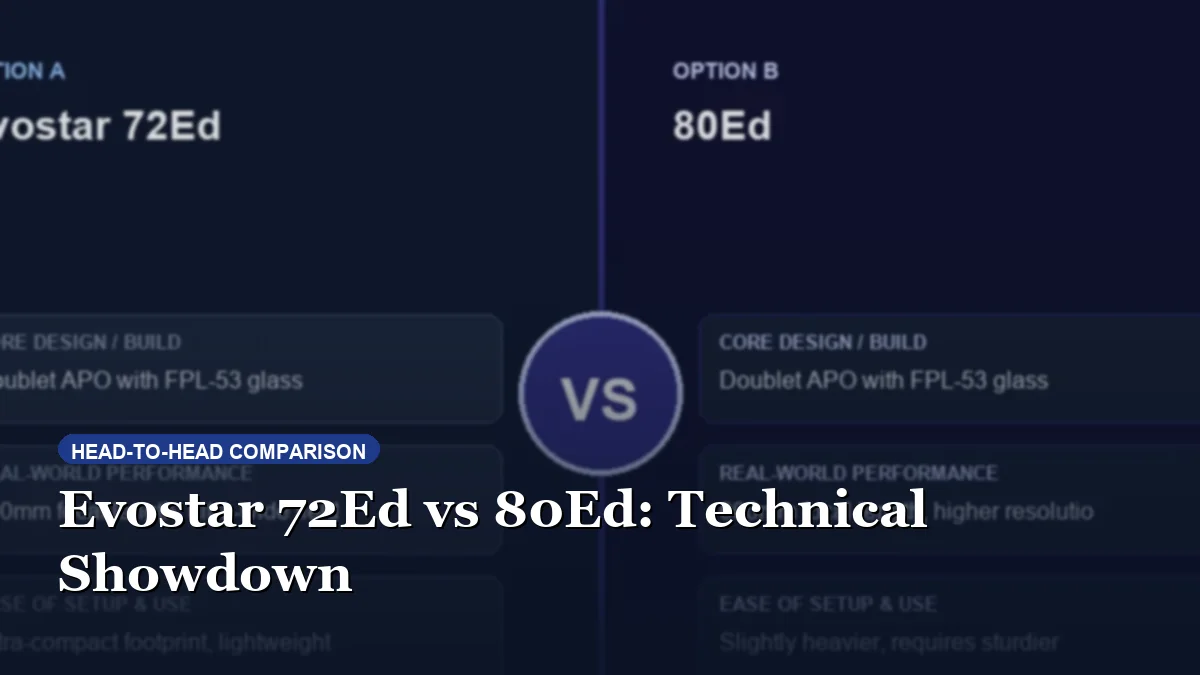
Select the Evostar 72Ed for maximum airline portability and wide-field astrophotography. Choose the 80Ed when you require increased light gathering for planetary details.
Compare all top models in our Best Telescope: Top Backyard Picks for Astronomy.
Side-by-Side Breakdown
| Criteria | Evostar 72Ed | 80Ed | Edge |
|---|---|---|---|
| Core Design / Build | Doublet APO with FPL-53 glass | Doublet APO with FPL-53 glass | Tie |
| Real-World Performance | 420mm focal length, ultra-wide field | 600mm focal length, higher resolution | 80Ed |
| Ease of Setup & Use | Ultra-compact footprint, lightweight | Slightly heavier, requires sturdier mount | Evostar 72Ed |
| Durability & Reliability | All-metal CNC tube construction | All-metal CNC tube construction | Tie |
| Efficiency / Operating Footprint | Fits into small backpacks easily | Demands standard medium transport case | Evostar 72Ed |
| Maintenance Requirements | Standard optics cleaning routines | Standard optics cleaning routines | Tie |
| Best Ideal Use Case | Mobile wide-field imaging setup | General visual and lunar tracking | 80Ed |
Core Design and Optical Engineering Differences
Apochromatic refractor design relies on precision glass elements to minimize chromatic aberration. Both telescopes feature doublet configurations incorporating premium FPL-53 extra-low dispersion glass elements to manage false color effectively.
Optical coatings play a critical role in light transmission efficiency across the visible spectrum. Metallic high-transmission coatings applied to all air-to-glass surfaces maximize brightness and contrast during night sky observations.
Mechanical tube assemblies utilize rigid aluminum alloy construction to prevent thermal flexure. Precision dual-speed rack and pinion focusers ensure zero image shift during delicate astrophotography focusing sessions.
The Sky-Watcher Evostar 72ED utilizes a duplet lens configuration featuring FPL-53 extra-low dispersion glass. This optical design effectively minimizes chromatic aberration across both visual and demanding photographic spectra.
Our comprehensive evostar 80ed review explains how stepping up to this model introduces a longer focal length of 600mm, changing your native focal ratio constraints.
Both optical tubes employ anti-reflective coatings on air-to-glass surfaces to maximize light transmission. However, the exact figure of the crown element varies due to strict manufacturing tolerances in mass production.
- Primary objective lens diameter of 72mm versus 80mm
- Focal ratio of f/5.6 on the compact model against f/7.5
- Total optical tube assembly weight varying by nearly one kilogram
Focal Length and Field of View Mechanics
Focal length directly determines your usable imaging scale and overall sky coverage. The shorter focal length provides expansive celestial vistas ideal for large emission nebulae.
Extended reach on the larger variant yields higher magnification potential for planetary observation. Resolving lunar craters and Saturn rings becomes notably easier with increased aperture.
- Wide unobstructed visual fields for star clusters
- Higher resolving power for tight double stars
Real-World Performance and Optical Evaluation
Field testing reveals distinct advantages when pointing these refractors at deep-sky targets. Star pinpoints remain sharp across APS-C sensors when matched with appropriate field flatteners.
Color correction remains impressive on bright stellar objects like Vega and Sirius. Secondary spectrum is virtually eliminated, showcasing true color fidelity for demanding visual observers.
Baffling internal systems suppress stray light reflections and enhance off-axis contrast significantly. Blackened lens edges further minimize internal scatter during high-contrast lunar imaging sessions.
You can examine our detailed evostar 72ed review to understand how this compact refractor handles wide-field stellar pinpoint imaging under dark skies with minimal field curvature.
Transitioning to the Evostar 80ED yields a noticeable increase in resolution for lunar craters. The higher magnification potential handles tight double stars more effectively during steady atmospheric seeing conditions.
Color correction remains remarkably clean on bright targets like Vega and Jupiter for both models. Residual violet haloing is negligible, confirming the quality of their ED glass elements.
- Exemplary star point sharpness across standard imaging sensors
- Controlled spherical aberration maintained through rigorous quality control
- Excellent contrast transfer function across spatial frequencies
Astrophotography and Imaging Capabilities
Modern astrophotography demands rigorous mechanical stability and flat illumination fields. Dedicated field flatteners are recommended to eliminate corner distortion on larger camera sensors.
Tracking accuracy depends heavily on your equatorial mount capacity and balancing. Both optical tubes feature standard dovetail mounting bars for secure connection to trackers.
- Compatibility with standard field flattener accessories
- Rigid focuser drawtube preventing camera sag under load
Mechanical Build Quality and Ergonomics
Field ergonomics dictate how easily you can assemble your gear in total darkness. Knurled focus knobs and smooth tension adjustments facilitate effortless operation wearing thick gloves.
Anodized aluminum finishes protect exterior surfaces against moisture and minor physical impacts. Protective dew shields retract smoothly to reduce overall storage length inside transport bags.
Mounting rings include standard threaded attachment points for guiding scopes and accessories. Balanced weight distribution minimizes strain on portable star tracker setups during long sessions.
Both telescopes feature robust aluminum tube assemblies finished with textured paint. The internal baffling system successfully suppresses stray light reflections, enhancing overall image contrast during daytime or nighttime viewing.
The rack-and-pinion focusers include a 1:10 dual-speed reduction gear for precise focus adjustments. This mechanical advantage helps lock down critical focus when heavy astrophotography cameras are attached.
Mounting rings and dovetail bars supplied with each unit provide secure mechanical coupling. Users should check tension screws periodically to prevent any unwanted slippage during long tracking sessions.
- Retractable dew shield mechanisms for transport convenience
- Precision machined aluminum rings with multiple mounting points
- Dual-speed 1:10 micro-focusers for critical sharpness adjustment
Focuser Performance and Payload Handling
Focuser stability prevents camera tilt during long exposure astrophotography sessions. Rack and pinion systems offer superior load-bearing capacity compared to traditional friction focusers.
Heavy DSLR and dedicated cooled CMOS cameras mount securely without slipping. Tension lock screws allow you to freeze focus position once optimal sharpness is achieved.
- Robust pinion gear engagement preventing slippage
- Rotatable camera angle adjuster for framing targets
Portability, Efficiency and Operating Footprint
For heavier setups, our skywatcher evostar 80ed review details how travel astrophotography requires minimizing equipment weight without sacrificing optical performance during airline flights.
Power consumption remains negligible since these are purely optical manual instruments. Battery requirements apply only if you add motorized dew heaters or auto-guiding cameras.
Rapid thermal acclimation ensures you spend less time waiting for glass to cool. Aluminum tubes reach ambient temperature quickly when moved from warm indoor environments.
The compact Evostar 72ED excels in mobile travel setups where airline carry-on limits apply. Its shorter tube length reduces moments of inertia on smaller, lightweight tracker mounts.
Moving up to the Evostar 80ED requires a slightly sturdier mount platform to handle the extra leverage. Despite this, it remains manageable for backyard observers needing a quick-setup grab-and-go instrument.
Dew shield design differs slightly, with the 80mm variant offering a sliding mechanism. Both shields help mitigate moisture accumulation on the objective lens during humid night observing sessions.
- Airline carry-on friendly dimensions for global travel
- Minimal counterweight requirements for lightweight mounts
- Fast thermal stabilization for immediate observation starts
Mount Requirements and Field Rigidity
Choosing the right mount ensures jitter-free viewing at high magnifications. Smaller OTA variants operate successfully on lightweight star trackers and photo tripods.
Larger optical configurations demand sturdier equatorial mounts to damp wind vibrations. Investing in a solid foundation guarantees blur-free long-exposure astrophotography results.
- Compatibility with popular lightweight portable trackers
- Requirement for sturdy steel tripod legs for stability
Maintenance, Longevity and Care Protocols
Proper equipment maintenance preserves optical coatings and mechanical integrity over decades of use. Lens surfaces should only be cleaned using certified optical cleaning solutions and microfiber cloths.
Dust covers must remain secured whenever the telescope is not actively in use. Storing optical tubes in padded cases prevents accidental impact damage during transport between sites.
Humidity control prevents internal mold growth on sensitive glass elements during damp nights. Silica gel packs placed inside storage containers absorb residual moisture effectively after sessions.
Routine maintenance requires gentle removal of dust using a bulb blower rather than compressed air. Protecting the optical coatings prevents premature degradation caused by abrasive micro-particulate contamination.
Storing optical tubes in padded cases with silica gel packets inhibits internal mold growth. Proper temperature acclimatization before observing sessions minimizes thermal currents inside the sealed aluminum optical tube.
Avoid touching the glass surfaces directly to keep skin oils away from delicate anti-reflective layers. Periodic checks of focuser tension ensure mechanical longevity without needing professional optical realignment services.
- Routine lens cleaning using specialized microfiber cloths
- Secure storage in padded aluminum or soft canvas cases
- Moisture mitigation using dedicated silica gel desiccants
Long-Term Durability and Resell Value
Quality apochromatic refractors retain their market value exceptionally well over time. Renowned brand optics and robust mechanical construction attract steady interest on the used market.
Protecting your investment involves inspecting collimation and dovetail tightness periodically. Regular checks prevent loose screws from causing unexpected equipment mishaps in the field.
- High retention of value on the secondary market
- Robust mechanical parts resisting normal wear and tear
Which Option Fits Your Observing Style Best
Matching telescope specifications to your personal goals prevents buyer remorse and frustration. Analyze whether wide-field imaging or lunar resolution matters most to your stargazing ambitions.
Backyard astronomers with permanent or semi-permanent setups benefit from larger aperture light grasp. Mobile observers prioritizing quick setup times lean toward ultra-portable lightweight designs.
Budget allocation should also account for necessary accessories like diagonals and eyepieces. Balancing your total system weight ensures enjoyable observation nights under starry skies.
As noted in our sky watcher evostar 72ed review, astrophotographers prioritizing ultra-wide framing and lightweight travel hardware will find this model serves diverse dark-sky locations.
Conversely, observers seeking deeper views of faint nebulae and planetary detail should choose the 80ED variant. Its added light-gathering surface area delivers meaningful visual advantages under suburban skies.
Assessing your available mount payload capacity, transport constraints, and primary observing targets ensures you select the ideal refractor telescope for long-term astronomical satisfaction and hobby enjoyment.
- Assess whether wide-field imaging or planetary detail is primary
- Evaluate your typical travel methods and storage limitations
- Calculate total payload weight alongside your preferred mount
Final Decision Matrix for Astronomers
Synthesizing aperture, weight, and focal length simplifies your final purchasing choice. Both instruments deliver exceptional optical views within their respective design parameters.
Review your local light pollution levels before committing to a specific aperture. Dark skies reward larger light buckets, while suburban backyards handle wide fields.
- Weigh optical performance against physical portability limits
- Consider future upgrade paths for astrophotography gear
Frequently Asked Questions
Can both telescopes be used for solar viewing safely?
Yes, provided you use certified full-aperture solar filters securely placed over the front objective lens. Never view the sun without proper professional solar filtration to prevent immediate eye damage.
Do these refractors require collimation by the user?
Doublet apochromatic lenses arrive factory-collimated in fixed cells requiring no routine adjustments. Factory lens cells maintain precise alignment through normal transport and temperature fluctuations.
What camera adapters do I need for astrophotography?
You need a standard T-ring specific to your camera brand and a field flattener. Matching field flatteners ensure pinpoint star shapes right up to the sensor edges.
Are star diagonals included with these optical tube assemblies?
Standard packages typically include mounting rings and a dovetail bar rather than diagonals. Optional accessories like diagonals and eyepieces must be purchased separately for visual use.
How do I prevent dew accumulation on the objective lens?
Using the extended dew shield helps delay condensation during chilly night observation sessions. Powered dew heaters wrap around the cell to keep optical surfaces clear of moisture.