ED Refractor vs Triplet Apo: Optical Performance Compared
Choosing between doublet extra-low dispersion glasses and three-element apochromatic systems defines your observatory workflow. Balancing thermal stability, chromatic correction, and optical weight dictates every successful imaging session.

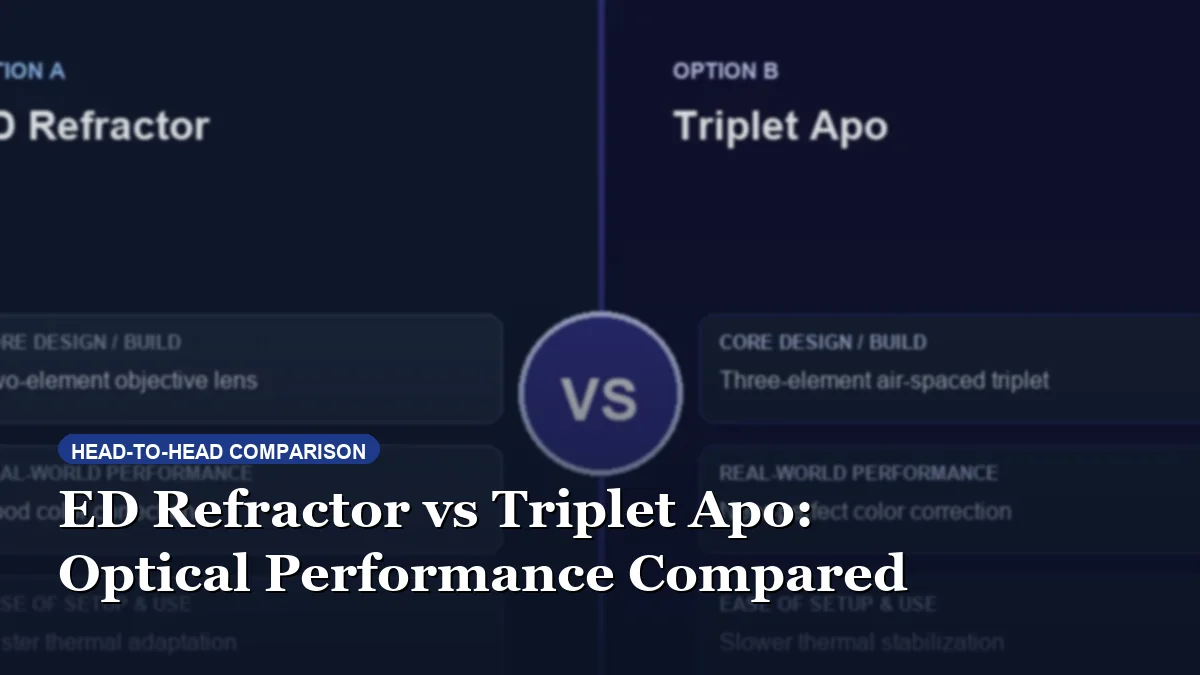
Choose the ED Refractor for faster thermal adaptation and lighter field transport. Select the Triplet Apo when uncompromising color correction and maximum imaging flatness are required.
Compare all top models in our Best Telescope: Top Backyard Picks for Astronomy.
Side-by-Side Breakdown
| Criteria | ED Refractor | Triplet Apo | Edge |
|---|---|---|---|
| Core Design / Build | Two-element objective lens | Three-element air-spaced triplet | Triplet Apo |
| Real-World Performance | Good color correction | Near-perfect color correction | Triplet Apo |
| Ease of Setup & Use | Faster thermal adaptation | Slower thermal stabilization | ED Refractor |
| Durability & Reliability | Fewer internal glass surfaces | Complex cell requiring robust alignment | ED Refractor |
| Efficiency / Operating Footprint | Lighter weight overall load | Heavier overall instrument payload | ED Refractor |
| Maintenance Requirements | Simple cell, rare collimation needs | Precise mechanical cell adjustments | ED Refractor |
| Best Ideal Use Case | Mobile wide-field astrophotography | High-magnification planetary observation | Triplet Apo |
Core Optical Architecture and Glass Physics
Optical engineering relies on managing refractive index variations across distinct wavelengths of light. Doublet extra-low dispersion systems pair a specialized glass element with a mating crown element to reduce false color fringes.
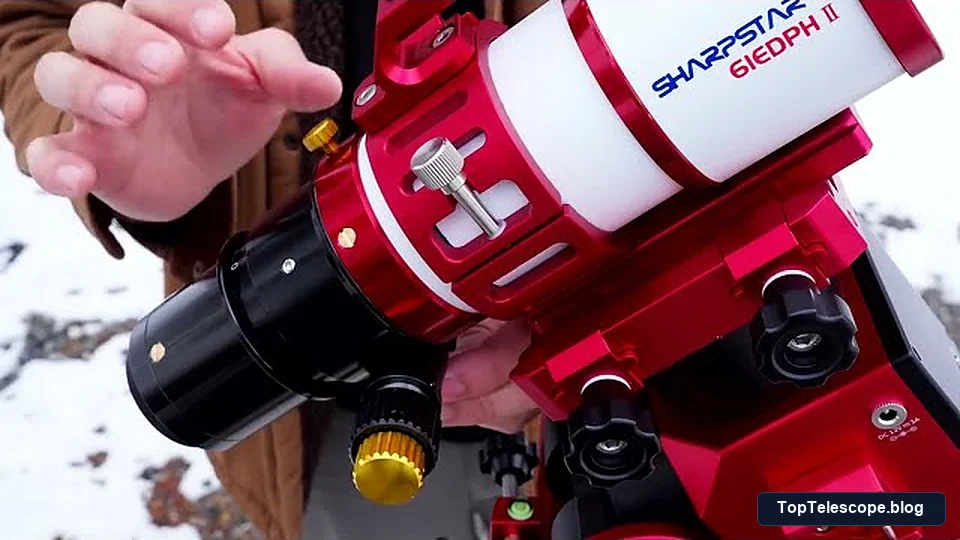
Triplet apochromatic designs incorporate three distinct optical elements separated by air spaces. While often priced above a typical best refractor telescope for beginners budget, this third element brings three wavelengths into focus.
ED doublets utilize a single extra-low dispersion element paired with a crown glass mate, managing primary spectrum correction effectively. This design delivers sharp axial color control for visual observers on a budget.
Triplet apochromats integrate three distinct lenses using premium fluorite or synthetic equivalents. This advanced configuration neutralizes secondary spectrum errors, achieving strehl ratio thresholds above 0.95 for uncompromised imaging performance.
- Doublets utilize two distinct glass blanks within a single adjustable cell.
- Triplets employ three elements to eliminate secondary spectrum chromatic aberrations completely.
- Air-spacing requires precision spacers to maintain exact centration across temperature shifts.
Material Selection and Dispersion Values
Manufacturer choices regarding FPL-53 or synthetic fluorite crystals dictate overall chromatic performance. Lower Abbe numbers correlate directly with higher dispersion, necessitating more complex glass pairings to control secondary spectrum artifacts effectively.
Synthetic fluorite offers unmatched transmission profiles but demands rigorous environmental protection against thermal shock and moisture ingress during field transport operations.
- FPL-53 provides exceptional fluorite-like dispersion characteristics at lower manufacturing costs.
- Crown glass mating elements must possess thermal expansion coefficients matching the primary ED element.
Thermal Equilibrium and Mechanical Housing
Reaching ambient temperature is vital for eliminating internal tube currents and optical boundary layers. Doublet ED objectives shed heat much faster due to lower total glass mass and simpler cell designs.
Heavy triplet cells trap thermal energy between multiple thick lens elements, demanding extended cooling periods before high-magnification viewing can begin without image degradation.
Doublet refractors generally reach thermal equilibrium faster due to having fewer air-to-glass surfaces and reduced mass. Quick cooling prevents internal air currents from degrading high-magnification planetary views during rapid temperature drops.
Triplets require robust CNC-machined aluminum tubes and adjustable cell spacers to maintain optical alignment. When shopping the best apo refractor models, precision thermal compensation prevents pinched optics when temperatures shift significantly.
- Glass mass directly dictates the duration required for full thermal stabilization.
- Aluminum and carbon-fiber tubes interact differently with dropping nighttime ambient temperatures.
- Lens cell retention rings must allow thermal expansion without pinching fragile glass.
Mechanical Cell Design and Stress Management
Precision lens cells prevent optical surface distortion by utilizing soft nylon spacers and careful edge spacing. Uneven pressure from metal retaining rings introduces astigmatism into the optical train instantly.
Advanced CNC-machined cells feature temperature compensation mechanisms that automatically adjust for the differing expansion rates of glass and aluminum components.
- Nylon spacers maintain precise air gaps without inducing mechanical stress.
- Retaining rings require careful torque calibration during factory assembly procedures.
Chromatic Aberration and Field Correction
Controlling false color remains the primary objective benchmark when evaluating high-end refractors. Doublet designs manage primary and secondary spectra well, though high-contrast targets may reveal faint violet halos.
Triplet objectives neutralize secondary spectra entirely, presenting pure white star points against inky black backgrounds even during extreme high-magnification planetary examinations.
While ED doublets minimize false color successfully, high-contrast targets like the Moon may exhibit faint violet halos. Using minus-violet filters helps suppress residual fringes during high-power visual observations.
Apochromatic triplets eliminate residual chromatic aberration across the visual and photographic spectrum. This complete correction guarantees pinpoint stellar images without unwanted color bloat around bright reference stars.
- Doublets exhibit minor residual defocus at extreme blue and red wavelengths.
- Triplets force three primary wavelengths to focus on an identical focal point.
- Field flatness depends heavily on dedicated field flattener lenses for both designs.
Visual Contrast and High-Magnification Performance
Planetary observers demand absolute light purity to resolve subtle Jovian cloud belts and Saturnian ring structures. The flawless color correction of a triplet reveals micro-contrast details invisible in lesser systems.
ED doublets still deliver exceptional contrast compared to traditional achromatic refractors, making them highly capable instruments for budget-conscious visual observers.
- Micro-contrast enhancement highlights planetary atmospheric subtleties reliably.
- High magnification stresses the optical limits of two-element objective configurations.
Astrophotography Integration and Imaging Circles
Modern digital sensors expose optical flaws across wide image formats immediately. Choosing the best apo refractor for astrophotography ensures you get matched field flatteners for pin-point star shapes.
Triplet systems provide the pristine color fidelity required for narrowband and broadband astrophotography, ensuring star halos do not bloat during long photographic exposures.
Doublet optical systems usually demand dedicated field flatteners to counteract inherent curvature across modern large sensors. Matching back-focus distance precisely ensures star corners remain sharp throughout extended exposure frames.
Premium triplets often incorporate integrated corrector elements within custom rack-and-pinion focusers. These designs yield expansive corrected imaging circles capable of illuminating full-frame sensors without vignetting or distortion.
- Large CMOS sensors demand rigorous optical alignment and flat field coverage.
- Backfocus tolerance windows measure within millimeters for optimal field flatteners.
- Color purity prevents bloated star profiles in broadband imaging workflows.
Focal Ratios and Exposure Efficiency
Faster focal ratios shorten exposure times but increase the manufacturing difficulty of correcting optical aberrations. Fast f/5 systems require exceptionally tight tolerances compared to slower f/7 counterparts.
Managing vignetting across large sensor frames necessitates robust drawtubes and properly sized internal baffling within the optical tube assembly.
- Faster focal ratios reduce total integration time during deep-sky sessions.
- Internal baffles eliminate stray reflections before light reaches the imaging plane.
Field Portability and Mount Requirements
Field ergonomics dictate how often an instrument actually gets deployed under dark skies. Lighter doublet assemblies reduce payload weight, allowing smaller equatorial mounts to track smoothly without guiding errors.
Adding a third heavy glass element increases overall optical tube weight significantly, forcing users to upgrade their mount capacity and counterweight configurations.
Lightweight ED doublets reduce payload demands, allowing astronomers to utilize smaller, highly portable equatorial mounts. This weight reduction facilitates rapid field deployment during remote dark sky expeditions.
Heavy triplet assemblies require sturdy heavy-duty mounts with robust counterweight systems to eliminate tracking vibrations. Solid mechanical stability remains vital when operating long focal lengths in windy field conditions.
- Total payload weight directly impacts mount tracking stability and wind resistance.
- Compact form factors simplify airline travel and remote site deployments.
- Ring handles and dovetail bars ensure secure mechanical attachment points.
Ergonomics and Dovetail Integration
Vixen and Losmandy style dovetail plates secure the optical tube safely to your mount head. Properly balanced instruments minimize strain on internal worm gears during tracking operations.
Carrying handles integrated into mounting rings prevent accidental drops during nighttime field assembly and teardown procedures.
- Dovetail security prevents catastrophic slipping during zenith observations.
- Proper balancing extends the operational lifespan of motor drives.
Maintenance, Collimation, and Long-Term Care
Investing in the best refractor telescope for viewing planets and galaxies means getting robust construction. Doublet objective cells rarely lose collimation unless subjected to severe mechanical impacts during transport.
Triplet cells feature adjustable screws allowing precise optical alignment, but rough handling can knock multiple elements out of alignment, requiring specialized bench testing.
ED doublets feature simpler push-pull cell designs that simplify user-level collimation procedures when necessary. Routine optical cleaning should be performed sparingly using certified optical wipes.
Triplets demand factory-level realignment if subjected to severe mechanical impacts during transport. Storing instruments in humidity-controlled cases prevents fungal growth on vulnerable internal glass coating layers.
- Sealed optical tubes prevent dust accumulation on internal lens surfaces.
- Lens coatings demand careful cleaning protocols using pure optical solutions.
- Collapsible dew shields protect front elements from heavy nocturnal dew.
Optical Cleaning and Storage Protocols
Removing particulate matter with a bulb blower prevents microscopic glass scratching during wet cleaning steps. High-quality multi-coatings protect outer surfaces from minor environmental degradation over decades of use.
Storing optical tubes in climate-controlled environments prevents fungal growth from etching delicate anti-reflective coatings during humid summer months.
- Bulb blowers safely remove abrasive dust without touching glass surfaces.
- Proper storage cabinets protect equipment from humidity and temperature extremes.
Frequently Asked Questions
What is the main optical difference between ED doublets and triplets?
ED doublets use two lens elements, while triplets incorporate three distinct elements to eliminate false color entirely. This extra element improves color correction at the expense of added weight.
Do ED refractors require frequent collimation adjustments?
No, refractors generally maintain factory alignment for years due to their fixed objective cells. Only severe mechanical impacts will disturb their optical alignment in the field.
Why do triplet apochromats take longer to cool down?
Triplets contain more glass mass and trapped air spaces that insulate the central elements. Allowing adequate thermal acclimation prevents internal tube currents from blurring your high-power views.
Are ED doublets sufficient for serious astrophotography?
Yes, high-end ED doublets paired with a dedicated field flattener deliver stunning deep-sky images. They offer exceptional performance while keeping your mount payload delightfully lightweight.
Which telescope type is better for planetary observation?
Triplet apochromats excel at planetary viewing because their uncompromising color correction reveals subtle details. The absence of secondary spectrum halos provides maximum possible visual contrast.