Dobsonian vs Newtonian: Optical Mechanics & Usability
Choosing between these optical twins depends entirely on your mount preference. Evaluate stability and portability before buying.

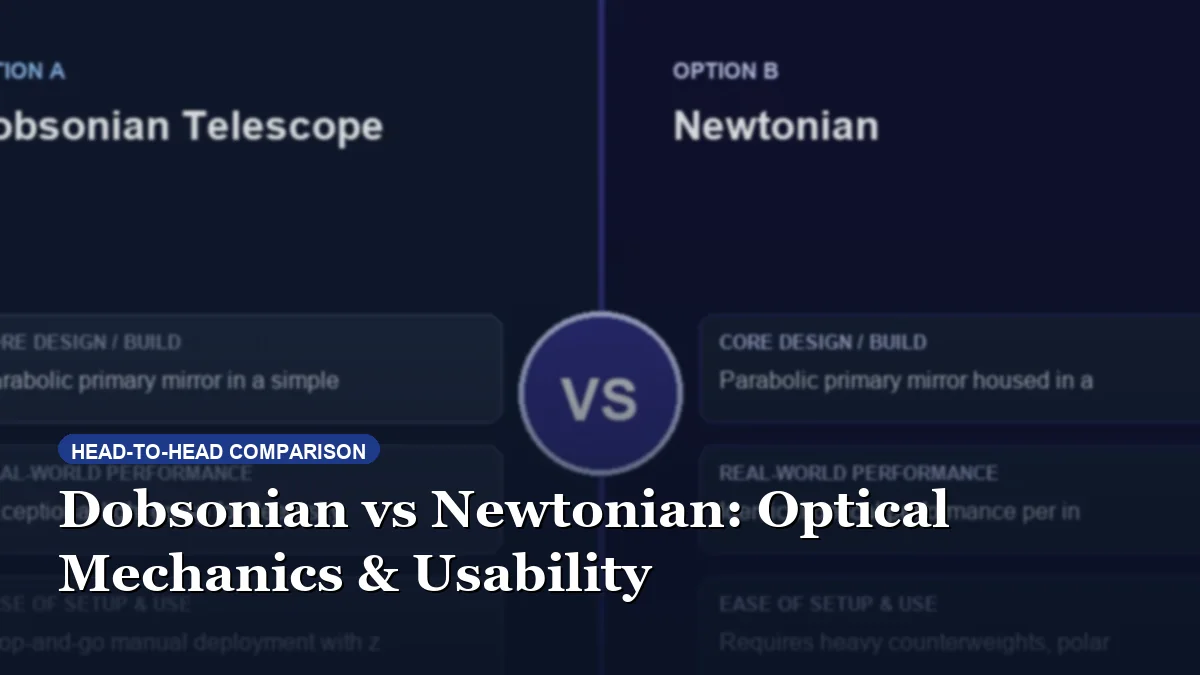
Choose the Dobsonian for intuitive manual tracking and maximum aperture value. Select the Newtonian if you require equatorial tracking for astrophotography.
Compare all top models in our Best Telescope: Top Backyard Picks for Astronomy.
Side-by-Side Breakdown
| Criteria | Dobsonian Telescope | Newtonian | Edge |
|---|---|---|---|
| Core Design / Build | Parabolic primary mirror in a simple alt-azimuth wooden rocker box. | Parabolic primary mirror housed in an OTA requiring ring mounting. | Dobsonian |
| Real-World Performance | Exceptional light grasp for deep-sky visual observing sessions. | Identical optical performance per inch of aperture diameter. | Tie |
| Ease of Setup & Use | Drop-and-go manual deployment with zero complex polar alignment. | Requires heavy counterweights, polar alignment, and sturdy tripods. | Dobsonian |
| Durability & Reliability | Rugged particle board or metal base with minimal mechanical failure points. | Complex equatorial gears and clutches prone to mechanical wear. | Dobsonian |
| Efficiency / Operating Footprint | Vertical floor footprint with high eyepiece positions at zenith. | Wide tripod stance requiring large safety zones in the dark. | Dobsonian |
| Maintenance Requirements | Standard primary mirror cleaning and periodic optical collimation checks. | Frequent collimation plus equatorial gear maintenance and backlash tuning. | Dobsonian |
| Best Ideal Use Case | Deep-sky visual astronomy and rapid backyard grab-and-go sessions. | Long-exposure astrophotography and tracked planetary imaging. | Newtonian |
Core Optical Architecture and Tube Mechanics
Both instrument styles share the exact same optical lineage invented by Sir Isaac Newton. They utilize a parabolic primary mirror at the rear to gather incoming photons.
A secondary flat diagonal mirror redirects this concentrated light cone outward. This clever reflection path eliminates chromatic aberration found in simple refractors.
Focal ratios typically range from fast f/4 systems to slower f/8 configurations. These ratios dictate your final exit pupil and overall field magnification limits.
Glass substrates usually consist of standard float glass or low-expansion borosilicate. Premium mirrors feature enhanced aluminum coatings delivering high reflectance across the visible spectrum.
Both configurations utilize a parabolic primary mirror to eliminate spherical aberration, converging light to a focal point. Newtonians typically employ a metal optical tube that requires robust internal baffling to suppress stray light reflections.
Selecting a reliable best dobsonian telescope model utilizes rigid Sonotube or aluminum truss architectures to maintain precise focal alignment. Truss-tube designs drastically reduce total weight while preserving structural integrity during heavy altitude slewing.
The secondary mirror flat is suspended via a thin three-vane or four-vane spider assembly. Proper tensioning prevents diffraction spikes from smearing high-resolution planetary details when observing Jovian cloud belts or tight binary stellar systems.
Thermal acclimation remains a vital operational factor for large apertures. Installing a low-vibration rear cooling fan accelerates mirror surface stabilization, reducing internal tube currents that severely degrade high-magnification planetary views.
- Identical Newtonian optical tube assemblies at their core
- Parabolic primary mirrors eliminate spherical aberration effectively
- Secondary diagonal mirrors obstruct a small percentage of incoming light
Mirror Cell Design Variations
The primary mirror cell supports the heavy glass substrate without pinching. Proper edge support prevents unwanted astigmatism during temperature drops.
Ventilation fans are frequently integrated into modern cells to accelerate thermal equilibrium. Reaching ambient temperature is vital for high-magnification planetary viewing.
- Floating multi-point mirror cells prevent optical surface distortion
- Rear cooling fans reduce thermal stabilization times significantly
Mount Mechanics and Stabilization Systems
The mounting system represents the single biggest mechanical divergence between these designs. Dobsonians utilize an alt-azimuth rocker box built from durable wood or metal.
Newtonian OTAs are typically cradled in tube rings attached to equatorial mounts. Equatorial mounts require precise polar alignment to track celestial objects smoothly.
Friction pads and Teflon bearings dictate the silky feel of manual alt-azimuth movement. Tension knobs let you adjust resistance to prevent accidental slipping.
Equatorial tracking requires heavy counterweights to balance the moment arm. This adds significant setup weight and increases the overall storage footprint.
Equatorial Newtonian setups require heavy counterweights and massive polar-aligned piers to counteract leverage forces. This complex balancing act introduces notable mechanical flexure unless you invest in commercial-grade German equatorial mounts.
Dobsonians utilize a radically simplified alt-azimuth rocker box constructed from engineered plywood or synthetic polymers. Teflon bearing pads glide smoothly against high-density polyethylene surfaces to deliver intuitive manual tracking at high powers.
Center of gravity management differs entirely between the two mounting philosophies. Truss Dobsonians often require adjustable side friction brakes to compensate for heavy eyepieces without causing unbalanced tube drift during observation sessions.
Damping times dictate practical usability when focusing or nudging the optical tube. Solid wooden rocker boxes generally absorb kinetic energy faster than spindly aluminum tripod legs paired with standard equatorial gear heads.
- Alt-azimuth rocker boxes offer supreme stability and vibration damping
- Equatorial mounts demand counterweight shafts and polar alignment scopes
- Manual tracking requires frequent nudges at high magnifications
Vibration Damping and Settling Times
Rigid wooden ground boards dissipate structural vibrations much faster than tall tripods. Short settling times keep your target centered after focusing adjustments.
Heavy equatorial tripods can act like tuning forks if legs are fully extended. Spreader trays help stiffen the tripod structure against wind gusts.
- Low-slung rocker bases minimize structural settling times
- Tall tripod legs amplify wind-induced image vibrations
Real-World Deep-Sky Performance Metrics
Aperture reigns supreme when hunting faint galaxies, planetary nebulae, and globular clusters. Large Dobsonians provide maximum light grasp per dollar spent.
Visual observers benefit immensely from the wide-field views delivered by fast parabolic mirrors. Deep-sky objects reveal delicate spiral structure under dark skies.
Planetary performance depends heavily on steady atmospheric seeing conditions and precise optical alignment. High-contrast details on Jupiter and Saturn emerge easily.
Light pollution filters thread directly into eyepiece barrels to boost contrast. OIII and H-beta filters transform faint emission nebulae against urban backdrops.
Light grasp scales exponentially with aperture diameter, directly influencing limiting magnitude in rural skies. A twelve-inch primary mirror gathers nearly four times more photons than an eight-inch optical system for faint nebulae.
Reviewing our best beginner dobsonian telescope list helps determine surface brightness and visual contrast across extended galaxies. Matching your eyepiece focal length optimizes integrated light transmission for elusive supernova remnants.
Central obstruction ratios directly affect the transfer function of planetary contrast. Keeping the secondary mirror minor axis under twenty-five percent preserves crisp planetary detail across tight lunar terminator shadows.
Field curvature and coma become increasingly noticeable in fast focal ratio systems. Utilizing a quality coma corrector restores pinpoint star images right to the edge of your wide-angle eyepiece field.
- Large apertures resolve faint telescopic deep-sky targets brilliantly
- Fast focal ratios yield expansive visual star fields
- Sharp primary optics reveal subtle planetary cloud bands
Aperture Advantage in Dark Skies
Transporting large aperture instruments to dark observing sites transforms your visual experience. Faint photons accumulate rapidly on your retina through giant mirrors.
Resolution limits scale directly with primary mirror diameter according to diffraction laws. Tight double stars separate cleanly at high power.
- Giant mirrors unlock spiral arms in distant galaxies
- Higher resolving power splits close binary star systems
Portability, Dimensions, and Field Ergonomics
Field ergonomics dictate how often you will actually take your equipment outside. Solid tube assemblies become unwieldy when mirror diameters exceed eight inches.
Choosing an option from our best 8 inch dobsonian telescope review breaks down into manageable modular components for transport. This clever engineering allows large aperture scopes to fit inside compact cars.
Equatorial Newtonian setups require multiple trips to carry heavy counterweights and tripods. Assembly in the dark demands patience and careful hardware management.
Eyepiece height varies dramatically depending on where the telescope is pointing. Viewing objects near the zenith often requires an adjustable observing chair.
Transporting large Newtonian tubes demands careful vehicle packaging to protect delicate optical coatings. Solid steel tubes exceeding ten inches in diameter struggle to fit across standard back seats without specialized padding.
Truss Dobsonians deconstruct into manageable components like rocker boxes and mirror boxes. This modular assembly approach allows observers to transport massive sixteen-inch instruments inside compact crossover utility vehicles.
Eyepiece height variations challenge ergonomic comfort during steep zenith observations. Newtonian tubes on equatorial mounts frequently force awkward neck angles requiring rotating tube rings for comfortable viewing positions.
Step stools or observing chairs become mandatory accessories when operating apertures above twelve inches. Maintaining a seated posture reduces fatigue and improves concentration during extended deep-sky sketching sessions.
- Truss assemblies enable large apertures to travel easily
- Solid tubes can exceed vehicle backseat dimensions quickly
- Zenith viewing on large scopes demands high stepladders
Eyepiece Position and Rotatable Tubes
As an alt-azimuth or equatorial scope tracks across the sky, the eyepiece rotates awkwardly. Rotatable tube rings let you reposition the focuser for comfortable viewing.
Ergonomic placement prevents neck strain during long marathon observing sessions under pristine skies. Comfort directly improves your ability to spot faint details.
- Rotatable tube rings optimize eyepiece viewing angles
- Ergonomic positioning prevents physical fatigue during viewing
Maintenance, Collimation, and Mirror Care
All reflector telescopes require periodic optical alignment known as collimation. Using a laser collimator ensures primary and secondary mirrors align perfectly.
Transporting instruments over bumpy roads will inevitably knock the optics slightly out of alignment. Quick collimation checks take only a few minutes before viewing.
Primary mirrors accumulate dust and pollen over years of outdoor exposure. Professional recoating or careful washing restores maximum light reflectivity safely.
Exposed optical surfaces must never be touched with bare fingers. Natural skin oils can etch delicate aluminum coatings over extended periods.
Highlighting maintenance tips from our apertura ad8 telescope review, optical alignment dictates whether your equipment resolves fine detail. Regular laser collimator checks ensure the mirrors maintain precise optical axis intersection.
Mirror coatings require infrequent washing to remove accumulated dust and organic residues safely. Submerging the primary in distilled water with mild surfactant prevents scratching your protective aluminum-silicon dioxide layer.
Mechanical collimation knobs on modern mirror cells simplify field adjustments significantly. Upgrading factory springs to heavy-duty locking screws prevents alignment drift during rough transport over bumpy roads.
Tube currents and thermal hysteresis demand proper storage in climate-controlled environments. Protecting optics from dew accumulation prevents mineral spotting and extends the lifespan of your primary mirror reflective surface.
- Regular collimation guarantees crisp high-power planetary images
- Laser and Cheshire tools simplify optical alignment procedures
- Clean primary mirrors maintain peak optical throughput
Cleaning Protocols for Reflector Optics
Washing a primary mirror requires distilled water and mild dish soap. Submersion removes grit safely without scratching delicate optical coatings.
Air drying prevents water spot formation on the newly cleaned reflective surface. Reinstalling the mirror cell completes the routine maintenance cycle.
- Immersion washing prevents abrasive scratching from dust particles
- Distilled water rinses leave zero mineral residue behind
Accessories, Focuser Mechanics, and Upgrades
Modern focusers utilize dual-speed Crayford mechanisms for ultra-smooth focal control. Fine adjustment knobs eliminate image jitter when focusing at high magnification.
Finderscopes range from zero-power red dot units to optical right-angle correct-image scopes. Finding faint targets becomes effortless with high-quality optical finders.
Coma correctors counteract optical aberrations inherent in fast Newtonian mirrors. These lens elements flatten the focal plane across wide-angle eyepiece fields.
Upgrading stock focusers and spring systems enhances overall mechanical performance drastically. Aftermarket accessories provide significant quality-of-life improvements for observers.
Precise focus control relies heavily on dual-speed rack-and-pinion or Crayford focusers. A ten-to-one micro-reduction knob allows effortless zeroing on faint planetary nebulae without inducing distracting mechanical shake.
Finder scopes bridge the gap between wide-field star hopping and high-power targeting. Combining a zero-magnification red dot unit with an optical finder creates an efficient dual-sighting navigation system.
Upgrading stock filter slides or adding broadband nebula filters enhances contrast on emission targets. Selecting standard two-inch filter threads maximizes compatibility with your heavy wide-field eyepieces.
Tracking platforms provide motorized alt-azimuth compensation for long-exposure imaging projects. Equatorial tables expand your dobsonian setup capabilities into basic astrophotography without requiring a massive German equatorial mount.
- Dual-speed Crayford focusers deliver micro-adjustment precision
- Coma correctors sharpen stars near the outer edges
- Optical finders simplify deep-sky star hopping routines
Eyepiece Selection and True Field
Wide-angle eyepieces create an immersive spacewalk visual experience in large scopes. Long focal length eyepieces deliver expansive exit pupils for sweeping nebulae.
Barlow lenses double your magnification without requiring entirely new eyepiece purchases. Premium glass elements preserve image sharpness across the field.
- Wide-apparent-field eyepieces enhance deep-sky immersion
- Barlow elements effectively double your eyepiece collection
Making Your Final Hardware Selection
Selecting the right telescope depends entirely on your personal astronomy goals. Visual astronomers benefit most from the pure aperture efficiency of Dobsonians.
Astrophotographers requiring tracked exposures must invest in sturdy equatorial Newtonian systems. Budget allocation dictates whether you prioritize light grasp or tracking motors.
Evaluate your physical storage space and transport vehicle before purchasing. Large optical tubes demand careful logistical planning for weekend stargazing trips.
Consult local astronomy clubs to test different equipment configurations firsthand. Real-world experience outweighs theoretical specifications when building your kit.
Balancing visual aspirations against physical storage limitations dictates your ideal telescope configuration. Assess your vehicle trunk capacity before purchasing any optical tube assembly exceeding ten inches in diameter.
Prioritize optical aperture if your primary goal involves hunting faint galaxies from dark locations. Deep-sky performance rewards raw light-gathering capability over complex automated tracking features found on smaller computerized telescopes.
Consider whether manual star hopping aligns with your personal observing philosophy. Dobsonians offer unhindered interactive engagement with the cosmos, whereas equatorial mounts require polar alignment calibration procedures.
Evaluate your willingness to perform routine maintenance tasks like mirror cleaning and collimation. Committing to basic hardware upkeep ensures lifetime performance from your chosen precision optical instrument.
- Visual observers thrive with large aperture Dobsonians
- Astrophotography requires motorized equatorial tracking mounts
- Storage space limits physical instrument size choices
Balancing Budget and Observing Style
Investing heavily in optical quality yields breathtaking views of faint nebulae. Prioritizing mechanical mount stability ensures frustration-free tracking experiences.
Your observing environment dictates optimal aperture and portability trade-offs. Urban backdoors require different solutions than dark rural fields.
- Match optical investments directly to your observing site
- Prioritize mount stability for seamless tracking experiences
Frequently Asked Questions
Can I do astrophotography with a standard Dobsonian telescope?
Basic lunar imaging is possible, but deep-sky long exposures require an equatorial platform. Equatorial mounts are strictly necessary to prevent field rotation.
How often do Newtonian and Dobsonian mirrors require collimation?
You should check alignment before every session, especially after transit. Laser tools make this quick optical adjustment straightforward.
Why are Dobsonians considered better value for visual astronomy?
Your money goes toward primary glass instead of complex gears. Simple rocker boxes cost significantly less than computerized equatorial mounts.
Are truss-tube Dobsonians difficult to assemble in the dark?
Truss poles use simple hand knobs and alignment pins for quick assembly. Labeled components make field setup intuitive under red flashlight illumination.
Do I need a coma corrector for fast parabolic mirrors?
Fast focal ratios exhibit optical coma at the edge of wide fields. A dedicated corrector lens restores pinpoint stars across your entire eyepiece view.