Celestron Rasa 8 vs Hyperstar C8: Concise Verdict
Choosing between a dedicated wide-field astrograph and a modular Schmidt-Cassegrain conversion involves weighing optical speed, focal length versatility, mechanical complexity, and your specific deep-sky imaging workflow demands.

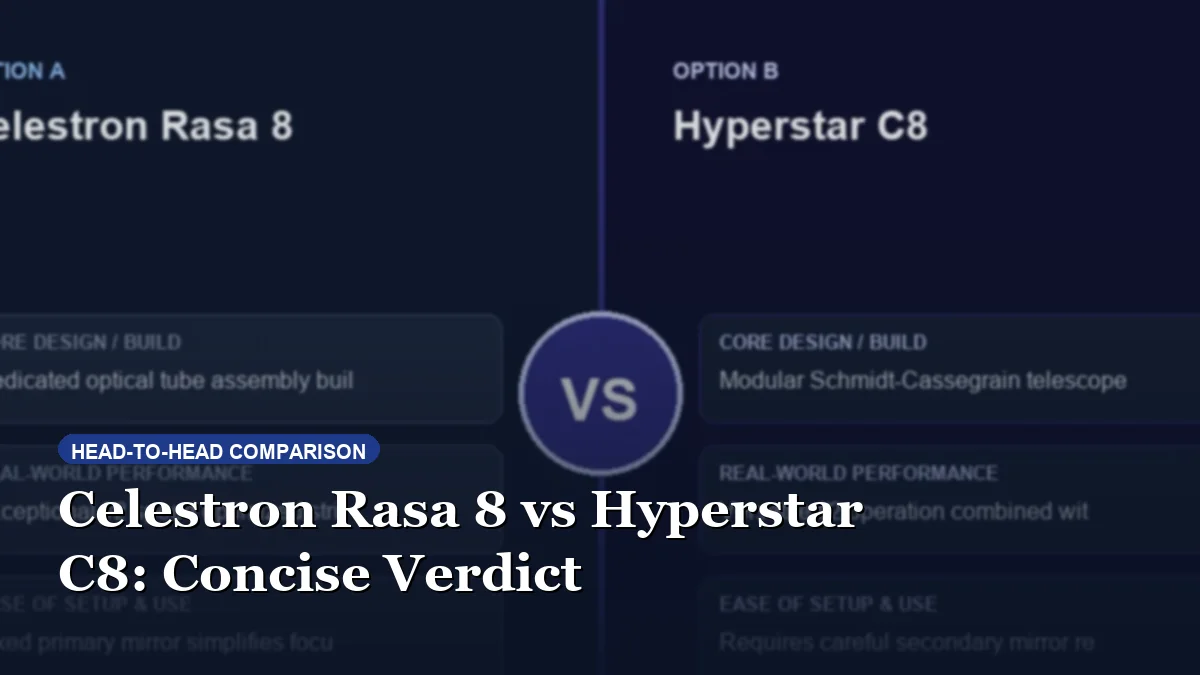
Choose the Celestron Rasa 8 for dedicated ultra-fast wide-field imaging with zero conversion hassle, or select the Hyperstar C8 if you require a dual-purpose telescope that transitions between fast surveys and long focal-length planetary work.
Compare all top models in our Best Telescope: Top Backyard Picks for Astronomy.
Side-by-Side Breakdown
| Criteria | Celestron Rasa 8 | Hyperstar C8 | Edge |
|---|---|---|---|
| Core Design / Build | Dedicated optical tube assembly built exclusively for wide-field camera integration. | Modular Schmidt-Cassegrain telescope featuring a removable secondary mirror assembly. | Celestron Rasa 8 |
| Real-World Performance | Exceptional f/2 speed optimized strictly for large sensor camera payloads. | Versatile f/2 operation combined with standard visual and planetary modes. | Hyperstar C8 |
| Ease of Setup & Use | Fixed primary mirror simplifies focus stability during extended imaging sessions. | Requires careful secondary mirror removal and precise collimation adjustments. | Celestron Rasa 8 |
| Durability & Reliability | Sealed optical tube minimizes internal dust accumulation on sensitive optical surfaces. | Open front assembly exposes internal corrector plate surfaces during lens swaps. | Celestron Rasa 8 |
| Efficiency / Operating Footprint | Shorter tube profile reduces moment arm strain on medium-duty equatorial mounts. | Standard C8 tube length increases wind sail profile during outdoor field sessions. | Celestron Rasa 8 |
| Maintenance Requirements | Specialized factory optical alignment rarely needs user intervention under normal conditions. | Frequent lens swaps increase the risk of misalignment and dust contamination. | Celestron Rasa 8 |
| Best Ideal Use Case | Astrophotographers wanting a turnkey wide-field mosaic machine without visual use. | Imagers desiring a convertible scope for both fast nebulae and narrow planets. | Hyperstar C8 |
Core Design Architecture and Optical Physics
Modern astrophotography demands uncompromising optical precision, making the internal layout of your telescope paramount. Both systems achieve an exceptionally fast f/2 focal ratio, yet their underlying engineering philosophies diverge significantly in practice.
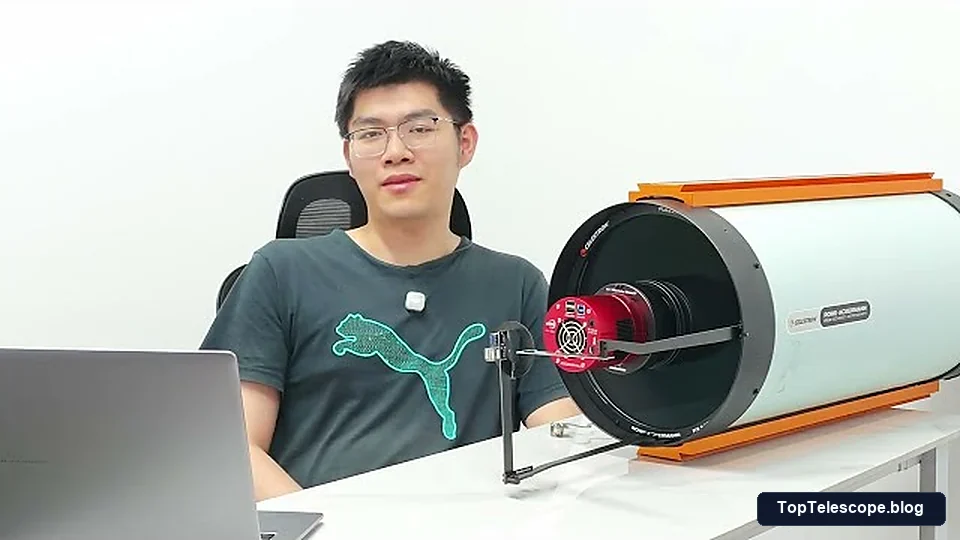
Engineers designed the dedicated optical tube assembly without provisions for a traditional visual eyepiece back. This omission allows the optical prescription to maximize flat-field performance across large modern CMOS sensors.
Conversely, the modular conversion approach retains the classic Schmidt-Cassegrain mechanical skeleton. Users remove the factory secondary mirror and install a specialized corrector lens group directly onto the front corrector plate.
- Fixed primary mirror design eliminates image shift completely.
- Removable secondary housing supports dual-purpose visual and photographic setups.
- Custom lens groupings correct aberrations specifically at the front focal plane.
Schmidt-Cassegrain Versus Dedicated Astrograph
A dedicated astrograph builds every mechanical component around prime-focus imaging. The rear cell remains sealed, enhancing structural rigidity and protecting internal optical coatings from environmental degradation over time.
Specialized optical designs detailed in our Celestron RASA 8 review demonstrate how fast astrographs handle wide-field imaging without traditional secondary obstruction, maximizing light transmission across the sensor.
- Sealed optical tube prevents internal dust accumulation.
- Convertible architecture adapts to changing observing priorities instantly.
Primary Mirror Fixing and Focus Mechanisms
Traditional Schmidt-Cassegrain focus mechanisms move the primary mirror along a central baffle tube. This movement can introduce micro-tilt and image shift during precise autofocus routines if not properly managed.
Dedicated fast astrographs often incorporate mirror locks and micro-focusers. These engineering upgrades secure the primary optical element rigidly in place, ensuring pin-sharp star profiles throughout multi-hour exposures.
- Mirror lock knobs prevent unwanted focal drift during tracking.
- External linear advance focusers eliminate internal mechanical slop.
Field of View and Sensor Compatibility
Wide-field imaging requires generous image circles that illuminate modern camera sensors evenly. Evaluating off-axis light cone delivery, much like the testing in our Celestron AstroMaster 130EQ review, helps prevent frustrating vignetting issues.
Optical designers optimized the custom corrector lens group to cover large APS-C and full-frame chips effortlessly. Spot diagrams reveal tight star containment right into the extreme corners of the framing rectangle.
Achieving this performance requires strict adherence to backfocus tolerances. Even a microscopic deviation in spacing distance introduces severe astigmatism and distorted star shapes across the captured frames.
- Full-frame sensor coverage without severe corner degradation.
- Precise mechanical backfocus spacing required for optimal stars.
- Minimal focal length delivery maximizes expansive nebulosity framing.
Spot Diagrams and Off-Axis Performance
Examining spot diagrams highlights how light converges across the focal plane. Both platforms deliver remarkable sharpness, but dedicated layouts maintain smaller root-mean-square spot sizes at extreme field angles.
The modular conversion performs admirably when paired with precision-machined camera adapters. Maintaining exact focal plane perpendicularity remains critical to preventing asymmetric star elongation in corner regions.
- Tight RMS spot sizes ensure pinpoint stellar disks.
- Off-axis aberrations minimized through advanced multicoating.
Backfocus Tolerances and Spacer Precision
Operating an optical system at ultra-fast speeds shrinks the acceptable margin for error. Spacer rings must be machined to exact tolerances to position the camera sensor correctly.
Threaded connections are heavily favored over slip-fit adapters to eliminate sag. Any mechanical drooping alters the optical axis, causing uneven corner illumination and frustrating tracking artifacts.
- Strict tolerance demands micro-shimming adjustments.
- Threaded camera couplings prevent mechanical axis tilt.
Real-World Imaging Performance and Speed
Gathering deep-sky photons efficiently is a core goal for modern astrographs. Operating at fast focal ratios dramatically shortens exposure durations compared to systems evaluated in our Celestron NexStar 8SE review.
This incredible speed allows imagers to capture faint extended hydrogen-alpha nebulosity in mere seconds. Sub-exposures accumulate rapidly, reducing the impact of guiding errors and satellite trails during long sessions.
However, high optical speed demands exceptional tracking accuracy from your equatorial mount. Any periodic error or wind gust instantly smears the compressed light cone across multiple pixels.
- F/2 focal ratio slashes required integration times.
- High photon collection efficiency reveals faint cosmic dust structures.
- Demands rigorous mount tracking stability for sharp results.
Focal Ratio and Exposure Time Reduction
Shooting at rapid speeds changes your entire data acquisition workflow. Integration times that traditionally required ten minutes now yield comparable signal-to-noise ratios in under sixty seconds.
This efficiency is a massive boon for amateur astronomers battling limited clear skies. You can complete complex multi-panel narrowband mosaics within a single favorable evening of observation.
- Drastic reduction in total project imaging hours.
- Faster turnaround for time-sensitive transient astronomical events.
Vignetting and Illumination Characteristics
Placing a camera sensor directly at the front corrector creates a physical obstruction. While optimized baffles mitigate this footprint, careful flat-field calibration remains mandatory for clean processing.
Illumination drops gently toward the corners of full-frame sensors. Modern calibration frames easily correct these gradients, yielding flat, clean backgrounds ready for stretch processing.
- Front-mounted camera creates minor central shadow obstruction.
- Master flat frames effectively neutralize corner brightness falloff.
Mechanical Rigidity and Alignment Stability
Mechanical integrity dictates whether your optical alignment survives transport to dark sky sites. Heavy front-mounted cameras exert significant leverage forces on the front mounting threads.
Engineers reinforce the corrector housing to support modern cooled astronomy cameras safely. Proper cable routing prevents pulling forces from misaligning the sensitive front optical group during tracking.
Thermal fluctuations also impact mechanical focus stability throughout the night. Aluminum tube assemblies expand and contract, necessitating periodic focus adjustments as ambient temperatures drop.
- Reinforced mounting threads handle heavy camera payloads.
- Cable management prevents mechanical torque on optics.
- Thermal expansion requires occasional focus re-optimization.
Collimation Requirements and Tolerance
Maintaining precise optical alignment is vital for pinpoint stars. The modular conversion requires user collimation whenever the secondary mirror assembly is reinstalled for imaging duties.
Dedicated configurations arrive pre-collimated from the factory and rarely require intervention. This factory alignment stability appeals greatly to astrophotographers seeking a grab-and-go workflow.
- Factory alignment minimizes user calibration headaches.
- Modular setups demand careful secondary tilt adjustments.
Camera Weight Distribution and Torque
Front-heavy loading alters the balance point of your entire optical tube. Counterweight positioning must be adjusted carefully to ensure smooth right ascension tracking performance.
Using rigid dovetail bars prevents flexing between the tube and mount. As noted in the Celestron AstroMaster 130 review, solid mechanical coupling eliminates differential flexure during long exposures.
- Front-mounted gear shifts telescope center of gravity.
- Sturdy dovetail plates eliminate mechanical flexure.
Maintenance, Cleaning, and Longevity
Protecting delicate optical surfaces ensures your investment delivers pristine performance for decades. Open front configurations expose internal glass elements to airborne dust during camera changes.
Routine inspection of corrector plates helps identify dew accumulation and particulate buildup early. Using professional optical cleaning solutions prevents permanent coating degradation from environmental pollutants.
Proper storage in padded transport cases shields the optical tube assembly from shock impacts. Keeping dust caps securely fastened during transport preserves the lifespan of antireflective coatings.
- Anti-reflective coatings require careful cleaning protocols.
- Dust caps protect exposed glass during transport phases.
- Padded storage cases absorb harmful mechanical shocks.
Corrector Plate Access and Dust Risks
Frequent lens swaps in field environments invite dust onto the primary mirror. Maintaining a clean workspace during assembly procedures significantly minimizes contamination risks.
Sealed optical designs drastically reduce internal dust accumulation over years of service. This enclosure integrity translates to fewer deep cleaning sessions and preserved optical coatings.
- Field lens swaps increase internal dust exposure.
- Sealed optical tubes protect interior glass elements.
Coating Durability and Environmental Wear
Advanced multi-coatings maximize light transmission across the visible spectrum. These delicate chemical layers require gentle handling with microfiber cleaning cloths and pure reagents.
Protecting the corrector plate from heavy dew prevents mineral deposits from etching the glass. Heated dew shields are essential accessories for preserving optical longevity outdoors.
- Multicoated glass demands specialized cleaning reagents.
- Dew prevention accessories protect optical coating integrity.
Operational Efficiency and Field Workflows
Streamlining your field workflow maximizes actual imaging time under dark skies. Quick assembly and teardown procedures reduce fatigue during late-night observation sessions.
Efficient power distribution and clean cable management prevent snagging during tracking sweeps. Organizing your accessory hub ensures rapid troubleshooting if minor hardware glitches occur outdoors.
Pre-planning your framing targets using planetarium software accelerates session startup. Spending less time configuring gear leaves more energy for capturing stunning celestial imagery.
- Streamlined cable routing prevents tracking snags.
- Efficient field workflows reduce setup fatigue.
- Target pre-planning maximizes clear sky productivity.
Rig Setup Time and Cable Management
Minimizing loose wires around the front-mounted camera is crucial. Bundling USB and power cables along the top dovetail bar prevents interference with mount slewing arcs.
Quick-disconnect fittings simplify breaking down your imaging rig at dawn. Keeping your components organized ensures faster deployment during your next astrophotography outing.
- Cable bundling eliminates meridian flip snags.
- Quick-disconnect fittings speed up teardown routines.
Power Consumption and Accessory Integration
Running cooled cameras, filter wheels, and dew heaters demands reliable power. Utilizing regulated power distribution boxes prevents voltage drop issues during long imaging nights.
Integrating electronic focusers and automatic filter wheels enhances remote automation capabilities. A well-powered rig operates autonomously while you sleep comfortably indoors.
- Regulated power distribution prevents voltage drops.
- Automation accessories enable hands-off overnight imaging.
Selecting the Ideal Configuration for Your Needs
Choosing the right instrument depends on your unique astronomical goals and budget. Evaluating whether you prioritize dedicated wide-field speed or optical versatility guides your final purchase.
Consider your current mount capacity and observatory environment before deciding. Matching your telescope to your lifestyle ensures long-term satisfaction with your deep-sky imaging hobby.
Consulting experienced peers and reviewing equipment specifications helps validate your decision. Investing in the correct platform unlocks endless nights of rewarding astronomical discovery.
- Align equipment choice with your primary imaging goals.
- Verify mount payload capacity before purchasing hardware.
- Prioritize versatility versus dedicated performance requirements.
Permanent Observatory Versus Mobile Deployment
Permanent observatory setups benefit greatly from specialized, turnkey optical assemblies. Fixed piers eliminate transport vibrations and preserve factory collimation indefinitely over time.
Mobile imagers traveling to dark sky sites may prefer convertible modular designs. Packing a versatile telescope allows you to adapt to changing celestial targets effortlessly.
- Observatories suit dedicated turnkey optical systems.
- Mobile imagers benefit from versatile modular configurations.
Budget Allocation and Existing Equipment Leverage
Assess your current collection of optical tubes and camera accessories. Leveraging an existing Schmidt-Cassegrain telescope with a modular conversion saves significant initial capital.
Purchasing a dedicated astrograph represents an investment in turnkey performance. Weighing total system costs ensures you build a balanced, capable deep-sky imaging rig.
- Convert existing scopes to save initial capital.
- Dedicated systems offer uncompromised turnkey performance.
Frequently Asked Questions
Can I use eyepieces for visual observation with a dedicated wide-field astrograph?
No, dedicated wide-field astrographs lack a rear visual back entirely. They feature a sealed rear cell optimized strictly for camera sensor integration.
How difficult is it to convert a standard Schmidt-Cassegrain for fast imaging?
Conversion requires removing the factory secondary mirror carefully. You then install a specialized corrector lens group, demanding precise mechanical alignment during setup.
What mount size is recommended for these fast optical systems?
A medium-duty equatorial mount with solid payload capacity is ideal. Accurate tracking performance is essential because ultra-fast focal ratios magnify guiding errors.
Do these fast optical setups require specialized filter sizes?
Yes, standard 2-inch filters can sometimes cause vignetting with full-frame sensors. Many imagers utilize large square filters placed closer to the camera.
How do I prevent dew buildup on the front corrector lens?
Using a powered dew heater strap connected to a controller is standard practice. This prevents condensation and protects your delicate optical coatings all night.